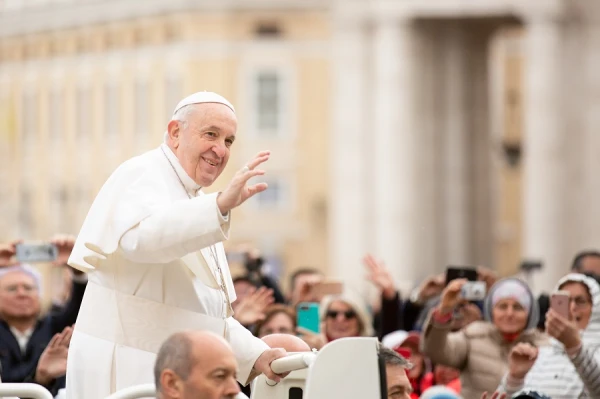
Vatican City, Mar 27, 2019 / 05:54 am (CNA).- The Vatican announced Wednesday that Pope Francis will visit the capital cities of the African countries of Mozambique, Madagascar, and Mauritius in September.
From Sept. 4-10, 2019, the pope will travel to Maputo in Mozambique, Antananarivo in Madagascar, and Port Louis in Mauritius.
The visit was accepted at the invitation of the bishops and heads of the respective states, papal spokesman Alessandro Gisotti said March 27.
The full schedule of the apostolic voyage will be published later.
Mauritius is a small island nation located off the eastern coast of Africa in the Indian Ocean. The whole country is 790 square miles with just over 1.2 million people. It has one diocese and one apostolic vicariate.
According to the country’s 2011 census, the largest religion in the country is Hinduism at 48.5 percent, followed by Christianity at 32.7 percent. Muslims make up around 17.2 percent of the country’s population and other religions .7 percent.
There are 22 Catholic dioceses in Madagascar, an island country about 250 miles off the coast of East Africa.
Christians, both Protestants and Catholics, make up the majority religion in Madagascar, at estimates between 40 and 80 percent. Other religions practiced are Islam and indigenous religions. The population is around 25 million.
Mozambique has a population of more than 27 million people. It has 12 dioceses, and in 2015 was estimated to be about 30 percent Catholic. Protestants and Muslims both make up about 19 percent of the population.
The motto for the pope’s visit to Mozambique will be “Hope, Peace, and Reconciliation.” In Madagascar, “Sower of Peace and Hope,” and in Mauritius the motto will be “Pilgrim of Peace.”
Pope Francis’ next voyage of 2019 will be to Morocco March 30-31. His other confirmed trips are to Bulgaria and Macedonia at the beginning of May and to Romania at the end of May and beginning of June.
The pope has also told journalists that he will travel to Japan in November. The Vatican has affirmed that the trip is under study.
If you value the news and views Catholic World Report provides, please consider donating to support our efforts. Your contribution will help us continue to make CWR available to all readers worldwide for free, without a subscription. Thank you for your generosity!
Click here for more information on donating to CWR. Click here to sign up for our newsletter.
Vatican City, Mar 23, 2017 / 06:44 am (CNA/EWTN News).- On Thursday Pope Francis approved the second and final miracle needed to canonize Blessed Francisco and Jacinta Marto, two of the shepherd children who witnessed the Fatima Marian apparitions.
Altar of the Chair in St. Peter’s Basilica, where Bernini’s gorgeous bronze monument to the Chair of Peter acts as a massive
bronze reliquary for the historic wooden chair. / Credit: Vatican Media
Vatican City, Feb 22, 2025 / 11:00 am (CNA).
Every year on Feb. 22, the Catholic Church celebrates the feast of the Chair of St. Peter, a tradition that dates back more than 1,600 years.
The feast honors not just a physical chair but what it represents: the authority of St. Peter, the first pope, and the unbroken line of his successors.
References to the “Chair of Peter” date back to the early centuries of Christianity. St. Jerome, a biblical scholar of the fourth century, wrote in a letter: “I follow no leader save Christ, so I enter into communion with … the Chair of Peter, for this I know is the rock upon which the Church is built.”
The feast itself has been celebrated on Feb. 22 since at least A.D. 336, according to Monsignor Tiziano Ghirelli, a canon of St. Peter’s Basilica. By the fifth century, its importance had grown, with the imperial family participating in celebrations at the old St. Peter’s Basilica in Rome in 450 and 467.
The word “cathedra” refers to the seat of the bishop, which is why the mother church of a diocese is known as a cathedral. The bishop of Rome, as Peter’s successor, holds a unique role in guiding the Church.
The Altar of the Chair in St. Peter’s Basilica, where Bernini’s bronze monument to the Chair of Peter acts as a massive bronze reliquary for the historic wooden chair. Credit: Vatican Media
Pope Benedict XVI explained in a 2006 catechesis that the Chair of Peter “is the symbol of the bishop’s authority and in particular, of his ‘magisterium,’ that is, the evangelical teaching which, as a successor of the apostles, he is called to safeguard and to transmit to the Christian community.”
The phrase “ex cathedra” — Latin for “from the chair” — is still used to describe the pope’s most authoritative teachings.
“Celebrating the ‘chair’ of Peter means attributing a strong spiritual significance to it and recognizing it as a privileged sign of the love of God, the eternal Good Shepherd, who wanted to gather his whole Church and lead her on the path of salvation,” Benedict said.
Yes, there is actually a chair relic kept in St. Peter’s Basilica
In addition to the symbolic meaning, there is also a physical relic known as the Chair of St. Peter housed in St. Peter’s Basilica.
The wooden chair, dating back to the ninth century, was displayed for public veneration last fall amid the restoration efforts underway in the basilica.
Prior to that, the chair was last publicly exhibited in 1867, when Pope Pius IX allowed it to be seen for 12 days to mark the 1,800th anniversary of the martyrdom of Peter and Paul. Before that, the chair had not been seen since 1666 when it was first encased inside Gian Lorenzo Bernini’s monumental bronze sculpture under the stained-glass Dove of the Holy Spirit window at the basilica’s apse.
Historical records indicate that the wooden chair was likely a gift from Holy Roman Emperor Charles the Bald to Pope John VIII in 875. It features ivory panels depicting scenes from Greek mythology, including the labors of Hercules.
Pope Francis venerates the chair of St. Peter at the Synod on Synodality closing Mass on Oct. 27, 2024. Credit: Vatican Media
During the Middle Ages, the popes were solemnly enthroned on the chair. Innocent III used the wooden chair for his consecration on Feb. 22, 1198.
“Since the 11th century, the feast of Feb. 22 has been celebrated in Rome, and at the Vatican Basilica, with particular emphasis,” Ghirelli explained.
Bernini’s monument
In the 17th century, Pope Alexander VII commissioned Bernini to create an elaborate reliquary to house the chair. Bernini’s design, completed in 1666, features a gilded bronze throne elevated above the ground crowned by a stained-glass window depicting the Holy Spirit as a dove.
The structure is supported by statues of four doctors of the Church — two from the West, St. Augustine and St. Ambrose, and two from the East, St. John Chrysostom and St. Athanasius — symbolizing the unity of the Church through the ages, bringing together the teachings of both the Latin and Greek Church Fathers.
Above the throne, cherubs hold a papal tiara and keys, a reference to the authority given to Peter in the Gospel of Matthew: “You are Peter, and upon this rock, I will build my Church.”
A physical relic known as the Chair of St. Peter is housed in St. Peter’s Basilica. The wooden chair, dating back to the ninth century, was displayed for public veneration in the fall of 2024 amid the restoration efforts underway in the basilica. Credit: Matthew Bunson
Though the chair relic is once again enclosed within Bernini’s sculpture, visitors to St. Peter’s Basilica continue to pause before this symbol of the special mission of Peter and his successors to pray for the pope and his intentions.
“As we contemplate it with the wonder of faith,” Pope Francis said, “let us remember that this is the chair of love, unity, and mercy, according to Jesus’ command to the Apostle Peter not to lord it over others but to serve them in charity.”





Leave a Reply