Washington D.C., Feb 12, 2019 / 11:30 am (CNA).- Congressional leaders hope to have avoided a further partial government shutdown after reaching an agreement on a budget that includes over a billion dollars in funding for new barriers along the United States’ border with Mexico.
The deal, announced February 11, comes ahead of a looming Friday deadline to reach an agreement on the budget or else face a further round of partial federal shutdowns. The deal still has to be approved by President Donald Trump, who has previously requested about $5.7 billion to fund the construction of a wall along parts of the southern border.
Senate Appropriations Committee Chairman Sen. Richard Shelby (R-AL) said that he expects the president to approve of the compromise. The final text has yet to be released, but could come as soon as Wednesday.
The compromise agreement reportedly provides $1.3 billion in funding for border barrier construction along 55 miles of the Rio Grande Valley. The deal is also set to include a gradual reduction of the number of beds used to detain undocumented immigrants in areas not located near the U.S. border, something pushed by Congressional Democrats throughout budget negotiations.
U.S. Immigration and Customs Enforcement claims that the majority of undocumented immigrants detained have previous criminal records.
Shelby told reporters that “hard negotiations” had gone in forging an agreement, and that he was confident there would be a successful resolution.
The United States Conference of Catholic Bishops has repeatedly called for Congress to find a solution that provides both border security as well as protections for undocumented migrants and immigrants.
In a January 10 statement calling for an end to the recent partial government shutdown Bishop Joseph Vasquez of Austin, chair of the USCCB’s migration committee, said that “secure borders and humane treatment of those fleeing persecution and seeking a better life are not mutually exclusive.”
Vasquez said that the U.S. must move to achieve these goals “without instilling fear or sowing hatred,” and said that he would “continue to advocate for immigration reform to advance the common good and address these issues.”
“We urge lawmakers to look beyond rhetoric and remember the human dignity that God our Father has given each of us simply because we are all His children,” he said.
Some border bishops have been vehemently opposed to the construction of walls in their dioceses. Bishop Daniel Flores of Brownsville, TX, filed suit against the federal government over their request to survey the land surrounding a small chapel located near the Rio Grande. If the border wall were to be built, the chapel would be located on the southern side of the wall and would not be accessible to most of the people who use it.
A judge recently ruled that the government would not be impeding the exercise of religious freedom if it were to survey the land around the chapel to determine if a wall could be built.
If you value the news and views Catholic World Report provides, please consider donating to support our efforts. Your contribution will help us continue to make CWR available to all readers worldwide for free, without a subscription. Thank you for your generosity!
Click here for more information on donating to CWR. Click here to sign up for our newsletter.
“The Shroud of Turin: An Immersive Experience,” a $5 million, 10,000-square-foot museum on the chancery campus of the Diocese of Orange in Southern California opened to visitors on Nov. 19, 2025. / Credit: Everett Johnson, Diocese of Orange
Los Angeles, California, Nov 19, 2025 / 16:53 pm (CNA).
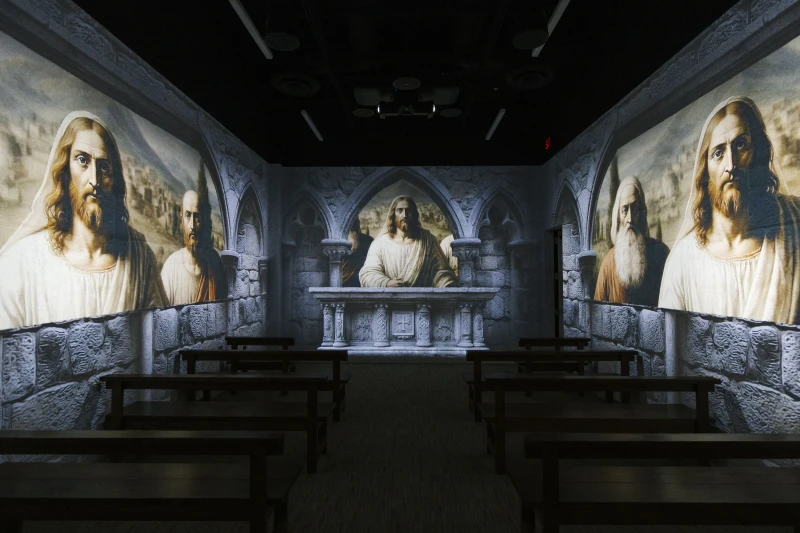
“The Shroud of Turin: An Immersive Experience,” a $5 million, 10,000-square-foot museum on the chancery campus of the Diocese of Orange in Southern California, opened to visitors Wednesday.
The museum is presented by Papaian Studios in partnership with the Diocese of Orange and Othonia Inc., an international team of specialists dedicated to exploring and sharing the mystery of the Shroud of Turin.
The 90-minute experience introduces visitors to the life, death, and resurrection of Jesus Christ, with a special focus on the Shroud of Turin, which many believe to be the burial cloth of Christ.
The 90-minute experience at the new Shroud of Turin museum on the chancery campus of the Diocese of Orange in California introduces visitors to the life, death, and resurrection of Jesus Christ, with a special focus on the Shroud of Turin, which many believe to be the burial cloth of Christ. Credit: Diocese of Orange
Inspired by the advanced technology incorporated in “Van Gogh Exhibition: The Immersive Experience” and the “Immersive King Tut,” the museum features 360-degree projection-room theaters as well as shroud replicas, interactive kiosks, a life-sized corpus, and a variety of artwork.
Jason Pearson of FiveHive Studios, which offers AI special effects and animation services, is a Catholic convert who worked with Othonia, a team of shroud specialists, to design the museum. Among his movie credits is Mel Gibson’s 2004 “The Passion of the Christ.” He has long had an interest in the shroud and has been a volunteer guide at the Shroud Center of Southern California located at the Santiago Retreat Center, also in the Diocese of Orange.
“Using technology on display like that of the Van Gogh or King Tut exhibits, we’re doing things that have never been done before,” Pearson told CNA.“Whether it be Jesus walking on water or through the streets of Jerusalem, or in the tomb at the moment of the Resurrection, we make use of sound and projections so that the visitor feels like he’s going back into a time machine and experiencing these things himself.”
“The Shroud of Turin: An Immersive Experience” located at the Christ Cathedral campus in the Diocese of Orange, California, opened to visitors on Nov. 19, 2025. Credit: Everett Johnson, Diocese of Orange
The museum is designed for everyone, Pearson continued, even those who have no religious background at all.
Located on the second floor of the campus’ Richard H. Pickup Cultural Center, the museum has three theater rooms. Using surround sound and images, including on the floor, the first room introduces the visitor to the person of Jesus Christ through presentation of 12 stories from his life, but each one is selected to show Christ’s connection to the supernatural (e.g. the Transfiguration). The next introduces the visitor to the shroud itself, including proof of its authenticity and what it tells us about the sufferings of Christ. The third is devoted to the Resurrection leading the viewer to ponder a pointed question: Who do you believe the man on the shroud is?
The third theater exits into the museum area, which includes displays of reproductions of items that were part of the passion of Christ, including a flagellum (whip), the crown of thorns and nails, as well as a reproduction of what the tomb of Christ might have looked like.
The new Shroud of Turin museum uses AI and 360-degree tech to explore Christ’s life and resurrection. Credit: Everett Johnson, Diocese of Orange
Other exhibits include an AI presentation of Secondo Pia (1855–1941) who, while photographing the shroud in 1898, discovered that its negative image offered a clearer image of the man on the shroud with a detail in his face that could not been seen by the naked eye. Another traces the history of the iconography of Christ, demonstrating how accurate, when comparing it to the shroud image, many of the icons were. And, one compares the Sudarium of Oviedo, or the facial cloth that covered Christ’s face after his death, to the image on the shroud.
Pearson hopes that the museum will be a prototype for additional shroud museums in different regions of the country. Inquiries have been made about establishing shroud museums from places as far away as Kuala Lumpur in Malaysia.
One portion of the museum is dedicated to the science of the shroud, and two kiosks allow visitors to ask questions of a digital Father Robert Spitzer, who has extensively researched the shroud over the past 20 years. Credit: Everett Johnson, Diocese of Orange
One portion of the museum is dedicated to the science of the shroud, and two kiosks allow visitors to ask questions of a digital Father Robert Spitzer, who has extensively researched the shroud over the past 20 years. Spitzer, who has an office at Christ Cathedral, noted that he was pleased with the museum’s opening. “It gets the pedagogy right, it’s biblically accurate, and they tell me the visual imagery is amazing.” (Spitzer has gone blind in recent years.)
He continued: “And while we welcome anyone, we especially hope many young people will come to learn about the shroud and lead many to come to know more deeply the person of Jesus Christ.”
Nora Creech is on the leadership team of Othonia and helped develop content for the museum. “We want people to come with an open mind, explore, and ask questions. We want them to ask, ‘Who is the man of the shroud?’” she said.
One special target group of the museum, Creech said, is younger people, “many of whom have not been brought up with knowledge of who Jesus is. That is why we seek first to introduce people to Jesus so that they will become interested in his burial shroud.”
Pearson agreed and related the story of two young women who visited the Shroud Center and began weeping, asking: “Why hasn’t anyone told us about him?”
But while the shroud is important in showing us what Jesus suffered, Creech continued, we also need the Church and the Scriptures “to learn why he suffered.”
Auxiliary Bishop Timothy Freyer blesses the new Shroud of Turin museum on the chancery campus of the Diocese of Orange in Southern California, opened to visitors Wednesday, Nov. 19, 2025. Credit: Kaylee Toole, Diocese of Orange
Orange Auxiliary Bishop Timothy Freyer, who played a key role in bringing the museum to Christ Cathedral, noted that his favorite feature was the reproduction of the crown of thorns, which, contrary to most artistic renditions, was actually shaped like a helmet or cap. He continued: “I’ve been impressed with the entire exhibition. It is very engaging, and I believe it will be an important tool in helping visitors come to know Christ better.”
Also among those excited to see the opening of the museum was Gus Accetta, a physician who has devoted much of his free time to studying the shroud. In 1996, he founded the Shroud Center in Huntington Beach, since relocated to the Santiago Retreat Center and welcoming 25,000 visitors annually.
“It’s a wonderful exhibit,” he said. It not only looks at the shroud but the whole life of Christ, of which the shroud is just a part.”
A crown of thorns from the “Shroud of Turin: An Immersive Experience,” a $5 million, 10,000-square-foot museum on the chancery campus of the Diocese of Orange in Southern California. The museum opened to visitors on Nov. 19, 2025. Credit: Diocese of Orange
The Shroud of Turin experience will be on display at Christ Cathedral at least through 2030. The museum is located on Christ Cathedral campus, 12141 Lewis St., Garden Grove, California, a few miles away from Disneyland and the Anaheim Convention Center. For more information, visit the website www.theshroudexperience.com.
Catholics recognize Easter — when Christ rises from the dead after sacrificing his life for all of humanity — as the first Sunday after the first full moon on or after the spring equinox. But, as it turns out, they can continue saying “Happy Easter” into June.
Easter lasts for a total of 50 days, from Easter Sunday until the feast of Pentecost, when the Holy Spirit comes upon the apostles, Mary, and the first followers of Christ.
This year, 2022, Easter runs from April 17 until June 5.
Easter explained
Catholics observe Easter in different stages. Easter Sunday is the greatest Sunday of the year, and it marks the start of the “Easter Octave,” or the eight days that stretch from the first to the second Sunday of Easter (also known as Divine Mercy Sunday). The Church celebrates each of these eight days as Solemnities of the Lord — a direct extension of Easter Sunday.
The entire Easter season lasts 50 days, and includes the Solemnity of the Ascension of Christ, which falls on the 40th day of Easter, which this year is May 26. It ends with Pentecost, which is derived from the Greek word “pentecoste,” meaning “50th.”
“The fifty days from the Sunday of the Resurrection to Pentecost Sunday are celebrated in joy and exultation as one feast day, indeed as one ‘great Sunday,’” according to the United States Conference of Catholic Bishops. “These are the days above all others in which the Alleluia is sung.”
The USCCB calls Easter “the most important of all liturgical times.”
“It celebrates Jesus’s victory of sin and death and salvation for mankind,” the U.S. bishops say. “It is God’s greatest act of love to redeem mankind.”
In the traditional Roman rite
In the traditional form of the Roman rite, Easter is known properly as Paschaltide, which includes three parts: the season of Easter, Ascensiontide, and the Octave of Pentecost. It thus lasts one week longer than the Easter season in the calendar of the Missal of St. Paul VI.
The season of Easter begins with the Easter Vigil on Holy Saturday, and runs through the afternoon of the Vigil of the Ascension.
Ascensiontide begins the evening before the Ascension, with First Vespers of the feast, and ends the afternoon of the Vigil of Pentecost – marking the first novena.
The Octave of Pentecost is an extension of the feast of Pentecost, beginning with the Vigil Mass of Pentecost and ending the afternoon of the following Saturday, which this year falls June 11.
Washington D.C., Dec 5, 2019 / 01:00 pm (CNA).- Speaker of the House Nancy Pelosi on Thursday rejected the suggestion that she “hates” President Donald Trump, and said that her Catholic faith prevents her from hating anyone.
“I don’t hate anybody. I was raised in a Catholic house, we don’t hate anybody—not anybody in the world,” said Pelosi. She had been asked by a journalist during her weekly press briefing if she “hates President Trump.”
Pelosi had earlier announced the House Democrats would begin drafting the articles of impeachment.
“As a Catholic I resent you using the word ‘hate’ in a sentence that addresses me,” a visibly angered Pelosi said, pointed her finger at the journalist. She went on to claim that she prays for Trump “all the time.”
“So don’t mess with me when it comes to words like that,” she added. The Speaker said that any disagreement with Trump was rooted in policy, not in who he was as a person.
Pelosi has in the past encouraged people to pray for President Trump. In October, Pelosi said that people should pray for the president’s health after she abruptly left a meeting with the President. In September, Pelosi said that she prays for the Trump family “all the time,” and that she “wish(es) that he would pray for the safety of other families and do something courageous on guns.”
On Twitter, Trump said that he did not believe Pelosi prays for him, “not even close,” and that Pelosi had suffered a “nervous fit” during her briefing.
“She hates that we will soon have 182 great new judges and sooo much more,” said Trump. “Help the homeless in your district Nancy,” he added.
Pelosi has repeatedly cited her Catholic faith in the political realm, and used it to justify her positions, especially her long-standing support for abortion. Pelosi’s statements have occasioned significant pushback from members of the Catholic hierarchy at different times.
In 2008, in her second year as Speaker of the House, Pelosi stated on an August 24 episode of “Meet the Press” that “as an ardent, practicing Catholic, [abortion] is an issue that I have studied for a long time. And what I know is, over the centuries, the doctors of the church have not been able to make that definition,” and that her faith “shouldn’t have an impact on a woman’s right to choose.”
At least 22 bishops released statements correcting Pelosi on this statement, and clarified the Church’s teachings on abortion.
“While in canon law these theories led to a distinction in penalties between very early and later abortions, the Church’s moral teaching never justified or permitted abortion at any stage of development,” said a statement published Aug. 25, 2008 by Cardinal Justin Rigali and then- Bishop William Lori.
At the time, Rigali was the chair of the USCCB’s pro-life activities committee, and Lori led the USCCB Committee on Doctrine. Lori is now the Archbishop of Baltimore and Rigali retired in 2011.
In June 2013, Pelosi opposed a bill that would ban abortion after 20 weeks gestation and said that the bill was an effort to ensure that “there will be no abortion in our country.”
“As a practicing and respectful Catholic, this is sacred ground to me when we talk about this,” she said at the time. “I don’t think it should have anything to do with politics.”






Leave a Reply