

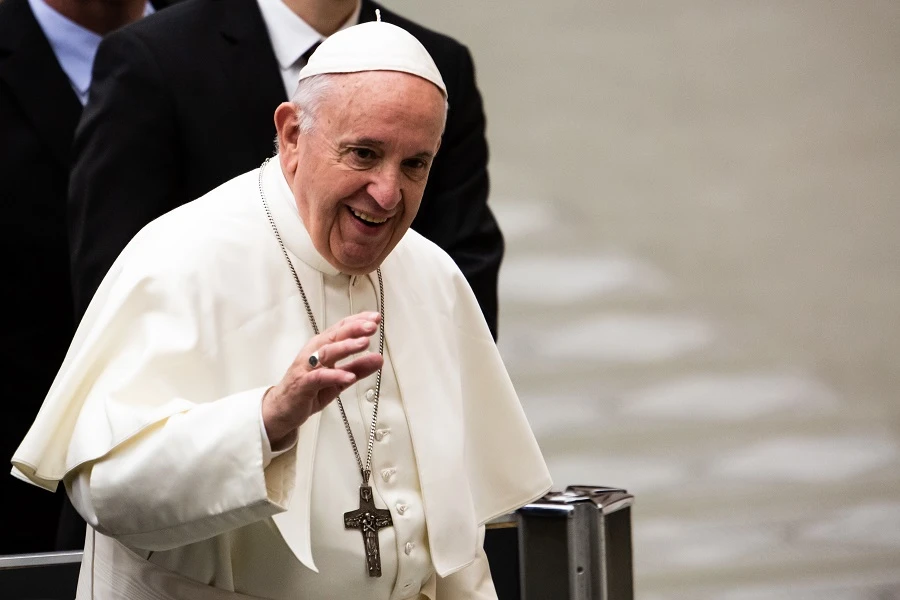
Vatican City, Feb 6, 2019 / 03:23 am (CNA/EWTN News).- Pope Francis said Wednesday that his recent trip to Abu Dhabi in the United Arab Emirates was a step forward in Catholic-Muslim dialogue and promoting peace among religions.
Though a brief visit, the “scattered seeds” of the Feb. 3-5 trip will bear fruit according to God’s will, he said during the general audience Feb. 6.
The visit to the UAE, and second meeting with the Muslim Grand Imam of al-Azhar, “wrote a new page in the history of dialogue between Christianity and Islam and in the commitment to promote peace in the world on the basis of human brotherhood.”
Pope Francis first met the Grand Imam of al-Azhar, Ahmed el-Tayeb, during a 2017 apostolic visit to Egypt. The two signed a joint document on human fraternity Feb. 4.
In the document, “we condemn all forms of violence, especially those with religious motivation, and we commit ourselves to spreading authentic values and peace throughout the world,” the pope stated.
In this era, he said, when there is strong a temptation to discord between Christian and Islamic cultures, and considering religions as sources of conflict, “we wanted to give a further, clear and decisive sign, that instead it is possible to meet, it is possible to respect and dialogue.”
He added that he recommends people read the document and try to understand it, because it has helpful points for how to carry out a dialogue on human fraternity.
“Despite the diversity of cultures and traditions, the Christian and Islamic world appreciate and protect common values: life, family, religious sense, honor for the elderly, the education of young people, and still other things,” he said.
Francis’ trip to the UAE, the first of a pope to the Arabian Peninsula, also fell 800 years after St. Francis of Assisi visited the Sultan Malik al Kamil in Egypt. Pope Francis said it was “Providence” that a pope named Francis made the historic trip on the 800th anniversary of the saint’s visit.
“I often thought of Saint Francis during this journey: he helped me to keep the Gospel, the love of Jesus Christ in my heart, while I was living the various moments of the visit,” he said.
“In my heart there was the Gospel of Christ,” he said, “the prayer to the Father for all his children, especially for the poorest, for the victims of injustice, wars, misery; prayer because the dialogue between Christianity and Islam is a decisive factor for peace in today’s world.”
During the audience, Francis also recalled his meetings with two 90-year-old priests who have both served in the UAE for many years. One, he said, is now blind and in a wheelchair, but a smile never left his lips. “The smile of having served the Lord and done very good.”
Another highlight of the trip, he pointed out, was the Mass he celebrated in the stadium in Abu Dhabi Feb. 5, which was attended by around 150,000 people. “There were so many people!” he said. “We prayed in a special way for peace and justice, with special intention for the Middle East and Yemen.”
If you value the news and views Catholic World Report provides, please consider donating to support our efforts. Your contribution will help us continue to make CWR available to all readers worldwide for free, without a subscription. Thank you for your generosity!
Click here for more information on donating to CWR. Click here to sign up for our newsletter.


If it leads to greater religious freedom for, and respect for the human rights of, Christians in the Middle East, then the trip can be deemed a success. But sadly I will not hold my breath.
Have you seen the photo of Jorge Bergoglio kissing the infidel, anti-Christ inman while signing a blasphemous joint document with him that proves his complete apostasy?
This document entitled “Human Fraternity for World Peace and Coexistence” contained the following two abominable sentences:
The pluralism and the diversity of religions, color, sex, race and language are willed by God in His wisdom, through which He created human beings. This divine wisdom is the source from which the right to freedom of belief and the freedom to be different derives.
These two sentences include at least three heretical teachings:
that pluralism is willed by God, whereas in fact it is diversity that is the consequence of the sin introduced by man into creation, as Sacred Scripture, including Genesis, the account of the Tower of Babel, and the Epistles of St. Paul make clear
that God is the source of error and erroneous beliefs
the Heresy of Ecumenism, introduced by Josef Ratzinger and the Vatican II Anti-council, that “all religions are equally true” and that “we all worship the same god.”
[Some information for this Commentary was contributed by Vatican Information Services.]
No! God did not will a plurality of religions.
Here is what a true Catholic, a true pope teaches:
Never perhaps in the past have we seen, as we see in these our own times, the minds of men so occupied by the desire both of strengthening and of extending to the common welfare of human society that fraternal relationship which binds and unites us together, and which is a consequence of our common origin and nature. For since the nations do not yet fully enjoy the fruits of peace – indeed rather do old and new disagreements in various places break forth into sedition and civic strife – and since on the other hand many disputes which concern the tranquility and prosperity of nations cannot be settled without the active concurrence and help of those who rule the States and promote their interests, it is easily understood, and the more so because none now dispute the unity of the human race, why many desire that the various nations, inspired by this universal kinship, should daily be more closely united one to another.
A similar object is aimed at by some, in those matters which concern the New Law promulgated by Christ our Lord. For since they hold it for certain that men destitute of all religious sense are very rarely to be found, they seem to have founded on that belief a hope that the nations, although they differ among themselves in certain religious matters, will without much difficulty come to agree as brethren in professing certain doctrines, which form as it were a common basis of the spiritual life. For which reason conventions, meetings and addresses are frequently arranged by these persons, at which a large number of listeners are present, and at which all without distinction are invited to join in the discussion, both infidels of every kind, and Christians, even those who have unhappily fallen away from Christ or who with obstinacy and pertinacity deny His divine nature and mission.
Certainly such attempts can nowise be approved by Catholics, founded as they are on that false opinion which considers all religions to be more or less good and praiseworthy, since they all in different ways manifest and signify that sense which is inborn in us all, and by which we are led to God and to the obedient acknowledgment of His rule.
Not only are those who hold this opinion in error and deceived, but also in distorting the idea of true religion they reject it, and little by little turn aside to naturalism and atheism, as it is called; from which it clearly follows that one who supports those who hold these theories and attempt to realize them, is altogether abandoning the divinely revealed religion.
Pius XI
Mortalium Animos