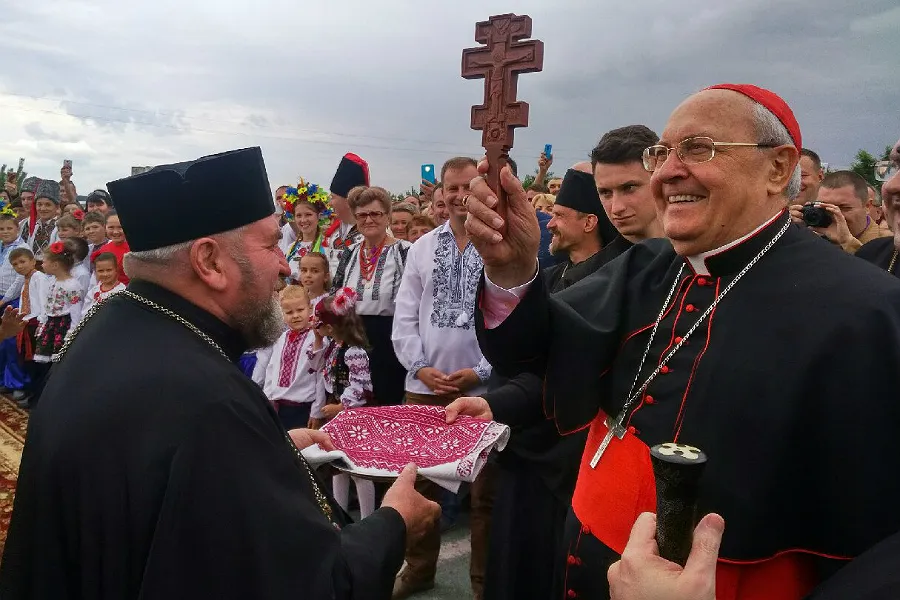
Buchach, Ukraine, Jul 20, 2017 / 12:04 am (CNA/EWTN News).- At the close of his recent trip to Ukraine, Cardinal Leonardo Sandri met with youth from the troubled country, telling them not to be discouraged by the challenges they face but rather to trust in the Lord and commit to changing society for the better.
The cardinal, prefect of the Congregation for Oriental Churches, began his July 15 speech noting that the youth “have had a thousand reasons to stay at home” rather than join him and his delegation for the annual pilgrimage to the shrine of Zarvanytsia, where the encounter took place.
Among these reasons are “the summer heart and the fatigue of the journey, but also and above all the interior ones,” he said, and pointed to the various doubts and questions they might have, such as “ why must I get on the road and march like a pilgrim, when when around me I see so much suffering and fatigue linked to the possibility of building a future?”
“Why believe in God, when around me I see so much violence, when I hear the noise of war, when the steps that are asked of some of you are those of marching like a soldier? Why trust still, when it seems that a corrupt mentality cannot be stopped and the attachment to power is lived as personal gain rather than for the interests of the community and the building of the common good?” he asked.
As a consolation, Cardinal Sandri said the only answer he can give them is to “look at yourselves, as we are doing here from the stage, at your faces – tired, perhaps, but happy.”
The decision to make the pilgrimage is itself “the answer that your hearts and your lives have given to every doubt and every question, which can arise in youth as in adults,” he said.
“Your journey is the right attitude of the heart and of life, and it’s also the most rational,” he said, explaining that “we walk with the mind, learning to study and reflect, cultivating intelligence and learning to discern what happens around us in the world.”
Pointing to the Annunciation, Cardinal Sandri noted that Mary’s question to the angel, “I do not know a man” showed that Mary was not static, but involved in the story. This question, he said, “ became the engine to not stay closed in herself, but rather to go out, to go to her cousin.”
“The encounter with Elizabeth is a precious occasion for Mary,” he said, noting that when meeting her, Mary “explodes in a song of joy, which we call the Magnificat, which is the song of the poor ones of Israel, of those who regardless of everything continued to believe that the Lord had not forgotten his promises.”
In this song, he said, is the “great wisdom” of one who has learned to entrust themselves to God and to contemplate the great things he has done throughout history and which he continues to do them now.
Even in the “famous and beautiful” shrine where the meeting took place is part of the story of faith of the Greek-Catholic Ukrainians, he said.
As such, it serves as an invitation to learn about their tradition and discover that even today, God “continues to be close and make us participants and protagonists in the work of salvation that he continues to fulfill even for your people.”
Cardinal Sandri made a July 11-17 visit to Ukraine to participate in the national pilgrimage to the Shrine of Zarvanytsia, located 15 miles north of Buchach.
His visit falls in amid of ongoing upheaval in the country, where pro-Russian separatists in the east have been fighting government forces since April 2014. The conflict has killed nearly 10,000, and displaced millions.
The fighting in eastern Ukraine followed closely on the March 2014 annexation of Crimea, a Ukrainian territory, by Russia. Russia is also believed by Western governments to be assisting the rebels in Ukraine’s Donetsk and Luhansk oblasts; a claim denied by Moscow.
In his speech, Cardinal Sandri said he would carry with him the various celebrations and meetings he had while in Ukraine, particularly his visit to the eastern, conflict-ridden region of the country “so tried by the battles which have forced many of your brothers and sisters to flee.”
“I have seen the pain, but also many signs of hope, like many flames which slowly light a great fire,” he said, and pointed to the example of displaced persons who, despite their own situation, have begun to work with the local Caritas to “alleviate the pain and deprivation” of others in the same situations.
He pointed to the example of priests, both Greek-Catholic and Latin rite, who during the years of communism were imprisoned or deported.
In addition to these, he also pointed to priests who “in recent episodes of war that have have bloodied your land have protected and saved as many as they could,” despite being in danger themselves.
As youth, who get the majority of their information through various forms of social media, the cardinal asked that they think of the suffering children in other parts of the world have to endure, such as the students and volunteers of the Jeremiah Educational Center of Faisalabad, Pakistan, who are persecuted “for their faith in Jesus.”
He also asked youth to consider stopping to pray the rosary, and in so doing, send “the embrace of Jesus” to the British infant Charlie Gard and his family, who are in the midst of a legal battle over treatment for the critically ill child.
“The exercise of intelligence to understand the present, prayer, charity and solidarity are ways in which you can also start to walk, like Mary,” he said.
Cardinal Sandri then told the youth to read and meditate on Pope Francis’ message for the upcoming World Youth Day in Panama in 2019.
In his message, the Pope asks that youth “continue your steps not only remembering the past, but also having the courage in the present and hope for the future, to recognize your origins, to always return to the essential and to throw yourself with creative fidelity into the building of new horizons,” Cardinal Sandri said.
“You are the salt and light of this world; don’t resign to thinking that things cannot change,” he said, telling them to “change society, where often the strongest and corrupt dominate, through a pure heart, faithful to God, faithful to the most authentic humanity.”
The cardinal also told attendees to “allow the oil of God’s consolation to soothe the inner wounds of so many,” particularly young women manipulated into being surrogate mothers – which he called “a terrible practice” increasingly banned by countries – and those who have had abortions.
“Let us pray that they feel the desire for the caress of God’s mercy and commit ourselves for a new surge of the defense of the dignity of women and children from every form of trafficking and exploitation,” he said.
Cardinal Sandri closed his speech asking the youth to also help their priests prepare for the upcoming synod of bishops in 2018, dedicated to “Young People, Faith and the Discernment of Vocation.”
The cardinal noted how in the Pope’s letter to youth, published alongside the initial outline of the synod discussion, Francis wrote: “Can things change? YES.”
“This cries from your young heart which does not bear injustice and cannot bend to the culture of waste, and neither can it believe in the globalization of indifference!” he said, quoting the Pope.
“Even when you experience, like the Prophet Jeremiah, the inexperience of your age, God encourages you to go where he invites you: do not be afraid, because I am with you to protect you,” Cardinal Sandri said, and entrusted the youth to the intercession of the Virgin Mary before giving his blessing.
 […]
[…]




There is nothing that can be construed to be “phobic”, about recognizing that “when psychology is not ordered to biology, a disorder exists”.
The Rights and Dignity of all human persons can only be affirmed with the recognition of the universal truth, that can be known through both our Catholic Faith and reason, that from The Beginning, every human person Is Created In The Image and Likeness of God, equal in Dignity, while being complementary as a beloved son or daughter, Willed by God, The Most Holy And Undivided Blessed Trinity, worthy of Redemption, as a Reflection of Love, though not yet Perfected, through Salvational Love, God’s Gift of Grace and Mercy.
Disordered Love is Love’s counterfeit.
There is order in Truth, as there is order in Love. Just as every element of Truth will serve to complement and thus enhance the fullness of Truth, so, too, will every element of Love, serve to complement and thus enhance the fullness of Love.
Truth and Love cannot serve in opposition to one another.
“Caritas In Veritate; Veritas In Caritate.”
https://www.catholicculture.org/culture/library/view.cfm?recnum=3416
“The phrase “sexual orientation” is radically equivocal.”
It is important to note that the phrase “sexual orientation” is not radically equivocal, but rather, necessarily serves to sexually objectify the human person, who is not, in essence, an object of sexual desire/inclination/orientation, but first and foremost a beloved son or daughter. The phrase “sexual orientation”, which by denying personhood, through its sexual objectification of the human person and denial of the essence of being first and foremost, a beloved son or daughter, necessarily discriminates against being, in essence, a son or daughter, brother or sister, husband or wife, father or mother.
The erroneous notion that private morality and public morality can serve in opposition to one another and are not complementary, has led to grievous error in both Faith and reason.
Since it is true that the desire to engage in a demeaning act of any nature, does not change the essence of a demeaning act, and it is true that every beloved son or daughter has the inherent Right to be treted with Dignity and respect in private as well as in public, refusing to condone the engaging in or affirmation of any act, including any sexual act, that demeans the inherent Dignity of our beloved sons and daughters is an act of Love, not an act of discrimination.
John Finnis a Transphobiac! Good news. Another label I’m happy to share along with Homophobic [although it’s not the literal meaning of fear of men rather fear of predatory gay men]. He deserves Oxford’s support because he defends the faith. Although defending the faith and defending human life can sometimes seem at odds. I just wrote a refutation of the distinguished professor’s position on infant craniotomy. Prof Finnis parses the interior act of the will known as intent arguing that one may not will the death of the infant lodged in the birth canal if the actual intent is to modify the skull’s dimensions for passage. Even if death is inevitable. The argument has merit if the surgeon does in fact attempt to modify by instruments designed to modify while seeking utmost care in preventing death, assuming a case when the mother cannot withstand a caesarean. However the works of Finnis I’ve read do not mention that. Instead they reference forceps which in such a case are designed more for crushing as in craniotomy than for modification of dimensions. His argument makes sense if one may rightfully will a good rather than the actual outcome of the procedure. Again the countermand remains. Craniotomy does not support that thesis. The reason as quoted elsewhere is stated by Aquinas. “The proximate end of an act of virtue must be entirely good because every privation of a good in any subject is an evil” (ST 1a2ae 21, 2). Aquinas distinguishes the interior act of the will, the will here the form of the act from the external act of the will [proximate end], its matter [materia circa quam], the latter as the object of the act. The end which is the intent and the end which is the external choice of the will, the act itself must both be good. Otherwise it’s not possible to distinguish good from evil since ultimately that is determined by what we do. Otherwise I fully support Prof Finnis in his exemplary witness to the truth of our faith.
“Homophobic [although it’s not the literal meaning of fear of men rather fear of predatory gay men]”
I thought the “homo” in that case was from the Greek for “same.”
Those who shriek “Homophobia! Haters!” or “Transphobia! Haters!” are the ones who are actually filled with hate. They are stigmatizing moral judgments as irrational fears. They hate truth; they hate normality. Ultimately, they hate God.
Leslie you’ve prompted me to be a language policeman. The Greek Homos means the same. The word I used Homo in Latin simply means Man. I’m turning in my badge now because I don’t like the job.
Excellent point, Father!
i wish i could tell the professor that i suppport him as well.
Oxford “supports” him.
How nice.
How about “defending” him?
There is such a thing as overplaying the ‘victim card’, at the same time assuming moral superiority over the accusee and that seems to be becoming increasingly common.