No Picture
News Briefs

‘Surf’s up’ for these Argentine priests
February 8, 2018 CNA Daily News 0

Buenos Aires, Argentina, Feb 9, 2018 / 12:00 am (CNA).- Fr. Santiago Arriola is convinced that “our entire life, in all its expressions and dimensions, calls for evangelization and can be evangelized.”

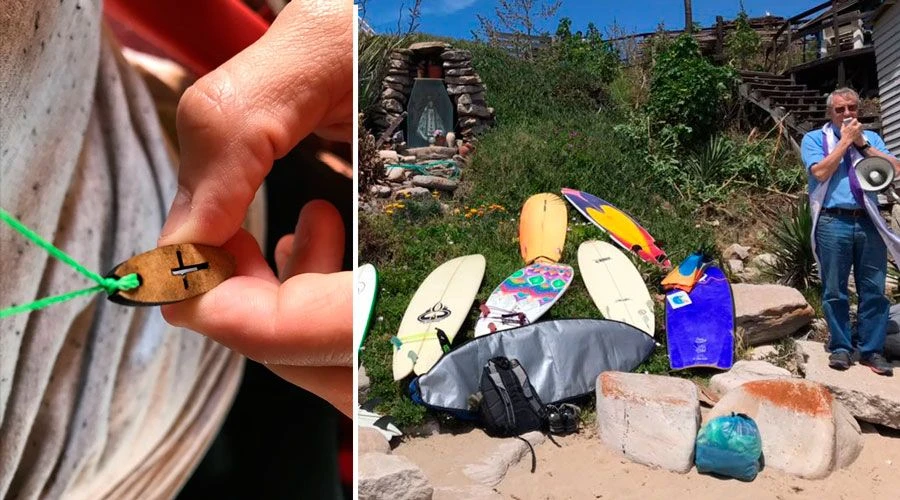
 With Fr. Pablo Etchepareborda, he has begun a surfing ministry on the beaches of Mar del Plata, Argentina.

Although their endeavor is “a work in progress,”  without all the details worked out, there have been two experiences that have encouraged the priests to continue this ministry.

The first effort was in the summer of 2016 when Fr.  Pablo Etchepareborda blessed surf boards, the sea, and a gathering of surfers in Mar del Plata.

And the pair recently held an “Aloha Encounter,” on a local beach.

“Surfers often say the Hawaiian word ‘aloha’ to each other, which has a multiplicity of meanings referring to wishing someone well,” Fr. Arriola told ACI Prensa, CNA’s Spanish language sister agency.

For two days,  18 surfers, body surfers, and stand-up paddlers, body surfing gathered for times of prayer, personal reflection and group sharing, as well as recreational activities.

Those attending included catechists and members of the Schoenstatt Movement (a Catholic secular institute devoted to defending family life and to venerating Mary), together with “young people who’ve had a faith experience and are involved in the Church in some way and others who have drifted away from the Church somewhat, but are still wrestling with their faith,” Fr. Arrila said.

“For surfers, surfing has a vital meaning, a meaning that transcends the mere sport itself. For many, it’s a time to get reinvigorated, to relax and get away from the frantic pace of daily life, to be with nature and have a kind of religious experience. So it seemed to us a beautiful opportunity to make
this vital meaning of surfing more explicit, and to do it in a community setting,” he explained.

The priest said that they will do other activities as Argentina’s summer, which is during the winter months of the Northern Hemisphere, continues, since the Aloha Encounter “is without a doubt a very positive, worthwhile and enriching experience for all of us who participated and it left our hearts yearning for more.”

This article was originally published by our sister agency, ACI Prensa. It has been translated and adapted by CNA.

[…]

No Picture
News Briefs

Bishop denies murdered Mexican priest had gang ties

February 8, 2018 CNA Daily News 0

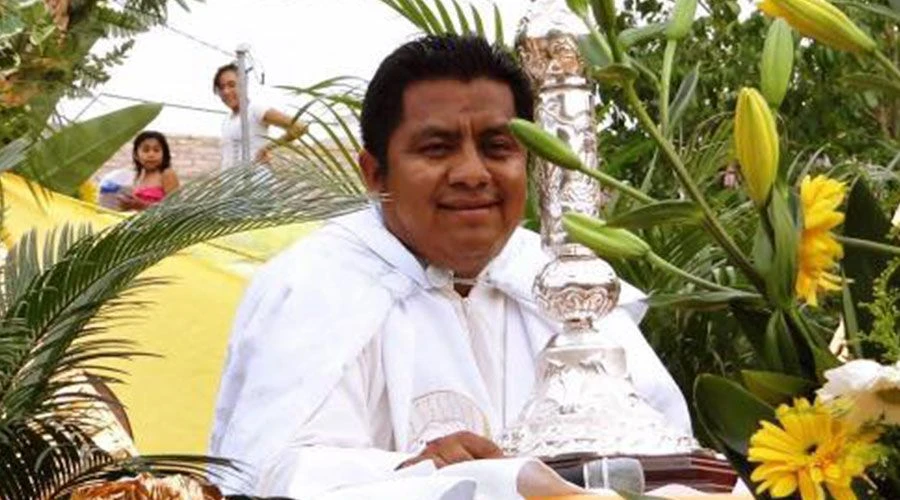
Acapulco, Mexico, Feb 8, 2018 / 07:00 pm (CNA).- The Bishop of Chilpancingo-Chilapa, Mexico denied that Fr.  Germain Muñiz Garcia, who was murdered on a Mexican highway Feb. 5 along with Fr. Iván Añorve Jaimes, had any connection to organized crime, as the Guerrero State Prosecutor’s Office has recently claimed.

In a statement released Feb 7, Bishop Salvador Rangel Mendoza said that Fr.  Muñiz Garcia “was never connected to any criminal gang.”

However, he said that the deceased priest “had knowledge, by the very nature of his pastoral work, of  some gangs operating in that area, since being a pastor and a public person he had to travel through the area where those gangs were based in order to to serve the different communities.”

The Mexican bishop responded in his statement to the accusations lodged by the Guerrero State Prosecutor’s Office, which claimed that the murdered priest belonged to “a criminal gang, by reason of the photographs and notes that circulated on the priest’s social media,” posted months prior, where he is seen with a rifle alongside masked criminals.  

According to the authorities, both priests were traveling to the town of Taxco de Alarcón to attend a party. According to the State Prosecutor’s Office, “it is known that many people belonging to different criminal gangs went there from Guerrero State as well as Morelos and Mexico States.”

“At said party there was no municipal, state or federal security, since preventative security support for  the party was not requested from any authority by the organizers.”

According to the Prosecutor’s Office, a conflict during the party “triggered the armed attack” which ended the lives of the Mexican priests.

Four people who survived the attack were also traveling in the vehicle in which the priests died,  including Fr. Germain’s sister.

Bishop Rangel Mendoza noted there are serious inconsistencies with the Prosecutor’s Office’s version of what happened.

“The Prosecutor’s statement seems strange to us, in that in the same place, Juliantla, in Guerrero, ‘members of criminal gangs from Morelos, Mexico and Guerrero States would have gotten together,’ without any reports of any confrontations between them or participants in the event. We also note the absence of municipal or state law enforcement, knowing the presence of the stated gangs,” the prelate stated.

The neighboring Archdiocese of Acapulco also expressed their criticism of the Prosecutor’s Office in a statement.

“It seems strange to us that people belonging to different criminal gangs, carrying weapons, could have gotten along with each other at the dance, without any incident. This does not seem to be their ordinary conduct,” they said.

In addition, they pointed out, the four survivors of the attack maintained “that there was no conflict at where the dance was held.”

“These four survivors report that coming back to Taxco they passed the assailants’ car which went after them, caught up with them, blocked their way and shot them,” the Archdiocese of Acapulco stated.

Regarding the photograph of the priest carrying a firearm alongside criminals, Bishop Rangel Mendoza told the press that although “it was extremely imprudent,” of him, and that he reprimanded the priest at the time, Fr. Muñiz Garcia “had to pass through the drug traffickers’ territories,” and he had to “greet them, he had to dialogue with them, he had to do it, because he had to pass through their territory, how else was he going to get through?”

The bishop said the priests went to the party “to offer their music and see if they would let them sing a few songs.”

In his statement, the prelate asked that “the investigations be objective, truthful and adhering to the law and the truth of the facts,” and that if the Prosecutor’s Office claims that the priest belonged to some criminal gang, “(I) urge them to specifically determine to which criminal gang he belonged to and not to limit themselves to making simple accusations.”

In addition, he demanded from the Guerrero State Prosecutor’s Office “a complete and certified copy of the file on the investigation that supports the said statements, since as the Prosecutor has the obligation to determine what actually happened, supporting the findings with reliable and truthful evidence.”  

This article was originally published by our sister agency, ACI Prensa. It has been translated and adapted by CNA.
[…]

No Picture
News Briefs

Trump at prayer breakfast: ‘Faith is central to American life and to liberty.’

February 8, 2018 CNA Daily News 0

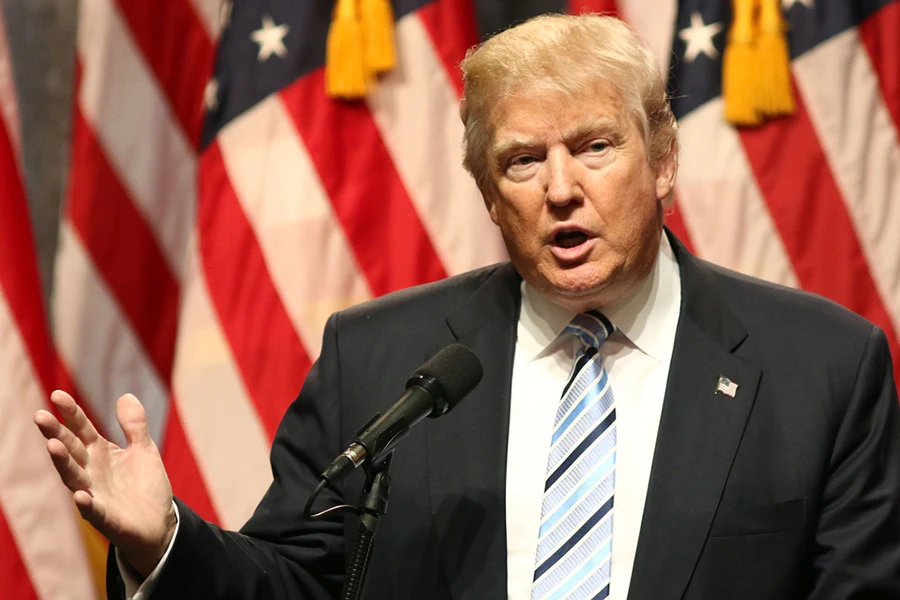
Washington D.C., Feb 8, 2018 / 10:58 am (CNA/EWTN News).- President Donald Trump lauded the importance of faith in American life as a foundation for freedom in his speech at the 66th annual National Prayer Breakfast this morning.

“Faith is central to American life and to liberty,” Trump began, “Our founders invoked our Creator four times in the Declaration of Independence.  Our currency declares, ‘In God We Trust.’ And we place our hands on our hearts as we recite the Pledge of Allegiance and proclaim we are ‘One Nation Under God.’”

During his remarks, the president emphasized the interconnection between freedom of religion and a flourishing society.

“When Americans are able to live by their convictions, to speak openly of their faith, and to teach their children what is right, our families thrive, our communities flourish, and our nation can achieve anything at all.”

Trump also committed America to the defense of religious freedom worldwide saying “We know that millions of people in Iran, Cuba, Venezuela, North Korea, and other countries suffer under repressive and brutal regimes. America stands with all people suffering oppression and religious persecution.”

“Our rights are not given to us by man, our rights come from our creator,” Trump said to the estimated 3,000 attendees at this year’s prayer breakfast.

The president said that he has seen God’s grace in the good works of American citizens who serve their communities, such as teachers, police officers, services members, and parents.

He also commended those Americans who responded to the tragedies that befell our country in the past year, particularly those who served others suffering amid hurricanes, forest fires, the Las Vegas shooting, and the opioid epidemic.

Following President Trump’s speech, U.S. Representative Steve Scalise, who was shot during practice for the Congressional Baseball Game last June, spoke about the role of his Catholic faith in his work in politics, his prayer life, and the power of prayer in his recovery.

“When you pray for somebody that you don’t know, they feel it. I felt that prayer, the prayers of so many people that I had never met before,” said Scalise.

Scalise reiterated the president’s comments on the integral relationship between faith and liberty. “If you go to the Jefferson Memorial right now, go read this inscription from Thomas Jefferson, ‘God, who gave us life, gave us liberty. Can the liberties of a nation be secure when we have removed a conviction that these liberties are the gift of God?’”

Another prayer offered at this morning’s gathering came from Democratic Senator Chris Coons who prayed, “Bless the world with better leaders,” he said, “Who seek your wisdom.”

The U.N. World Food Programme Executive Director, David Beasley, who prayed for sustainable policies to address world hunger, read a passage from Matthew 25, and emphasized that “every human on the face of the earth was made in [God’s] image.”

Republican Senator James Lankford prayed,  “We don’t know everything, but we’re so grateful to know the One who does.”


[…]

No Picture
News Briefs

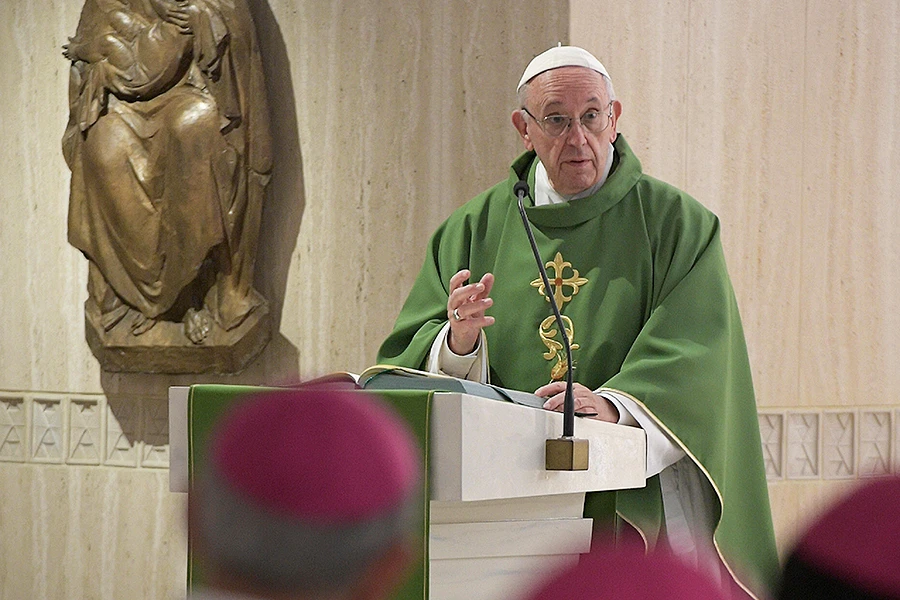
Pope Francis: Corrupt people can never be saints

February 8, 2018 CNA Daily News 1

Vatican City, Feb 8, 2018 / 10:08 am (CNA/EWTN News).- In his daily homily Thursday Pope Francis drew a distinction between the biblical figures of David and his son Solomon, saying that, like David, sinners who repent are still able to become saints, but the corrupt will not achieve holiness.

“David was a saint. He was a sinner. A sinner, and he became a saint. Solomon was rejected because he was corrupt,” the Pope said Feb. 8, adding that “someone who is corrupt cannot become a saint.”

Speaking from the small chapel inside the Vatican’s Saint Martha guesthouse where he lives, the Pope centered his reflection on the day’s first reading from the First Book of Kings, which recounted how God became angry with Solomon for worshiping false gods that his wives believed in.

In the reading, God told Solomon that he would “deprive you of the kingdom.” However, for the sake of David’s righteousness, God said he would take it from Solomon’s son instead, leaving him only a small portion of his kingdom.

The reading recounted something “a bit strange,” Francis said, because God took away the kingdom from Solomon, but didn’t say whether he had committed any major sins. However, from scripture we know that David had difficulties and was a sinner.

Despite this fact, David is a saint, while Solomon – who at the beginning of his reign had been praised by God for seeking wisdom rather than riches – was condemned because his heart had “turned away from the Lord.”

This can be explained, Francis said, by the fact that David, knowing he had sinned, asked for forgiveness, whereas Solomon was praised throughout the world, but never recognized his fault when he distanced himself from the Lord and followed false gods.

“The heart of Solomon was not entirely with the Lord, his God, as the heart of David, his father, had been.”

Francis said the problem comes from a “weakness of heart,” which, he said isn’t like a typical sin that is recognized “immediately” after being committed. Rather, this sort of weakness, he said, is more subtle, and is “a slow journey that slides along step by step, step by step, step by step.”

“Solomon, adorned in his glory, in his fame, began to take this road,” he said, explaining that “the clarity of a sin is better than weakness of the heart.”

Despite being praised for his wisdom, “the great king Solomon wound up corrupted: serenely corrupt, because his heart was weakened,” the Pope said, adding that the same danger exists for every Christian.

A man or woman with a weak heart is “defeated,” he said, and “this is the process of many Christians, of many of us.”

While many people might be able to say “No, I haven’t committed grave sins,” Francis countered, asking “how is your heart? Is it strong? Does it stay faithful to the Lord, or does is it slowly sliding away?”

This subtle sliding away can happen to anyone, he said, saying the remedy to ensure this doesn’t happen is to always be “watchful” and vigilant.

“Guard your heart. Be watchful. Every day, be careful about what is happening in your heart,” he said, explaining that a person becomes corrupt “by following the path of weakness of the heart.”

Pope Francis closed his reflection telling the congregation to “guard your heart at all times” and to ask themselves how their relationship with the Lord is going, urging them to “enjoy the beauty and the joy of fidelity.”


[…]