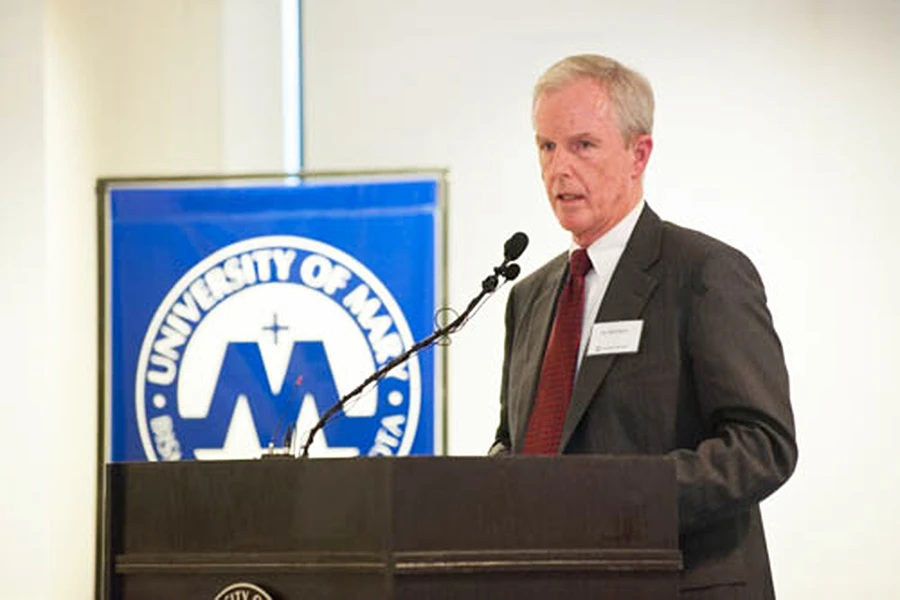
Bismarck, N.D., Feb 16, 2018 / 12:01 pm (CNA/EWTN News).- Dr. Don Briel, who held a chair in liberal arts at the University of Mary and who had founded the first Catholic Studies program, at the University of St. Thomas in Minnesota, died Thursday night.
The University of Mary has confirmed to CNA the news of Briel’s Feb. 15 death.
Briel was 71, and had been diagnosed with two untreatable acute leukemias Jan. 19. He had been in hospice care at his home.
In recent weeks he has been the subject of tributes for his contribution to the renewal of Catholic higher education in the US, most notably through this founding, in 1993, of the Catholic Studies Program at the University of St. Thomas in St. Paul-Minneapolis, Minn. That program was the inspiration for similar programs at both Catholic and public universities across the country.
Briel remained at the University of St. Thomas for 20 years, and in 2014 he was given the Blessed John Henry Newman Chair of Liberal Arts at the University of Mary in Bismarck, N.D.
At the University of Mary, he helped develop a Catholic Studies program, developed its Gregorian Scholars Honors Program, and taught at its Rome campus.
Briel’s doctoral work focused on Bl. John Henry Newman, “whose vision of university education had a profound impact on my vision of what was necessary in our own time, [through] his insistence that the purpose of university was to form the mind and habit of students, which enables them to see things in relation and make judgments about reality,” as he told The Catholic Spirit in the weeks preceding his death.
In a Jan. 24 homage to Briel at First Things, George Weigel included his founding the Catholic Studies program among the three seminal moments for Catholic higher education in the US since World War II.
Weigel described Briel’s work as, in part, an effort “to repair the damage that was done to institutions of Catholic higher learning in the aftermath of Land O’ Lakes.”
At the Land O’Lake conference in 1967, Catholic universities also began to distance themselves from the hierarchy of the Church, insisting on their “true autonomy and academic freedom in the face of authority of any kind, lay or clerical.”
“But there was, and is, far more to Don Briel’s vision, and achievement, than damage-repair,” Weigel wrote. “Nourished intellectually by John Henry Newman and Christopher Dawson, Briel has aimed at nothing less than creating, in twenty-first-century circumstances, the ‘idea of a university’ that animated his two English intellectual and spiritual heroes.”
Weigel characterized conversion “to the truth of Christ and the love of Christ as manifest in the Catholic Church,” and thereby the conversion of culture, as what “Don Briel’s life-project [is] all about.”
John and Madelyn Dinkel, who studied under Briel in Rome, wrote to him after his illness that “Your course taught us that following Christ through truth, beauty, and goodness is something always to strive for. You taught us that being a saint will not be easy, but that it truly is the only way worth living. Dr. Briel, your course did teach us this, but most importantly, your character, your virtue, and your Holy Christian example, taught us this during our time abroad.”
Briel is the subject of a recently published festschrift, Renewal of Catholic Higher Education: Essays on Catholic Studies in Honor of Don J. Briel. Edited by Matthew Gerlach, the book includes reflections from Catholic Studies professors, alumni, and scholars.
In the weeks preceding his death, Briel exhibited a profound peace and a sense of gratitude.
In an interview with Maria Weiring of The Catholic Spirit conducted Feb. 8, he said that when told he had a month to live, “I felt great peace about this. I had always prayed that I would have some advance knowledge of dying, and my ideal time frame was actually one month. It’s time enough to focus on the reality of death; it’s not too short, and it’s not too long.”
“The thing is, that if I hadn’t had this incidental appointment with this surgeon, I wouldn’t have known, and therefore I wouldn’t have had this knowledge, which I had always prayed for. So there seems to be providence in it, on every aspect of the diagnosis and my experience of it.”
He characterized his time as spent primarily in prayer and in greeting friends: “I do read, but it’s more [a] time of this combination of prayer – an intensification of prayer – and seeing so many former students and colleagues.”
“I have to say that I look forward to death, not with a sense a great success, but a sense of the privilege, again, of having been invited into the work that has had these remarkable results … This is not my work, it’s not our work, it’s God’s work, and to have been given this possibility to assist in realizing this great educational vision has been the great privilege of my life.”
 […]
[…]