

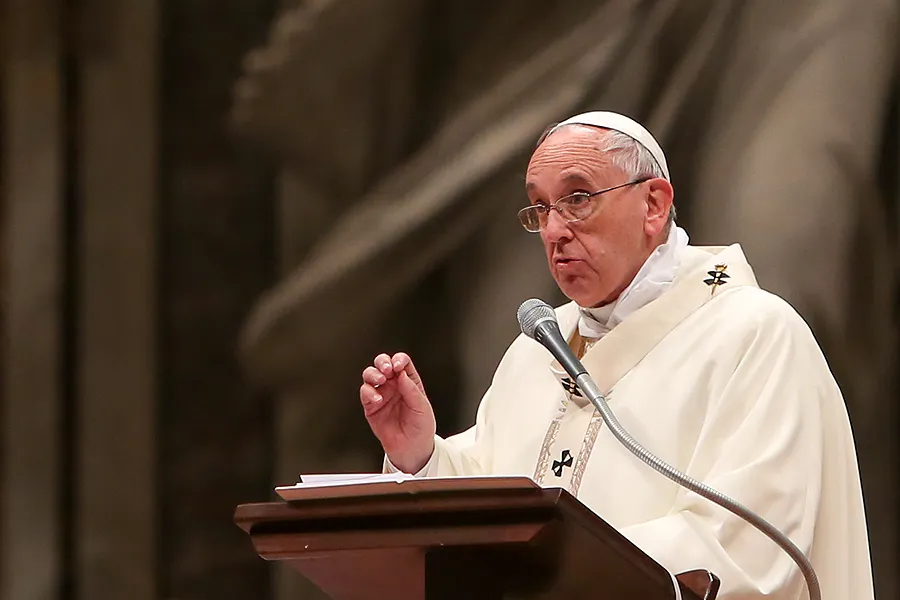
Vatican City, Dec 17, 2018 / 12:00 pm (CNA/EWTN News).- The death penalty is always a rejection of the Gospel and of human dignity, and therefore must be rejected by all countries, Pope Francis told the Delegation of the International Commission against the Death Penalty on Monday.
In his meeting with the delegation at the Vatican, the Pope set aside his prepared remarks and gave an impromptu address.
In his prepared text, which was then handed out to the delegation, Francis said he has prioritized the abolition of the death penalty throughout his ministry because of the great harm it does to human dignity.
“The certainty that every life is sacred and that human dignity must be safeguarded without exception has led me, from the beginning of my ministry, to work at different levels for the universal abolition of the death penalty,” he said.
The Pope in August ordered a revision of paragraph 2267 of the Catechism of the Catholic Church, calling the death penalty “inadmissible” and urging its elimination. The Pope called for the changes in May, the final draft of the new paragraph was issued by the Congregation for the Doctrine of the Faith.
The Catechism previously taught that the state had the authority to use the death penalty in cases of “absolute necessity,” though with the qualification that the Church considered such situations to be extremely rare.
The previous version of paragraph 2267 in the Catechism of the Catholic Church had stated: “Assuming that the guilty party’s identity and responsibility have been fully determined, the traditional teaching of the Church does not exclude recourse to the death penalty, if this is the only possible way of effectively defending human lives against the unjust aggressor.”
In his address on Monday, Pope Francis said the change in the Catechism expressed a “progress of the doctrine of the most recent Pontiffs as well as the change in the conscience of the Christian people, which rejects a penalty that seriously harms human dignity.”
The death penalty was a lingering value of bygone centuries, Pope Francis said, during which “the instruments available to us for the protection of society were lacking and the current level of development of human rights had not yet been achieved.”
It hearkens to a time when legal values were extolled over Christian ones and justice prevailed over mercy, he added.
“The Church cannot remain in a neutral position in the face of the current demands for the reaffirmation of personal dignity,” he said.
Today, the Church rejects the death penalty in all cases because it “counters the inviolability and the dignity of the person” and denies guilty people the “hope of redemption and reconciliation with the community,” he said.
Pope Francis encouraged members of the United Nations to continue to observe the group’s moratorium on the use of the death penalty, first issued in 2007, which asks member countries to suspend the application of the death penalty and to work toward its total abolition.
He also invited non-UN-member countries to take steps toward eliminating the death penalty.
“The suspension of executions and the reduction of crimes punishable by capital punishment, as well as the prohibition of this form of punishment for minors, pregnant women or people with mental or intellectual disabilities, are minimum objectives with which leaders around the world must engage,” the pope said.
Francis urged those who work in the field of criminal justice to work to understand the root causes of violence and crime, in order “to address the ethical and moral problems that arise from conflict and social injustice, to understand the suffering of the specific people involved and to reach other types of solutions that do not deepen those sufferings.”
He also condemned the “regrettably recurrent phenomenon” of “extrajudicial, summary or arbitrary executions” carried out by state authorities in many countries.
“As a consequence, any use of lethal force that is not strictly necessary for (self-defense and preservation of life) can only be considered an illegal execution, a state crime.”
The Pope thanked then the delegation for their work and assured them of the Church’s support.
“The Church is committed to (the abolition of the death penalty) and I hope that the Holy See will collaborate with the International Commission against the Death Penalty in the construction of the necessary consensus for the eradication of capital punishment and all forms of cruel punishment.”
If you value the news and views Catholic World Report provides, please consider donating to support our efforts. Your contribution will help us continue to make CWR available to all readers worldwide for free, without a subscription. Thank you for your generosity!
Click here for more information on donating to CWR. Click here to sign up for our newsletter.


Today, the Church rejects the death penalty in all cases because it “counters the inviolability and the dignity of the person” and denies guilty people the “hope of redemption and reconciliation with the community,” he said.
But is the above statement true? No.
“As a consequence, any use of lethal force that is not strictly necessary for (self-defense and preservation of life) can only be considered an illegal execution, a state crime.”
Wrong all these years? No.
From here on, I can only resist Bergoglio …his vile, treacherous traitorous, tone deaf, (and most of all) hypocritical regard he has towards China…his cronyism centered in homosexuality…his trivialization of marriage and the Eucharist…his rigged “synodal” Church…his disdain for Scripture and Tradition and the “pious faithful.”
Exactly right, Joseph. We have a Pope Frankenstein who is ripping the Church apart. If this is not heresy, what is when the clear and certain teaching of both the Old and New Testaments as uniformly followed by Tradition and every pope over 2,000 years are dismissed as ignorant rubbish?
Pope Francis won’t say ‘intrinsically evil.’
Both the Pope and John Finnis are trying desperately to reconcile the Church’s past on capital punishment.
And not succeeding..
“Prohibiting gay civil unions is an offense against human dignity!”
It needs to be said plainly: Jorge Mario Bergoglio is a heretic.
“Liberalism is a heresy.”
So for two thousand years the Catholic Church, the Bible, the Church Fathers, the Doctors of the Church, and 265 previous Popes were wrong by holding that the Death Penalty could be morally just in principle, but Pope Francis somehow right by coming to the opposite conclusion?
More likely the opposite is true.
Assuming that eternal life — in heaven or hell — awaits us after our brief sojourn on earth, anything that redounds to our salvation must be counted as more valuable than human life itself. Far from being inhumane, then, a death sentence is one of the greatest blessings we sinners can receive. By focusing the mind on the mortality that most of us ignore, it provides a compelling incentive for reconciliation. This applies even to those rare few who’ve been falsely convicted.
How many “victims” of capital punishment (not to mention terminal illness) might have been damned without the knowledge of their imminent demise? Do they share our mortal squeamishness in paradise? Not likely. They undoubtedly conclude, and rightly so, that we place too much emphasis on this life and too little on the next.
Laughable from commentators – the outrage over losing their moral satisfaction over killing people.
6 “Whoever causes one of these little ones* who believe in me to sin, it would be better for him to have a great millstone hung around his neck and to be drowned in the depths of the sea.
Some teachings are rooted in Scripture, and are also confirmed by the words of Christ, and also have been preserved in the Church by the Holy Spirit for two millennia. The teaching that the state has the authority to put criminals to death is one of those teachings. Human nature hasn’t changed. God hasn’t changed. That which the Holy Spirit has preserved in the Church for two millennia cannot be legitimately contradicted or reversed, not even by a pope, because that is tantamount to saying that the Holy Spirit made a mistake. And if the Holy Spirit makes mistakes, or Christ has not kept his promise that the Holy Spirit would remain with the Church forever and guide it into the truth, then the whole basis for Catholicism collapses.
The assertion that the death penalty is “inadmissible” contradicts two millennia of Church teaching, which was rooted in the Scriptures and had been confirmed by the words of Christ where He acknowledged Pilate’s authority to put people to death, saying that such authority had been given him “from above.”
There are translations that I prefer over Young’s Literal Translation which I used here, but I used the YLT because it gets the Greek word exousian right, translating it as “authority,” instead of as “power” as it often is in English translations of these verses. Anybody holding a hammer who can sneak up behind somebody else has the power to kill them. That isn’t the same as having the authority to kill them. Christ was obviously talking about Pilate’s authority, not his power, and acknowledges his God-given authority to put criminals to death by saying it was given him “from above.” He also makes clear that Pilate is sinfully abusing and misusing that authority as Pilate had already admitted that he found no fault in Jesus (John 19:4, Luke 23:4,15).
If Bergoglio wants to abolish truly unjust instances of the sinful misuse and abuse of the death penalty, he should start with the contemporary, militantly atheistic, radically secularized state pretending to have the authority to confer upon women the right to sentence their own unborn children to death, for any reason whatsoever, or for no reason at all. These blatantly criminal executions of innocent children have taken the lives of two billion children in the last 45 years of “legal” murder. That is more people than the entire human population of planet Earth at the beginning of the 20th century.
Take a look at this photograph of a beautiful child at 18 weeks after conception, which appeared on the cover of an April, 1965 edition of LIFE Magazine:
Beautiful Child
Hundreds of millions of beautiful children as far along or farther along than the child shown in that photograph have been brutally murdered — unjustly sentenced to death. That is what is inadmissible. (All abortion is inadmissible, but there is no excuse — not even for the worldly — to tolerate the mass murder of what are clearly innocent children. My two-year-old grandson, upon seeing that photograph, exclaimed “Baby!”)
John Paul II, in Evangelium Vitae, called this “murder” and insisted we had an obligation to defy civil authorities. Bergoglio objects to the death penalty for dangerous murderers, and has yet to call for the world-wide abolition of the death penalty being unjustly applied to innocent children.
It is time to revisit the claims that Bergoglio’s election to the papacy was not valid. A genuine Pope is protected by the Holy Spirit from officially teaching error.
I know certain people think the book by Professors Feser and Bessette volume provides proof of an unchanging Catholic tradition on the death penalty. Some of the examples in this book are not that convincing when you study them carefully. For example, Pope Innocent I’s 405 Letter to the Bishop of Toulouse not only supports the right to carry out the death penalty but also torture (PL 20, 499). Pope St. Nicholas I, however, in his letter to the Bulgarians in 866 says that “neither divine nor human law” allows such torture (Denz.-H, 648). This shows that what Innocent I expressed in his 405 letter about torture and the death penalty was hardly definitive. It’s also important to note that, after being asked whether it’s permissible for people after baptism to administer torture (tormenta) or a capital sentence (capitalem … sententiam), Innocent I says: “About these matters we read nothing definitive from the forefathers” (De his nihil legimus a majoribus definitum; PL 20, 499). This one simple sentence completely refutes Feser and Bessette’s claim that there was a definitive magisterial tradition upholding the legitimacy of the death penalty in the early Patristic Age. Pope Innocent I explicitly states that he reads “nothing definitive” from the forefathers on this matter. The fact that Pope Nicholas I in 866 rejects the legitimacy of torture likewise proves that Innocent I’s 405 letter to the Bishop of Toulouse cannot be considered a definitive magisterial judgment. Pope St. Nicholas also tells the Bulgarians: “….without hesitation and in every possible circumstance, save the life of the body and soul of each individual. You should save from death not only the innocent but also criminals, because Christ has saved you from the death of the soul” (Epistula 97, cap. 25). Since the lives of criminals on death row can be saved, executing them would be as inadmissible for Pope St. Nicholas I (r. 858–867) as for Pope Francis.
Feser and Bessette also appeal to the “profession of faith” prescribed for a group of Waldensians by Innocent III in 1208 and amended in 1210 (Denz.-H 790-797). Innocent III’s profession states that the death penalty can be carried out by the secular power under certain conditions “without mortal sin.” This is hardly a hardly an enthusiastic endorsement of the death penalty. It’s simply a judgment on the subjective culpability of the one who carries out the sentence for the secular power. If this judgment were definitive, then nothing in the 1210 profession of faith could change. This same profession, though, also requires Catholics to oppose “manifest heretics… even unto death … as adversaries of Christ and the Church” (Denz.-H 796). This requirement, though, was not reaffirmed by Vatican II, which looks upon Non-Catholic Christians—who are in material heresy on many points of dogma—as “separated brethren” (Decree on Ecumenism, 3). Sometimes only with the passage of time can we know which teachings are definitive and which are open to development. The Magisterium is the authority to decide this, not private scholars like Professors Feser and Bessette.
Not even the Magisterium has the authority to contradict that which the Holy Spirit has preserved in the Church for twenty centuries, and the truth of which was confirmed by the words of Christ recorded in the Gospels (See my post above.) Furthermore, the legitimacy of the death penalty in principle was clearly taught by St. Paul, and how Paul’s teaching was understood in the Early Church is made clear by St. Irenaeus (died 155 A.D.), who explains how the death penalty protects human dignity, and why God granted the state such authority, and assures us of God’s punishment of unjust civil authorities: