Kyiv, Ukraine, Nov 26, 2018 / 04:23 pm (CNA/EWTN News).- As the Ukrainian parliament voted to introduce martial law after Russian forces seized three of its naval vessels, Christians in the country are asking for prayer and solidarity to de-escalate the conflict.
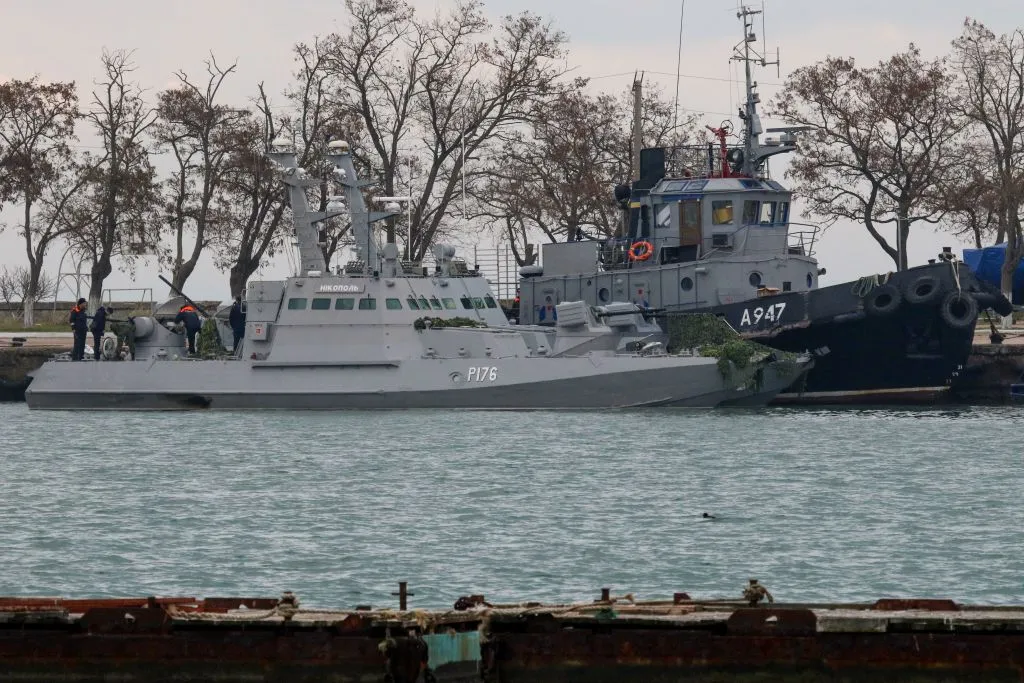
Russia captured three Ukrainian vessels together with their 23 crew members Nov. 25 in the Kerch Strait, between Crimea and Russia’s Taman Peninsula. Crimea, a Ukrainian territory, was annexed by Russia in 2014.
Ukraine’s parliament voted Nov. 26 to impose martial law in 10 oblasts, most of them bordering Russia, for 30 days beginning Nov. 28. Martial law allows military rule and the restriction of rights, including the freedoms of assembly and expression.
In response to the situation, the Baptist Union of Ukraine has asked that Christians around the world pray for Ukraine, for its protection and for the protection of ministers who serve in areas of occupation and military conflict.
“We don’t know all the details of what happened,” said Igor Bandura, First Vice President of the Baptist Union of Ukraine, or what are the intentions of Russian president Vladimir Putin. “But the situation is extremely serious. We are asking for your prayer for our situation in Ukraine as we believe in our Christian solidarity.”
Some have noted the religious dimension of Russian actions.
“The Russian Orthodox Church has broken off relations with Constantinople and is ready to defend its ‘canonical territories’ by any means,” said Michael Cherenkov, Mission Eurasia’s Executive Field Director.
“Ukrainian Baptist churches in the occupied territories are outlawed as extremists. And in Russia itself, the persecution of evangelical believers is intensifying. All of this suggests that Russia is preparing for a big war in which the religious factor will have a major role,” Cherenkov observed.
Ukraine called the Nov. 25 incident in the Kerch strait an “act of agression” on the part of Russia.
The three vessels captured were going from Odesa to Mariupol, in the Sea of Azov – a seaport only accessible by the Kerch strait. Russia claimed the boats had illegally entered its territorial waters, and fired on the Ukrainian vessels. Three Ukrainian crewmen have been hospitalized, according to the Kyiv Post.
Pro-Russian separatists in eastern Ukraine have been fighting government forces since April 2014, shortly after the Russian annexation of Crimea. The conflict has killed more than 10,000 people, and displaced more than 1 million.
If you value the news and views Catholic World Report provides, please consider donating to support our efforts. Your contribution will help us continue to make CWR available to all readers worldwide for free, without a subscription. Thank you for your generosity!
Click here for more information on donating to CWR. Click here to sign up for our newsletter.

Major Archbishop Sviatoslav Shevchuk, leader of the Ukrainian Greek Catholic Church, on Dec. 9, 2022 / Oleksandr Sawranskij / Major Archbishopric of the Ukrainian Greek Catholic Church
Rome Newsroom, Feb 24, 2023 / 09:30 am (CNA).
What does it … […]
Pope Francis and José María Del Corral, president of the Scholas Occurrentes youth movement, smile during a meeting with the group’s volunteers in Cascais, Portugal, on Aug. 3, 2023. / Daniel Ibáñez/CNA
Washington, D.C. Newsroom, Aug 3, 2023 / 08:50 am (CNA).
In his first encounters with young people ahead of his arrival at World Youth Day later in the day, Pope Francis on Thursday urged his audiences to use their knowledge and skills to care for the planet and the poor.
The Holy Father began his second day in Portugal with a meeting with students at the Portuguese Catholic University in Lisbon, followed by a visit with young volunteers in a coastal town outside the city who promote education in poor communities.
At the university, the pope first heard the testimonies of four students who shared their academic experiences and hopes for the future. The theme there was “integral ecology,” a view of the interconnected nature of the world’s problems that Francis developed in Laudato Si’, his 2015 encyclical on the environment.
Tomás Virtuoso, 29, a second-year theology student with undergraduate and master’s degrees in economics, speaks to Pope Francis at the Portuguese Catholic University in Lisbon, Portugal, on Aug. 3, 2023. Daniel Ibáñez/CNA
“It seems to me that my generation is being asked not to ignore the many insights that Laudato Si’ offers us,” said Tomás Virtuoso, 29, a second-year theology student with undergraduate and master’s degrees in economics.
“First, when it encourages us to bring the best of science to bear, trusting in the divine gift of reason, to continue to find effective solutions to the challenges we face,” he explained.
“Secondly, when it asks us to reject technological progress that does not have a strong ethical and spiritual root, that does not ensure respect for the inviolable dignity of the person and of all creation,” he continued.
“Thirdly, when it leads us to the firm decision to live according to the demands of the common good, the structuring principle of the Church’s social doctrine,” which “places the preferential option for the poor at the center,” he said.
“Finally, when it encourages young Catholics of my generation to evangelize, to fearlessly affirm that an authentic integral ecology is not possible without God, that there can be no future in a world without God.”
Working for a just society
In his remarks, Pope Francis urged students to “seek and risk,” reminding them that an education like theirs is both a gift and a responsibility.
“A university would have little use if it were simply to train the next generation to perpetuate the present global system of elitism and inequality, in which higher education is the privilege of a happy few. Unless knowledge is embraced as a responsibility, it bears little fruit,” he said.
“An academic degree should not be seen merely as a license to pursue personal well-being but as a mandate to work for a more just and inclusive — that is, truly progressive — society.”
Pope Francis meets with students at the Portuguese Catholic University in Lisbon, Portugal, on Aug. 3, 2023. Daniel Ibáñez/CNA
Speaking of the responsibility of environmental stewardship, the Holy Father challenged students not to be content with mere “palliative” or “halfway measures” that “simply delay the inevitable disaster,” as he observes in Laudato Si’.
“Rather, it is a matter of confronting head-on what sadly continues to be postponed: the need to redefine what we mean by progress and development,” he explained.
“In the name of progress, we have often regressed. Yours can be the generation that takes up this great challenge. You have the most advanced scientific and technological tools, but please, avoid falling into the trap of myopic and partial approaches,” he stressed.
“Keep in mind that we need an integral ecology, attentive to the sufferings both of the planet and the poor. We need to align the tragedy of desertification with that of refugees, the issue of increased migration with that of a declining birth rate, and to see the material dimension of life within the greater purview of the spiritual,” he said.
“Instead of polarized approaches,” the pope underscored, “we need a unified vision, a vision capable of embracing the whole.”
Order out of ‘chaos’
Later in Cascais, a picturesque medieval town and popular coastal resort west of Lisbon, Pope Francis met with young members of the Portuguese chapter of Scholas Occurrentes, an international youth movement. It was the pope himself, as the archbishop of Buenos Aires, who founded the group, which promotes education in poor communities around the world.
A view of the “Life between Worlds” mural project at the Portuguese headquarters of the Scholas Occurrentes youth movement in Cascais, Portugal. Pope Francis visited with members of the community on Aug. 3, 2023. Daniel Ibáñez/CNA
While there, the pope was given a paintbrush he used to put the finishing touches on an elaborate “Life Between Worlds” mural that decorates the walls and ceiling of the group’s headquarters. “Old people and young people, rich and poor, children of different religions and nonbelievers, and young people of different nationalities participated in this work of art,” the group said in a statement.
In his unscripted remarks, the pope addressed the “chaos” some of the volunteers referenced in describing the challenges they face in their lives.
The pope reminded them that God always brings some good out of chaos, beginning with the first moments of creation.
“There it is in poetic language, how God makes light one day out of chaos, another day he makes man and goes on creating things and transforming chaos into cosmos,” he noted.
“The same thing happens in our lives. There are moments of crisis … that are chaotic … then the job of the people who accompany us, of a group like this, is to transform [that situation into] a cosmos,” he said.
After some time to eat and rest, the pope was set to arrive at the site of World Youth Day for a welcome service Thursday evening.
Brussels, Belgium, Sep 17, 2017 / 06:01 am (Church Pop).- Br. René Stockman says it clearly: the path to euthanasia is not viable for a Catholic hospital.
After a board of trustees decision to allow euthanasia in Belgian hospitals sponsored by the Brothers of Charity, the community’s general superior spoke with CNA about the issues at stake, and the possibility that the Brothers of Charity might discontinue sponsoring hospitals if things do not change.
The Congregation of the Brothers of Charity is a religious community of brothers founded in Belgium in 1807, with the mission to care for the poor, elderly and those affected by psychiatric diseases.
“It was immediately clear to our founder, Fr. Pierre Joseph Triest, that there was the need to combine the contemplative life of religious orders with a professional work on charity. But we are not social workers, though we work in professional ways. Mostly, through our social activity we help people to see how God shine in their lives.”
Pioneers in the field of psychiatric care, the Brothers of Charity are active in many part of the world. In Belgium, they sponsor 15 hospitals and care for about 5,000 patients.
The hospitals are managed by a civil corporation named after the Brothers of Charity, though the board of trustees includes only 3 Brothers of Charity out of 15 members.
This board made the decision to allow Catholic hospitals to permit acts of euthanasia, in certain limited circumstances. The Brothers of Charity protested this decision, appealed to the Congregation of the Doctrine of the Faith, and the Vatican responded by requesting that the corporation stop allowing euthanasia in their hospitals.
The board of trustees defied the Vatican request, and published a long statement in which they reiterated their view.
Br. Stockman explained to CNA that “the next step is a meeting with the authorities of the Vatican during the week of Sep. 25. We will then make our decisions in accordance with the vision of the Vatican.”
Asked if the Brothers of Charity could withdraw their sponsorship from the hospital, Br. Stockam said that “if there no change in the policies, it is a possibility.” If the 3 members of the organization leave the board of the hospital, it will no longer be considered a Catholic hospital.
In their statement, the hospital board of trustees lamented the lack of dialogue and stressed they will “continue with the request of establishing a dialogue,” though they do not want in any way change their decision.
Br. Stockman commented that “there is only a request to dialogue on the way to implement euthanasia, and not on the fact of euthanasia as such. I asked very clearly many times to first dialogue on euthanasia and the vision as such, in the hope coming to a consensus, but they refused to change their initial vision”.
The civil board has claimed that their decision is “consistent” with the doctrine of the Church, since “the text has come about starting from the Christian frame of thought as we apply it within the organization. In this, we always take into account the shifts and evolutions within society. We have considered the following elements: recognition of the exceptional, proportional view of ethics, deontological view and ideologization, and choice of conscience”.
This view is completely rejected by Br. Stockman. “This is totally wrong and against the doctrine of the Church,” he underscored.
He then explained: “The whole issue starts with the refusal to see the respect of life still as absolute. For them, it became fundamental, on the same level as the autonomy of the patient and the relation in the care. Therefore we cannot accept their statement. They take distance of the doctrine of the Church.”
Hermann van Rompuy, a former Belgian prime minister who is a part of the board of trustees, said that “the times when the Pope had the last word are far away.”
Brother Stockman explained to CNA that the Brothers of Charity appealed to the Congregation for the Doctrine of the Faith because the civil board of trustees “refused both our request and also the one of the Belgian bishops” to change their policies, and so “we had to appeal to the Holy See.”
The Holy See, Br. Stockman recounted, “asked the hospitals to conform themselves with the doctrine of the Church about the absolute respect for life and not doing euthanasia to psychiatric patients. After our request as general superior and council and after the statement of the Belgian Bishops, the civil corporation governing our hospitals in Belgium refused to adapt their vision.”
Br. Stockman affirmed that the Brothers of Charity would remain faithful to the Church’s teaching, despite serious civil pressure to the contrary.
“I am sure,” he said, “that the great majority of the brothers, also in Belgium, are against euthanasia, but the pressure on them is very high. We have clear guidelines against euthanasia, that we developed already before this case.”
Leave a Reply