No Picture
News Briefs

The cycle of porn and loneliness

July 11, 2018 CNA Daily News 0

Richmond, Va., Jul 11, 2018 / 05:46 pm (CNA/EWTN News).- Andy*, a devout Catholic and recently married man in his twenties, encountered a vicious cycle of pornography in high school and some college – a cycle of porn and loneliness.  

“[Porn] would create this whole loneliness, but then, [because of] that loneliness itself, I was seeking for some sort of connection and I was seeking that through the use of pornography, like this reciprocating cycle,” he told CNA.

Starting sophomore year of high school and ending sometime in college, Andy’s porn use would also make him feel shame about interacting with people. It would lead him to be more anti-social, then to loneliness, and ultimately to more porn use. He said it was real, human connection which broke that cycle.

“I found that one of the things that actually helped me break that cycle was actually more interaction with people that were really good friends and people that were there for me.”

Andy’s experience is not uncommon, according to a recent study from the Institute of Family Studies.

IFS linked greater porn use to increased loneliness and higher levels of loneliness to more porn use, pointing to a vicious and unhealthy cycle. One of the men behind the study, Mark Butler, wrote an article describing the research.

“If loneliness can lead to pornography use, and pornography use may bring about or intensify loneliness, these circular linkages may create a vicious cycle, pulling the user even further from health-promoting relationship connections,” he wrote July 3.

The study surveyed more than 1,000 people from around the world, and a statistical model was developed to analyze the potential reasons behind this cycle of loneliness and porn use.

Butler wrote that “each incremental increase in loneliness was associated with an increase in pornography use (by a factor of 0.16), and each incremental increase in pornography use predicted a significant increase in loneliness (by a factor of 0.20).”

“While the magnitude of effects was small, they were statistically significant,” Butler wrote. “Interlocking partnerships like this are worrisome since they represent an entrapment template associated with addiction.”

The model highlights the biological experience and results of the sexual system that ought to produce greater relational connection through pleasure and comfort.

“First, there’s the physical pleasure of arousal, intercourse, and climax – the engine designed to ensure offspring. Then, after climax, partners experience the brain’s ‘love’ plan for pair bonding, when oxytocin … is released, producing feelings of comfort, connection, and closeness.”

However, without a partner with whom to bond, the sexual activity produces a false relationship experience, “offering temporary ‘relief’ from lonely feeling, but soon enough, the user again faces a real-world relationship void,” he said.  

The mental fantasy of a relationship experience invited by pornography “only tricks the brain for a while,” Butler said.

“The user can’t escape the fact that when the experience is over, they’re still alone in an empty room. So, when sexual intoxication wears off, the experience may only end up excavating a deeper emptiness – a setup for a vicious cycle.”

The temporary escape from the long term loneliness creates a false-belief that porn is a “fix” for loneliness, he said, noting that it is similar to drug addictions.  

“The sexual system’s combination of two very different rewards – intense sensual gratification during arousal and climax, followed by oxytocin’s relief and comfort during the resolution period – could be thought of like a combined cocaine-valium experience and ‘hook.’”

“We hypothesize that this experience could create the potential for getting trapped in the short-term, feel-good escape of pornography joined with long-term loneliness.”

Butler also pointed to other studies that show a decrease in porn use after marriage, suggesting that human connection contrasts with this vicious cycle.

“Married persons use pornography less than single persons. The fact that pornography use decreases after marriage may hint at a link between pornography, relational success, and loneliness.”


*Name changed to respect privacy

[…]

No Picture
News Briefs

New superior general elected by SSPX

July 11, 2018 CNA Daily News 0

Sion, Switzerland, Jul 11, 2018 / 04:32 pm (CNA).- On Wednesday the general chapter of the Society of Saint Pius X, a canonically irregular priestly society, elected Fr. Davide Pagliarani as its superior general.

The July 11 election was made at the Seminary of St. Pius X in Ecône, about 10 miles southwest of Sion, Switzerland. The general chapter is being held through July 21.

Elected as general assistants were Bishop Alfonso Gallareta and Fr. Christian Bouchacourt.

The SSPX was founded by Archbishop Marcel Lefebvre in 1970 to form priests, as a response to what he described as errors that had crept into the Church after the Second Vatican Council.

Its relations with the Holy See became particularly strained in 1988 when Archbishop Lefebvre and Bishop Antonio de Castro Mayer consecrated four bishops without the permission of St. John Paul II.

Fr. Pagliarani, 47, succeeds Bishop Bernard Fellay as superior general of the SSPX. He has a mandate of 12 years in his office as superior general.

He was ordained a priest in 1996, and served at chapels in Italy and Singapore before he was appointed superior of the Italian district of the SSPX. He has been rector of Our Lady Co-Redemptrix Seminary in Argentina since 2012.

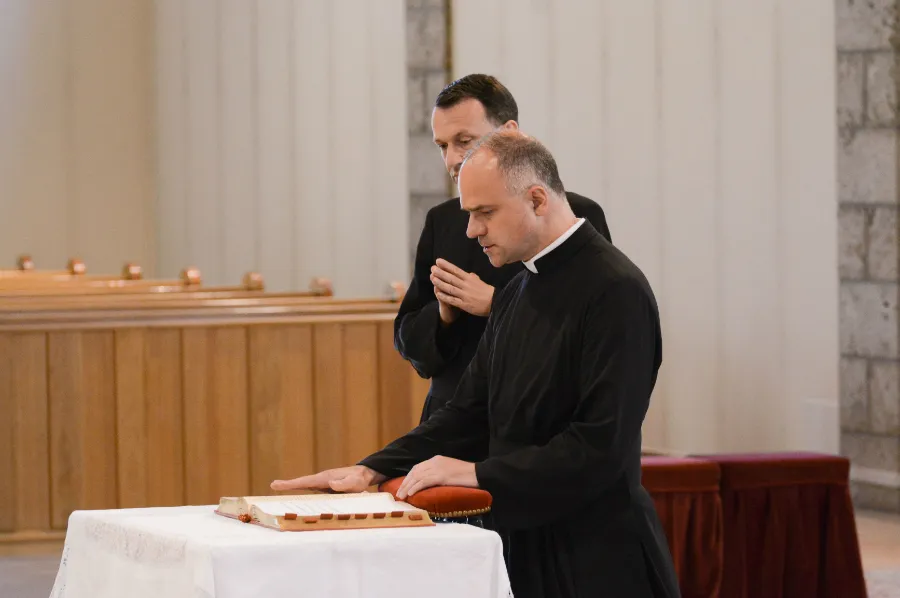
After accepting his office, Fr. Pagliarani made a profession of faith and took the Anti-Modernist Oath.

The illicit episcopal consecrations made in 1988 resulted in the excommunication of the bishops involved. The excommunications of the surviving bishops were lifted in 2009 by Benedict XVI, and since then negotiations “to rediscover full communion with the Church” have continued between the SSPX and the Vatican.

When he remitted the excommunications, Benedict noted that “doctrinal questions obviously remain and until they are clarified the Society has no canonical status in the Church and its ministers cannot legitimately exercise any ministry.”

The biggest obstacles for the SSPX’s reconciliation have been the statements on religious liberty in Vatican II’s declaration Dignitatis humanae as well as the declaration Nostra aetate, which it claims contradict previous Catholic teaching.

There were indications in recent years of movement towards regularization of the priestly society, which has some 590 priest-members.

In March 2017, Pope Francis gave diocesan bishops or other local ordinaries the authorization to grant priests of the SSPX the ability to celebrate licitly and validly the marriages of the faithful who follow the Society’s pastoral activity.

Archbishop Guido Pozzo, secretary for the Pontifical Commission Ecclesia Dei, spoke about interactions with the SSPX in an April 2016 interview with La Croix. The archbishop, whose commission is responsible for discussions with the SSPX, said that discussions over the last few years have led to “an important clarification” that the Second Vatican Council “can be adequately understood only in the context of the full Tradition of the Church and her constant Magisterium.”

And in September 2015, the Pope announced that the faithful would be able to validly and licitly receive absolution from priests of the SSPX during the Jubilee Year of Mercy. This ability was later extended indefinitely by Francis in his apostolic letter Misericordia et misera, published Nov. 20, 2016.

[…]

No Picture
News Briefs

After new appointments, will Pope Francis’ stalled curial reform start moving?

July 11, 2018 CNA Daily News 1

Vatican City, Jul 11, 2018 / 01:15 pm (CNA).- A long-time priority of Pope Francis, curial reform – specifically the overhaul of Vatican finances and communications – has been hanging by a thread for the past few years, and some wonder about the pope’s ability to make any meaningful or lasting changes in the Vatican’s way of doing business.

Observers seem to be underwhelmed at the progress Francis has made on major governance issues, among them financial oversight and sexual abuse policy. Some insiders have noted a palpable sense of confusion about what the pope’s reforms are meant to be, and where exactly they are going.

Since June 2017, the man tasked with leading the Vatican’s financial reform, Australian Cardinal George Pell, has been on leave, and is now preparing to face a historic trial for accusations of sexual abuse in his homeland. Some observers have argued that even when Pell was working at full-strength, the financial oversight structures Francis put into place were so tangled by internal power grabs that pursuing meaningful progress had become a delayed goal.

The pope’s communications overhaul seemed to be in shambles after the man charged with overseeing the process, Msgr. Dario Edoardo Vigano, stepped down amid the fallout of March’s “Lettergate” fiasco.

In recent months Francis has also come under fire for inaction on the topic of clerical sexual abuse, specifically in Chile.

Accused of insulting victims and ignoring their complaints, the pope had a major turnaround on the situation in Chile after receiving fresh evidence against a leading abuser priest in the country and launching an investigation which yielded findings frightening enough to make the pope stop dead in his tracks and speed into reverse.

But one of Pope Francis’ closest aides over the past five years, newly-minted Cardinal Giovanni Angelo Becciu, who is leaving the Secretariat of State for a new position as head of the Vatican’s office for canonizations, said recently that the pope’s reform still lacks an overall vision.

In comments to the press ahead of the June 28 ceremony in which he was given his red biretta, Becciu said that while many steps had been taken, it is still “too early” to give a comprehensive judgment on the Curial reform, since it is not yet finished.

An overall unifying vision is still missing, he said, explaining that “so far we’ve had elements, but not a unified idea.” This vision, he said, will likely be provided in the new apostolic constitution drafted by the pope’s nine cardinal advisors, called “Predicate Evangelium,” or “Preach the Gospel,” which has reportedly been completed and is now awaiting approval from Pope Francis.

A gloomy-seeming outlook for curial reform is often pinned on poor personnel decision-making at the Vatican. But two recent appointments to major posts could mark a turning point for Francis, and provide a much-needed morale boost for Catholics looking for the pope to clean house in Vatican offices.

The first of these is the appointment of a close Francis ally, Archbishop Nunzio Galantino, to take the reigns at the Administration of the Patrimony of the Holy See (APSA), which oversees the Vatican’s real estate holdings and investments.

During pre-conclave meetings in 2013, APSA was a key point in discussions on curial reform, as many cardinals recognized it had been being plagued by corruption and was in serious need of greater oversight.

Until Galantino’s June 26 appointment, APSA was led by Cardinal Domenico Calcagno, who has been accused of corruption and was, at one point, under investigation for charges of embezzlement in a previous diocese.

It took Francis more than five years to take action on APSA, which has been a sore spot for many who were hoping to see the pope crack down on financial issues. In a recent interview with Reuters the pope admitted that “there is no transparency” at APSA.

“We have to move ahead on transparency, and that depends on APSA,” he said in the interview. Many Vatican watchers are hopeful that Galantino will be able to bring in the accountability and oversight the office has typically resisted.

The second important personnel change is the appointment of Italian layman Paolo Ruffini as head of the Vatican’s communications office, making him the first layperson to lead a Vatican department, also called a dicastery.

Though Ruffini’s nomination was highly celebrated among Italians, who are pleased to have one of their own moving to such an important post, the new prefect is also seen as highly competent, bringing with him professional experience in journalism dating back to 1979.

Until his appointment Ruffini worked as the director of TV2000, the network of the Italian Bishops’ Conference, and he brings with him extensive experience in television, radio, and print, making him a choice perceived as a competent, well-rounded pick for the job.

Ruffini is considered to be in line with key priorities of the current pontificate, and his appointment can be read as follow-through on Pope Francis’ commitment to eradicate a clericalist mentality in the curia and to add more laypeople to the mix.

Despite the fact that Msgr. Dario Vigano, who headed the office until the “Lettergate” scandal, is expected to stay in the dicastery in the advisory role the pope gave him, observers are hopeful that at least some of the pope’s stubbornness in decision-making is gone, and that the days of poor personnel choices will be a thing of the past.

And with several decisions made that seem to indicate reform is moving in the right – or at least a better – direction when it seemed to be on the brink of failure, a natural question comes to mind: what changed?

Some believe the turning point was the pope’s reaction to the Chilean abuse crisis. After initially defending the bishop at the center of the debate, calling accusations of cover-up on the part of the bishop “calumny” and claiming that no evidence of the prelate’s guilt had been brought forward, Francis had a major turnaround when news came out that evidence had been presented years prior which he either never got, or potentially ignored.

It was a serious blow to Francis’ credibility in the fight against sex-abuse in the Church, and to his public image. Soon after he sent his top investigator on abuse to Chile to look into the situation, and after receiving a 2,300 page report, the pope issued a letter to Chilean bishops saying he had made “serious errors” in judging the situation due to a lack of “truthful and balanced information.”

Many observers pinned the blame on 84-year-old Chilean Cardinal Javier Francisco Errazuriz, who is a member of the pope’s nine-member Council of Cardinals and who has come under heavy fire from victims for covering up abuse while archbishop of Santiago, and for trying to discredit victims’ testimonies.

In his recent interview with Reuters, Pope Francis said his council of cardinal advisors, called the “C9” and whose mandate will be up in October, would be refreshed with new members.

Though such a decision is natural after term limits end, some observers have pondered whether the Chilean crisis and the accusations against Errazuriz, the absence of Cardinal Pell and separate accusations of financial misdealing on the part of Honduran Cardinal Oscar Maradiaga, also a member of the advisory team, have, to a certain degree, awakened Francis to the need to be more selective with his inner circle.

The answers to these questions, of course, are pure speculation, but if one thing can be said about the pope’s latest round of appointments, it’s that while his track record on reform efforts has not been the best, and while there are still loose ends to tie up, he is at least aware of the problems and he seems intent on making good on his promises, even if that does not happen immediately.

And if the first five years of Pope Francis’ curial reform have largely been seen as ineffective, the appointment of Ruffini and Galantino just might give the flicker of hope needed for Catholics to decide that the jury is still out on the long-term process. However, as with any reform, really only time will tell.


[…]

The Dispatch

A pastor in full

July 11, 2018 George Weigel 1

It’s Father Newman I’ve called on hundreds of occasions to share a joke, commiserate over some ecclesiastical folly or another, or just blow off steam; […]

No Picture
News Briefs

Calls to ban or regulate ‘Orange walks’ after priest spat on in Scotland

July 11, 2018 CNA Daily News 1

Glasgow, Scotland, Jul 11, 2018 / 12:18 pm (CNA/EWTN News).- After a priest was spat at, verbally abused, and lunged at with a pole while an “Orange walk” passed by his parish in Glasgow Saturday, there have been widespread calls to regulate further or to ban outright the Protestant processions.

“Canon Tom White was meeting and greeting parishioners” following the anticipated Mass at St. Alphonsus parish in Glasgow July 7, according to a Facebook post by the Archdiocese of Glasgow.

“An Orange march approached. Police – who had been guarding the church – were called away to deal with another nearby incident … Canon White and parishioners were subjected to vile abuse … ‘Fenian bastard’ being the most typical.”

The archdiocese reported that “Spittle landed on the back of [Canon White’s] head. He wiped it away. Another mouthful of thick spittle was spat into his eye socket. Again he wiped it away leaving his hand full of the vile liquid. He was then further insulted and lunged at by a man carrying a pole before police arrived to restore some kind of order.”

The Glasgow archdiocese asked Police Scotland and Glasgow City Council “What kind of society is it that allows ministers of religion and church goers to be intimidated and attacked by a group which has a long history of fomenting fear and anxiety on city streets?”, and “Why is the Orange Order still allowed to schedule its intimidating parades on streets containing Catholic Churches at times when people are trying to get in and out for Mass?”

Orange walks are organized by the Protestant fraternal group the Orange Order, largely in Northern Ireland and Scotland, to commemorate the defeat of James II by William of Orange at the Battle of the Boyne in 1690.

James had been deposed as king of England, Ireland, and Scotland in a 1688 revolution by the Parliament of England after he had expanded toleration of Catholics and Protestant nonconformists in the officially Protestant kingdoms.

According to the Scottish Sun, Glasgow’s Orange walk included thousands of marchers, and four arrests were made in connection with the demonstration, though none were related to the attack on Canon White.

Scotland has experienced significant sectarian division since the Scottish Reformation of the 16th century, which led to the formation of the Church of Scotland, an ecclesial community in the Calvinist and Presbyterian tradition which is the country’s largest religious community.

Sectarianism and and crimes motivated by anti-Catholicism have been on the rise in Scotland in recent years.

Police Scotland are investigating the assault on Canon White as a hate crime. A spokeswoman said that “Whilst the parade was passing the church at the time, any involvement, if at all, by someone from the Orange Walk, is still to be established.”

The Grand Orange Lodge of Scotland has denied any involvement in the assault.

“We understand that abusive comments were directed at a local Priest from a group of young men who were not part of the parade,” read a statement from the fraternal order. “We can confirm that no members of the parade were involved in this or any of the reported incidents. The Orange Order is founded on the principle of religious liberty and respect for people of all faiths. We totally condemn the bigoted actions of those involved and hope that they are dealt with to the full extent of the law.”

St. Alphonsus parish, along with nearby St. Mary’s parish, have issued a statement which welcomed the Orange Order’s condemnation of the assault, while adding that “we are distressed and deeply saddened that, in the 21st century, we are unable to exercise our human rights of freedom of association, freedom of assembly and the right to celebrate our faith free from intimidation and violence.”

They asked the Scottish Parliament “to ensure all those exercising their right to religious freedom will be protected by the appropriate statutory authorities.”

A petition calling on the Glasgow City Council to end the Orange walks has garnered more than 70,000 signatures.

The petition at change.org said that now “is the time to have a real debate on how we can stop this outdated and repressive display …  They have a long history of spreading anxiety and fear amongst everyday Glaswegians.”

“There is no room in our society for this type of bigotry and division. Sign the petition and call time on the Orange Order marching on our streets!”

A variety of Scottish politicians have condemned the assault on Canon White.

Nicola Sturgeon, First Minister of Scotland and leader of the Scottish National Party, tweeted that “behaviour like this – hate crime of and kind – is simply unacceptable, and we will always sonider what more we must do to eradicate it.”

Annie Wells, Member of Scottish Parliament for Glasgow and a member of the Scottish Conservative Party, said that “This was a shocking attack against a respected member of the local community. Police Scotland must move quickly to identify those involved and bring charges.”

Monica Lennon, an MSP of the Scottish Labour Party, lamented that “Anti-Catholic hate crime remains prevalent in Scotland, accounting for 57% of religiously aggravated charges in 2016-17 … Scotland must do better.”

And Caron Lindsay, equalities spokeswoman for the Scottish Liberal Democrats, said, “No-one in Scotland should feel threatened or intimidated as they go about their daily business.”

An April poll of Catholics in Scotland found that 20 percent reported personally experiencing abuse of prejudice toward their faith; and a government report on religiously-motivated crime in 2016 and 2017 found a concentration of incidents in Glasgow.

[…]