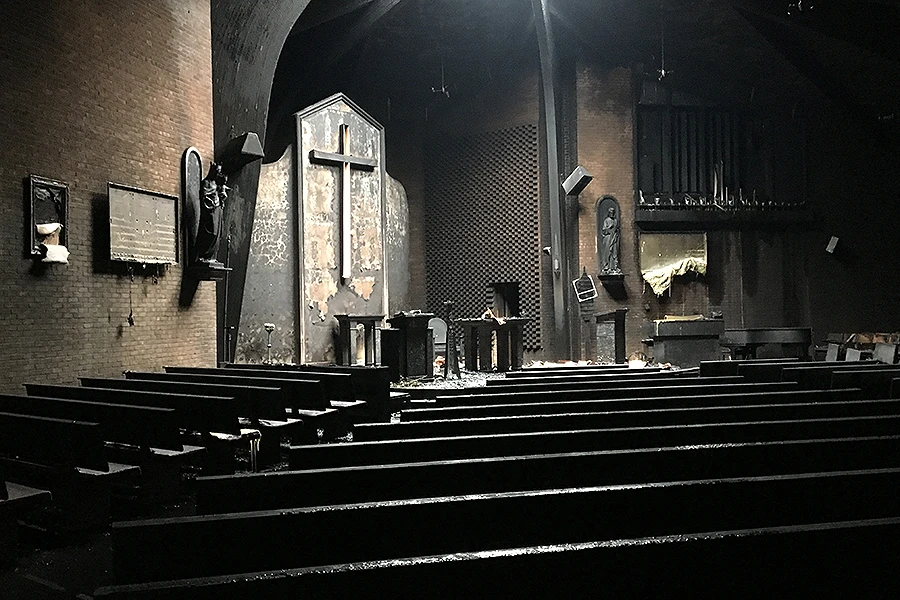
Newark, N.J., May 18, 2018 / 03:30 pm (CNA/EWTN News).- After a fire destroyed their chapel just days before Pentecost, a community of Salesian sisters expressed gratitude for the first responders who extinguished the flames and saved the church’s tabernacle.
“Though our hearts are heavy, we are fortunate to be able to report that no one was harmed and that firemen were able to rescue the most precious item in the chapel: the tabernacle,” the Salesian Sisters of Saint John Bosco reported in a statement on Friday.
At 1:39am on May 18, a fire broke out at the sisters’ school, Mary Help of Christians Academy in North Haledon, New Jersey.
The blaze was a four-alarm fire, meaning at least 168 firefighters were on the scene. Fire departments from four municipalities provided support. The fire was finally snuffed out at 4am. The cause of the fire has not been released.
The chapel is regularly used by the school, and by the sisters residing nearby. The church was expected to be used for the school’s baccalaureate Mass on June 1 and commencement on June 2. The chapel was built in 1976 and renovated in 2016.
“During a morning assembly led by Principal Sr. Marisa DeRose, FMA, our community wept as photos of the charred altar, pews, and melted Peragallo pipe organ were shared, along with a warning to students to keep far from the building,” the statement said.
Despite their sorrow, the community expressed gratitude that the fire did not spread to other areas of the campus, and a donation to rebuild the chapel was received before the school day began.
“The Sisters, students,faculty, and staff of the Academy are devastated by this loss, but remain thankful to the dedicated firemen who contained the fire before it could cause additional damage to our facilities,” the sisters said.
“A testament to the strength of our community, the first donation to help rebuild the chapel was received from a faculty member before the school day had even begun; upon hearing about the blaze on the fire scanner radio, she was immediately moved to help.”
Mary Help of Christians Academy opened its doors in 1924. According to the academy’s website, the school teaches young women in the “charism of reason, religion and loving kindness as inspired by Saint John Bosco and Saint Mary Mazzarello.”
If you value the news and views Catholic World Report provides, please consider donating to support our efforts. Your contribution will help us continue to make CWR available to all readers worldwide for free, without a subscription. Thank you for your generosity!
Click here for more information on donating to CWR. Click here to sign up for our newsletter.

Michael Stucchi poses in front of the restored statue of Jesus with children at St. Mel’s Church in Woodland Hills, California. / Photo credit: Tom Hoffarth
Woodland Hills, California, Nov 5, 2022 / 08:00 am (CNA).
In the darkness of an early Saturday morning last March 19, Father Steve Davoren and his golden lab, Blue, came out the back exit of the rectory at St. Mel’s Church in Woodland Hills, California, for a pre-dawn run.
But before he could start, the priest’s heart sank when he saw what the floodlights pointing at the church’s iconic statue cluster of Jesus and three children revealed.
Grainy security footage only captured the arm of a person repeatedly swinging an unidentified weapon at the statues. Pieces fell from what has been a longtime centerpiece of the parish, in a highly visible spot off of busy Ventura Boulevard.
Chunks of the marbled concrete that came off the twisted, exposed rebar were everywhere: in the raised flower bed flanked by white rose bushes, in the parking lot, on the sidewalk next to the parish office.
Davoren immediately called the church’s business manager, Lisa Feliciano, who threw on a hoodie and came right over.
“It was horrific,” Feliciano said. “But now we were putting pieces in a box, crying. I couldn’t believe anyone could have this much hate to do this.”
Feliciano filed a police report along with the surveillance video, which she described as “two minutes of torture.”
“I see it and it still makes me cry,” she said.
Details of the damaged statues of Jesus at St. Mel’s Church in Woodland Hills, California. Photo credit: Michael Stucchi
It fell to Davoren to explain the attack to parishioners the next day at Sunday Masses, preaching understanding and forgiveness in the place of anger and frustration.
“To me, the irony of this was the person who did this had to be a broken person himself,” said Davoren, pastor at St. Mel’s since 2018. “Through Scripture we know we need to pray for people who feel they have to destroy.”
Michael Stucchi heard Davoren’s message loud and clear that weekend. A systems software engineer by trade, Stucchi has found satisfaction working for the parish to restore four in-church statues in the past as well as Nativity scene statues.
He has been their humble go-to, fix-it man. But this was something bigger.
“When I spoke to Father Steve about it a few days after it happened, I admit, I was angry, mad, indignant because the statues were special to me and my family,” said Stucchi, whose son works in the parish office. “But then I heard his sadness and concern for the mental state of the person who damaged the statues. That’s so much like him. This really altered my paradigm from reactive to proactive — to ask if I could look into ways of repairing them.
“Father Steve’s compassion is what Jesus would want us to have. All the people who work here are in the same mindset of love and forgiveness. We have no idea what terrible things are in that person’s life.”
Stucchi and Feliciano started the reconstruction by collecting and studying photographs of the statues to examine all their features. The depiction of Jesus is about 6 feet tall and weighs about 1,000 pounds; each child on its own concrete base weighs about 300 pounds.
The collection dates to the 1950s, when the parish was first built. It had once been part of a fountain display in front of the school office and later relocated near the church’s west doors in the 1990s when the new parish center was built.
Feliciano had contacted the Los Angeles Archdiocese about filing an insurance claim and was told it might cost as much as $30,000 to repair.
Stucchi said he could take care of it, with no charge to the parish.
That didn’t surprise Feliciano, who calls Stucchi “a true angel.”
“Look at the difference between someone filled with hate and destruction … and then someone like Michael who spends his time showing pure love and joy putting it back together,” Feliciano said. “Both are our neighbors, they live among us. How can there be such a vast difference in someone’s heart and soul?”
Michael Stucchi has pieced together the statues at St. Mel’s Church in Woodland Hills, California, to where they may even be in better condition when finished. Photo credit: Michael Stucchi
Stucchi experimented with different combinations of compounds — crushed marble, white Portland cement, and waterproof exterior grout. Most of the work had to be done on site, with some pieces taken to his home garage.
“I was super cautious about not making anything worse,” said Stucchi, noting the materials often dried too quickly in the summer heat, causing more delays. “The saddest part to me was the damage to Jesus. We know enough about the pain and suffering Jesus went through in his life, but to see an image of him obliterated, that’s too much.”
Slowly and meticulously, Stucchi has pieced together the statues to where they may even be in better condition now because of the ways weather and age already caused cracks and decay before the vandalism.
Seven months later, Stucchi has a few finishing touches — and plenty of gratitude — still left.
“As a priest’s sacrifice and commitment are beyond my comprehension or capabilities, having seen their dedication and that of the other volunteers and staff, I felt it’s the least I can do,” Stucchi said. “Notwithstanding, the Catholic Church was always there for me when I was a child and young adult.”
From a business perspective, Feliciano said the experience has taught her about the need for better security. The statues also were previously vandalized in 2021 when someone painted the faces a green color, but they were easy enough to repaint white.
“As a parishioner, the kindness of Michael reminds me that there is goodness in the world,” said Feliciano, who noted the 100-degree days Stucchi spent with the statue last summer. “I am reminded to pray for the person who was filled with enough hate to do the damage and thank God for blessing us with Michael.”
Father Davoren believes that “to some degree, we’re all broken and damaged, but our faith in the love of God allows people like Michael the tenderness to painstakingly put those pieces of the statue back together.
“It’s about giving people the right amount of grace to rebound in their lives.”
Washington, D.C. Newsroom, Nov 17, 2020 / 08:00 pm (CNA).- Bishops on Tuesday discussed pastoral strategies and the movement of the Holy Spirit during the coronavirus pandemic, noting the great desire for the sacraments on the part of many Catholics. B… […]
CNA Staff, Aug 12, 2020 / 03:26 am (CNA).- Efforts to protect people from harm and error now marginalize and even demonize others for unpopular opinions, warns a new statement urging a revival of civil engagement and conscientious respect for the convictions of others.
“We want—and to be true to ourselves we need—to be a nation in which we and our fellow citizens of many different faiths, philosophies, and persuasions can speak their minds and honor their deepest convictions without fear of punishment and retaliation,” said the newly released Philadelphia Statement.
The statement was released Aug. 11. Its signers include academics, religious leaders and other commentators, including Archbishop emeritus of Philadelphia Charles Chaput and Princeton Law School professor Robert George.
“Our liberty and our happiness depend upon the maintenance of a public culture in which freedom and civility coexist—where people can disagree robustly, even fiercely, yet treat each other as human beings—and, indeed, as fellow citizens—not mortal enemies,” the statement continued.
It cited former slave and abolitionist Frederick Douglass, who said “Liberty is meaningless where the right to utter one’s thoughts and opinions has ceased to exist.”
“Truly open discourse—the debates, exchange of ideas, and arguments on which the health and flourishing of a democratic republic crucially depend—is increasingly rare,” the statement continued. “Ideologues demonize opponents to block debates on important issues and to silence people with whom they disagree.”
The Philadelphia Statement takes inspiration from Philadelphia’s pivotal role in American independence and the drafting of the U.S. Constitution.
It was drafted after meetings with “a diverse working group of prominent thinkers, scholars, and practitioners,” the statement’s website says. It says it is the start of “an ongoing movement to restore free speech and civil discourse in American law and culture.”
The statement criticized the spread of “blacklisting;” corporations’ use of “hate-speech” policies that block content deemed “wrong” or “harmful;” and speech regulations that protect students from “challenges to campus orthodoxy.”
“Common decency and free speech are being dismantled through the stigmatizing practice of blacklisting ideological opponents, which has taken on the conspicuous form of ‘hate’ labeling,” the statement continued. “Responsible organizations are castigated as ‘hate groups.’ Honest people of good faith are branded ‘hate agents.’ Even mainstream ideas are marginalized as ‘hate speech.’ This threatens our ability to listen, discuss, debate, and grow.”
The statement lamented phenomena like “social media mobs,” “cancel culture” and “campus speech policing,” all of which have drawn increasing concern from free speech advocates in recent years.
In June 2020, the Catholic former president of Florida State University’s student senate said he was removed from office for questioning controversial policy positions of the Black Lives Matter Global Network Foundation on abortion and sexuality in a private text message thread with fellow Catholic students that was later sent to student leadership.
In 2017, the payment processor Vanco dropped service for the Ruth Institute, claiming it promoted “hate, violence, harassment and/or abuse.” The institute, which rejected the charge, said it aims to combat family breakdown. The institute supports Christian teaching about marriage, family and human sexuality.
In 2012, a Catholic student group left the Vanderbilt University campus over a controversial school non-discrimination policy which barred the group from requiring its leaders to be Catholic.
At the same time, the Philadelphia Statement comes after years of debate about how to respond to political misinformation, false or misleading medical information, alleged foreign interference in elections, online harassment, political extremism, and pornography.
Free speech, in the view of the Philadelphia Statement, does not include “defamation, obscenity, intimidation and threats, and incitement to violence.”
However, it stressed, making “hate speech” an exception to free speech is “foreign to our free speech ideals.” The concept is “impossible to define” and is “often used by those wielding political, economic, or cultural power to silence dissenting voices.”
“That is why we must favor openness, to allow ideas and beliefs the chance to be assessed on their own merits; and we must be willing to trust that bad ideas will be corrected not through censorship but through better arguments,” the statement said.
To seek unity instead of division and to secure a free, pluralistic society where people may live according to their consciences, the statement said, “we must renounce ideological blacklisting and recommit ourselves to steadfastly defending freedom of speech and passionately promoting robust civil discourse.”
The statement’s signers include Alan Sears, former president of Alliance Defending Freedom; Dr. Daniel Mark, past chairman of the U.S. Commission on International Religious Freedom; Dr. Mary Eberstadt of the Faith and Reason Institute; Nina Shea, director of the Hudson Institute’s Center for Religious Freedom; Howard Slugh, founder and general counsel of the Jewish Coalition for Religious Liberty; Dr. Russell Moore, president of the Ethics and Religious Liberty Commission of the Southern Baptist Convention; and Dr. Thomas Farr, president of the Religious Freedom Institute.
One signer is Ayaan Hirsi Ali, a Somali-born former Muslim who is now an atheist, a staunch critic of Islam, and a research fellow at the Hudson Institution. Another signer is Dr. Charles Murray, whose controversial 1994 book “The Bell Curve” discussed social stratification and apparent racial differences in intelligence. Kevin D. Williamson, a writer for the conservative National Review, also signed. In 2018 Williamson was briefly hired by the prestigious cultural commentary journal The Atlantic, then fired for polemical comments he made in 2014 that appeared to suggest hanging as a criminal punishment for abortion.
Leave a Reply