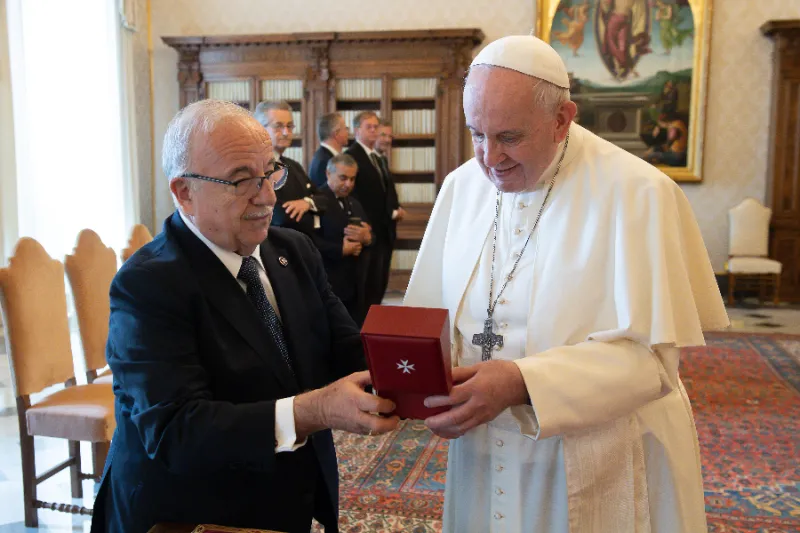
 Pope Francis meets with the Order of Malta’s Fra’ Marco Luzzago on June 25, 2021. / Vatican Media
Rome Newsroom, Mar 31, 2022 / 04:42 am (CNA).
Pope Francis received two drafts of a new constitution for the Order of Malta at an audience with members of the 1,000-year-old institution on March 19. He reserved the right to read them calmly and then make his final decisions.
To understand what’s at stake, it’s essential to know how the order is structured. The organization’s members belong to three classes.
The First Class consists of the Knights of Justice, or professed knights, and Professed Conventual Chaplains, who take the religious vows of poverty, chastity, and obedience. They are defined as religious but not required to live in a community.
The Second Class is composed of Knights and Dames in Obedience, who promise to strive for Christian perfection in the spirit of the order.
The Third Class comprises lay members who neither take vows nor make promises but are committed to living a fully Catholic life according to the order’s principles.
Only First Class knights who descend from a family of four quarters of nobility are eligible to be elected as the Grand Master, the order’s religious superior and sovereign. This provision means that fewer than 40 people in the order can be considered for the position.
The Grand Master oversees the order with the help of a body called the Sovereign Council, whose members are elected for five-year terms by the order’s General Chapter.
Members of the Sovereign Council include the influential figure of the Grand Chancellor, who oversees the order’s 133 diplomatic missions, and the Grand Hospitaller, responsible for the order’s extensive humanitarian initiatives.
The order has three different types of national institutions spread around the world: six grand priories, six sub-priories, and 48 local associations.
The participants in the meeting with the pope on March 19 represented two sides in a years-long debate over reforms to the order’s constitution.
Some of those present were members of the group entrusted with drafting the new constitution, led by the papal delegate Cardinal Silvano Maria Tomasi. Also attending were representatives of the professed knights, the government of the order, the procurators of the priories, and the presidents of the associations, as well as the order’s current leader, Fra’ Marco Luzzago, who is known as the Lieutenant of the Grand Master.
The gathering enabled Pope Francis to hear the advocates of two contrasting visions for the order. First, that of the working group led by Tomasi, which stressed the need for the Order of Malta to be led above all by the professed. And second, that of the group set up by the Grand Chancellor Albrecht von Boeslager and entrusted to the leadership of Marwan Sehanaoui, president of the order’s Lebanese association, which called for a more collegial style of government.
The private papal audience lasted for two and a half hours instead of the expected hour and a half. According to participants who spoke with CNA, the pope said that he wanted to retain everything that makes the Order of Malta such an effective provider of humanitarian aid and he would review material provided by both sides before making a decision.
The two colliding visions have shaped the debate ever since Pope Francis launched the reform process in 2017 after he accepted the resignation of Grand Master Fra’ Matthew Festing in the middle of an internal governance crisis.
The debate over the new constitution became even more problematic following the death of Festing’s successor, Giacomo dalla Torre del Tempio di Sanguineto, in 2020.
Luzzago was then chosen to lead the order, not as Grand Master but as Lieutenant of the Grand Master, who typically serves a one-year term. But this term was extended by the pope himself, to an unlimited extent, amid the push to conclude the constitutional reform.
Pope Francis believes that the reform must, first of all, strengthen the Order of Malta as a religious institution and, secondly, reinforce its service to the poor. The draft presented by Tomasi’s working group should be read in this light.
The Tomasi-led group is composed of the canon law expert Father Gianfranco Ghirlanda, S.J., Msgr. Brian Ferme, the secretary of the Vatican’s Council for the Economy, and Maurizio Tagliaferri, Federico Marti, and Gualtiero Ventura.
Ghirlanda is understood to have spent about an hour explaining his position that the professed should lead the organization because it is at heart a lay religious order.
In practice, Ghirlanda derives authority from religious consecration. This, however, is only valid if the Order of Malta is considered primarily as a spiritual body. The situation is different if its governing bodies are considered “governing bodies” in the strict sense.
Ghirlanda was among the speakers at a recent press conference after the launch of Praedicate evangelium, the new Vatican constitution reforming the Roman Curia. At the press conference, he commented on the change allowing any baptized person, not only a bishop, to lead certain Vatican dicasteries. He said that this was possible because it was not ordination but receiving a canonical mission that gave dicastery heads their authority.
Ghirlanda said that this decision resolved the question posed by Canon 129 of the Code of Canon Law, according to which authority derives from priestly ordination. Ghirlanda noted that the decision had resulted from extensive debate.
But if the possibility for the laity to participate in government applies to the Roman Curia, why doesn’t it apply to the government of a body such as the Sovereign Order of Malta?
This is a much-debated topic that is at the heart of the reform proposals. Although the order’s sovereignty derives from a concession from the Holy See, it is constituted as a state without territory. With this international personality, it maintains diplomatic relations with other states and it is its sovereignty that allows it to continue working with the poor.
Many in the Order of Malta have stressed that a reform highlighting only the religious character, mainly submission to the Holy See, would dilute its sovereignty forever.
The importance of the order’s sovereignty was also raised by Luzzago in a speech to the diplomatic corps accredited to the order on Jan. 11 (although the text of the address can no longer be found on the order’s website.)
The pope’s affirmation that he wants to keep everything that allows the order to continue its work for the poor stems from this debate.
The vision of the group led by Sehnaoui, according to a source inside the order, is markedly different. It proposes that the General Chapter, the body bringing together representatives of all classes, would have 15 representatives of the professed knights. The associations would be represented not by assessing the number of works carried out but rather based on the budget allocated to these works. If the budget was less than $20 million, an association would be entitled to one delegate. If it exceeded $20 million, there would be a right to another representative, up to a total of four.
In this way, associations would see some of their concerns represented. Marc Odendall, a member of the first commission established by the pope to clarify the order’s internal problems in 2016, summed up this reasoning when he told CNA that “$2 billion turnovers, 45,000 employees, 100,000 volunteers in the world cannot be managed by 19 professed who are under 70 and have no professional qualifications.”
Sehnaoui’s draft reflects this concern, trying to find a balance between the need to maintain the order’s religious character and having a government more independent from the Holy See that also considers the professional work of many associations.
It remains to be seen which of the two world views will prevail. Now, everything is firmly in the pope’s hands. At the same time, the role of the papal delegate, Cardinal Tomasi, seems to be increasingly marginal.
[…]






I happen to be a national publisher, and even I could not understand what you were trying to say in your article. When was it that journalism morphed into more of an effort to confuse readers, rather than inform them? One would literally have to be a mind-reader to understand many of your points here. Honestly, you might as well have been writing to yourself, because I can assure you that the majority of readers would not understand what you were trying to convey. The clearest language you used was in your title. Thereafter, I felt like I was trying to solve a crossword puzzle. This is an indictment of the colleges and universities that teach journalism today. It is unfortunate that by the late 80’s journalism transitioned to more of a “creative writing” practice than an effort to effectively communicate to the masses… very sad.
Ironically enough, the article is classic example, both in its intent and its practice, of exactly what the Pope is talking about. It might have been better if both writer and editor spent more time on what the Pope actually said in his homily and less time dissecting recent papal pronouncements so as to extract any kind of ‘ammo’ that will fit, in the fruitless pasttime of criticizing the current Pope irrespective of what he does or does not say. Just a tad Sanhedrin!
Well put, Peter. I too have found Mr. Altieri’s frequent articles on this site a source of perplexity and confusion since the hard and often bitter facts of this papacy about which he writes become dissolved in a mist of ambiguity and uncertainty. What needs to be said and often repeated and emphasized is that one must look to Pope Bergoglio’s actions in order to understand his words. In the infallible judgment of Our Lord Jesus Christ, it is by their fruits and actions that a man is known. By that standard, the Vigano scandal is an exercise in dishonesty, duplicity, hypocrisy, and cynicism by all parties involved.
I don’t understand the basis of your criticism. The opinion piece seemed clear enough to me. What was ambiguous?
I agree – I had to read half way through the article to figure out what was trying to be said. That is why I prefer some Catholic sites over others – clear reporting without ambiguity, that’s my cuppa tea.
I agree, the article is a “nothingburger.”
I think I understand what he is saying. I think we all need to work on assuming the best of others and stop crucifying each other with our tongues.
Pope Francis, in that homily, proved that he is either totally detached from the reality of his own trespasses, or worse, projects his own trespasses onto others, in a double-minded play at wrongly accusing others and wrongly exonerating himself.
He stirs up trouble every day, and then pretends he is above the fray.
Is there any utterance emerging from this pontificate which does not ring hollow? Five years of deafening vacuousness on good days, pandering, mendacity and vindictiveness more commonly. A culture of third world corruption reigns upon the Chair which should be above culture. We have sunk to the depths. Pope Captain Kangaroo with Cardinal Mr. Greenjeans Maradiaga. We live in the saddest of days.
As with K. Aldrich, I don’t see where publisher Rick finds the confusion here.
If Rick really is a publisher, then he might want to look into some reading comprehension courses.
I thought the author did a nice job in framing the words of the Holy Father and the problems occurring around him. Pope Francis called this, “[T]he voice of those who twist reality and invent stories for their own benefit, without concern for the good name of others,” Yes, the good name of others. Words have meaning as the Holy Father has used so eloquently. Like when he said that those women who have many children “dont have to be like rabbits” (Oh how my protestants friends howled with laughter, my sister wept). Or when the Holy Father pointed to the former mayor of Roma and said, “that man, he is a pretend catholic”. that one had me rolling..
This is an excellent article. Altieri, as usual a loyal son of the Church, tries to leave Francis and his gang of thugs a “way out”. And so, I guess we all should, except that I find it increasingly hard to do.
Sin and heresy should be called by its name. Christ was very clear on hypocrites and the like. The “Francis effect” has been devastating for the Catholic Church – Our Lady’s prophecy is clear – the final battle will be against marriage and family, bishop against bishop, cardinal against cardinal . Who has orchestrated all of this – POPE FRANCIS – aka Jorge Bergoglio. The smoke of Satan has flooded the church.
Now he is trying to mitigate his actions by means of messages and a film – the truth is now well known in the Catholic blogosphere. The Political Pope cannot pull the wool over our eyes any more.
Well, this is really a commentary, but I think the point is actually very clear…
“That eloquent denunciation [of fake news] hit very close to home after a week in which the Holy Father accepted the resignation of his hand-picked media czar, Msgr. Dario Viganò, precisely for making partial use of the truth …
One would like to think that this was an instance of the Holy Father’s famed capacity for reproof… or he was preaching to himself. The Pope, however, asked Viganò to stay on.”
So, the Pope preaches about fake news, lets fake news be broadcast from under his own roof, and essential confirms the faker. For me that’s not hard to get. What is hard to get, or take, is a pope using the Crucifixion to makes points about sociopolitical stuff.
Well, this is really a commentary, but I think the point is actually very clear…
“That eloquent denunciation [of fake news] hit very close to home after a week in which the Holy Father accepted the resignation of his hand-picked media czar, Msgr. Dario Viganò, precisely for making partial use of the truth …
One would like to think that this was an instance of the Holy Father’s famed capacity for reproof… or he was preaching to himself. The Pope, however, asked Viganò to stay on.”
So, the Pope preaches about fake news, lets fake news be broadcast from under his own roof, and essential confirms the faker. For me that’s not hard to get. What is hard to get, or take, is a pope using the Crucifixion to make points about sociopolitical stuff.
Blaming the messenger on this matter gets us nowhere. The clumsy attempt to get Benedict’s endorsement of items Benedict wouldn’t endorse was painful. And it doesn’t seem to matter what happens – Francis has a tin ear for any kind of criticism. His supporters never do wrong – he never does wrong – so if there is criticism it must be vindictive and self-evidently dishonest. Personally I think Mr. Altieri like most writers trying to make sense of the Francis papacy bends over backward to be fair. After all, if the author speaks ill of the Pope, he must be vindictive and dishonest – the Pope tells us so.