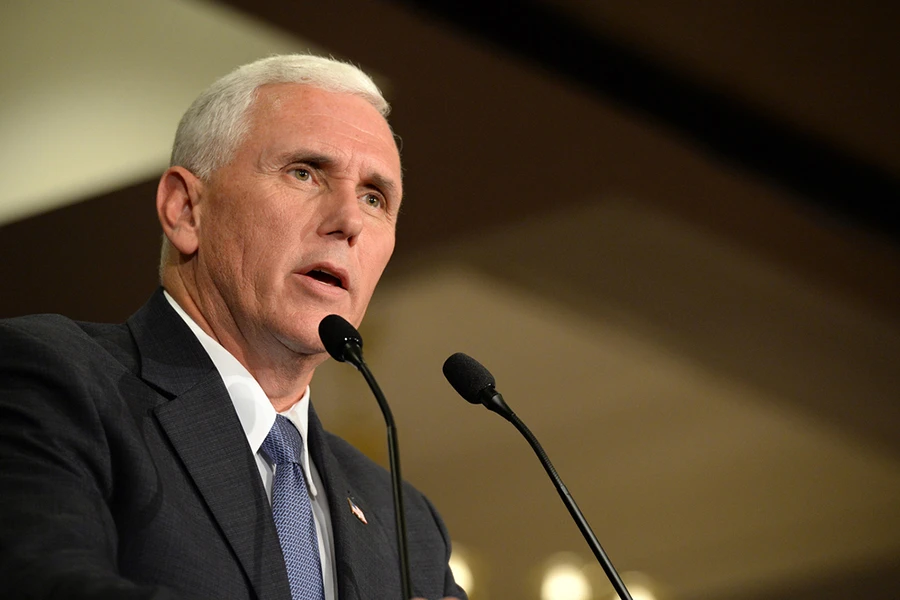
Jerusalem, Jan 23, 2018 / 04:02 pm (CNA/EWTN News).- U.S. Vice President Mike Pence reaffirmed America’s commitment to both peace and persecuted Christians during his four-day trip to Israel and the Middle East, which concluded on Tuesday.
In a Jan. 22 speech to the Knesset, Israel’s national legislature, Pence confirmed that the U.S. government intends to relocate its embassy from Tel Aviv to Jerusalem by the end of 2019.
“Our President made his decision…we believe that his decision is in the best interests of peace. By finally recognizing Jerusalem as Israel’s capital, the United States has chosen fact over fiction. And fact is the only true foundation for a just and lasting peace,” said Pence, who added that America will support a two-state solution if both Israel and Palestine are in agreement.
On Dec. 6, U.S. President Donald Trump announced that the United States was recognizing Jerusalem as Israel’s capital. Israel has traditionally always recognized Jerusalem as its capital. However, Palestinians claim that the eastern portion of the city is the capital of the future Palestinian state. In recognizing Jerusalem as Israel’s capital, the U.S. is the first country to do so since the state was established in 1948.
As a result of the announcement, Pence’s trip to the Middle East was postponed, taking on a new tone and focus.
Pence had posted on Twitter on Dec. 4, “Important dialogue with Bashar Warda, the Archbishop of Erbil, about @POTUS’ commitment to directly assist persecuted Christians & religious minorities in Iraq. I’m heading to the Middle East this month to discuss U.S. plans to accelerate funding those impacted in the region.”
However, following Trump’s Dec. 6 announcement, the Egyptian Coptic patriarch Tawadros II and other religious leaders stated that they would not meet with Pence.
Thirteen religious leaders in the region signed an open letter warning that the move would only lead to “increased hatred, conflict, violence and suffering in Jerusalem and the Holy Land, moving us father from the goal of unity and deeper toward destructive division.”
The announcement was also met with opposition from the Vatican, which has long called for a two-state solution to the Israeli-Palestinian conflict.
With stops in both Jordan and Egypt in additional to Israel, Pence cut his formerly planned visits to Bethlehem and the West Bank during his rescheduled four-day January trip this week.
Pence did have a chance to speak about U.S. plans to aid persecuted Christians towards the end of his speech to the Israeli parliament. He told Israeli lawmakers that the U.S. is dedicated to its assistance of Christians and other religious minorities in the region.
“We will also support faith leaders in this region and across the world, as they teach their disciples to practice love, not hate. And we will help persecuted peoples, who have suffered so much at the hands of ISIS and other terrorist groups,” he said.
“To this end, the United States has redirected funding from ineffective relief efforts. And, for the first time, we are providing direct support to Christian and other religious minorities as they rebuild their communities after years of repression and war.
“The United States has already committed more than $110 million to assist Christian and other religious minorities across the wider Middle East.”
The vice president rounded out his trip with a personal visit to the Western Wall and the Yad Vashem Holocaust memorial in Jerusalem. Reflecting on his trip, Pence wrote of Israel on Twitter, “I never fail to leave without a sense our faith has been renewed – our faith in God, but also our faith in the people of Israel & their commitment to freedom, security & peace.”
If you value the news and views Catholic World Report provides, please consider donating to support our efforts. Your contribution will help us continue to make CWR available to all readers worldwide for free, without a subscription. Thank you for your generosity!
Click here for more information on donating to CWR. Click here to sign up for our newsletter.

Jos, Nigeria, Apr 26, 2018 / 03:16 am (CNA/EWTN News).- At least 19 people, including two priests, were killed on Tuesday when nomadic cattle farmers in central Nigeria opened fire at morning Mass in a Catholic parish.
Reports indicated that Fulani herdsmen attacked Saint Ignatius Church in Ayar-Mbalom, a town within Nigeria’s Benue State, on April 24. According to officials, the herdsmen killed 17 worshipers and two priests: Father Joseph Gor and Father Felix Tyolaha.
After the attack on the church, the herdsmen proceeded to shoot residents in the area and set fire to around 50 homes, according to survivor Peter Iorver, whose stepmother had been a victim.
“The herdsmen came and opened fire on the church while morning mass was going on,” Iorver told New Telegraph, a local newspaper. “After they attacked and killed those in the church, they left and started shooting sporadically, killing residents around the area.”
“They burnt over 50 houses and destroyed food and farm crops as they retreated to their base. My stepmother was one of the victims; she was at the mass when the attack happened.”
The attack took place near Nigeria’s middle belt, where the Muslim north meets the southern Christian area.
While none of the attackers have been arrested so far, Nigerian President Muhammadu Buhari pledged to find those responsible for the shooting.
“This latest assault on innocent persons is particularly despicable. Violating a place of worship, killing priests and worshippers is not only vile, evil and satanic, it is clearly calculated to stoke up religious conflict and plunge our communities into endless bloodletting,” he tweeted.
<blockquote class=”twitter-tweet” data-lang=”en”><p lang=”en” dir=”ltr”>This latest assault on innocent persons is particularly despicable. Violating a place of worship, killing priests and worshippers is not only vile, evil and satanic, it is clearly calculated to stoke up religious conflict and plunge our communities into endless bloodletting.</p>— Muhammadu Buhari (@MBuhari) <a href=”https://twitter.com/MBuhari/status/988799479632596993?ref_src=twsrc%5Etfw”>April 24, 2018</a></blockquote>
<script async src=”https://platform.twitter.com/widgets.js” charset=”utf-8″></script>
U.S. Congressman Chris Smith (R-NJ), chair of the House Subcommittee on Africa, also decried the violence.
“Tuesday’s killing of priests and parishioners on the grounds of St Ignatius Catholic Church in the Makurdi Diocese signals that the religious violence in Nigeria is escalating,” he said. “It’s imperative that Nigerian authorities punish those who are culpable, lest violence worsen during the upcoming election cycle.”
“Nigeria should explore justice system reforms that address grievances so that herdsman – the perpetrators of much of the recent violence – cease targeting farmers, exacerbating religious and ethnic tensions in the process,” Smith continued, adding that the creation of a religious equity commission would also be timely.
Violence between Fulani herdsmen and farmers has increased in recent years, as climate issues have pushed herders further south.
By mid-January this year, more than 100 deaths had been attributed to the herdsmen.
The Catholic Bishop’s Conference of Nigeria voiced grave concern about the violence in a January statement. They recognized the challenges faced by the herdsman, but expressed the need for better alternatives to open grazing.
“Government should rather encourage cattle owners to establish ranches in line with international best practice,” the bishops said.
“Farmers and herdsmen have a lot to contribute to the socio economic prosperity of our nation. A more enduring strategy must be worked out for their peaceful co-existence and mutual respect.”
Father Francesco Patton, custos of the Holy Land, stops at the Eighth Station of the Via Dolorosa in Jerusalem during the Good Friday Via Crucis on March 29, 2024. / Credit: Marinella Bandini
Jerusalem, Jan 28, 2025 / 06:00 am (CNA).
Franciscan Father Francesco Patton’s nine-year tenure as custos of the Holy Land began unexpectedly in 2016 when he found himself “redirected” — as he put it — to a largely unfamiliar land while preparing to take on a different assignment in Italy.
“I had only visited the Holy Land a couple of times as a pilgrim,” he admitted. “At first, I was apprehensive about accepting this responsibility because I felt I lacked the necessary knowledge to fulfill it properly.”
As the friar approaches the conclusion of his second term as custos of the Holy Land, he spoke with CNA about his experiences, challenges, and key moments in the role.
Father Francesco Patton, OFM, custos of the Holy Land, holding the replica of the jubilee cross during the opening ceremony of the holy year on Nov. 29, 2024, in Nazareth. Credit: Marinella Bandini
Patton emphasized that listening and studying were crucial to immersing himself in his new reality when he arrived. He credited the support of friars and collaborators, including Shibli, his driver. “He taught me to celebrate Mass in Arabic. While traveling, I would practice reading, and he would correct me. We developed a truly fraternal relationship.”
The custos serves as a unique provincial minister within the Franciscan order, leading a community of friars while also being the Holy See’s official guardian of the Christian holy sites. This responsibility was entrusted to the Franciscans by Pope Clement VI through the papal bull Gratias Agimus on Nov. 21, 1342.
Over its 700-year history, the Custody of the Holy Land has also become a point of reference for politicians, diplomats, and local authorities due to its deep roots in the region.
This distinctive role is reflected in the process of electing the custos. Unlike other provincials, who are directly elected by their friars, the custos is selected by the “General Definitorium” (the order’s governing council) and approved by the Holy See. The process is currently underway and will culminate between March and April with the appointment of the 169th custos of the Holy Land.
Father Francesco Patton, OFM, custos of the Holy Land, takes a group photo with 16 friars who have just made their solemn profession. Looking ahead, Patton envisions the custody’s mission continuing amid complexity. Internally, he foresees a more international community with less European influence. “This will be both a challenge and a source of enrichment,” he observed. “We will need to work much harder on formation.” Credit: Marinella Bandini
Patton described his service as deeply centered on the friars’ growth and community life. “I have personally interpreted my role as more focused on accompanying and supporting the friars,” he said.
“Intensity, spirituality, and fraternity” are the three words Patton used to summarize his experience in the Holy Land.
These nine years, he noted, have been “a profound spiritual journey, beginning with the connection to the holy sites. I have moved from theoretical knowledge to tangible reality.”
“I am even more convinced that as Christians, we must be anchored to the historical dimension of the mystery of the Incarnation,” he added.
Father Francesco Patton, custos of the Holy Land, in prayer during the celebrations of St. Francis of Assisi, founder of the Franciscan order. According to St. Francis, the custos explained to CNA, “fraternity means approaching others with trust and seeing them as brothers, never enemies. “Trust is always worth it.” Credit: Marinella Bandini
Among the custos’ favorite sites are the basilicas of the Annunciation, the Nativity, and the Holy Sepulcher, as well as the sanctuaries around the Sea of Galilee. “These are places where Jesus shared the life of ordinary people, performed acts of fraternity, and had profound conversations, such as with Peter,” he reflected.
Franciscan fraternity, he explained, means approaching others with trust and seeing them as brothers, never enemies. “Trust is always worth it,” he emphasized.
This is precisely what took place in the paradigmatic encounter between St. Francis and Sultan Malik al-Kamil in 1219, an event that marked the beginning of the Franciscan presence in the Holy Land.
“War and evil produce only destruction and ugliness, while fraternity and peace create beauty,” he said. “I believe this is God’s dream, and we should nurture it more.”
Father Francesco Patton, custos of the Holy Land, at a moment of rest. On the left, the general minister of the Order of Friars Minor, Father Massimo Fusarelli; on the right, the vicar of the Custody of the Holy Land and the custos’ primary collaborator, Father Ibrahim Faltas. Credit: Marinella Bandini
Fraternity is also a style of governance, one that he has sought to follow throughout these nine years.
“My approach has been to lead by sharing,” he explained. “Today, people often speak of synodality; I personally prefer the term participation. While some decisions must be made individually, the more the friars are involved, the more fruitful those decisions will be, because those who are included also feel responsible.”
This participatory leadership reflects the Franciscan tradition, which at all its levels operates through a communal decision-making body — the chapter. “The fundamental idea,” Patton noted, “is that leadership is a service. It’s not always easy or successful, but it’s essential.”
Father Francesco Patton, custos of the Holy Land, in front of the Edicule of the Holy Sepulchre at the end of the Good Friday Via Crucis on March 19, 2024. Credit: Marinella Bandini
“I have always seen my role as temporary,” he said. “My suitcase is always ready. Sometimes people joke about how I travel with just a small backpack, but Jesus himself, in the Gospel (Luke 10:4), tells us not to carry a bag. So, even the backpack might be too much!”
Patton pointed to the Gospel account of Christ washing his disciples’ feet as the ultimate example of servant leadership — a lesson that continues to shape his vision of fraternity in action.
The Franciscan acknowledged the challenges of his tenure, including war, the COVID-19 pandemic, and political tensions.
Father Francesco Patton, custos of the Holy Land, in prayer at the chapel of the Seventh Station on the Via Dolorosa, in Jerusalem, during the Good Friday Via Crucis, March 29, 2024. Credit: Marinella Bandini
“I have lived through difficult moments,” Patton shared. “I was especially apprehensive for the friars serving in dangerous areas, such as Syria. However, I have not faced major misunderstandings, as I do not expect everyone to fully grasp what I am trying to accomplish, and I consider it legitimate for some to have differing opinions.”
When he arrived in 2016, the war in Syria was at its peak. “I asked Fra Hanna Jallouf, now Latin vicar of Aleppo, if he wanted to leave. He told me he would rather stay with his people, even if it meant dying, not abandon them like a mercenary. His faith helped me approach difficult decisions with greater serenity.”
Nine years later, with the new situation in the country, that decision now seems almost providential. “The friars were the only Christian presence in the Idlib region for many years. Now, they can play a role in facilitating dialogue with the new leadership,” he said, adding: “When I arrived, I prayed to the Heavenly Father that I might at least witness the end of one war during my term. Perhaps that prayer has been heard.”
Father Francesco Patton, custos of the Holy Land, walks together with the Latin patriarch of Jerusalem, Cardinal Pierbattista Pizzaballa, during the Palm Sunday procession in Jerusalem in 2024. Credit: Marinella Bandini
Reflecting on the war in Gaza, Patton emphasized the need for true peace, not just temporary truces. “We need to adopt a long-term perspective, even if the path to peace is arduous.”
During the pandemic, the custody faced severe economic challenges, also taking out loans to support employees. “We faced these difficulties with faith and a willingness to take personal risks,” he said.
Patton also noted growing political tensions and pressures, including attacks on Christian sites and increased challenges from the Israeli political climate.
“In 2018, we closed the Holy Sepulcher, in agreement with all the churches, in order to oppose a legislative initiative that we believed would unfairly tax us and introduce mechanisms that could ultimately lead to the expropriation of Church properties.”
Father Francesco Patton, custos of the Holy Land, presides over the Eucharistic celebration in Tabgha, on the shores of the Sea of Galilee, on the occasion of the feast of the Primacy of Peter in May 2024. Among the custos’ favorite sites are the sanctuaries around the Sea of Galilee: “These are places where Jesus shared the life of ordinary people, performed acts of fraternity, and had profound conversations, such as with Peter,” he told CNA. Credit: Marinella Bandini
Over the years, the custos explained, “I have witnessed a progressive shift in Israeli politics, steering the country toward a right-wing alignment that combines nationalist and religious fundamentalism. Pressure has increased on the West Bank, and the war in Gaza would have been fought differently with another government, with more attention given to the issue of hostages. We ourselves have faced growing pressure, such as on the issue of taxes, as well as an increase in attacks, both in the holy sites and personally, with insults and even spitting.”
In these circumstances, Patton expressed confidence in the custody’s contribution to a different future: “I am convinced that the custody is already making a contribution, starting with the schools where we educate everyone to have a fraternal perspective toward others.”
Father Francesco Patton, custos of the Holy Land, greets a group of children from the Terra Sancta School of Bethlehem in Manger Square during the Advent entrance in 2023. “I am convinced that the custody is already making a contribution to a different future starting with the schools where we educate everyone to have a fraternal perspective toward others,” he told CNA. Credit: Marinella Bandini
Looking ahead, Patton envisions the custody’s mission continuing amid complexity. Internally, he foresees a more international community with less European influence. “This will be both a challenge and a source of enrichment,” he observed. “We will need to work much harder on formation.”
When it comes to his own future, amid speculation about a possible episcopal appointment, he said: “Nine years ago, I thought I would be a parish priest in Turin, but I came to the Holy Land instead. Since then, I have resolved not to make plans but to trust in God.”
Leave a Reply