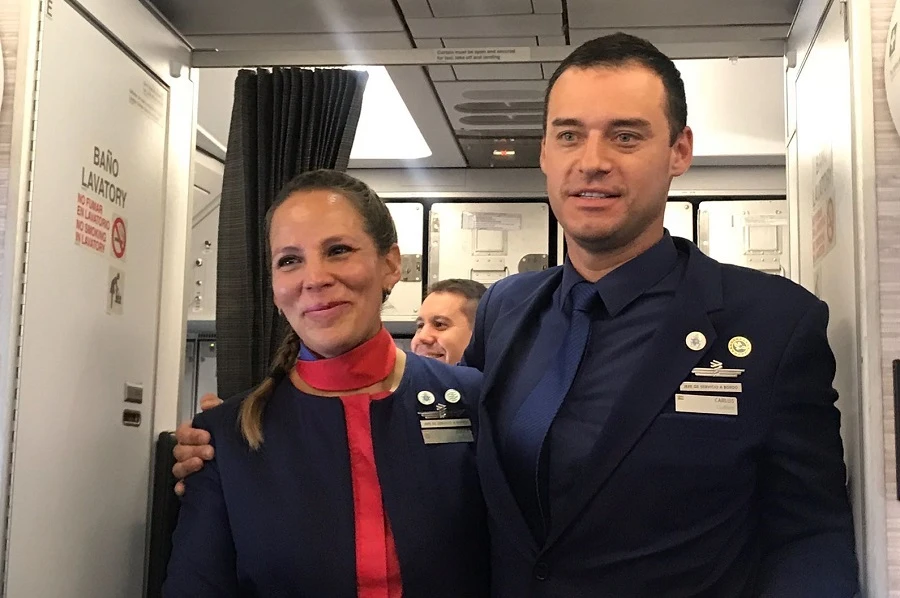
Aboard the papal plane, Jan 18, 2018 / 07:00 am (CNA/EWTN News).- In his five years in office, Pope Francis gained a reputation for tossing protocol and embracing spontaneity. Today, he did it again with another papal first: marrying two flight attendants on board his flight from Santiago to Iquique.
According to journalists traveling with the Pope, the couple – Paula Podest and Carlos Ciuffardi – went to the Pope during the Jan. 18 flight to ask for his blessing.
The couple told Francis they had been civilly married, but had not been able to get married in the Church because their parish was destroyed in the massive 8.8 earthquake that rocked Santiago in 2010.
In response, the Pope offered to marry them on the spot. Ignacio Cueto, owner of the airline company, LATAM, was a witness in the ceremony.
According to Ciuffardi, who spoke briefly with journalists after the ceremony, the Pope asked the couple if they were married yet, and when they explained why they hadn’t been married in the Church, he said “do you want to get married?”
The Pope, Ciuffardi said, asked them “Are you sure, absolutely sure?” They said yes, gave the Pope Podest’s ring and asked Cueto if he would be a witness. The Pope then blessed the ring, placed their hands together, offered some brief reflections and pronounced them man and wife.
#PopeFrancis married these flight attendants aboard the papal plane flying to Iquique, #Chile this morning.
Their wedding was canceled when an earthquake destroyed their church in Santiago in 2010.
According to Ciuffardi, Francis told them what happened “was historic,” because “never has a Pope married a couple on a plane.”
Referring to the rings, Francis jested that they shouldn’t be too tight, because “they would be a torture,” nor too loose, because they might lose them.
Since they didn’t have an official marriage certificate to sign, Pope Francis asked the cardinals with him to draft one, so they grabbed a piece of blank copy paper and each signed their names and what role they played in the ceremony. One of the cardinals also signed as a witness.
The Pope also gave the couple two rosaries, Podest received a white rosary and Ciuffardi a black one.
The couple – who have two children, Rafaela, 6, and Isabela, 3 – said they will be traveling with the Pope to Iquique, and from there will take a different flight to another destination, and will celebrate after.
“It was something historic, really. Very exciting. What he told us was very important: he told us ‘this is the sacrament that the world needs, the sacrament of marriage. Hopefully, this will motivate couples around the world to get married’,” Ciuffardi said.
If you value the news and views Catholic World Report provides, please consider donating to support our efforts. Your contribution will help us continue to make CWR available to all readers worldwide for free, without a subscription. Thank you for your generosity!
Click here for more information on donating to CWR. Click here to sign up for our newsletter.

Pope Francis waves during the weekly general audience in the Vatican’s Paul VI Hall on Dec. 28, 2022. / Credit: Vatican Media.
Vatican City, Dec 28, 2022 / 10:30 am (CNA).
Pope Francis Wednesday published a message on St. Francis de Sales, a saint who teaches us that “devotion [to God] is meant for everyone, in every situation.”
The pope’s apostolic letter, titled Totum amoris est, or “Everything Pertains to Love,” was published on Dec. 28, the 400th anniversary of St. Francis de Sales’ death in 1622.
The title comes from the preface of the Swiss saint’s book “Treatise on the Love of God,” in which he wrote that “In Holy Church, everything pertains to love, lives in love, is done for love and comes from love.”
St. Francis de Sales was a priest and bishop who taught against Protestant heresies and encouraged holiness in all people, no matter their vocation. He is known for his spiritual writings, including two books that are still widely read today: “An Introduction to the Devout Life” and “Treatise on the Love of God.” In 1877, he was proclaimed a Doctor of the Church.
“On this anniversary of the fourth centenary of his death, I have given much thought to the legacy of Saint Francis de Sales for our time,” Pope Francis said in his apostolic letter. “I find that his flexibility and his far-sighted vision have much to say to us.”
“Today he bids us set aside undue concern for ourselves, for our structures and for what society thinks about us, and consider instead the real spiritual needs and expectations of our people,” the pope noted.
Saint Francis de Sales, painted by Francisco Bayeu y Subías. Wikimedia (CC0)
Commenting on St. Francis de Sales’ teachings, Pope Francis said “devotion is meant for everyone, in every situation, and each of us can practice it in accordance with our own vocation.”
“As Saint Paul VI wrote on the fourth centenary of the birth of Francis de Sales, ‘Holiness is not the prerogative of any one group, but an urgent summons addressed to every Christian: “Friend, come up higher” (Lk 14:10). All of us are called to ascend the mountain of God, albeit not each by the same path.’”
“Devotion,” Paul VI said, quoting St. Francis, “must be practiced differently by the gentleman, the craftsman, the chamberlain, the prince, the widow, the young woman, the wife. Moreover, the practice of devotion must be adapted to the abilities, affairs and duties of each.”
False Devotion
In his letter, Pope Francis reflected on what St. Francis de Sales called “false devotion” and its relevance for our spiritual lives today.
Saint Francis de Sales. Kelson / Wikimedia (CC0)
“Francis’ description of false devotion is delightful and ever timely. Everyone can relate to it, since he salts it with good humor,” the pope explained.
De Sales wrote: “Someone attached to fasting will consider himself devout because he doesn’t eat, even though his heart is filled with bitterness; and while, out of love for sobriety, he will not let a drop of wine, or even water, touch his tongue, he will not scruple to drench it in the blood of his neighbor through gossip and slander. Another will consider himself devout because all day long he mumbles a string of prayers, yet remains heedless of the evil, arrogant and hurtful words that his tongue hurls at his servants and neighbors. Yet another will readily open his purse to give alms to the poor, but cannot wring an ounce of mercy from his heart in order to forgive his enemies. Another still will pardon his enemies, yet never even think of paying his debts; it will take a lawsuit to make him do so.”
“All these,” Pope Francis said, “of course, are perennial vices and struggles, and they lead the saint to conclude that ‘all these fine people, commonly considered devout, most surely are not.’”
True Devotion
The pope explained that St. Francis de Sales taught that true devotion, instead, is found in “God’s life dwelling within our hearts.”
“True and lively devotion presupposes the love of God; indeed, it is none other than a genuine, and not generic, love of God,” the saint said.
Saint Francis de Sales giving Saint Jeanne de Chantal the rule of the order of the Visitation /. null
Pope Francis said: “In Francis’ lively language, devotion is ‘a sort of spiritual alertness and energy whereby charity acts within us or, we act by means of it, with promptness and affection.’ For this reason, devotion does not exist alongside charity, but is one of its manifestations, while at the same time leading back to it.”
“Devotion is like a flame with regard to fire: it increases the intensity of charity without altering its quality,” the pope said, adding a quote from St. Francis de Sales, who said: “Charity is a spiritual fire that, when fanned into flame, is called devotion. Devotion thus adds nothing to the fire of charity but the flame that makes charity prompt, active and diligent, not only in the observance of God’s commandments but also in the exercise of his divine counsels and inspirations.”
“Understood in this way, devotion is far from something abstract,” the pope said. “Rather, it becomes a style of life, a way of living immersed in our concrete daily existence. It embraces and discovers meaning in the little things: food and dress, work and relaxation, love and parenthood, conscientiousness in the fulfillment of our duties. In a word, it sheds light on the vocation of each individual.”
Love
Pope Francis also reflected on St. Francis de Sales’ teachings on love as “the first act and principle of our devout or spiritual life.”
Mosaic of Sales on the exterior of St. Francis de Sales Oratory in St. Louis, Missouri. RickMorais / Wikimedia (CC BY-SA 4.0)
“The source of this love that attracts the heart is the life of Jesus Christ,” he explained. “‘Nothing sways the human heart as much as love,’ and this is most evident in the fact that ‘Jesus Christ died for us; he gave us life through his death. We live only because he died, and died for us, as ours and in us.’”
“These words are profoundly moving; they reveal not only a clear and insightful understanding of the relationship between God and humanity, but also the deep bond of affection between Francis de Sales and the Lord Jesus,” the pope said. “The ecstasy of life and action is no abstract reality, but shines forth in the charity of Christ that culminates on the cross. That love, far from mortifying our existence, makes it radiate with extraordinary brightness.”
Vatican City, Jul 18, 2017 / 10:02 am (CNA/EWTN News).- A commission of Catholic and Orthodox leaders tasked with examining the wartime record of Bl. Aloysius Stepinac concluded their final session last week, agreeing to disagree about the Croatian cardinal’s cause for canonization.
The Secretariat of the Holy See prepared a joint statement, adopted by both sides, at the conclusion of the commission’s sixth and final round of meetings at the Vatican July 12-13.
The document states that the opinions of either side remain unchanged, but also acknowledges that ultimately the competency for approval of the cardinal’s cause falls under Pope Francis.
“It has come to the conclusion that various events, speeches, writings, silences, and views are still subject to different interpretations. In the case of Cardinal Stepinac, the interpretations that were predominantly given by Catholic Croats and Orthodox Serbs remain divergent,” it states.
It included their thanks to Pope Francis for establishing the commission, which he did in May 2016 after receiving a letter from the Patriarch of the Serbian Orthodox Church Irinej, who stated his opposition to the cardinal’s canonization.
They also expressed their gratitude for the atmosphere of the discussions which allowed “full freedom of expression.”
“From the commencement of the commission’s work, the members were aware that the process of canonization of Cardinal Stepinac was in the exclusive competence of the Pope. They also admit that each Church has its own criteria for the canonization process,” it continued.
The Secretariat of the Holy See, Cardinal Pietro Parolin, accepted the outcome of the commission, which was led by Fr. Bernard Ardura, president of the Pontifical Committee for Historical Sciences.
With the conclusion of the commission, the path to the canonization of Cardinal Stepinac is fully open. The proper requisites in place, it is in the hands of the Congregation for the Causes of Saints, and then will go to Pope Francis for approval. It is believed the announcement of his canonization could take place soon.
Cardinal Stepinac, who is hailed as a hero in Croatia, has been a target of decades-long communist smears and disinformation. Despite this, he was beatified as a martyr by Pope St. John Paul II in October 1998.
Many in the Serbian Orthodox community are deeply skeptical of the cardinal’s wartime record. Though one researcher of the period says the facts counter false claims about the beatified cardinal’s record.
“What you have is a false narrative created by Soviet agents,” Prof. Ronald J. Rychlak told CNA/EWTN News in 2016.
Cardinal Stepinac was the Archbishop of Zagreb from 1937 until his death in 1960 at the age of 61. In Yugoslavia during the Second World War, the pro-Nazi Ustashe movement came to power under leader Ante Pavelic after the Axis occupied the country.
“Stepinac’s sermons against the Ustashe were so strong. They prohibited them from being published, because they were so strong against the Ustashe,” Rychlak said. Instead, his words were secretly printed and circulated and occasionally broadcast over the radio.
He also severely condemned the Ustashe’s destruction of Zagreb’s main synagogue in 1941 and in an October 1943 homily, the archbishop condemned notions of racial superiority.
In 1946, Stepinac was put on trial for allegedly collaborating with the Ustashe’s crimes. The trial drew critical coverage from Western media like Time and Newsweek and protests from those who saw it as a show trial.
Archbishop Stepinac was denied effective representation and only met with his attorney for an hour before the trial. The government’s witnesses were told what to say, and the archbishop was not allowed to cross-examine them.
In 1953, Pope Pius XII made him a cardinal, although he was never allowed travel to the Holy See to be officially elevated. He died in 1960 of an alleged blood disorder, which was said to have been caused by the conditions he endured in jail. Recent tests of his remains by Vatican investigators show evidence he was also poisoned.
In June 2011 Pope Benedict XVI praised Cardinal Stepinac as a courageous defender of those oppressed by the Ustashe, including Serbs, Jews and gypsies.
He said the cardinal stood against “the dictatorship of communism, where he again fought for the faith, for the presence of God in the world, the true humanity that is dependent on the presence of God.”
They’re flight attendants who fly all over the world. There esa’s no church where they could have had their marriage legitimized in the eyes of God anywhere else. Tens of thousands of priests… but it took them 8 years.
Dee it’s the Pope’s usual publicity stunt. Chuck Schumer recently quoted a criticism that “The most dangerous place in Congress is between Chuck Schumer and the cameras” (Bob Dole). Schumer is outmatched by Pope Francis. You’re “horse pucky” quip is hilarious. But that’s what it is.
“The couple told Francis they had been civilly married, but had not been able to get married in the Church because their parish was destroyed in the massive 8.8 earthquake that rocked Santiago in 2010.”
In 7 years? That doesn’t sound likely. What, *nobody* from that parish has been able to be married in the Church since 2010?
I’m glad the couple is now sacramentally married. But much of this story doesn’t make sense. The couple cites the 2010 destruction of their parish, but the Archdiocese of Santiago has over 200 parishes. Oh well. God grant them many years!
Indeed. Better that they did the right thing a little late than not at all.
(And, in passing, one of the things in this story that doesn’t make sense is that apparently neither Pope Francis nor any of the cardinals heard the couple’s confessions before marrying them. Come on: they’ve been cohabitating for almost 8 years. If they couldn’t find a church to get married in, I’ll bet that they didn’t find one to go to confession in, either.)
I’m quite certain that the Pontiff determined while airborne that the two were free from impediment to marry, successfully completed both Pre-Cana classes and a course on NFP and were in a state of grace.
I’m sorry. This story is pure horse pucky.
They’re flight attendants who fly all over the world. There esa’s no church where they could have had their marriage legitimized in the eyes of God anywhere else. Tens of thousands of priests… but it took them 8 years.
God help us. Keep us from this stupidity
Dee it’s the Pope’s usual publicity stunt. Chuck Schumer recently quoted a criticism that “The most dangerous place in Congress is between Chuck Schumer and the cameras” (Bob Dole). Schumer is outmatched by Pope Francis. You’re “horse pucky” quip is hilarious. But that’s what it is.
“The couple told Francis they had been civilly married, but had not been able to get married in the Church because their parish was destroyed in the massive 8.8 earthquake that rocked Santiago in 2010.”
In 7 years? That doesn’t sound likely. What, *nobody* from that parish has been able to be married in the Church since 2010?
I’m glad the couple is now sacramentally married. But much of this story doesn’t make sense. The couple cites the 2010 destruction of their parish, but the Archdiocese of Santiago has over 200 parishes. Oh well. God grant them many years!
Indeed. Better that they did the right thing a little late than not at all.
(And, in passing, one of the things in this story that doesn’t make sense is that apparently neither Pope Francis nor any of the cardinals heard the couple’s confessions before marrying them. Come on: they’ve been cohabitating for almost 8 years. If they couldn’t find a church to get married in, I’ll bet that they didn’t find one to go to confession in, either.)
I’m quite certain that the Pontiff determined while airborne that the two were free from impediment to marry, successfully completed both Pre-Cana classes and a course on NFP and were in a state of grace.
The circus continues.