The complicated context of Pope Francis’ confusing remarks about the “Our Father”
The Holy Father’s remarks, made to the Italian bishops’ TV magazine program, invoked a drawn-out and at times acrimonious controversy under the tent of French Catholicism, over the official liturgical translation of the The Lord’s Prayer.
Pope Francis is pictured next to Msgr. Guido Marini, papal master of ceremonies, as he looks up at statue of Mary near the Spanish Steps in Rome Dec. 8. The pope led a brief prayer service at the statue to mark the feast of the Immaculate Conception. (CNS photo/Paul Haring)
Pope Francis has managed to get himself in the papers again, this time over remarks to the Italian bishops’ TV magazine program, Padre Nostro. The episode that is the source – or at least the occasion – of the controversy aired on the Italian bishops’ TV2000 network this past Tuesday. In the episode, the Holy Father noted the recent change in the official French translation of the Our Father, as the prayer appears in the official French translation of the Ordo Missae – the Missal of the Ordinary Form of the Roman Rite.
The headlines were, predictably, breathless and misleading.
What he did was use a part of a serial conversation about the Lord’s Prayer to address a basic point of theology. Only, he did so by invoking a drawn-out and at times acrimonious controversy under the tent of French Catholicism, over the official liturgical translation of the Our Father. Hold on to your hats: it gets awfully confusing awfully fast.
First, the Pope was talking about the prayer in Italian, as Italian-speakers know and recite it.
“This,” i.e. the Italian, non ci indurre in tentazione (“…lead us not into temptation”), “is not good [as] a translation,” Pope Francis told don Marco Pozza, host of the program. “The French have even changed the text now, with a translation that is: ‘let me not fall into temptation.’ For, I am the one, who falls into temptation,” Pope Francis explained. “But it is not He, who tosses me into temptation, in order to see then, how I fall – no – a father does not do this. A father helps [one] to get right back up. The one, who induces you into temptation is Satan,” the Holy Father continued. “That is Satan’s office.”
Questa è una traduzione non buona. Anche i francesi hanno cambiato adesso il testo, con una traduzione che è: ‘non mi lasci cadere nella tentazione.’ [Per]ché, sono io a cadere nella tentazione. Ma, non è lui che mi butta alla [sic] tentazione, per poi vedere come sono caduto – no – un padre non fa questo. Un padre aiuta a alzarsi subito. Quello che t’induce alla tentazione è Satana. È quello, [l’]ufficio di Satana.
The Pope is right about the language, by the way: the now obsolete French translation, which read, ne nous soumets pas à la tentation – “do not submit us to temptation” is – was – pretty awful. One French parish priest, Fr. Emmanuel Schwab, was quoted in the National Catholic Reporter as saying, “The version, ‘do not submit us to temptation’, made some people think God threw banana peels in front of people to see if they would slip and fall, but that is absolutely not the biblical view of God.”
It was perhaps this idea – this misconception – that Pope Francis was addressing, though one does wonder who ever really had the idea, not to mention how Pope Francis got to the catechetical concerns of grunt priests in the pastoral trenches of Paris by way of the long-standing Italian version of the world’s oldest and most recognized Christian prayer.
There’s a good half-dozen stories in there.
While there is a great deal, indeed, that one might say about the merits of the Pope’s remarks to don Marco, themselves, it is necessary to note a point of fact at the basis of the whole controversy, which is being almost entirely overlooked.
The French bishops were making a change to the liturgical texts, which are a translation of the Latin editio typica.
This is important for several reasons, not least of which is that, whatever the merits of the French bishops’ preference for et ne nous laisse pas entrer en tentation – “let us not enter into temptation” as a rendering of, say, the Aramaic – a subject on which very few in the world are equipped to speak – it is not a translation of the Latin text, ne nos inducas in tentationem, which is the text of the prayer as it appears in the editio typica.
Nota bene.
Whatever the deficiencies of the old French rendering, it was defensible as a way of translating the Latin. This new French version is not at all recognizable as a translation of the Latin text it is supposed to render.
This is significant because – forgive me, but repetita iuvant – the Bishops were translating an official liturgical text, and liturgical texts have their own authority. The Church at prayer, in her official public worship, is a source of faith that is both chronologically and ontologically prior to any written record of Christ’s words and deeds – and the words the Latin Church prays officially and publicly, are: ne nos inducas in tentationem.
Translators have a job: to translate text.
If the text they are translating is in Latin, their job is to translate the Latin text – and though that task might benefit from consultation of other, older texts that are the putative source of the words they are charged with rendering, the translators miscarry in their duty when they ignore the text they are supposed to translate.
The really alarming thing in all this, in other words, is that we seem in part, at least, to be returned to the heady post-Conciliar days, in which a great deal of confusion was created and more consternation caused, not by bad men intent on destroying the Church (there were a few of those, too), but by basically good men failing to stop and ask simple but absolutely necessary questions, like, “What are we doing here?” and “Is this what we’re supposed to be doing?”
In defense of Pope Francis, his theological point is sound, even if it does belabor the obvious and needlessly heap abuse on an innocent straw man. God does not toss us into temptation to see how we fall (though there are reliable accounts that have Him allowing Satan to do his nasty work on righteous men, in order to prove a point – once, we’re told, to win a bet).
I don’t have a crystal ball, but I do have a nickel that says this tempest will not transcend the walls of the teacup in which it is now churning. When it comes to the broader issue, of which the French episode is merely an illustration, all bets are off.
If you value the news and views Catholic World Report provides, please consider donating to support our efforts. Your contribution will help us continue to make CWR available to all readers worldwide for free, without a subscription. Thank you for your generosity!
Click here for more information on donating to CWR. Click here to sign up for our newsletter.
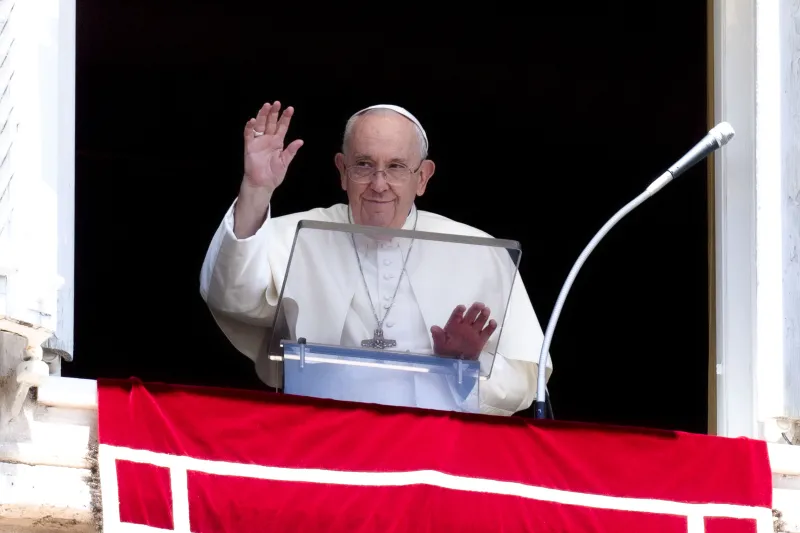
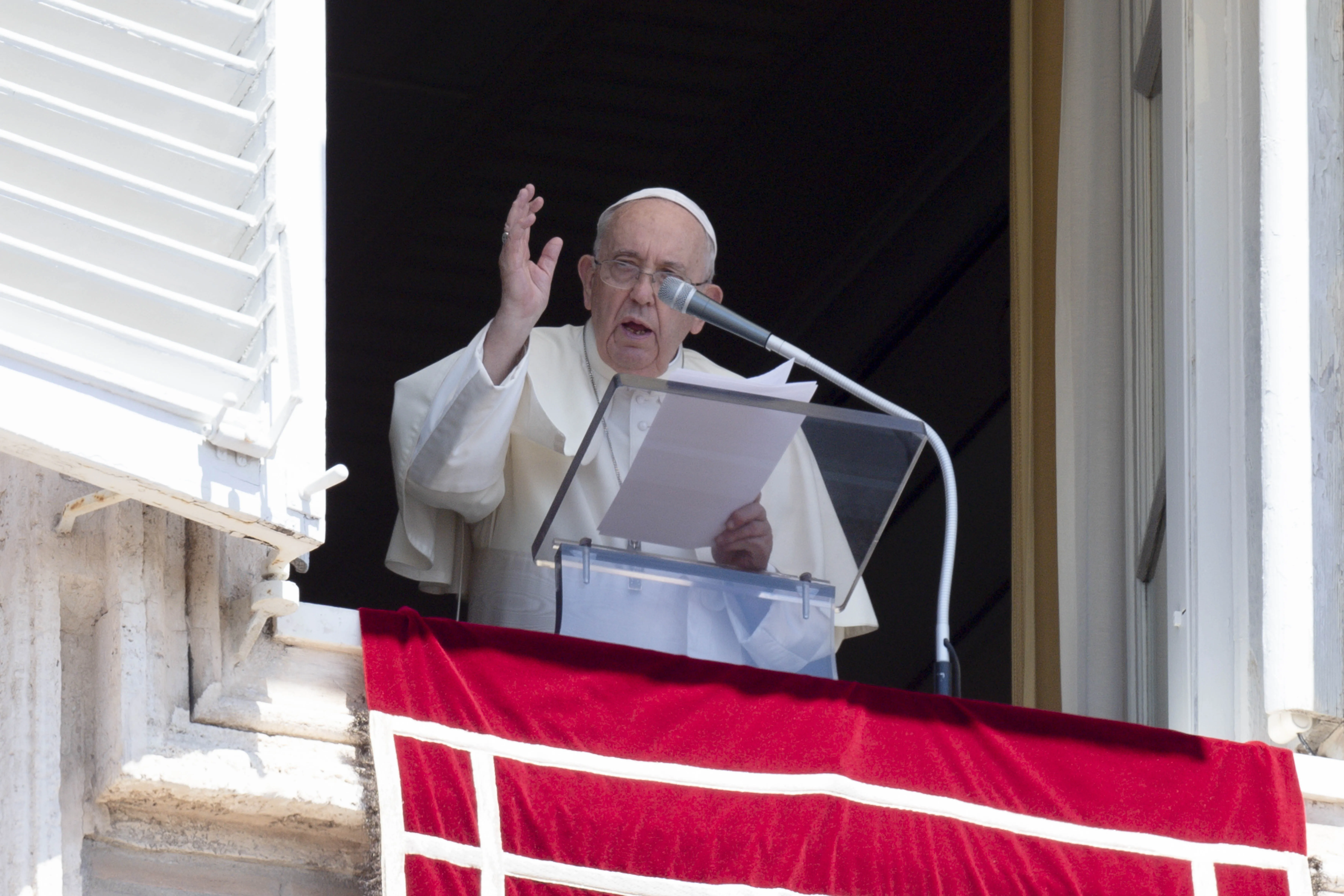
Pope Francis reflected on the dangers of coveting wealth and possessions during his Angelus reflection in St. Peter’s Square in Rome on July 31, 2022. / Vatican Media
Washington, D.C. Newsroom, Jul 31, 2022 / 06:32 am (CNA).
A day after returning to Rome from his weeklong trip to Canada, Pope Francis on Sunday reflected on the dangers of coveting wealth and possessions.
In Sunday’s Gospel, Jesus responds to a man who wants his brother to share his inheritance with him. “Take care to guard against all greed,” Jesus tells the crowd, “for though one may be rich, one’s life does not consist of possessions” (Lk. 12:15).
The Holy Father noted that rather than entering into the details of the man’s situation, he “goes to the root of the divisions caused by the possession of things”: covetousness.
“What is covetousness? It is the unbridled greed for possessions, always desiring to be rich,” the pope said, speaking to pilgrims in St. Peter’s Square before the weekly recitation of the Angelus.
“This is an illness that destroys people, because the hunger for possessions creates an addiction. Above all, those who have a lot are never content, they always want more, and only for themselves. But this way, the person is no longer free: he or she is attached to, a slave, of what paradoxically was meant to serve them so as to live freely and serenely,” Pope Francis warned.
“Rather than being served by money, the person becomes a servant of money.”
The pope identified covetousness as a “dangerous illness for society as well,” pointing to the greed that fuels wars and in particular the “scandal” of the arms trade.
“And so, let us try to ask ourselves: Where am I at with my detachment from possessions, from wealth?” the pope asked. “Do I complain about what I lack, or do I know how to be content with what I have? In the name of money or opportunity, am I tempted to sacrifice relationships and sacrifice time with others? And yet again, does it happen that I sacrifice legality and honesty on the altar of covetousness?”
Pope Francis reflected on the dangers of coveting wealth and possessions during his Angelus reflection in St. Peter’s Square in Rome on July 31, 2022. Vatican Media
The pope next shifted to focus on the “richness” of God.
“And so, we might think, so, no one should desire to get rich? Certainly, you can; rather, it is right to want it. It is beautiful to become rich, but rich according to God! God is the richest of anyone,” he said.
“He is rich in compassion, in mercy. His riches do not impoverish anyone, do not create quarrels and divisions. It is a richness that knows how to give, to distribute, to share. Brothers and sisters, accumulating material goods is not enough to live well, for Jesus says also that life does not consist in what one possesses (see Lk 12:15). It depends, instead, on good relationships – with God, with others, and even with those who have less.”
The pope continued: “So, let us ask ourselves: For myself, how do I want to get rich? Do I want to get rich according to God or according to my covetousness? And, returning to the topic of inheritance, what legacy do I want to leave? Money in the bank, material things, or happy people around me, good works that are not forgotten, people that I have helped to grow and mature?”
Pope Francis concluded by asking Our Lady, who shared in God’s riches, to “help us understand what the true goods of life are, the ones that last forever.”
Following his reflection, the pope thanked all those who assisted him on his trip to Canada, while assuring those suffering from the war in Ukraine that they remain in his prayers.
“Also, during this journey, I did not cease praying for the suffering and battered Ukrainian people, asking God to free them from the scourge of war,” Pope Francis said.
“If one looked at what is happening objectively, considering the harm that war brings every day to those people, and even to the entire world, the only reasonable thing to do would be to stop and negotiate,” he added. “May wisdom inspire concrete steps toward peace.”
Pope Francis at the general audience in St. Peter’s Square, Oct. 5, 2016. / Credit: Daniel Ibanez/CNA
CNA Staff, Mar 13, 2024 / 12:00 pm (CNA).
March 13 marks the anniversary of the election of Pope Francis as the 266th successor of St. Peter. Here is a timeline of key events during his papacy:
2013
March 13 — About two weeks after Pope Benedict XVI steps down from the papacy, Cardinal Jorge Bergoglio is elected pope. He takes the papal name Francis in honor of St. Francis of Assisi and proclaims from the central balcony of St. Peter’s Basilica: “Let us begin this journey, the bishop and people, this journey of the Church of Rome, which presides in charity over all the Churches, a journey of brotherhood in love, of mutual trust. Let us always pray for one another.”
March 14 — The day after he begins his pontificate, Pope Francis returns to his hotel to personally pay his hotel bill and collect his luggage.
July 8 — Pope Francis visits Italy’s island of Lampedusa and meets with a group of 50 migrants, most of whom are young men from Somalia and Eritrea. The island, which is about 200 miles off the coast of Tunisia, is a common entry point for migrants who flee parts of Africa and the Middle East to enter Europe. This is the pope’s first pastoral visit outside of Rome and sets the stage for making reaching out to the peripheries a significant focus.
Pope Francis gives the Wednesday general audience in St. Peter’s Square on Oct. 2, 2013. Elise Harris/CNA.
July 23-28 — Pope Francis visits Rio de Janeiro, Brazil, to participate in World Youth Day 2013. More than 3 million people from around the world attend the event.
July 29 — On the return flight from Brazil, Pope Francis gives his first papal news conference and sparks controversy by saying “if a person is gay and seeks God and has goodwill, who am I to judge?” The phrase is prompted by a reporter asking the pope a question about priests who have homosexual attraction.
Nov. 24 — Pope Francis publishes his first apostolic exhortation Evangelii Gaudium (The Joy of the Gospel). The document illustrates the pope’s vision for how to approach evangelization in the modern world.
2014
Feb. 22 — Pope Francis holds his first papal consistory to appoint 19 new cardinals, including ones from countries in the developing world that have never previously been represented in the College of Cardinals, such as Haiti.
March 22 — Pope Francis creates the Pontifical Commission for the Protection of Minors. The commission works to protect the dignity of minors and vulnerable adults, such as the victims of sexual abuse.
Pope Francis greets pilgrims during his general audience on Nov. 29, 2014. Bohumil Petrik/CNA.
Oct. 5 — The Synod on the Family begins. The bishops discuss a variety of concerns, including single-parent homes, cohabitation, homosexual adoption of children, and interreligious marriages.
Dec. 6 — After facing some pushback for his efforts to reform the Roman Curia, Pope Francis discusses his opinion in an interview with La Nacion, an Argentine news outlet: “Resistance is now evident. And that is a good sign for me, getting the resistance out into the open, no stealthy mumbling when there is disagreement. It’s healthy to get things out into the open, it’s very healthy.”
2015
Jan. 18 — To conclude a trip to Asia, Pope Francis celebrates Mass in Manila, Philippines. Approximately 6 million to 7 million people attend the record-setting Mass, despite heavy rain.
March 23 — Pope Francis visits Naples, Italy, to show the Church’s commitment to helping the fight against corruption and organized crime in the city.
May 24 — To emphasize the Church’s mission to combat global warming and care for the environment, Pope Francis publishes the encyclical Laudato Si’, which urges people to take care of the environment and encourages political action to address climate problems.
Pope Francis at a Wednesday general audience in St. Peter’s Square on June 17, 2015. Bohumil Petrik.
Sept. 19-22 — Pope Francis visits Cuba and meets with Fidel Castro in the first papal visit to the country since Pope John Paul II in 1998. During his homily, Francis discusses the dignity of the human person: “Being a Christian entails promoting the dignity of our brothers and sisters, fighting for it, living for it.”
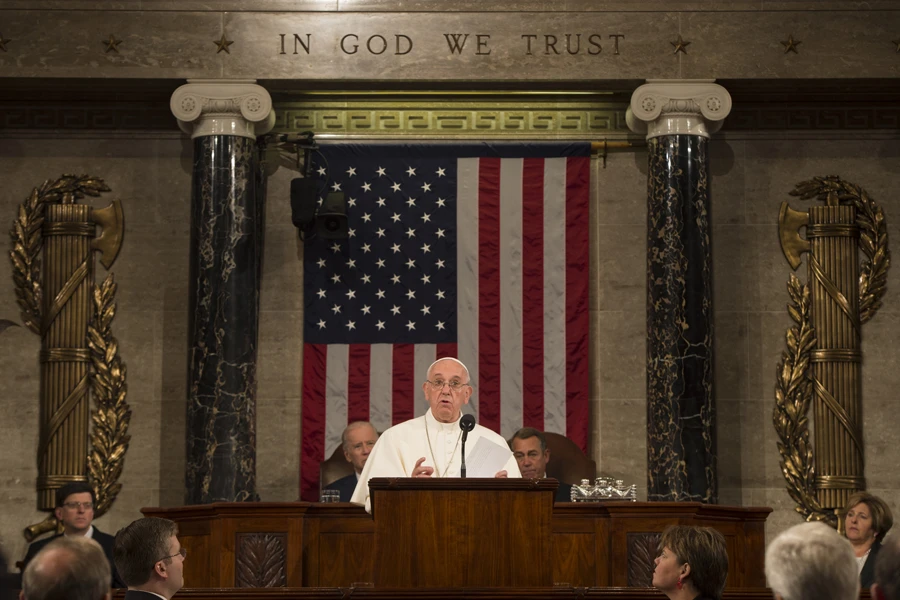
Sept. 22-27 — After departing from Cuba, Pope Francis makes his first papal visit to the United States. In Washington, D.C., he speaks to a joint session of Congress, in which he urges lawmakers to work toward promoting the common good, and canonizes the Franciscan missionary St. Junípero Serra. He also attends the World Meeting of Families in Philadelphia, which focuses on celebrating the gift of the family.
Pope Francis speaks to the U.S. Congress in Washington, D.C. on Sept. 24, 2015. . L’Osservatore Romano.
Oct. 4 — Pope Francis begins the second Synod on the Family to address issues within the modern family, such as single-parent homes, cohabitation, poverty, and abuse.
Oct. 18 — The pope canonizes St. Louis Martin and St. Marie-Azélie “Zelie” Guérin. The married couple were parents to five nuns, including St. Therese of Lisieux. They are the first married couple to be canonized together.
Dec. 8 — Pope Francis’ Jubilee Year of Mercy begins. The year focuses on God’s mercy and forgiveness and people’s redemption from sin. The pope delegates certain priests in each diocese to be Missionaries of Mercy who have the authority to forgive sins that are usually reserved for the Holy See.
2016
March 19 — Pope Francis publishes the apostolic exhortation Amoris Laetitia, which discusses a wide variety of issues facing the modern family based on discussions from the two synods on the family. The pope garners significant controversy from within the Church for comments he makes in Chapter 8 about Communion for the divorced and remarried.
April 16 — After visiting refugees on the Greek island of Lesbos, Pope Francis allows three Muslim refugee families to join him on his flight back to Rome. He says the move was not a political statement.
Pope Francis at the General Audience in St. Peter’s Square, Feb. 24, 2016. Daniel Ibanez/CNA.
July 26-31 — Pope Francis visits Krakow, Poland, as part of the World Youth Day festivities. About 3 million young Catholic pilgrims from around the world attend.
Sept. 4 — The pope canonizes St. Teresa of Calcutta, who is also known as Mother Teresa. The saint, a nun from Albania, dedicated her life to missionary and charity work, primarily in India.
Sept. 30-Oct. 2 — Pope Francis visits Georgia and Azerbaijan on his 16th trip outside of Rome since the start of his papacy. His trip focuses on Catholic relations with Orthodox Christians and Muslims.
Oct. 4 — Pope Francis makes a surprise visit to Amatrice, Italy, to pray for the victims of an earthquake in central Italy that killed nearly 300 people.
2017
May 12-13 — In another papal trip, Francis travels to Fatima, Portugal, to visit the Shrine of Our Lady of Fatima. May 13 marks the 100th anniversary of the first Marian apparition to three children in the city.
July 11 — Pope Francis adds another category of Christian life suitable for the consideration of sainthood: “offering of life.” The category is distinct from martyrdom, which only applies to someone who is killed for his or her faith. The new category applies to those who died prematurely through an offering of their life to God and neighbor.
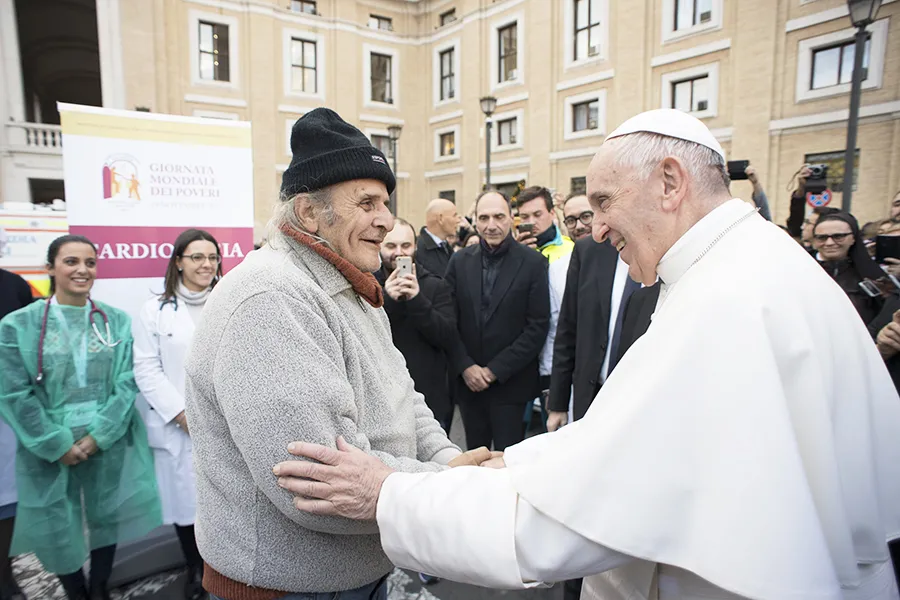
Pope Francis greets a participant in the World Day of the Poor in Rome, Nov. 16, 2017. L’Osservatore Romano.
Nov. 19 — On the first-ever World Day of the Poor, Pope Francis eats lunch with 4,000 poor and people in need in Rome.
Nov. 27-Dec. 2 — In another trip to Asia, Pope Francis travels to Myanmar and Bangladesh. He visits landmarks and meets with government officials, Catholic clergy, and Buddhist monks. He also preaches the Gospel and promotes peace in the region.
2018
Jan. 15-21 — The pope takes another trip to Latin America, this time visiting Chile and Peru. The pontiff meets with government officials and members of the clergy while urging the faithful to remain close to the clergy and reject secularism. The Chilean visit leads to controversy over Chilean clergy sex abuse scandals.
Aug. 2 — The Vatican formally revises No. 2267 of the Catechism of the Catholic Church, which concerns the death penalty. The previous text suggested the death penalty could be permissible in certain circumstances, but the revision states that the death penalty is “inadmissible.”
Aug. 25 — Archbishop Carlo Viganò, former papal nuncio to the United States, publishes an 11-page letter calling for the resignation of Pope Francis and accusing him and other Vatican officials of covering up sexual abuse including allegations against former Cardinal Theodore McCarrick. The pope initially does not directly respond to the letter, but nine months after its publication he denies having prior knowledge about McCarrick’s conduct.
Aug. 25-26 — Pope Francis visits Dublin, Ireland, to attend the World Meeting of Families. The theme is “the Gospel of family, joy for the world.”
Pope Francis at the 2018 World Meeting of Families in Ireland. Daniel Ibanez/CNA.
Oct. 3-28 — The Synod on Young People, the Faith, and Vocational Discernment takes place. The synod focuses on best practices to teach the faith to young people and to help them discern God’s will.
2019
Jan. 22-27 — The third World Youth Day during Pope Francis’ pontificate takes place during these six days in Panama City, Panama. Young Catholics from around the world gather for the event, with approximately 3 million people in attendance.
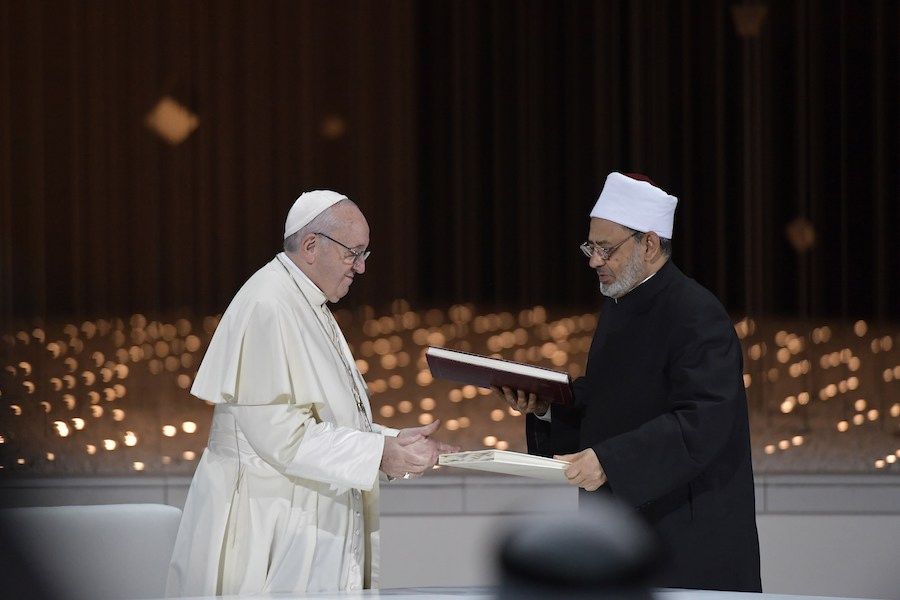
Feb. 4 — Pope Francis signs a joint document in with Sheikh Ahmed el-Tayeb, the grand imam of Al-Azhar, in Abu Dhabi, United Arab Emirates, titled the “Document on Human Fraternity for World Peace and Living Together.” The document focuses on people of different faiths uniting together to live peacefully and advance a culture of mutual respect.
Pope Francis and Ahmed el-Tayeb, grand imam of al-Azhar, signed a joint declaration on human fraternity during an interreligious meeting in Abu Dhabi, UAE, Feb. 4, 2019. Vatican Media.
Feb. 21-24 — The Meeting on the Protection of Minors in the Church, which is labeled the Vatican Sexual Abuse Summit, takes place. The meeting focuses on sexual abuse scandals in the Church and emphasizes responsibility, accountability, and transparency.
Oct. 6-27 — The Church holds the Synod of Bishops for the Pan-Amazon region, which is also known as the Amazon Synod. The synod is meant to present ways in which the Church can better evangelize the Amazon region but leads to controversy when carved images of a pregnant Amazonian woman, referred to by the pope as Pachamama, are used in several events and displayed in a basilica near the Vatican.
Oct. 13 — St. John Henry Newman, an Anglican convert to Catholicism and a cardinal, is canonized by Pope Francis. Newman’s writings inspired Catholic student associations at nonreligious colleges and universities in the United States and other countries.
2020
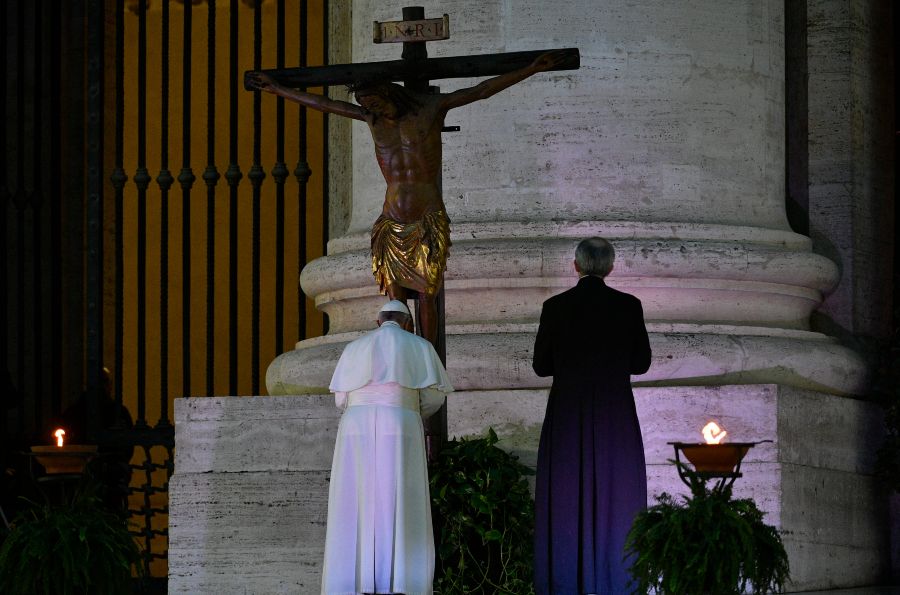
March 15 — Pope Francis takes a walking pilgrimage in Rome to the chapel of the crucifix and prays for an end to the COVID-19 pandemic. The crucifix was carried through Rome during the plague of 1522.
March 27 — Pope Francis gives an extraordinary “urbi et orbi” blessing in an empty and rain-covered St. Peter’s Square, praying for the world during the coronavirus pandemic.
Pope Francis venerates the miraculous crucifix of San Marcello al Corso in St. Peter’s Square during his Urbi et Orbi blessing, March 27, 2020. Vatican Media.
2021
March 5-8 — In his first papal trip since the start of the COVID-19 pandemic, Pope Francis becomes the first pope to visit Iraq. On his trip, he signs a joint statement with Grand Ayatollah Ali al-Sistani condemning extremism and promoting peace.
July 3 — Cardinal Giovanni Angelo Becciu, who was elevated to the College of Cardinals by Pope Francis, is indicted in a Vatican court for embezzlement, money laundering, and other crimes. The pope gives approval for the indictment.
July 4 — Pope Francis undergoes colon surgery for diverticulitis, a common condition in older people. The Vatican releases a statement that assures the pope “reacted well” to the surgery. Francis is released from the hospital after 10 days.
July 16 — Pope Francis issues a motu proprio titled Traditionis Custodes. The document imposes heavy restrictions on the celebration of the Traditional Latin Mass.
Dec. 2-6 — The pope travels to Cyprus and Greece. The trip includes another visit to the Greek island of Lesbos to meet with migrants.
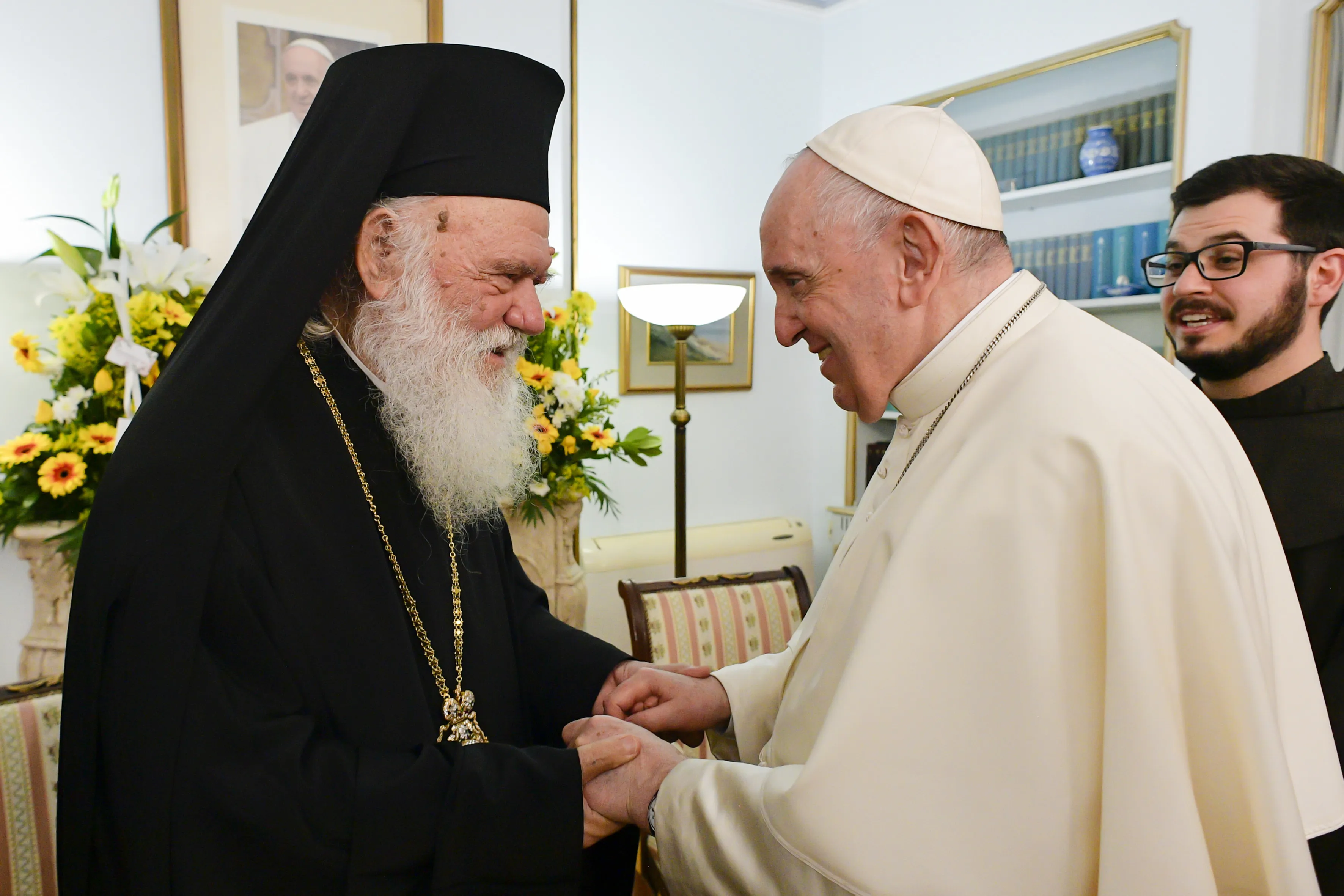
Pope Francis greets His Beatitude Ieronymos II in Athens, Greece on Dec. 5, 2021. Vatican Media
2022
Jan. 11 — Pope Francis makes a surprise visit to a record store in Rome called StereoSound. The pope, who has an affinity for classical music, blesses the newly renovated store.
March 19 — The pope promulgates Praedicate Evangelium, which reforms the Roman Curia. The reforms emphasize evangelization and establish more opportunities for the laity to be in leadership positions.
May 5 — Pope Francis is seen in a wheelchair for the first time in public and begins to use one more frequently. The pope has been suffering from knee problems for months.
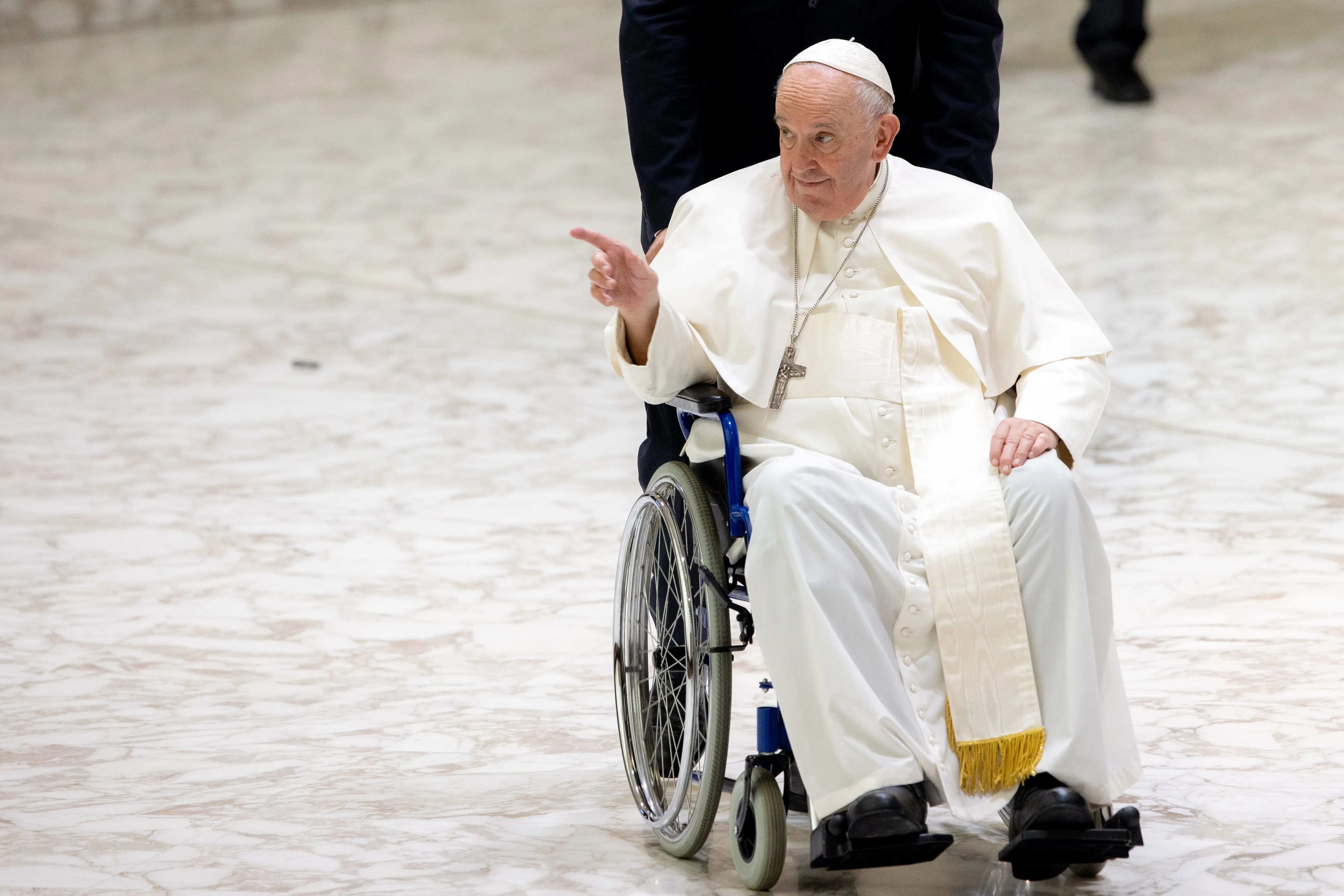
Pope Francis greeted the crowd in a wheelchair at the end of his general audience on Aug. 3, 2022. Daniel Ibanez/CNA
July 24-30 — In his first papal visit to Canada, Pope Francis apologizes for the harsh treatment of the indigenous Canadians, saying many Christians and members of the Catholic Church were complicit.
2023
Jan. 31-Feb. 5 — Pope Francis travels to the Democratic Republic of Congo and South Sudan. During his visit, the pope condemns political violence in the countries and promotes peace. He also participates in an ecumenical prayer service with Anglican Archbishop of Canterbury Justin Welby and Moderator of the Church of Scotland Iain Greenshields.
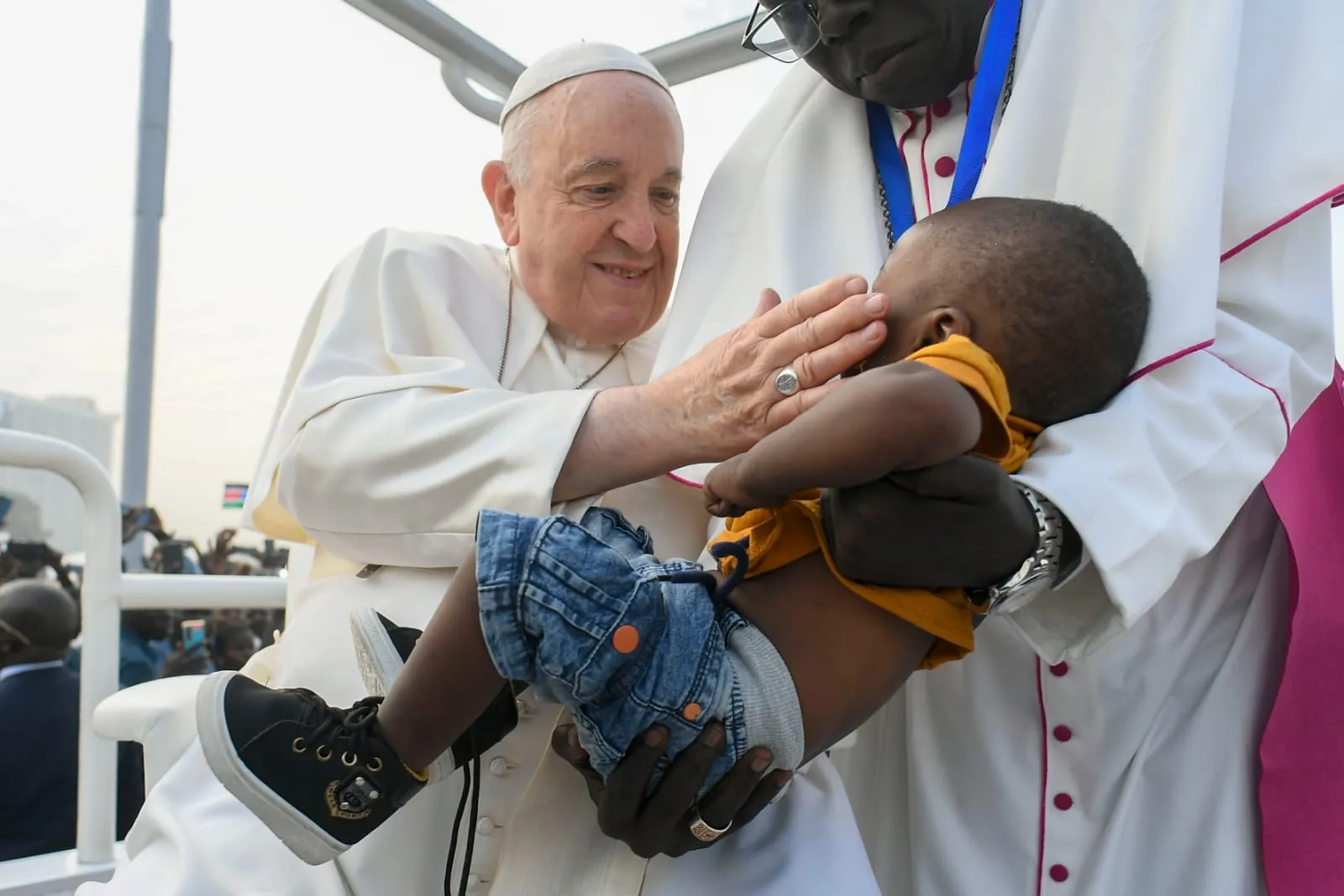
Pope Francis greets a young boy a Mass in Juba, South Sudan on Feb. 5, 2023. Vatican Media
March 29-April 1 — Pope Francis is hospitalized for a respiratory infection. During his stay at Rome’s Gemelli Hospital, he visits the pediatric cancer ward and baptizes a newborn baby.
April 5 — The pope appears in the Disney documentary “The Pope: Answers,” which is in Spanish, answering six “hot-button” issues from members of Gen Z from various backgrounds. The group discusses immigration, depression, abortion, clergy sexual and psychological abuse, transgenderism, pornography, and loss of faith.
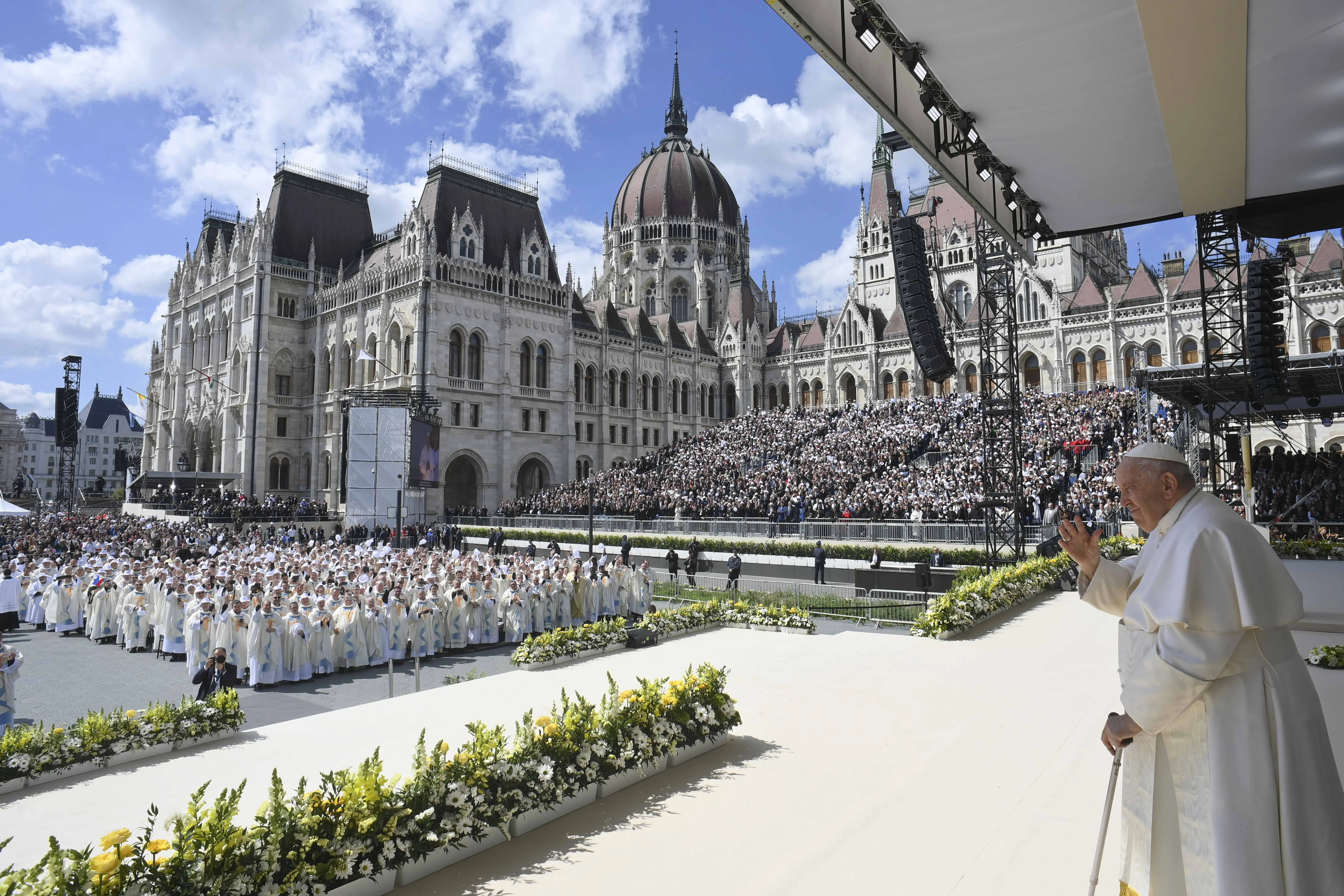
April 28-30 — Pope Francis visits Hungary to meet with government officials, civil society members, bishops, priests, seminarians, Jesuits, consecrated men and women, and pastoral workers. He celebrates Mass on the final day of the trip in Kossuth Lajos Square.
Pope Francis stands on an altar erected outside the Parliament Building in Budapest’s Kossuth Lajos’ Square during a public outdoor Mass on April 30, 2023. Vatican Media
June 7 — The Vatican announces that Pope Francis will undergo abdominal surgery that afternoon under general anesthesia due to a hernia that is causing painful, recurring, and worsening symptoms. In his general audience that morning before the surgery, Francis says he intends to publish an apostolic letter on St. Thérèse of Lisieux, “patroness of the missions,” to mark the 150th anniversary of her birth.
June 15 — After successful surgery and a week of recovery, Pope Francis is released from Gemelli Hospital.
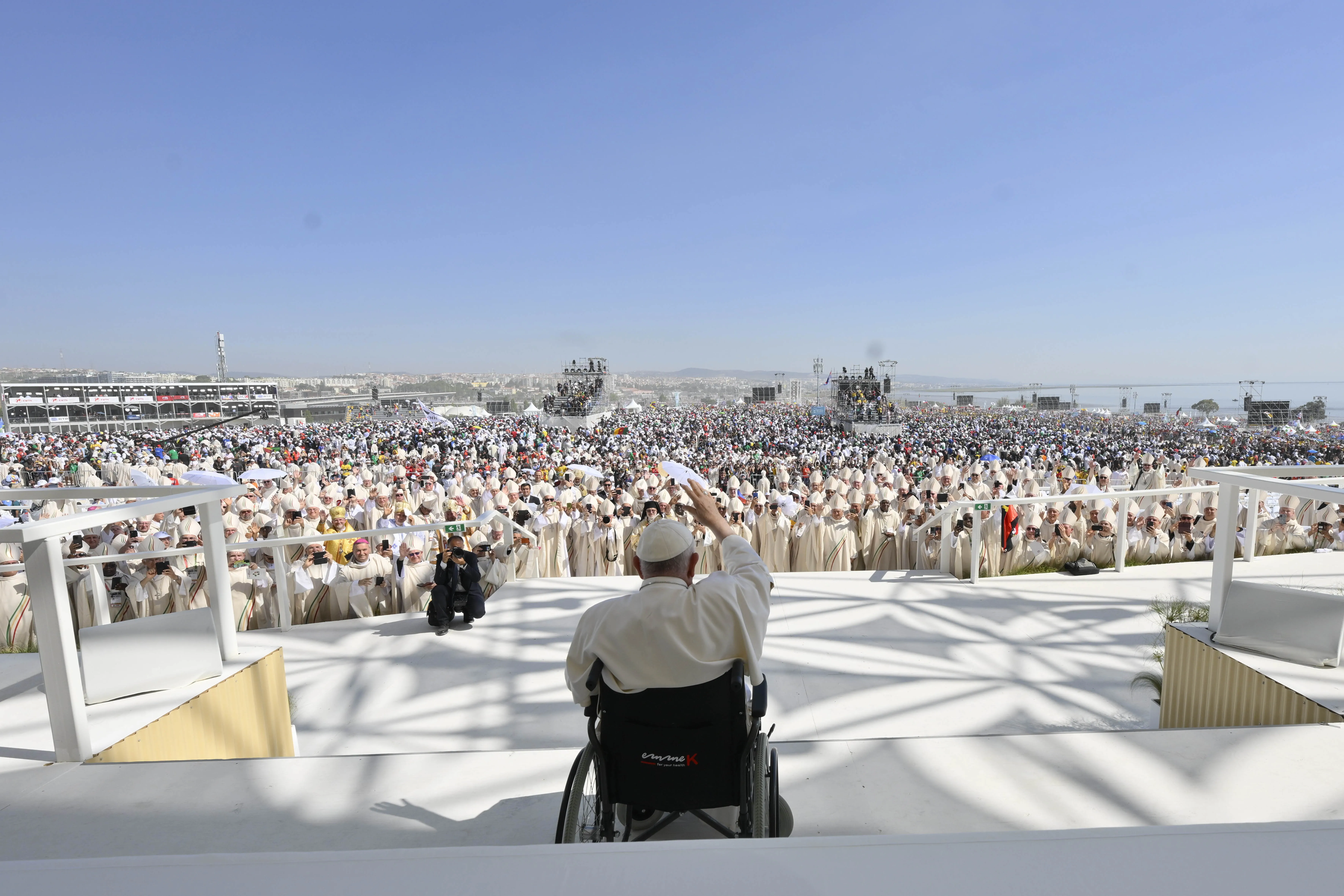
Aug. 2-6 — Pope Francis travels to Lisbon, Portugal, for World Youth Day 2023, taking place from Aug. 1-6. He meets with Church and civil leaders ahead of presiding at the welcoming Mass and Stations of the Cross. He also hears the confessions of several pilgrims. On Aug. 5, he visits the Shrine of Our Lady of Fátima, where he prays the rosary with young people with disabilities. That evening he presides over the vigil and on Sunday, Aug. 6, he celebrates the closing Mass, where he urges the 1.5 million young people present to “be not afraid,” echoing the words of the founder of World Youth Days, St. John Paul II.
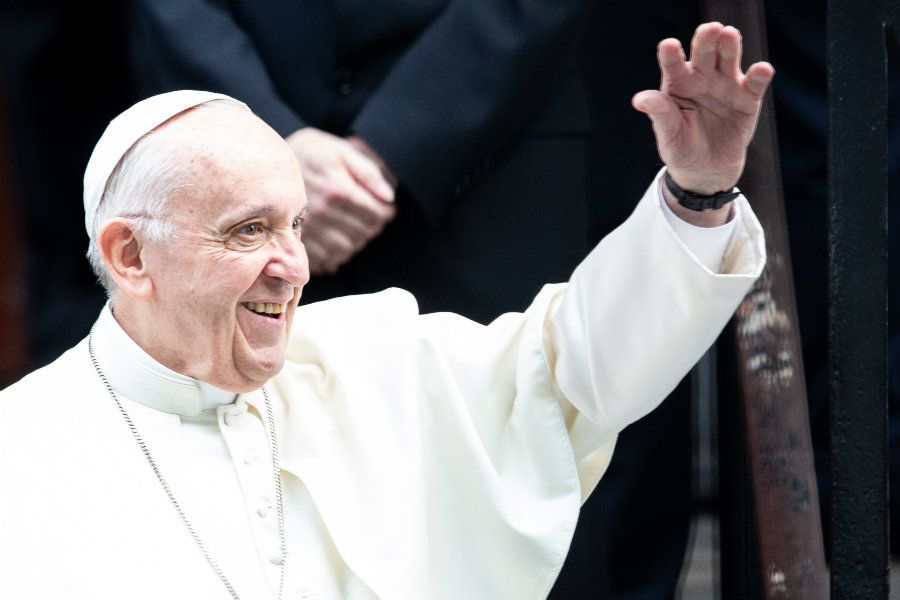
Pope Francis waves at the crowd of 1.5 million people who attended the closing Mass of World Youth Day 2023 in Lisbon, Portugal on Aug. 6, 2023. Vatican Media.
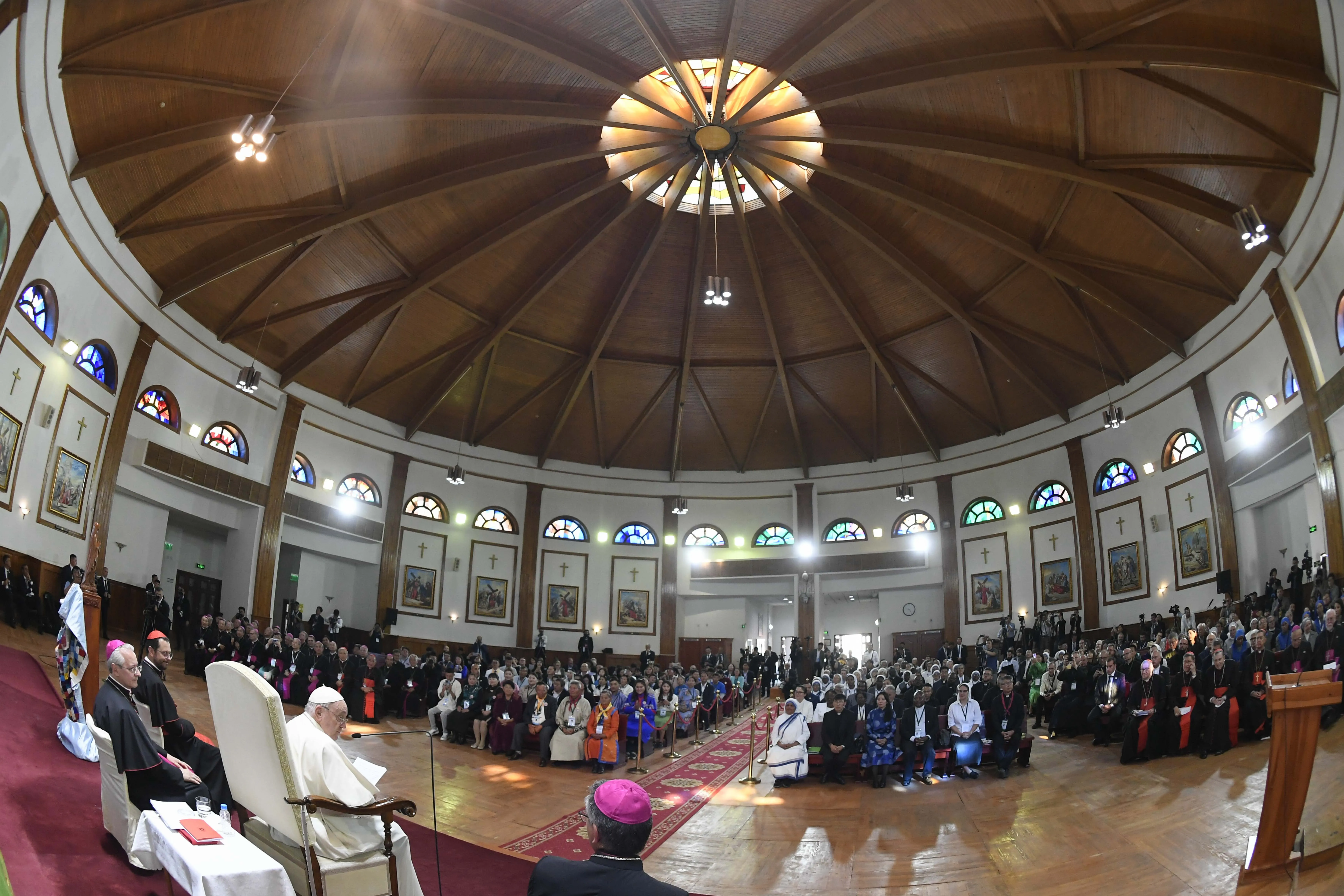
Aug. 31-Sept. 4 — Pope Francis travels to Mongolia, the world’s most sparsely populated sovereign country. The trip makes Francis the first pope to visit the Asian country that shares a 2,880-mile border with China, its most significant economic partner. Mongolia has a population of about 1,300 Catholics in a country of more than 3 million people.
Pope Francis meets with local priests and religious of Mongolia, which includes only 25 priests (19 religious and six diocesan), 33 women religious, and one bishop — Cardinal Giorgio Marengo — in Ulaanbaatar’s Cathedral of Sts. Peter and Paul on Sept. 2, 2023. Credit: Vatican Media
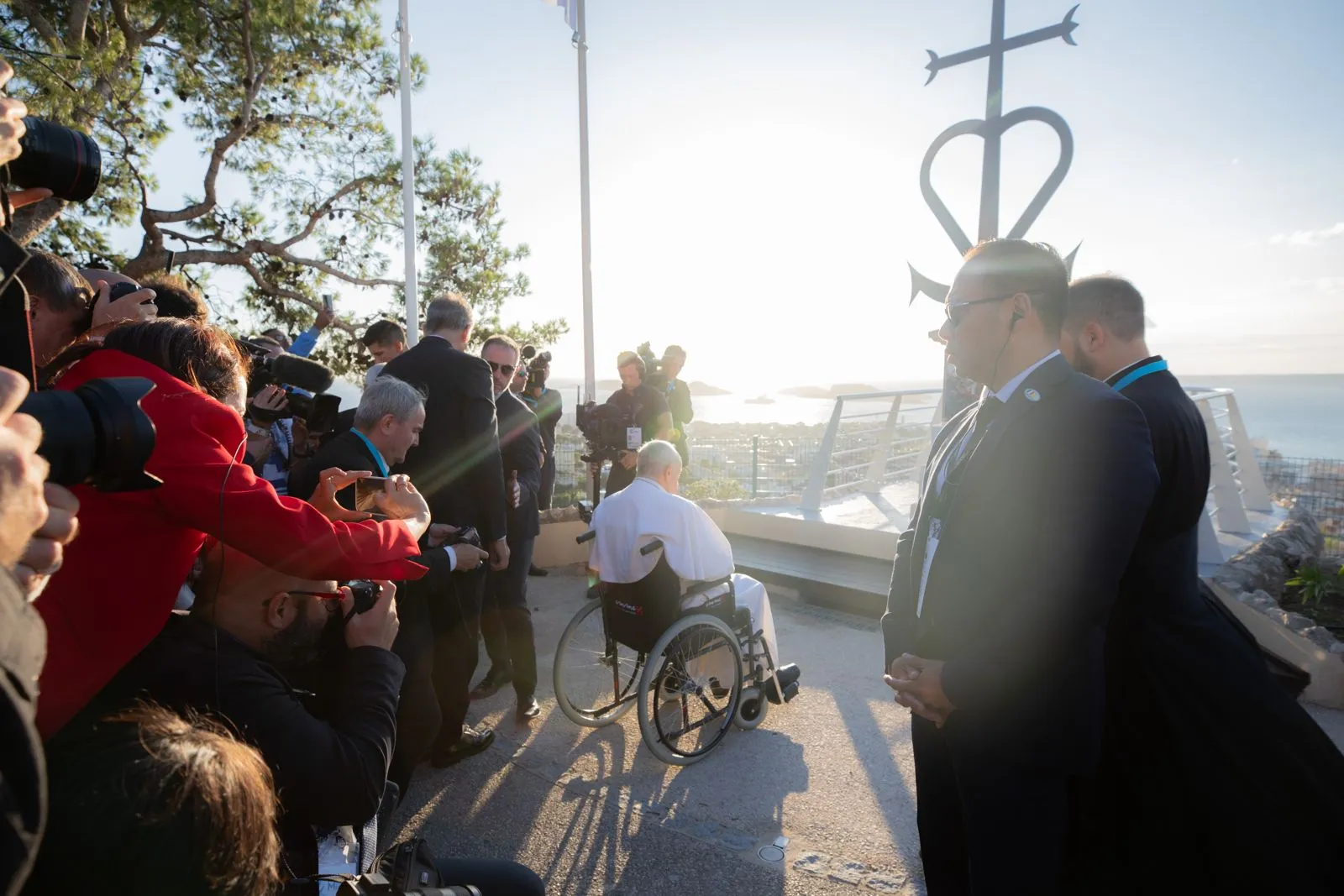
Sept. 22-23 — On a two-day trip to Marseille, France, Pope Francis meets with local civil and religious leaders and participates in the Mediterranean Encounter, a gathering of some 120 young people of various creeds with bishops from 30 countries.
Pope Francis asks for a moment of silence at a memorial dedicated to sailors and migrants lost at sea on the first of a two-day visit to Marseille, France, Sept. 22, 2023. A Camargue cross, which comes from the Camargue area of France, represents the three theological virtues of faith, hope, and charity. The three tridents represent faith, the anchor represents hope, and the heart represents charity. Credit: Daniel Ibañez/CNA
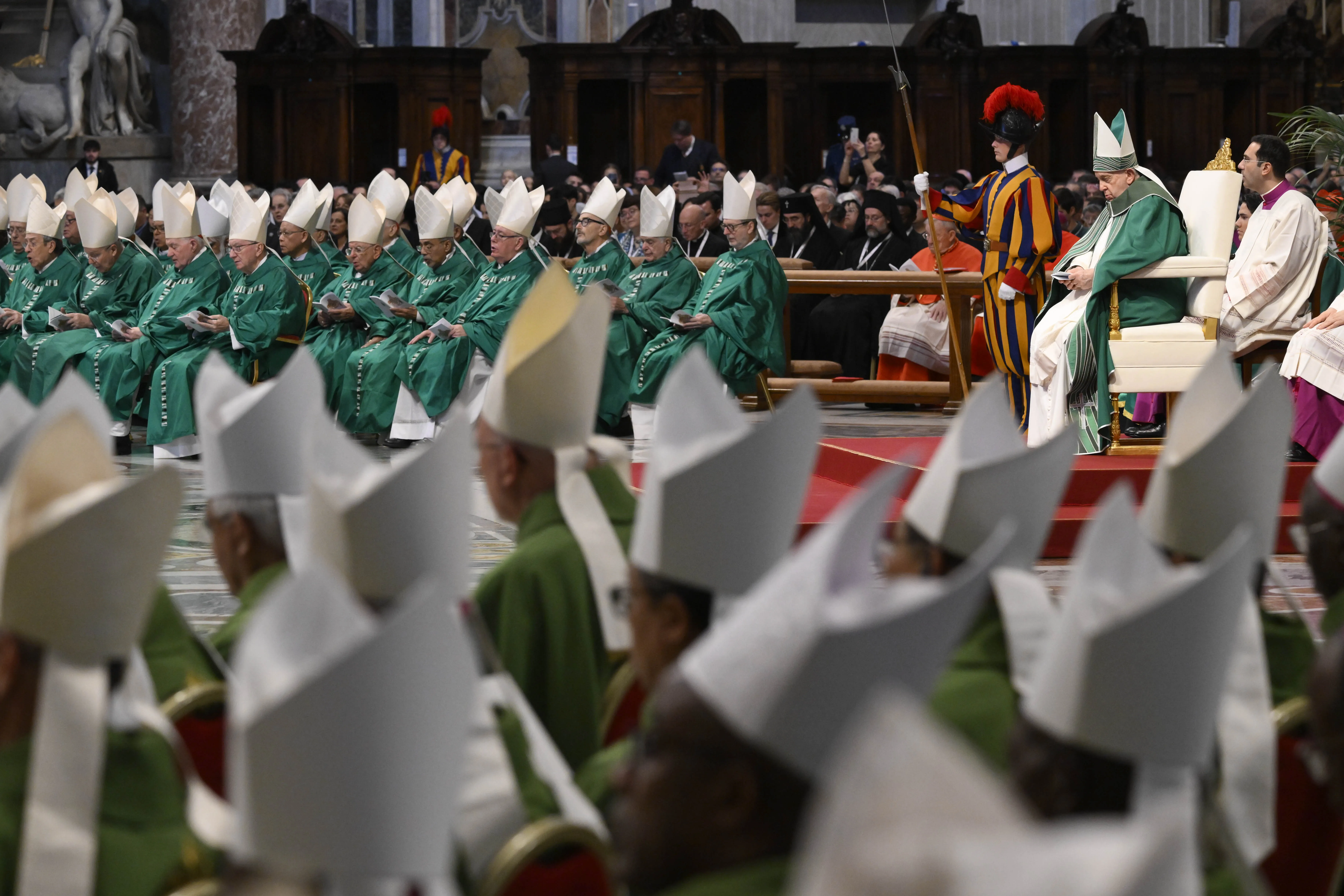
Oct. 4-29 — The Vatican hosts the first of two monthlong global assemblies of the Synod on Synodality, initiated by Pope Francis in 2021 to enhance the communion, participation, and mission of the Church. Pope Francis celebrates the closing Mass of the synod at St. Peter’s Basilica on Oct. 29. The second and final global assembly will take place at the Vatican in October 2024.
Pope Francis at the Synod on Synodality’s closing Mass in St. Peter’s Basilica on Oct. 29, 2023. Vatican Media
Nov. 25 — Pope Francis visits the hospital briefly for precautionary testing after coming down with the flu earlier in the day. Although he still participates in scheduled activities, other officials read his prepared remarks. The Vatican on Nov. 28 cancels the pope’s planned Dec. 1–3 trip to Dubai for the COP28 climate conference, where he was scheduled to deliver a speech, due to his illness.
Dec. 18 — The Dicastery for the Doctrine of the Faith issues the declaration Fiducia Supplicans, which authorizes nonliturgical blessings for same-sex couples and couples in “irregular situations.” Various bishops from around the world voice both support for and criticism of the document.
2024
Jan. 4 — Amid widespread backlash to Fiducia Supplicans, Cardinal Victor Manuel Fernández, prefect of the Dicastery for the Doctrine of the Faith, publishes a five-page press release that refers to Fiducia Supplicans as “perennial doctrine” and underlines that pastoral blessings of couples in irregular situations should not be “an endorsement of the life led by those who request them.”
Jan. 14 — Pope Francis for the first time responds publicly to questions about Fiducia Supplicans in an interview on an Italian television show. The pope underlines that “the Lord blesses everyone” and that a blessing is an invitation to enter into a conversation “to see what the road is that the Lord proposes to them.”
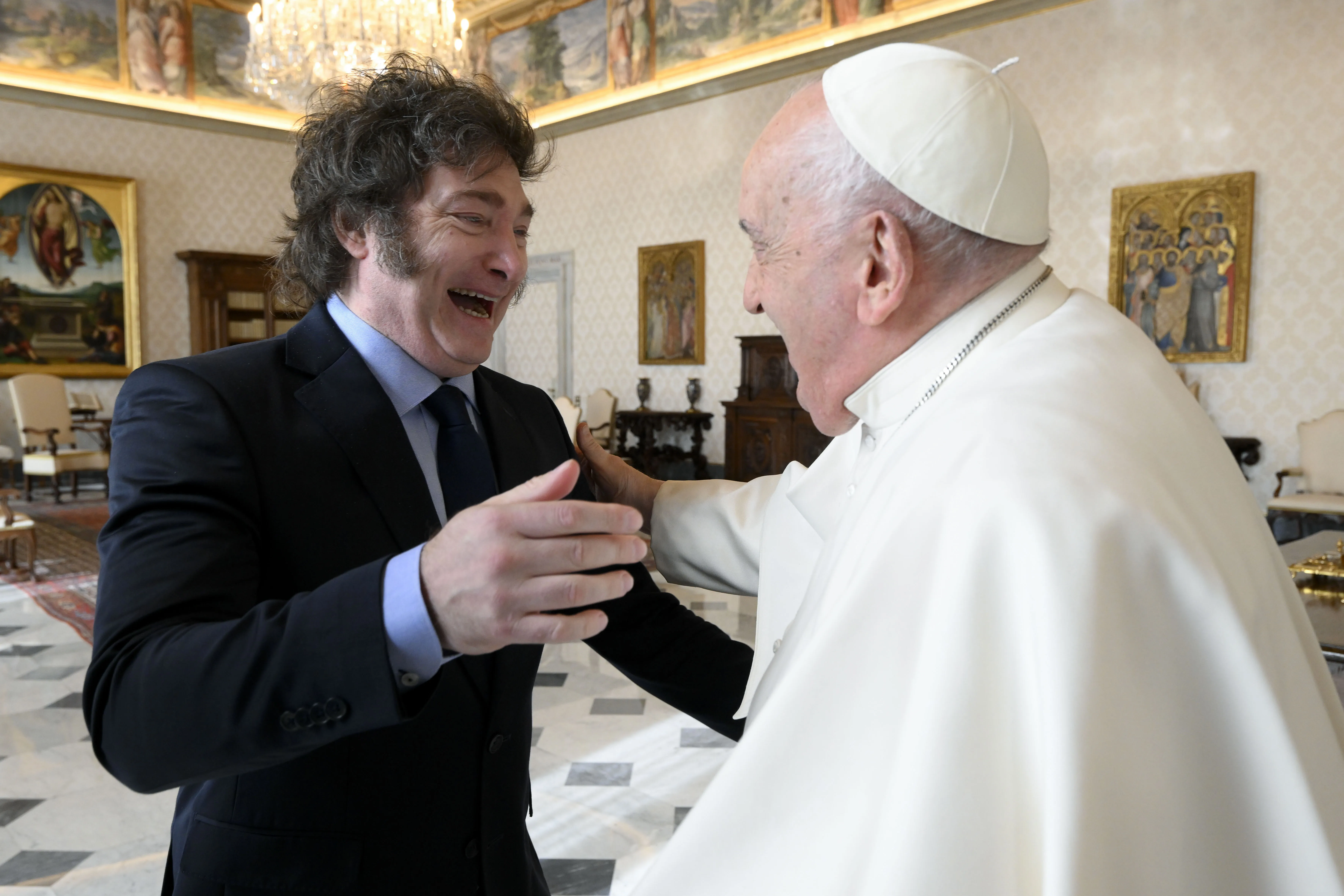
Feb. 11 — In a ceremony attended by Argentine president Javier Milei, Pope Francis canonizes María Antonia of St. Joseph — known affectionately in the pope’s home country as “Mama Antula” — in a Mass at St. Peter’s Basilica. The president and the former archbishop of Buenos Aires embrace after the ceremony. Pope Francis, who has not returned to his homeland since becoming pope in 2013, has said he wants to visit Argentina in the second half of this year.
Pope Francis meets with Argentina President Javier Milei in a private audience on Feb. 12, 2024, at the Vatican. Credit: Vatican Media
Feb. 28 — After canceling audiences the previous Saturday and having an aide read his prepared remarks at his Wednesday audience due to a “mild flu,” Pope Francis visits the hospital for diagnostic tests but returns to the Vatican afterward.
March 2 — Despite having an aide read his speech “because of bronchitis,” the pope presides over the inauguration of the 95th Judicial Year of the Vatican City State and maintains a full schedule.
March 13 — Pope Francis celebrates 11 years as Supreme Pontiff of the Roman Catholic Church.
1 Peter 1:6-7
In this you greatly rejoice, even though now for a little while, if necessary, you have been distressed by various trials, so that the proof of your faith, being more precious than gold which is perishable, even though tested by fire, may be found to result in praise and glory and honor at the revelation of Jesus Christ;
What “lead us not into temptation,..” means is that we ask God not to put us to the test, where in all likelihood being weak and sinful, we would fail. We ask Him to deliver us from temptation, a test of faith, and deliver us from evil. I see us as acknowledging the fact that God can test us at any time, and in any manner but we know that without Him we are doomed to fail.
The article circumvents the issue by making a complication out of nothing. Never mind AP’s editing of Francis statement. The pope said: “It is not a good translation because it speaks of a God who induces temptation.”
The pope is attacking, not a translation, but the original text of prayer that Jesus gave us. The original text from the Lord’s Prayer, as taken from the Latin Vulgate, reads, “et ne inducas nos in temptationem sed libera nos a malo,” which translated is, “lead us not into temptation, but deliver us from evil.” (Matthew 6:13)
The pope is accusing the Our Father of inducing temptation, and in so doing, is inducing his own temptation. He is saying that the prayer, as said in English and Latin speaking countries down through the centuries “is not good.”
Not so. The prayer needs no change. Christ’s words on the mount were perfect.
When we say, “lead us not into temptation,” we’re simply asking God to help us choose right from wrong, good from bad, God from Satan. It is God, our leader, who leads this enterprise, therefore we ask him to “lead us” thus. A seven-year-old CCD student can understand this perfectly, yet the leader of the world’s Catholics can’t seem to get it!
No. In this text of Matthew 4,1 that you cite, the Spirit leads Jesus to a physical place (the wilderness), but it is always Satan the one responsible for the actual temptation, as is very clear in the text. So unlike what you state, the old way doesn’t have a point.
A good Biblical event that compares to the original Gk text that refers to suffering and trial is Job. God permitted Satan to test Job to prove his loyalty. The other is Christ’s temptations by Satan during His forty days trial in the desert. God permitted [we might say allowed or led] Christ to enter a place of suffering trial and test. For benefit of all Mankind. If that was true for Christ we must assume it also includes our own participation with Him in resisting the Evil One. Satan’s presence is coupled with that last sentence, But deliver us from the Evil One to affirm that. Unfortunately the Pontiff seems to overlook that significance, the necessity of trial and our willingness to practice the virtue of Fortitude and reject evil. That dynamic is paramount during this time of Darkness within the Church.
True. While it is not a sin for us to have disordered inclinations, it is a sin to not desire to overcome these disordered inclinations, so that we are not lead into temptation, but become transformed through Salvational Love, God’s Gift of Grace and Mercy.
Fr., the words of Scripture are clear in Matt 4 that the Spirit LED Jesus into the desert to be tempted by the devil. Mark is even stronger saying that the Spirit drove Him into the desert. The event is the typological fulfilment of Moses and the Israelites being led into the desert by God to be put to the test or tempted. While it may be the world, the flesh or the devil which actually do the tempting, it is clear from Scripture that God can and does lead His people through a testing at various times.
Amen to that. I have no religion, I have simply faith in the Lord JESUS CHRIST and our father God. The GOD of all Gods. Creator of all the universe. I have faith in his words. I am afraid of his power. I tried everyday to follow him and repent and I am Hopi g that he gives me Grace through faith in my life. As being a good person from the Gospel of JESUS CHRIST. Amen!
The French translation is not, as you say. I shudder to think what the bishop’s conferences are going to come up with now that they have been given their heads. Jerome’s Latin is a word for word translation of the NT Greek. If there were something theologically askew here, surely the Church Fathers/Doctors would have noticed long before now. Are there ancient commentaries to that effect? What no one seems to have commented on is the way the sentence ends : sed libera nos a malo, BUT deliver us/free us/liberate us from evil. That, to be freed from all evil, is what we are asking of the Father in this last petition of the prayer.
Ya know why Francis wants to change the “Our Father”? Coz he’s so humble! No, don’t laugh! It’s taken us 2,000 years to get to this point. Those other pitiful sinners throughout the millenia couldn’t figure this out.
But what about “Tradition” you say? Pffffffttt………….tradition……shmadition! You’re rii-gid! Riiiii-ggiiidd!!!
Let’s hope the Pope doesn’t start reading the Old Testament. What would he make of the following?
“And he smote the men of Bethshemesh, because they had looked into the ark of the LORD, even he smote of the people fifty thousand and threescore and ten men: and the people lamented, because the LORD had smitten many of the people with a great slaughter.” 1 Samuel 6:19
Perhaps that also is a bad translation? Maybe “smote” should be translated as “he took them to the naughty step and asked them to try and be good next time”
I may be wrong, but I sense a tinge of Manichaeism here.
Once again we see the Pope who is always promoting discernment ignoring the primary discernment of the Church for its flock – The Catechism of the Catholic Church. Why couldn’t Pope Francis have just said ” I encourage all to read the Catechism of the Church which reflects on this in consideration of tradition and sacred scripture” – but that would of course assume that he is not hankering to play volley ball with the Catechism (for the sake of perpetual discernment).
Would it be disrespectful to suggest that Pope Francis should consider putting less effort into making the Our Father “less confusing” in favor of putting more effort into fixing his own confusing remarks?
Hmm … in all of the commentaries and comments, I haven’t heard anything about Liturgiam Authenticam. Perhaps we need to take a different view of the Holy Father’s statement.
Perhaps, just perhaps mind you, Francis is giving a round-about approval for his notion that every episcopal conference should be able to translate the liturgy any way they like. Remember this is primarily about the translation used in the liturgy!
Kind of like if he were to write an ambiguous teaching about, say, who could receive the sacraments, and then obliquely acknowledges a bishop’s conference in South America as having the correct interpretation without actually addressing said ambiguous teaching. This kind of fits his pattern of tossing something out there and then winking and nodding his approval when someone else puts it into actual practice.
I always thought that “lead us not into temptation but deliver us from evil” was an admission to God that we know we are weak sinners, so he doesn’t need to put us to the test so that we become aware of that.
God already knows us through and through; the test would be for our sake, not His. The test, if God decides we need it, is for our own good; it keeps us from becoming self-satisfied and self-righteous like the pharisees. Even if we don’t “flunk it” we become aware of our inclination to sinfulness and our need of God’s grace.
Regretfully this incident of gross imprudence on the part of the Bishop of Rome merely reflects the personal comportment of broad component of the clergy class bent on their own notions, without depth reflection, but merely unleashed by the absence of impulse control.
They must spray paint their “tag” on everything.
Its purpose ultimately is self aggrandizement. Its immediate consequence is to “lead us into error” at the hands of “pastors.”
Utterly tragic.
If he, Pope Francis is not changing the Lord’s prayer in that phrase, Lead us not into temptation, then why at mass last evening, Saturday, 2-17, did our priest say from the pulpit, the Pope wants us to say,,,,and he repeated the phrase the Pope has said we should now say. It was a shocker to many. I don’t believe many said the new phrase though. I have been saying the Lord’s Prayer for 80 years and since I was 3 when my Mother taught me. I am not about to change for anyone else because I believe this is the way the Dearest Lord Jesus taught it to be said.Correct me if I am wrong.
It seems to me a great deal of latitude is given to local Pastors and priests. Perhaps too much latitude. You should write (and sign) a respectful letter to your pastor and Bishop objecting to the change. I have not heard any official change has come down from the Pope on this prayer. It is possible your priest took too much upon himself in his enthusiasm for the supposed change and acted on his own without authorization.






Matthew
4:1 “Then Jesus was led by the Spirit into the wilderness to be tempted by the devil.”
The old way has a point….according to 4:1.
1 Peter 1:6-7
In this you greatly rejoice, even though now for a little while, if necessary, you have been distressed by various trials, so that the proof of your faith, being more precious than gold which is perishable, even though tested by fire, may be found to result in praise and glory and honor at the revelation of Jesus Christ;
What “lead us not into temptation,..” means is that we ask God not to put us to the test, where in all likelihood being weak and sinful, we would fail. We ask Him to deliver us from temptation, a test of faith, and deliver us from evil. I see us as acknowledging the fact that God can test us at any time, and in any manner but we know that without Him we are doomed to fail.
Absolutely so.
I always feel that the meaning is in asking God to grant that we may not be led into temptation — but not that He is doing the ‘leading’.
Yes, and the old way is always the best.
The article circumvents the issue by making a complication out of nothing. Never mind AP’s editing of Francis statement. The pope said: “It is not a good translation because it speaks of a God who induces temptation.”
The pope is attacking, not a translation, but the original text of prayer that Jesus gave us. The original text from the Lord’s Prayer, as taken from the Latin Vulgate, reads, “et ne inducas nos in temptationem sed libera nos a malo,” which translated is, “lead us not into temptation, but deliver us from evil.” (Matthew 6:13)
The pope is accusing the Our Father of inducing temptation, and in so doing, is inducing his own temptation. He is saying that the prayer, as said in English and Latin speaking countries down through the centuries “is not good.”
Not so. The prayer needs no change. Christ’s words on the mount were perfect.
When we say, “lead us not into temptation,” we’re simply asking God to help us choose right from wrong, good from bad, God from Satan. It is God, our leader, who leads this enterprise, therefore we ask him to “lead us” thus. A seven-year-old CCD student can understand this perfectly, yet the leader of the world’s Catholics can’t seem to get it!
No. In this text of Matthew 4,1 that you cite, the Spirit leads Jesus to a physical place (the wilderness), but it is always Satan the one responsible for the actual temptation, as is very clear in the text. So unlike what you state, the old way doesn’t have a point.
A good Biblical event that compares to the original Gk text that refers to suffering and trial is Job. God permitted Satan to test Job to prove his loyalty. The other is Christ’s temptations by Satan during His forty days trial in the desert. God permitted [we might say allowed or led] Christ to enter a place of suffering trial and test. For benefit of all Mankind. If that was true for Christ we must assume it also includes our own participation with Him in resisting the Evil One. Satan’s presence is coupled with that last sentence, But deliver us from the Evil One to affirm that. Unfortunately the Pontiff seems to overlook that significance, the necessity of trial and our willingness to practice the virtue of Fortitude and reject evil. That dynamic is paramount during this time of Darkness within the Church.
True. While it is not a sin for us to have disordered inclinations, it is a sin to not desire to overcome these disordered inclinations, so that we are not lead into temptation, but become transformed through Salvational Love, God’s Gift of Grace and Mercy.
Fr., the words of Scripture are clear in Matt 4 that the Spirit LED Jesus into the desert to be tempted by the devil. Mark is even stronger saying that the Spirit drove Him into the desert. The event is the typological fulfilment of Moses and the Israelites being led into the desert by God to be put to the test or tempted. While it may be the world, the flesh or the devil which actually do the tempting, it is clear from Scripture that God can and does lead His people through a testing at various times.
Amen to that. I have no religion, I have simply faith in the Lord JESUS CHRIST and our father God. The GOD of all Gods. Creator of all the universe. I have faith in his words. I am afraid of his power. I tried everyday to follow him and repent and I am Hopi g that he gives me Grace through faith in my life. As being a good person from the Gospel of JESUS CHRIST. Amen!
The French translation is not, as you say. I shudder to think what the bishop’s conferences are going to come up with now that they have been given their heads. Jerome’s Latin is a word for word translation of the NT Greek. If there were something theologically askew here, surely the Church Fathers/Doctors would have noticed long before now. Are there ancient commentaries to that effect? What no one seems to have commented on is the way the sentence ends : sed libera nos a malo, BUT deliver us/free us/liberate us from evil. That, to be freed from all evil, is what we are asking of the Father in this last petition of the prayer.
Can’t take anything the pope says seriously anymore, but neither can i just assume anything he says is innocent.
As I understand the Cathecism the difficulty was translating from Greek and arriving at “lead” in the English translation.
I’m so exhausted from Pope Francis.
Thanks, Your Holiness, for another nothing burger.
Great job.
I wonder what Pope F thinks he should call his new “Church”?
Chris. Hazel Motes [Wiseblood] Church of Christ Without Christ sounds fitting.
Why don’t they have like buttons anymore?
Ya know why Francis wants to change the “Our Father”? Coz he’s so humble! No, don’t laugh! It’s taken us 2,000 years to get to this point. Those other pitiful sinners throughout the millenia couldn’t figure this out.
But what about “Tradition” you say? Pffffffttt………….tradition……shmadition! You’re rii-gid! Riiiii-ggiiidd!!!
Let’s hope the Pope doesn’t start reading the Old Testament. What would he make of the following?
“And he smote the men of Bethshemesh, because they had looked into the ark of the LORD, even he smote of the people fifty thousand and threescore and ten men: and the people lamented, because the LORD had smitten many of the people with a great slaughter.” 1 Samuel 6:19
Perhaps that also is a bad translation? Maybe “smote” should be translated as “he took them to the naughty step and asked them to try and be good next time”
I may be wrong, but I sense a tinge of Manichaeism here.
He wouldn’t touch that as it is not an experience of the faithful.
Once again we see the Pope who is always promoting discernment ignoring the primary discernment of the Church for its flock – The Catechism of the Catholic Church. Why couldn’t Pope Francis have just said ” I encourage all to read the Catechism of the Church which reflects on this in consideration of tradition and sacred scripture” – but that would of course assume that he is not hankering to play volley ball with the Catechism (for the sake of perpetual discernment).
Might it not apply to those who do not read, but nevertheless learn the faith by rote and repetition?
Would it be disrespectful to suggest that Pope Francis should consider putting less effort into making the Our Father “less confusing” in favor of putting more effort into fixing his own confusing remarks?
Hmm … in all of the commentaries and comments, I haven’t heard anything about Liturgiam Authenticam. Perhaps we need to take a different view of the Holy Father’s statement.
Perhaps, just perhaps mind you, Francis is giving a round-about approval for his notion that every episcopal conference should be able to translate the liturgy any way they like. Remember this is primarily about the translation used in the liturgy!
Kind of like if he were to write an ambiguous teaching about, say, who could receive the sacraments, and then obliquely acknowledges a bishop’s conference in South America as having the correct interpretation without actually addressing said ambiguous teaching. This kind of fits his pattern of tossing something out there and then winking and nodding his approval when someone else puts it into actual practice.
{Sorry, that should read Magnum Principium, not Liturgiam Authenticam}
I always thought that “lead us not into temptation but deliver us from evil” was an admission to God that we know we are weak sinners, so he doesn’t need to put us to the test so that we become aware of that.
God already knows us through and through; the test would be for our sake, not His. The test, if God decides we need it, is for our own good; it keeps us from becoming self-satisfied and self-righteous like the pharisees. Even if we don’t “flunk it” we become aware of our inclination to sinfulness and our need of God’s grace.
What’s not complicated is the fact the Pope is a burden right now on faithful Catholics.
Regretfully this incident of gross imprudence on the part of the Bishop of Rome merely reflects the personal comportment of broad component of the clergy class bent on their own notions, without depth reflection, but merely unleashed by the absence of impulse control.
They must spray paint their “tag” on everything.
Its purpose ultimately is self aggrandizement. Its immediate consequence is to “lead us into error” at the hands of “pastors.”
Utterly tragic.
If he, Pope Francis is not changing the Lord’s prayer in that phrase, Lead us not into temptation, then why at mass last evening, Saturday, 2-17, did our priest say from the pulpit, the Pope wants us to say,,,,and he repeated the phrase the Pope has said we should now say. It was a shocker to many. I don’t believe many said the new phrase though. I have been saying the Lord’s Prayer for 80 years and since I was 3 when my Mother taught me. I am not about to change for anyone else because I believe this is the way the Dearest Lord Jesus taught it to be said.Correct me if I am wrong.
It seems to me a great deal of latitude is given to local Pastors and priests. Perhaps too much latitude. You should write (and sign) a respectful letter to your pastor and Bishop objecting to the change. I have not heard any official change has come down from the Pope on this prayer. It is possible your priest took too much upon himself in his enthusiasm for the supposed change and acted on his own without authorization.
Someone should suggest the Pope become familiar with a well known Americanism:
“If it ain’t broke, don’t fix it.” Leave the Our Father alone.