Washington D.C., Dec 8, 2017 / 03:43 pm (CNA/EWTN News).- The U.S. Department of Justice has launched a formal investigation of Planned Parenthood, the nation’s largest provider of abortions, for their role in the alleged sale of baby body parts.
“The Justice Department’s investigation of Planned Parenthood is a major turning point in the battle to hold the nation’s largest abortion business accountable,” Marjorie Dannenfelser, president of the Susan B. Anthony List, said Dec. 8.
“Evidence shoes Planned Parenthood sought to squeeze every last opportunity for cash from the sale of hearts, brains, lungs, and livers of aborted children… that ends now,” Dannenfelser continued.
The Justice Department confirmed Dec. 7 they were formally looking into allegations against Planned Parenthood for the illegal sale of aborted baby body parts.
“Over two years ago, citizen journalists at the Center for Medical Progress first caught Planned Parenthood’s top abortion doctors in a series of undercover videos callously and flippantly negotiating the sale of tiny baby hearts, lungs, livers and brains,” said Daleiden Dec. 8, according to Fox News.
“It is time for public officials to finally hold Planned Parenthood and their criminal abortion enterprise accountable under the law,” he continued.
While federal law allows compensation for fetal tissue to be used for research purposes, the amount of money received from clinics is not allowed to be of “valuable consideration,” and should only cover the costs of transportation and preservation.
Planned Parenthood and other clinics were recommended to the Justice Department for investigation by Senate Judiciary Committee Chairman Chuck Grassley (R-Iowa) in December 2016, after publishing the “Human Fetal Tissue Research: Context and Controversy” report.
Grassley reported that the committee found “substantial evidence” suggesting that Planned Parenthood and other parties “may have violated” the law by charging more money for fetal tissue and baby body parts than was actually recommended.
Stephen Boyd, the Justice Department assistant attorney general for legislative affairs, originally requested the unredacted documents from the Senate Judiciary Committee from the 2016 report. Last month, the FBI additionally requested these documents for investigative purposes.
“The Department of Justice appreciates the offer of assistance in obtaining these materials, and would like to request the Committee provide unredacted copies of records contained in the report, in order to further the Department’s ability to conduct a thorough and comprehensive assessment of that report based on the full range of information available,” stated Boyd, according to Fox News.
Planned Parenthood has denied accusations of breaking the law.
If you value the news and views Catholic World Report provides, please consider donating to support our efforts. Your contribution will help us continue to make CWR available to all readers worldwide for free, without a subscription. Thank you for your generosity!
Click here for more information on donating to CWR. Click here to sign up for our newsletter.
Philadelphia, Pa., Sep 23, 2018 / 03:01 pm (CNA/EWTN News).- Archbishop Charles Chaput offered Friday on First Things a critique by a theologian of the working document for the upcoming Synod on Youth, which highlights five principal theological difficulties in the document.
The synod will be held Oct. 3-28 at the Vatican. Archbishop Chaput is one of five representatives who were chosen by the US bishops’ conference to attend the meeting.
In addition, Pope Francis appointed Cardinal Blase Cupich of Chicago and Cardinal Joseph Tobin of Newark; though Tobin has elected not to attend, citing pastoral obligations in his local Church amid the sexual abuse crisis.
The Archbishop of Philadelphia wrote Sept. 21 that in recent months he has “received scores of emails and letters from laypeople, clergy, theologians, and other scholars, young and old, with their thoughts regarding the October synod of bishops in Rome focused on young people.”
“Nearly all” of those “note the importance of the subject matter”, “praise the synod’s intent”, and “raise concerns of one sort or another about the synod’s timing and possible content,” he wrote.
Archbishop Chaput shared the text of a critique of the instrumentum laboris, which he received “from a respected North American theologian.”
He noted it “is one person’s analysis; others may disagree. But it is substantive enough to warrant much wider consideration and discussion as bishop-delegates prepare to engage the synod’s theme.”
The theologian identified five principal problems with the text of the instrumentum laboris for the youth synod: naturalism, an inadequate grasp of the Church’s spiritual authority, a partial theological anthropology, a relativistic conception of vocation, and an impoverished understanding of Christian joy.
The author said the document “displays a pervasive focus on socio-cultural elements, to the exclusion of deeper religious and moral issues,” and expresses a desire to examine reality through the faith and experience of the Church, while “regrettably fail[ing] to do so.”
Four examples of this naturalism are given. One of them is the discussion in section 144, where “there is much discussion about what young people want; little about how these wants must be transformed by grace in a life that conforms to God’s will for their lives.”
“After pages of analysis of their material conditions, the IL offers no guidance on how these material concerns might be elevated and oriented toward their supernatural end … the majority of the document painstakingly catalogues the varied socio-economic and cultural realities of young adults while offering no meaningful reflection on spiritual, existential, or moral concerns. The reader may easily conclude that the latter are of no importance to the Church,” the theologian wrote.
The theologian next discussed the document’s “inadequate grasp of the Church’s spiritual authority,” saying that “the entire document is premised on the belief that the principal role of the magisterial Church is ‘listening.’”
By its emphasis on listening and dialogue, the instrumentum laboris suggests that “the Church does not possess the truth but must take its place alongside other voices,” the author wrote. “Those who have held the role of teacher and preacher in the Church must replace their authority with dialogue.”
This misunderstanding of the Church’s teaching authority results in a “conflation of the baptismal and sacramental priesthood”, the theologian wrote, and it also “presents a pastoral problem”: “the Church as mother and teacher cannot through negligence or cowardice forfeit this necessary role of setting limits and directing (Cf. §178). In this regard §171, which points to the motherhood of the Church, does not go far enough. It offers only a listening and accompanying role while eliminating that of teaching.”
Third, the theologian discussed the “partial theological anthropology” of the instrumentum laboris, which they said “fails to make any mention of the will” in its discussion of the human person.
“It is the will that is fundamentally directed toward the good,” the author notes. “The theological consequence of this glaring omission is extraordinarily important, since the seat of the moral life resides in the will and not in the vicissitudes of the affect.”
Then is discussed the “relativistic conception of vocation” in the document, which gives the impression “that vocation concerns the individual’s search for private meaning and truth.”
An example of this problem is section 139, which “gives the impression that the Church cannot propose the (singular) truth to people and that they must decide for themselves. The role of the Church consists only in accompaniment. This false humility risks diminishing the legitimate contributions that the Church can and ought to make.”
The last principal difficulty of the instrumentum laboris is its impoverished understanding of Christian joy, according to the theologian.
Spirituality and the moral life “are reduced to the affective dimension, clearest in §130, evidenced by a sentimentalist conception of ‘joy.’”
According to the theologian, the document presents joy as “a purely affective state, a happy emotion … Despite its constant reference to ‘joy,’ nowhere does the IL describe it as the fruit of the theological virtue of charity. Nor is charity characterized as the proper ordering of love, putting God first and then ordering all other loves with reference to God.”
Consequent upon this understanding of joy is a lack of “any theology of the Cross” in the instrumentum laboris.
“Christian joy is not antithetical to suffering, which is a necessary component of a cruciform life,” the theologian writes. “The document gives the impression that the true Christian will be ‘happy’ at all times, in the colloquial sense. It further implies the error that the spiritual life itself will always result in felt (affective) joy.”
“The pastoral problem that results from this comes to the fore most clearly in §137: Is it the role of the Church to make youth “feel loved by him [God]” or to aid them in knowing they are loved regardless of how they might feel?”
The theologian added that there are other serious theological concerns in the document, noting, “a false understanding of the conscience and its role in the moral life; a false dichotomy proposed between truth and freedom; false equivalence between dialogue with LGBT youth and ecumenical dialogue; and an insufficient treatment of the abuse scandal.”
A scene from the trailer promoting Liberty University’s campus ministry production of “Scaremare.” / Scaremare on YouTube
Washington, D.C. Newsroom, Oct 29, 2022 / 10:55 am (CNA).
This October some churches and ministries in the United States are once again hosting Christian versions of haunted houses, and nonbelievers and believers alike are lining up for some rather existential spine-tingling for the first time since the pandemic.
Popular among evangelical Protestant churches in the South, these “judgment houses” typically stage dramatic representations depicting what happens after people die, leaving visitors to ponder whether they themselves are headed for heaven or hell, and presumably, to act accordingly.
Is this a good way to save souls? Some Catholics experts in evangelization who spoke to CNA have reservations.
A different way to evangelize
The late Jerry Falwell, the Baptist televangelist, and founder of Liberty University, in Lynchburg, Virginia, is credited with hosting the first judgment house in 1972, “Scaremare.”
Scaremare is still going strong in Lynchburg, where the university’s campus ministry stages a production every year around Halloween that draws people from all over the region attracted by the lure of “fun-house rooms and scenes of death in order to confront people with the question ‘What happens after I die?’”
The performance does not disappoint those looking for the sort of adrenaline surge a horror movie produces. As many as 4,000 visitors a night witness gruesome death scenes including a massacre at a movie theater and a camper who is mauled by a wild animal.
According to Josh Coldren, the director of the 2022 production of Scaremare, the scenes are intended to make people think about their fears and their mortality.
“We talk about how everyone faces death, but how there is hope beyond our fears and hope beyond death, and that hope is in Jesus Christ,” Coldren told CNA.
According to Scaremare’s website, over 26,000 people who visited over the years “have made decisions for Christ over the past two decades. Ironically, this House of Death points to the Way of Life!”
While judgment houses can function as memento mori, efficacious reminders of the inevitability of death, some judgment houses, also known as “Hell Houses,” have become controversial for taking the idea to an extreme. Graphic scenes such as abortions, extramarital sex, and drug use are sometimes depicted along with the consequence of these actions as the sinners are shown condemned to spend eternity in hell.
Scaremare doesn’t get into these issues or talk about hell at all, Coldren told CNA.
“We don’t have a scene of hell, and we stay away from demons. We believe those things are real, we just make sure we stay away from them,” Coldren said.
Tom Hudgins, is the owner of Judgement House, a company based in Seminole, Florida, that provides scripts to churches to stage dramas. Before COVID, he told CNA, they helped as many as 350 churches at a time hold Judgement Houses. They are slowly getting back to business, he said, and about 50 participating churches are listed on their website.
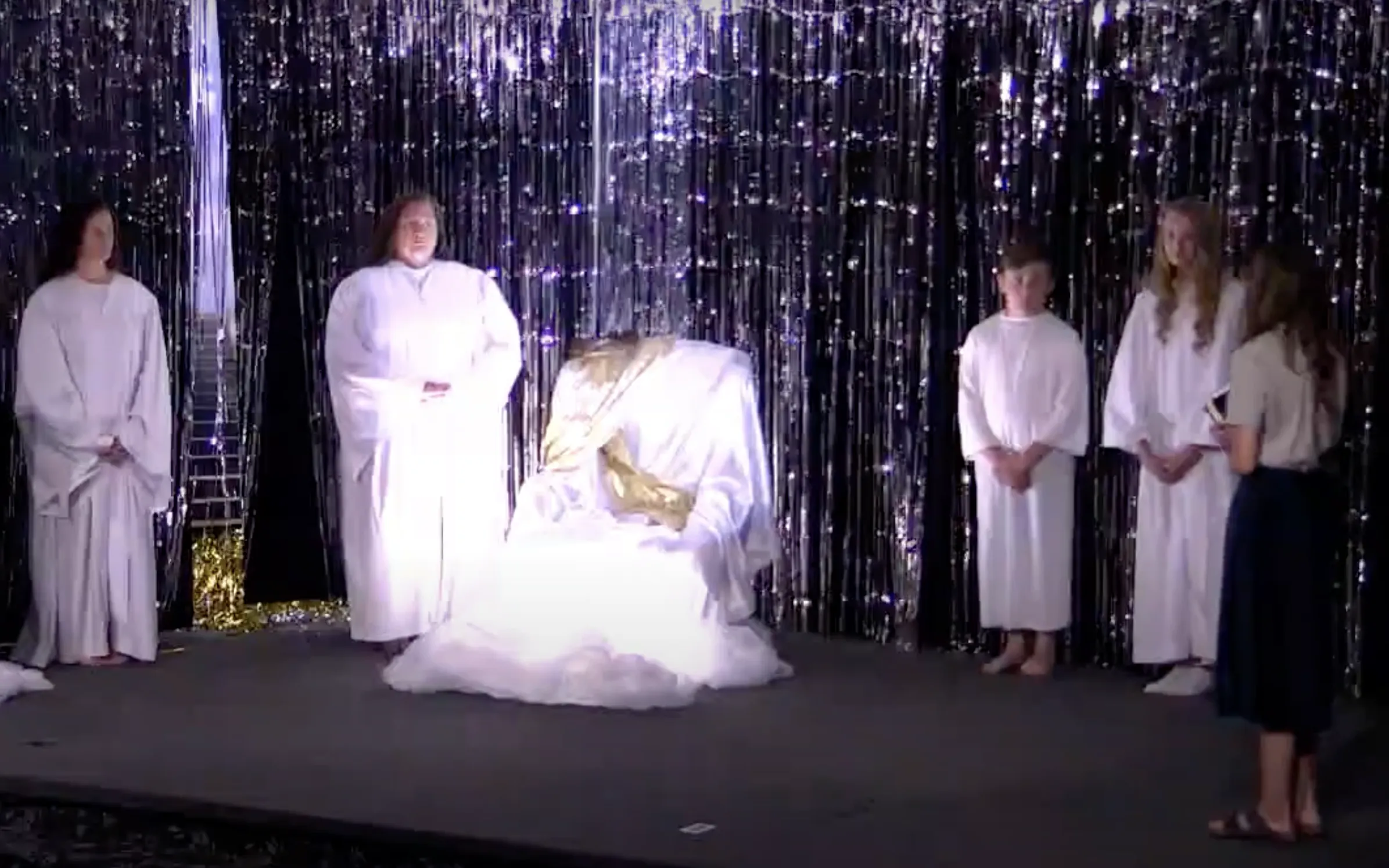
Hudgins explained to CNA that, unlike more extreme Hell House productions, his scripts never talk about social issues. Small groups of visitors walk through scenes meant to encourage self-reflection. Each production begins with death, by a car crash or cancer, for example, and then the audience sees what happens after death.
“They see what hell would be like, but they also see what heaven will be like, and everyone can make their own decisions,” Hudgins said.
A scene from a production of a Judgement House script. Decaturville Pentecostal Church YouTube
Bonnie Gilliland, the dramatic director at Morningside Baptist Church in Tallahassee, Florida, is staging a play with the help of Judgement House this October. She told CNA that the productions are a way of sharing the Gospel.
“We include a lot of scripture, it’s very biblically based,” she said.
Gilliland explained that this year’s production isn’t just for nonbelievers – it’s meant to give the regular churchgoer a wake-up call.
“The current drama gives people an opportunity to understand and examine whether they have a relationship with Jesus Christ because it’s more than just going to church, it’s about accepting Jesus as your savior and receiving the gift of eternal life,” Gilliland said.
Kelly Armstrong, the director of the judgment house at New Harmony Baptist Church in Albertville, Alabama, told CNA that past productions have depicted scenes of car wrecks, overdoses, and abuse.
Visitors see “how people make decisions that affect their eternity,” he said. “It brings our church together, and makes people think.”
Catholic criticism of “hell houses”
Judgment houses have not found favor among Catholic churches in the United States, and two experts in evangelization and pastoral care told CNA that they don’t think talking about hell attracts people to the Church.
Sherry Weddell is the founder of the Catherine of Siena Institute, an apostolate that helps evangelize Catholic parishes to turn pew-sitters into “intentional missionary disciples.” She told CNA that she advises any Catholics considering introducing hell-related themes to their Halloween decorations or celebrations, to rethink that idea.
“If you live in an area that has a significant number of young adults, especially parents of young children, or in an area that is highly secularized like urban areas of the East or West coasts, many will find it offensive or off-putting. And there is a real chance that sensitive and young children could be upset by it which would fuel their parents’ unhappiness with the sponsoring Catholic community,” Weddell explained.
“You could upset people who might otherwise have been open to attending an Advent or Christmas event at your parish or just open to a friendship with a Catholic like you.
“Instead of building or strengthening bridges of trust, you could be shattering or weakening whatever trust may already exist. There are creative, positive, child and parent-friendly alternatives such as “trunk-or-treating,” costume parties, and community of light events that foster both long-standing relationships and fun,” Weddell said.
Monsignor Stephen Rossetti, the chief exorcist for the Archdiocese of Washington, and a psychologist and researcher at the Catholic University of America, told CNA that the threat of hell isn’t effective in this day and age.
“People today are not convinced or influenced by threats of hell. The Church just really stopped doing that because it just doesn’t work. You know, you can do all the hellfire and damnation sermons you want, but people just kind of yawn, “ Rossetti said.
“We’re trying to emphasize God’s love and God’s mercy, which I think is much more to the point, frankly. And also more of a message that’s needed in our day. And I think that started with Pope John XXIII at Vatican II. He said, today what the message needs to be is of God’s mercy and compassion and God’s love.
“This is what attracts people, and this is sort of the core of our message. God loves us and God has saved us out of his love and compassion in Jesus,” he said.






Leave a Reply