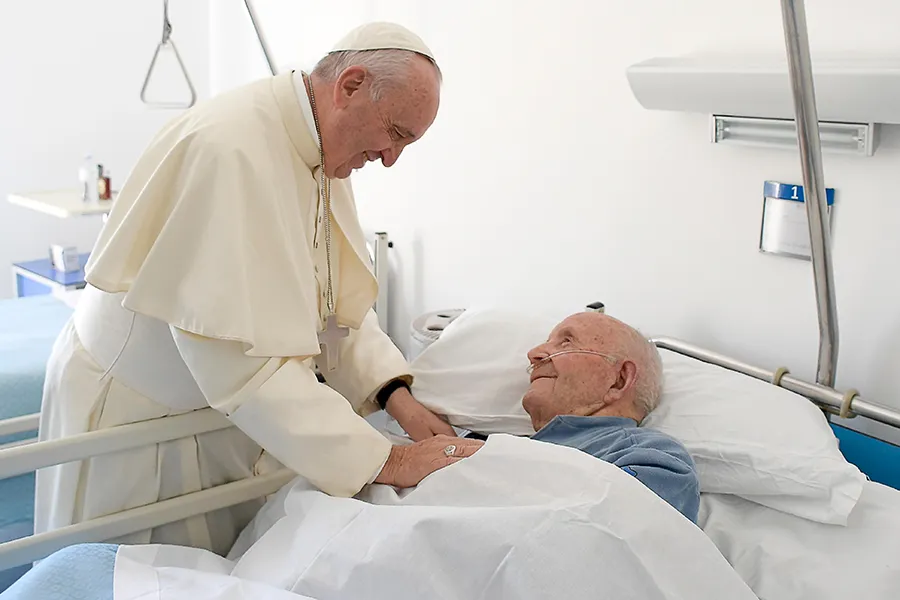
Vatican City, Dec 4, 2017 / 10:14 am (CNA/EWTN News).- In his prayer video for the month of December, Pope Francis prays for grandparents and the elderly, urging people to respect and support them, that their wisdom may continue to be passed down to new generations.
“A people that does not take care of grandparents, that does not treat them well, has no future!” the Pope said in the video. “The elderly have wisdom.”
He also noted that the elderly have a great responsibility to pass on to others their life experiences, and the histories of their family, community and culture.
“Let us keep in mind our elders, so that sustained by families and institutions, (they) may with their wisdom and experience collaborate in the education of new generations,” he concluded.
Released Dec. 4, the video takes a more light-hearted approach than past prayer intention videos, first depicting a young man who ignores several elderly people he passes on the street.
Soon after the young man hears lively jazz music coming from a building, and upon entering, discovers the three he passed earlier all playing music together. They then invite him to join them.
The importance of the relationship between the elderly and the younger generation, particularly between grandparents and their grandkids, is one of Pope Francis’ favorite topics.
Last year in Rome he held an audience with around 7,000 grandparents, urging them to talk with their grandkids about the faith.
“And talk to your grandchildren, talk. Let them ask you questions,” he said. They may be different from you, they may have other hobbies, “they like other music… but they need the elderly, this ongoing dialogue.”
“You are an important presence, because your experience is a precious treasure, essential to looking to the future with hope and responsibility,” the Pope said at that encounter, Oct. 15, 2016.
At a special Mass in June he said that the older generation is called to be spiritual “grandparents” to young people, sharing their experiences, especially of the faith.
“And this is what the Lord today asks us: to be grandparents. To have the vitality to give to young people, because young people expect it from us; to not close ourselves, to give our best: they look for our experience, for our positive dreams to carry on the prophecy and the work,” he said.
“I ask the Lord for all of us that he give us this grace.”
If you value the news and views Catholic World Report provides, please consider donating to support our efforts. Your contribution will help us continue to make CWR available to all readers worldwide for free, without a subscription. Thank you for your generosity!
Click here for more information on donating to CWR. Click here to sign up for our newsletter.

CNA Staff, Dec 8, 2020 / 02:01 pm (CNA).- The Vatican Secretary of State was admitted to a Roman hospital Tuesday for a scheduled surgery to treat prostate enlargement.
“It is expected that in a few days he will be able to leave the hospital and… […]
Pope Francis addresses international diplomats to the Holy See on Jan. 9, 2023, in the Vatican’s Blessing Hall. / Vatican Media
Rome Newsroom, Jan 9, 2023 / 06:28 am (CNA).
The global community is engaged in a “third world war” marked by heightened fear, conflict, and risk of nuclear violence, but a recommitment to “truth, justice, solidarity and freedom” can provide a pathway to peace, Pope Francis told international diplomats Monday.
Citing the ongoing war in Ukraine, but also drawing on conflicts in places such as Syria, West Africa, Ethiopia, Israel, Myanmar, and the Korean Peninsula, the Holy Father said this global struggle is being “fought piecemeal,” but is nonetheless interconnected.
“Today the third world war is taking place in a globalized world where conflicts involve only certain areas of the planet direct, but in fact involve them all,” said Pope Francis, speaking in the Vatican’s apostolic palace.
The pope made these remarks as part of his annual address to the diplomatic corps accredited to the Holy See. Pope Francis characterized this speech as “a call for peace in a world that is witnessing heightened divisions and war.”
Pope Francis addresses diplomats to the Holy See in the Blessing Hall at the Vatican on Jan. 9, 2023. Vatican Media
As part of this heightening of tensions, the Pope warned about the increased threat of nuclear warfare, drawing particular concern to the stall in negotiations for the Iran nuclear deal. He told the gathered diplomats that the possession of nuclear weapons is “immoral” and called for an end to a mentality that pursues conflict deterrence through the development of ever-more lethal means of warfare.
“There is a need to change this way of thinking and move toward an integral disarmament, since no peace is possible when instruments of death are proliferating,” the pope said.
In proposing a path towards global peace, the Holy Father drew heavily from Pacem in Terris (“Peace on Earth”), the papal encyclical promulgated by St. John XXIII in 1962. Pope Francis said the conditions which prompted the “good Pope” to issue Pacem in Terris 60 years ago bear a striking similarity to the state of the world today.
In particular, the Holy Father drew from what John XXIII described as the “four fundamental goods” necessary for peace: truth, justice, solidarity, and freedom, values that “serve as the pillars that regulate relationships between individuals and political communities alike.”
Regarding “peace in truth,” the Holy Father underscored the “primary duty” of governments to protect the right to life at every stage of human life.
“Peace requires before all else the defense of life, a good that today is jeopardized not only by conflicts, hunger, and diseases, but all too often in the mother’s womb, through promotion of an alleged ‘right to abortion,’” said Pope Francis, also calling for an end to the death penalty and violence against women.
Speaking of the necessity of religious freedom for peace, the Holy Father noted widespread religious persecution against Christian minorities, but also discrimination in countries where Christianity is a majority religion.
“Religious freedom is also endangered wherever believers see their ability to express their convictions in the life of society restricted in the name of a misguided understanding of inclusiveness,” he said.
Regarding justice, the Holy Father called for a “profound rethinking” of multilateral systems such as the United Nations to make them more effective at responding to conflicts like the war in Ukraine. But he also criticized international bodies for “imposing forms of ideological colonization, especially on poorer countries” and warned of the growing risk of “ideological totalitarianism” that promotes intolerance towards those who dissent from certain positions claimed to represent ‘progress.’”
Pope Francis visits with international diplomats accredited to the Holy See on Jan. 9, 2023, at the Vatican. Vatican Media
The Holy Father also spoke of the need to deepen a sense of global solidarity, citing four areas of interconnectedness: immigration, the economy and work, and care for creation,
“The paths of peace are paths of solidarity, for no one can be saved alone. We live in a world interconnected that, in the end, the actions of each have consequences for all.”
Finally, regarding “peace in freedom,” Pope Francis warned of the “weakening of democracy” in many parts of the world, and an increase in political polarization. He said peace is only possible if “in every single community, there does not prevail that culture of oppression and aggression in which our neighbor is regarded as an enemy to attack, rather than a brother or sister to welcome and embrace.”
The Holy Father’s address to the diplomatic corps, which includes representatives of the 91 countries and entities with an embassy chancellery accredited to the Holy See, also served as an opportunity to review diplomatic highlights of the past year and expectations for the year to come.
Milestones included the signing of new bilateral accords with both the Democratic Republic of São Tomé and Príncipe and with the Republic of Kazakhstan. The Holy Father also briefly mentioned the provisional agreement between the Holy See and the People’s Republic of China, first agreed to in 2018 and renewed in 2022 for an additional two years.
“It is my hope that this collaborative relationship can increase, for the benefit of the life of the Catholic Church and that of the Chinese people.”
The next significant marker on the pope’s diplomatic docket: His trip to the Democratic Republic of Congo at the end of the month as a “pilgrim of peace,” followed by a joint visit to South Sudan with the Archbishop of Canterbury and the head of the Presbyterian Church of Scotland.
Cupola of St. Peter’s Basilica, Vatican City / CNA
Washington D.C., Jun 29, 2021 / 16:01 pm (CNA).
Some Canadian bishops, along with Indigenous leaders, will meet with Pope Francis at the Vatican in December 2021, according to the Canadian bishops’ conference.
The delegations of a “small” group of Canadian bishops, along with Indigenous First Nations, Inuit, and Métis leaders, will be scheduled for papal meetings at the Vatican from Dec. 17-20, 2021, “to foster meaningful encounters of dialogue and healing,” the Canadian bishops’ conference stated on Tuesday.
Pope Francis is inviting each group of Indigenous delegations – First Nations, Métis and Inuit – to a distinct meeting, the bishops said, praising “the Holy Father’s spirit of openness.”
First Nations communities are Indigenous peoples who lived south of the Arctic region in modern-day Canada, while Inuit peoples resided in the Arctic region. Métis communities share both Indigenous and European heritage.
All delegations will share a final audience with Pope Francis on Dec. 20. They will include Indigenous elders, residential school survivors, youth, and a small group of Bishops and Indigenous leaders,” the bishops’ conference said.
“Pope Francis is deeply committed to hearing directly from Indigenous Peoples, expressing his heartfelt closeness, addressing the impact of colonization and the role of the Church in the residential school system, in the hopes of responding to the suffering of Indigenous Peoples and the ongoing effects of intergenerational trauma,” the Canadian bishops’ conference announced in the statement.
“The Bishops of Canada reaffirm their sincere hope that these forthcoming encounters will lead to a shared future of peace and harmony between Indigenous Peoples and the Catholic Church in Canada,” they wrote.
The announcement comes after the recent discovery of unmarked graves of 215 Indigenous children at a former Catholic-run residential school in British Columbia.
That discovery on the weekend of May 22 prompted leaders of the Assembly of First Nations and the Métis National Council to plan a visit to the Vatican, with the Canadian Conference of Catholic Bishops (CCCB), to request a formal papal apology for the Church’s role in the residential school system.
At his June 6 Sunday angelus, Pope Francis expressed “sympathy” over the discovery of children’s remains, urged healing and reconciliation, and called for a “turn away from the colonizing model,” but he did not issue a formal apology. Other Canadian bishops have apologized for the Church’s role in the residential school system, including the bishops of Alberta in 2014 and, recently, the archbishops of Vancouver and Ottawa.
The residential school system was set up by the Canadian federal government, beginning in the 1870s, as a means of forcibly assimilating Indigenous children and stripping them of familial and cultural ties. Catholics and members of other Christian denominations ran the schools, although the Catholic Church or Catholics oversaw more than two-thirds of the schools. The last remaining federally-run residential school closed in 1996.
According to the Truth and Reconciliation Commission, a Canadian body set up to investigate abuses in the schools, at least 4,100 children died from “disease or accident” at the schools. One of the commission’s calls was for a formal papal apology for the Church’s role in the residential school system.
At the site of the former Kamloops Indian Residential School in British Columbia, the remains of 215 Indigenous children were discovered on the weekend of May 22 with ground-penetrating radar. It is unclear when or how the children died.
On June 24, Cowesses First Nation leaders announced that 751 unmarked graves had been discovered at the site of the former Marieval Indian Residential School.
One scholar who worked with the Truth and Reconciliation Commission issued a report following the Kamloops discovery, explaining that the schools were historically underfunded and under-regulated by the federal government. More work is needed to accurately document the location of residential school cemeteries amid the recent discovery of unmarked graves, he wrote.
Dr. Scott Hamilton, a professor in the Department of Anthropology at Lakehead University in Thunder Bay, wrote that the federal government for decades did not establish or implement proper health care and cemetery care regulations at the schools.
In at least some cases, the government had a policy of only paying for deceased residential school students to be transported home for funerals when the cost of transportation was less than the cost of a burial at a residential school, he noted. When the government took control of residential schools from religious groups in the late-20th century, cemeteries and burial grounds were not adequately documented.
As a result, the locations of many cemeteries could fade from memory over time due to lack of regulation and documentation, Hamilton said, and individual grave markers could have been moved or succumbed to the elements.
Grandparents beware.