Vatican City, Nov 9, 2017 / 04:29 pm (CNA/EWTN News).- Archbishop Protase Rugambwa was appointed secretary of the Congregation for the Evangelization of Peoples on Thursday. He had previously served as the congregation’s adjunct secretary and president of the Pontifical Mission Societies.
The Nov. 9 appointment makes Archbishop Rugambwa, 57, second in the congregation, behind Cardinal Fernando Filoni, who is 71.
Archbishop Rugambwa was born in Bunena, Tanzania, in 1960. He studied at Kibosho Senior Seminary and St. Charles Lwanga Segerea Senior Seminary, and was ordained a priest of the Diocese of Rulenge in 1990.
He served as a parochial vicar, a teacher at a minor seminary, and a hospital chaplain. He obtained a doctorate in pastoral theology from the Pontifical Lateran University in 1998, and then served as vocations director and vicar general of his diocese.
In 2008 he was consecrated Bishop of Kigoma, where he served until he was transferred to the Congregation for the Evangelization of Peoples in 2012.
Pope Francis on Thursday also appointed Father Giovanni Pietro Dal Toso to fill the vacancy left by Archbishop Rugambwa’s appointment. He was also appointed Titular Archbishop of Foratiana.
A priest of the Bolzano-Bressanone diocese, Fr. Dal Toso had worked at the Pontifical Council Cor Unum from 1996 until it was suppressed Jan. 1.
Previously known as Propaganda Fidei, the Congregation for the Evangelization of Peoples is responsible for the work of spreading the Gospel in mission territories.
If you value the news and views Catholic World Report provides, please consider donating to support our efforts. Your contribution will help us continue to make CWR available to all readers worldwide for free, without a subscription. Thank you for your generosity!
Click here for more information on donating to CWR. Click here to sign up for our newsletter.
Vatican City, Dec 5, 2019 / 10:00 am (CNA).- Members of a Vatican special committee met with the Secretary General of the United Nations on December 4 to deliver a petition on human fraternity co-authored by Pope Francis and the Sunni Islamic Gran… […]
Vatican City, Jun 6, 2017 / 02:24 pm (CNA/EWTN News).- Pope Francis said Tuesday that truthfulness is the weapon against the temptation of hypocrisy, which destroys the community with lies and flattery.
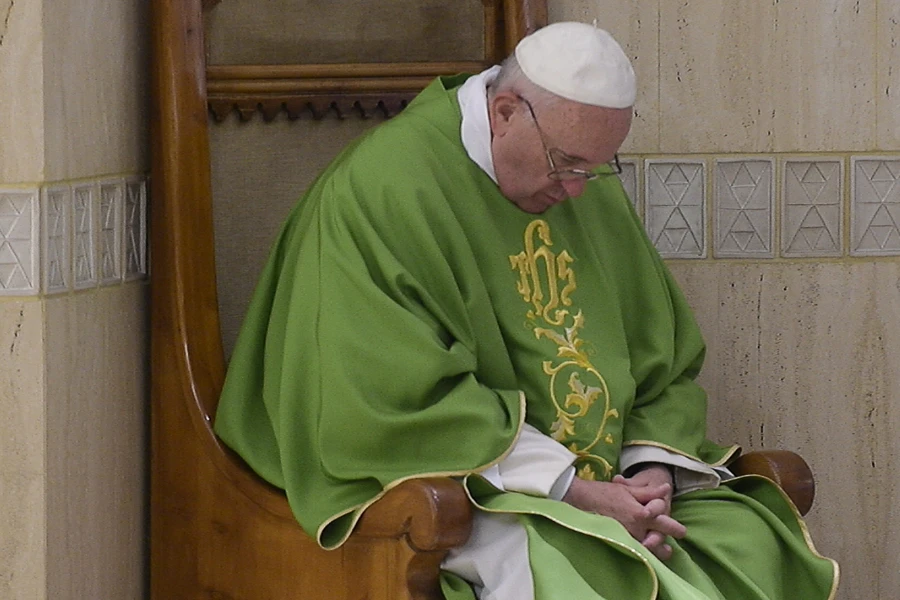
“The hypocrite is capable of destroying a community. While speaking gently, he ruinously judges a person. He is a killer,” said the Pope during his homily at Mass June 6 at the chapel of the Vatican’s Casa Santa Marta.
Pope Francis reflected on the Gospel passage in which the Pharisees and Herodians, who tried to ensnare Christ with his words, began by flattery.
“The hypocrite always uses language to flatter,” said the Pope, explaining that they will exaggerate the truth, “feeding into one’s vanity.”
He continued to the say that hypocrites are two-faced, and “the language of hypocrisy is the language of deceit, it is the same language the serpent used with Eve.”
He gave an example of a priest he met who “drank up all the flattery,” and he said that flattery is initiated by bad intentions. He said the Pharisees were trying to hide their true intentions, hoping to test Christ by asking him, “is it lawful to pay the census tax to Caesar or not?”
However, he said reality and truth are the tools to combat such hypocrisy, and it is Christ who exposes a lie with reality.
“Jesus always responds to hypocrites and ideologists with reality: ‘this is the reality; everything else is either hypocrisy or ideology.’”
He continued to say that “the reality was that the coin carried the image of Caesar.”
Hypocrisy not only destroys community, but he said it also “tears to pieces the personality and the soul of a person.”
Pope Francis ended his homily asking the Lord to strengthen a commitment to truth by the members of the Church.
“Let us ask the Lord to guard us from this vice, to help us be truthful, and if this is not possible to keep silent – but never to be a hypocrite.”
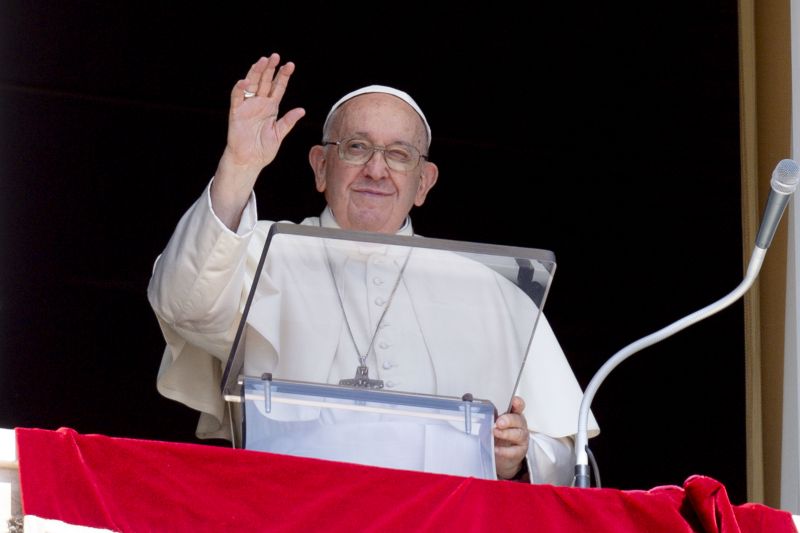
Pope Francis waves to pilgrims gathered in St. Peter’s Square for his Angelus reflection on Sept. 10, 2023. / Credit: Vatican Media
Rome Newsroom, Sep 10, 2023 / 07:05 am (CNA).
To dialogue with someone who has wronged us is a process that requires “real courage,” Pope Francis said Sunday, reflecting on the theme of “fraternal correction.”
In Sunday’s Gospel reading (Matthew 18:15-20) Jesus says: “If your brother sins against you, go and tell him his fault between you and him alone. If he listens to you, you have won over your brother.”
Fraternal correction is “one of the highest expressions of love, and also the most demanding, because it is not easy to correct others,” the Holy Father observed, speaking on Sept. 10 from a window at the Apostolic Palace to pilgrims gathered in St. Peter’s Square. “When a brother in the faith commits a fault against you, you, without rancor, help him, correct him: Help by correcting.”
The pope went on to condemn gossip, or “chattering,” which is “not right” and is “not pleasing to God.” He called gossip “a plague on the lives of people and communities because it brings division, it brings suffering, it brings scandal, and it never helps to improve, it never helps to grow.”
Fraternal correction, on the other hand, is a process that allows us to help the other person “understand where he is wrong. And do this for his good, overcoming shame and finding true courage, which is not to speak badly, but to say things to his face with meekness and kindness,” Pope Francis said. But he warned that “pointing the finger” at the other’s fault “is not good, in fact, it often makes it more difficult for those who made a mistake to recognize their mistake.”
“But we might ask, what if this is not enough? What if he does not understand?” the pope asked.
“Then we must look for help. Beware, though: not from the group that gossips! Jesus says: ‘Take one or two others along with you,’ meaning people who genuinely want to lend a hand to this misguided brother,” Francis urged.
“And if he still does not understand? Then, Jesus says, involve the community. But here, too, this does not mean to pillory a person, putting him to shame publicly, but rather to unite the efforts of everyone to help him change,” the pope said.
“And so, let us ask ourselves: How should I behave with a person who wrongs me? Do I keep it inside and accumulate resentment?” Pope Francis asked. “Do I talk about it behind their backs? ‘Do you know what he did?’ and so on. Or am I brave, courageous, and do I try to talk about it to him or her? Do I pray for him or her, ask for help to do good? And do our communities take care of those who fall so that they can get back up and start a new life? Do they point their fingers or open their arms?”
The pope asked again: “What do you do: Do you point the finger or open your arms?”
Pilgrims gathered in St. Peter’s Square for the pope’s weekly Angelus reflection on Sept. 10, 2023. Credit: Vatican Media
Following his reflection, the Holy Father expressed his “closeness to the dear people of Morocco” in the aftermath of a devastating 6.8 magnitude earthquake on the evening of Sept. 8 that has left more than 2,000 people dead and more than 2,000 injured as of Sept. 10.
Pope Francis also spoke briefly about the beatification of the Ulma family in Markowa, Poland. The Nazis brutally executed the devoutly Catholic family of Józef and Wiktoria Ulma and their seven children in 1944 for hiding eight Jews in their home outside the village of Markowa in southeast Poland. This is the first time an entire family has been beatified together.
The pope highlighted the family’s courage and evangelical love, for they “represent a ray of light in the darkness of the Second World War, be a model for all of us to imitate in our desire for good and in the service of those in need.“
Pope Francis used the example of the Ulma family to call for acts of charity to counter violence, as well as prayer; especially “for many countries that suffer from war; in a special way,” he said, “let us intensify our prayers for the tormented Ukraine.”




Leave a Reply