Doylestown, Pa., Aug 14, 2017 / 08:02 pm (CNA/EWTN News).- In an effort to draw the ‘selfie generation’ to Marian spirituality, the Pauline Fathers of Doylestown, Pennsylvania collected photos from dozens of countries around the world for a mosaic of Our Lady of Czestochowa.
“In history of Our Lady of Czestochowa, it was a tradition to offer to her new crowns and dresses, made of precious stones and jewels,” said Father Timothy Tarnacki, the coordinator for the Living Crown of Mary Project.
“But today, the world is changing, and we have to find new ways how to reach people, how they can make their faith and their relationship with Jesus and Mary more personal,” he told CNA.
The project was started almost a year ago and the priests will collect photos until Aug. 20 to build a large mosaic of the Marian image, also known as the Black Madonna. It will be revealed on Sept. 10 in the main church in celebration of the 300 anniversary of Poland’s coronation of Our Lady of Czestochowa.
Along with a photo, the Living Crown of Mary project requires the participant to offer a spiritual gift to Mary, which may be an additional Marian prayer or sacrifice.
Fr. Tarnacki said the project originated from the orders’ members in Poland as means to honor Mary and spread Marian spirituality especially among the youth, but also to offer pilgrims the opportunity to participate in a spiritual offering to Mary.
“They offered to the Blessed Mother their entire life, families, difficult situations, unemployment, illnesses. I remember one couple who offered to Mary their resolution to live in chastity before they get married.”
The priests do not have an exact number of the photos sent so far but Fr. Tarnacki estimates the amount to be around 2,000, ranging from cellphone selfies to old black and white photos. All of the photos will be digitalized then a computer software program will arrange the pictures into the image of Our Lady of Czestochowa.
The Pauline Fathers, or the Order of Saint Paul the First Hermit, are the original protectors of the image of the Black Madonna, first established in Poland in 1382 at the Shrine of Jasna Gora. Having a large portion of the Polish immigrant community dedicated to Czestochowa in the U.S., a copy of Mary’s icon blessed by Pope Saint John XXIII was brought to America in 1951 and a shrine was later established in Doylestown in 1955.
The Marian center is a significant piece of history for the Polish-American community, Fr. Tarnacki said, noting his surprise that a project which started off slowly received a large portion of its participates from countries facing political difficulties.
“We were thinking that our project will only cover USA, but it became an international version of the project from Poland, bringing people from every continent into it from about 60 countries.”
If you value the news and views Catholic World Report provides, please consider donating to support our efforts. Your contribution will help us continue to make CWR available to all readers worldwide for free, without a subscription. Thank you for your generosity!
Click here for more information on donating to CWR. Click here to sign up for our newsletter.
Washington D.C., Mar 2, 2023 / 16:00 pm (CNA).
The bishops of England and Wales announced this week that the distribution of holy Communion from the chalice during Mass will resume starting Holy Thursday.The U… […]
Washington D.C., Mar 20, 2023 / 15:36 pm (CNA).
This Easter season the U.S. bishops are inviting old and new Catholics to discover the truth, beauty, and goodness of the Mass through a brand-new ref… […]
“The Shroud of Turin: An Immersive Experience,” a $5 million, 10,000-square-foot museum on the chancery campus of the Diocese of Orange in Southern California opened to visitors on Nov. 19, 2025. / Credit: Everett Johnson, Diocese of Orange
Los Angeles, California, Nov 19, 2025 / 16:53 pm (CNA).
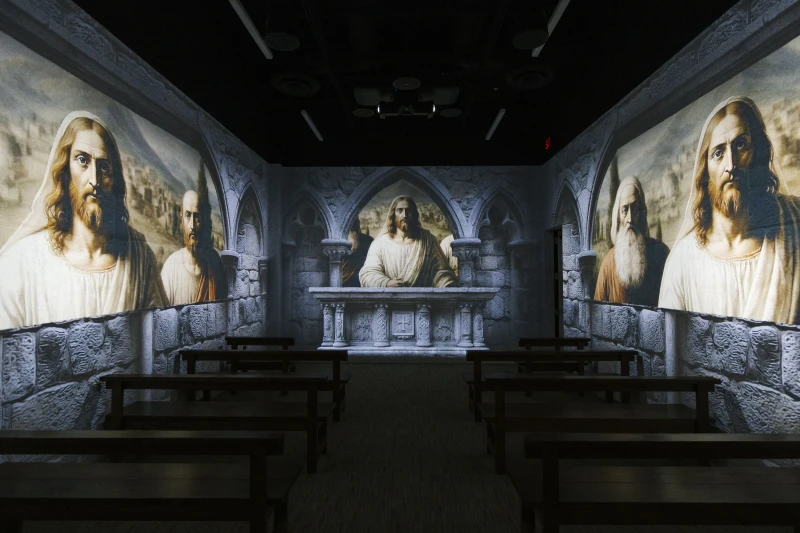
“The Shroud of Turin: An Immersive Experience,” a $5 million, 10,000-square-foot museum on the chancery campus of the Diocese of Orange in Southern California, opened to visitors Wednesday.
The museum is presented by Papaian Studios in partnership with the Diocese of Orange and Othonia Inc., an international team of specialists dedicated to exploring and sharing the mystery of the Shroud of Turin.
The 90-minute experience introduces visitors to the life, death, and resurrection of Jesus Christ, with a special focus on the Shroud of Turin, which many believe to be the burial cloth of Christ.
The 90-minute experience at the new Shroud of Turin museum on the chancery campus of the Diocese of Orange in California introduces visitors to the life, death, and resurrection of Jesus Christ, with a special focus on the Shroud of Turin, which many believe to be the burial cloth of Christ. Credit: Diocese of Orange
Inspired by the advanced technology incorporated in “Van Gogh Exhibition: The Immersive Experience” and the “Immersive King Tut,” the museum features 360-degree projection-room theaters as well as shroud replicas, interactive kiosks, a life-sized corpus, and a variety of artwork.
Jason Pearson of FiveHive Studios, which offers AI special effects and animation services, is a Catholic convert who worked with Othonia, a team of shroud specialists, to design the museum. Among his movie credits is Mel Gibson’s 2004 “The Passion of the Christ.” He has long had an interest in the shroud and has been a volunteer guide at the Shroud Center of Southern California located at the Santiago Retreat Center, also in the Diocese of Orange.
“Using technology on display like that of the Van Gogh or King Tut exhibits, we’re doing things that have never been done before,” Pearson told CNA.“Whether it be Jesus walking on water or through the streets of Jerusalem, or in the tomb at the moment of the Resurrection, we make use of sound and projections so that the visitor feels like he’s going back into a time machine and experiencing these things himself.”
“The Shroud of Turin: An Immersive Experience” located at the Christ Cathedral campus in the Diocese of Orange, California, opened to visitors on Nov. 19, 2025. Credit: Everett Johnson, Diocese of Orange
The museum is designed for everyone, Pearson continued, even those who have no religious background at all.
Located on the second floor of the campus’ Richard H. Pickup Cultural Center, the museum has three theater rooms. Using surround sound and images, including on the floor, the first room introduces the visitor to the person of Jesus Christ through presentation of 12 stories from his life, but each one is selected to show Christ’s connection to the supernatural (e.g. the Transfiguration). The next introduces the visitor to the shroud itself, including proof of its authenticity and what it tells us about the sufferings of Christ. The third is devoted to the Resurrection leading the viewer to ponder a pointed question: Who do you believe the man on the shroud is?
The third theater exits into the museum area, which includes displays of reproductions of items that were part of the passion of Christ, including a flagellum (whip), the crown of thorns and nails, as well as a reproduction of what the tomb of Christ might have looked like.
The new Shroud of Turin museum uses AI and 360-degree tech to explore Christ’s life and resurrection. Credit: Everett Johnson, Diocese of Orange
Other exhibits include an AI presentation of Secondo Pia (1855–1941) who, while photographing the shroud in 1898, discovered that its negative image offered a clearer image of the man on the shroud with a detail in his face that could not been seen by the naked eye. Another traces the history of the iconography of Christ, demonstrating how accurate, when comparing it to the shroud image, many of the icons were. And, one compares the Sudarium of Oviedo, or the facial cloth that covered Christ’s face after his death, to the image on the shroud.
Pearson hopes that the museum will be a prototype for additional shroud museums in different regions of the country. Inquiries have been made about establishing shroud museums from places as far away as Kuala Lumpur in Malaysia.
One portion of the museum is dedicated to the science of the shroud, and two kiosks allow visitors to ask questions of a digital Father Robert Spitzer, who has extensively researched the shroud over the past 20 years. Credit: Everett Johnson, Diocese of Orange
One portion of the museum is dedicated to the science of the shroud, and two kiosks allow visitors to ask questions of a digital Father Robert Spitzer, who has extensively researched the shroud over the past 20 years. Spitzer, who has an office at Christ Cathedral, noted that he was pleased with the museum’s opening. “It gets the pedagogy right, it’s biblically accurate, and they tell me the visual imagery is amazing.” (Spitzer has gone blind in recent years.)
He continued: “And while we welcome anyone, we especially hope many young people will come to learn about the shroud and lead many to come to know more deeply the person of Jesus Christ.”
Nora Creech is on the leadership team of Othonia and helped develop content for the museum. “We want people to come with an open mind, explore, and ask questions. We want them to ask, ‘Who is the man of the shroud?’” she said.
One special target group of the museum, Creech said, is younger people, “many of whom have not been brought up with knowledge of who Jesus is. That is why we seek first to introduce people to Jesus so that they will become interested in his burial shroud.”
Pearson agreed and related the story of two young women who visited the Shroud Center and began weeping, asking: “Why hasn’t anyone told us about him?”
But while the shroud is important in showing us what Jesus suffered, Creech continued, we also need the Church and the Scriptures “to learn why he suffered.”
Auxiliary Bishop Timothy Freyer blesses the new Shroud of Turin museum on the chancery campus of the Diocese of Orange in Southern California, opened to visitors Wednesday, Nov. 19, 2025. Credit: Kaylee Toole, Diocese of Orange
Orange Auxiliary Bishop Timothy Freyer, who played a key role in bringing the museum to Christ Cathedral, noted that his favorite feature was the reproduction of the crown of thorns, which, contrary to most artistic renditions, was actually shaped like a helmet or cap. He continued: “I’ve been impressed with the entire exhibition. It is very engaging, and I believe it will be an important tool in helping visitors come to know Christ better.”
Also among those excited to see the opening of the museum was Gus Accetta, a physician who has devoted much of his free time to studying the shroud. In 1996, he founded the Shroud Center in Huntington Beach, since relocated to the Santiago Retreat Center and welcoming 25,000 visitors annually.
“It’s a wonderful exhibit,” he said. It not only looks at the shroud but the whole life of Christ, of which the shroud is just a part.”
A crown of thorns from the “Shroud of Turin: An Immersive Experience,” a $5 million, 10,000-square-foot museum on the chancery campus of the Diocese of Orange in Southern California. The museum opened to visitors on Nov. 19, 2025. Credit: Diocese of Orange
The Shroud of Turin experience will be on display at Christ Cathedral at least through 2030. The museum is located on Christ Cathedral campus, 12141 Lewis St., Garden Grove, California, a few miles away from Disneyland and the Anaheim Convention Center. For more information, visit the website www.theshroudexperience.com.





Leave a Reply