Cardiff, Wales, Aug 7, 2017 / 04:19 pm (CNA).- How does a pub make up for mistakenly trying to kick out a group of celebrating seminarians? By naming a beer after them and calling it the “Thirsty Priests.”
Tim Lewis is the PR Manager for Brains, the company which owns the City Arms Pub in Cardiff, Wales.
He said that re-naming one of the seminarian’s favorite beers was a small thank you for the group’s good humor in being mistaken as a bachelor party and nearly kicked out of City Arms Pub.
“We wanted to do something as a ‘thank you’ to the priests for taking the misunderstanding in such good spirits,” said Lewis, according to Wales Online.
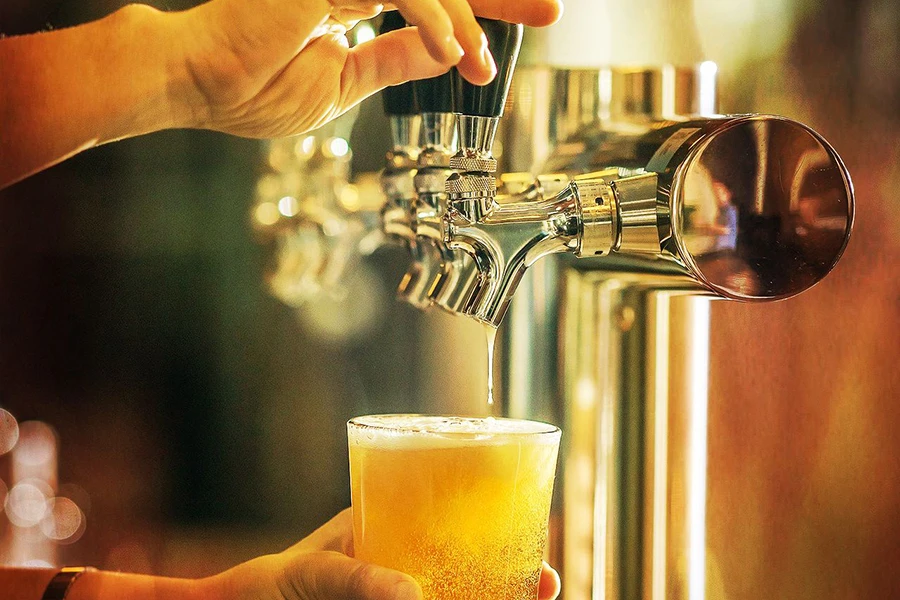
Described as a “rich, warming ale with a clean, rewarding finish,” The Rev James beer was renamed the “Thirsty Priests,” with the added slogan “saving souls and satisfying thirsts.” It was added to the pub’s tap this past weekend.
While celebrating the July 29 ordination of Father Peter McClaren, a group of seminarians dressed in their cassocks entered the City Arms Pub, only to be turned away by staff members who mistook them for a bachelor party.
“The staff thought they were a stag. We do have quite a few issues on the weekends with parties wearing fancy dress so it is our policy to turn them away,” said assistant manager Matt Morgan, according to the BBC.
But as the seminarians were about to leave the bar, the manager overheard them praying, and, realizing the establishment’s mistake, invited the men back in for a round of beers on the house.
The seminarians took the error in good humor, and were warmly received by staff and customers for the rest of their time at the pub. The whole affair was amusing, noted the seminarians, and the men were encouraged by the positive interaction with the community – which also enabled the locals to engage the seminarians in questions about the Church.
Archbishop George Stack of Cardiff, who is also a fan of City Arms Pub, said he was happy to hear about the seminarians’ interaction with the community, noting that “Priests are of the community and for the community they serve.”
Adding to the amusement of the evening, one member of the group, Reverend Robert James – who was ordained a deacon last June – was partial to a beer resembling his own name. The Rev James, a popular ale on the bar’s menu, is now rebranded at the establishment in honor of the seminarians.
The Archdiocese of Cardiff applauded the pub for its good humor over the viral news, jokingly adding that “a number of our clergy, including the Archbishop of Cardiff, frequent your bar so don’t turf any more out please!”
If you value the news and views Catholic World Report provides, please consider donating to support our efforts. Your contribution will help us continue to make CWR available to all readers worldwide for free, without a subscription. Thank you for your generosity!
Click here for more information on donating to CWR. Click here to sign up for our newsletter.
CNA Staff, Jun 18, 2020 / 08:00 am (CNA).- An English bishop has hailed the restoration of a cross atop his cathedral as “a sign of hope” amid the coronavirus pandemic.
Bishop Mark Davies of Shrewsbury said June 16: “In this year of global pandemic, it seems especially appropriate to see the cathedral cross restored as the sign of hope in the victory of life and love. Raised high above the cathedral, this cross that will continue to shine on the skyline of Shrewsbury for generations to come.”
The wrought iron cross was installed at the Cathedral Church of Our Lady Help of Christians and St. Peter of Alcantara, Shrewbury, in 1856, the year the cathedral opened.
According to Shrewsbury diocese, the cross is an early example of the work of the Arts and Crafts movement, which was inspired in part by the ideas of architect Augustus Pugin, who designed the cathedral located in the county of Shropshire in western England.
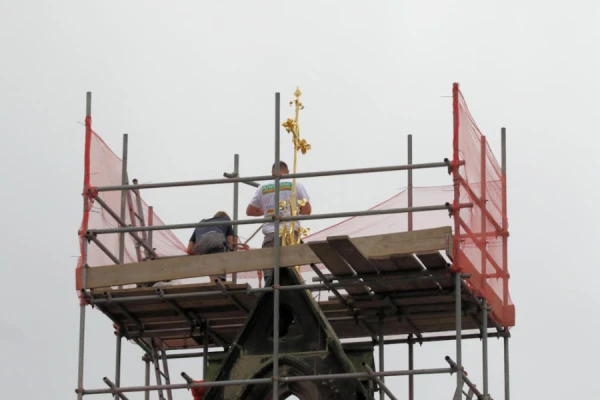
The diocese said the cross was in “dire need” of restoration due to rust and other damage. The conservation specialist M. Salt Limited removed the cross for the first time since its installation, repairing it and repainting it. It was restored to the cathedral’s bell tower the day that Catholic churches in England were permitted to reopen for private prayer following the coronavirus lockdown.
In a June 16 press statement, the diocese said: “There is no documentary evidence to show who designed and commissioned the cross though architects suspect it was AW Pugin’s son, Edward, who took the responsibility to finish the cathedral after the death of his father in 1852.”
Conservation expert Mike Salt suggested that the wrought iron cross was inspired by Jean Tijou, a French Huguenot ironworker who made gates and railings for Hampton Court Palace, King Henry VIII’s favorite palace.
The body of the cathedral cross is made of wrought iron with charcoal iron used to form ornate leaves. Salt said the use of charcoal iron indicated the cross was made using the repoussé technique associated with Tijou, in which metal is shaped by hammering from the reverse side.
Salt said: “In my mind therefore, the cross is historically important not only because it demonstrates the best in the [Arts and Crafts] movement, but also because it demonstrated that it was still possible to reproduce Tijou’s work in a modern environment. I would like to think that its repair and conservation has continued that theme.”
The work on the cross is part of an ambitious restoration project at the cathedral, which is one of the smallest in England.
Davies, who became the 11th bishop of Shrewsbury in 2010, has brought the Tabernacle back to the center of the cathedral. He has also obtained permission to remove wooden platforming that created an extended sanctuary in 1980s.
Writing in the Catholic Herald in 2019, Davies said: “The new cathedrals of England were built to create sacred space for the people of our land. In Shrewsbury, we are seeking to renew this mission so that our cathedral may continue to present the vision of the Catholic faith to new generations who might know little of its beauty.”
“This mission is ultimately to lead us to recognize Jesus Christ truly present in the mystery and reality of the Eucharist.”
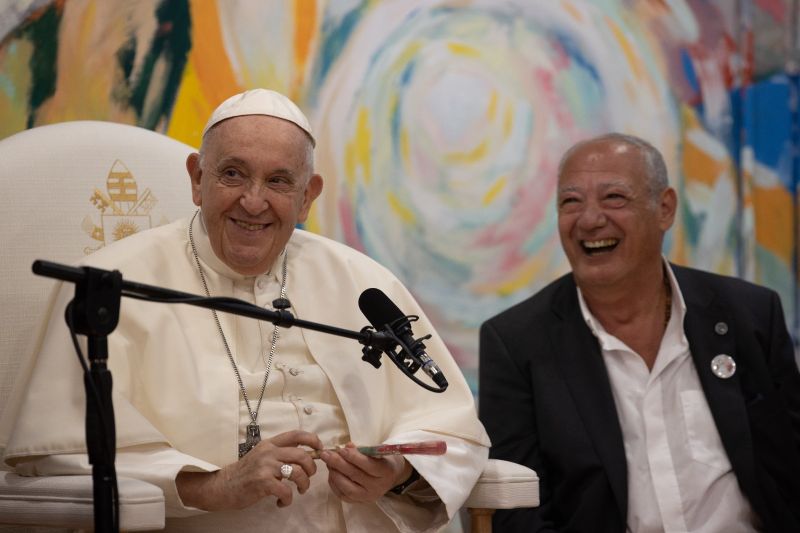
Pope Francis and José María Del Corral, president of the Scholas Occurrentes youth movement, smile during a meeting with the group’s volunteers in Cascais, Portugal, on Aug. 3, 2023. / Daniel Ibáñez/CNA
Washington, D.C. Newsroom, Aug 3, 2023 / 08:50 am (CNA).
In his first encounters with young people ahead of his arrival at World Youth Day later in the day, Pope Francis on Thursday urged his audiences to use their knowledge and skills to care for the planet and the poor.
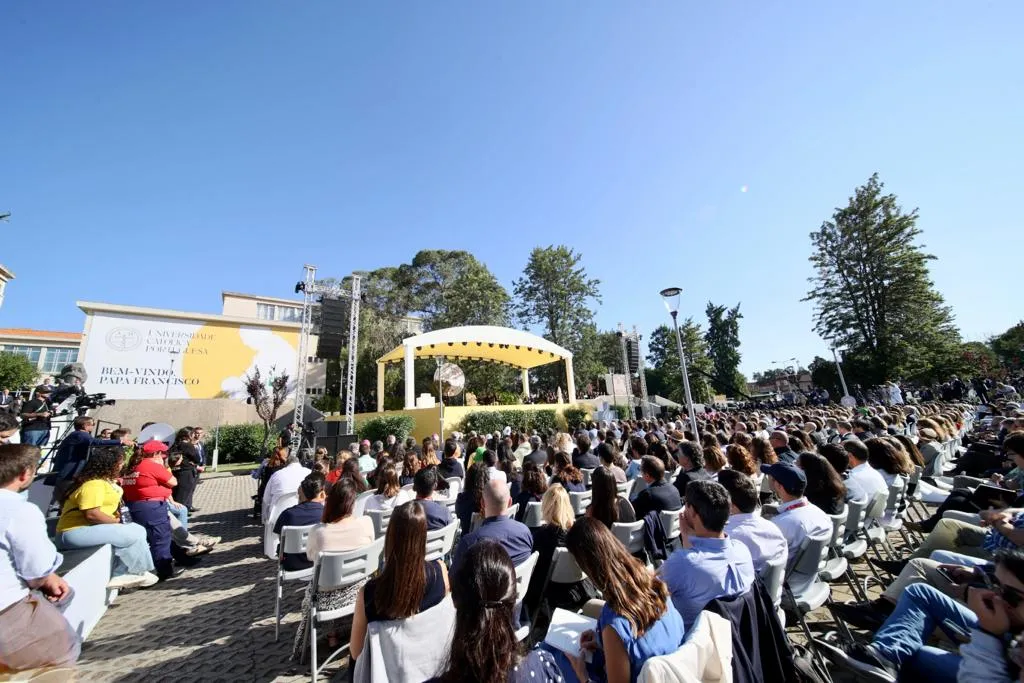
The Holy Father began his second day in Portugal with a meeting with students at the Portuguese Catholic University in Lisbon, followed by a visit with young volunteers in a coastal town outside the city who promote education in poor communities.
At the university, the pope first heard the testimonies of four students who shared their academic experiences and hopes for the future. The theme there was “integral ecology,” a view of the interconnected nature of the world’s problems that Francis developed in Laudato Si’, his 2015 encyclical on the environment.
Tomás Virtuoso, 29, a second-year theology student with undergraduate and master’s degrees in economics, speaks to Pope Francis at the Portuguese Catholic University in Lisbon, Portugal, on Aug. 3, 2023. Daniel Ibáñez/CNA
“It seems to me that my generation is being asked not to ignore the many insights that Laudato Si’ offers us,” said Tomás Virtuoso, 29, a second-year theology student with undergraduate and master’s degrees in economics.
“First, when it encourages us to bring the best of science to bear, trusting in the divine gift of reason, to continue to find effective solutions to the challenges we face,” he explained.
“Secondly, when it asks us to reject technological progress that does not have a strong ethical and spiritual root, that does not ensure respect for the inviolable dignity of the person and of all creation,” he continued.
“Thirdly, when it leads us to the firm decision to live according to the demands of the common good, the structuring principle of the Church’s social doctrine,” which “places the preferential option for the poor at the center,” he said.
“Finally, when it encourages young Catholics of my generation to evangelize, to fearlessly affirm that an authentic integral ecology is not possible without God, that there can be no future in a world without God.”
Working for a just society
In his remarks, Pope Francis urged students to “seek and risk,” reminding them that an education like theirs is both a gift and a responsibility.
“A university would have little use if it were simply to train the next generation to perpetuate the present global system of elitism and inequality, in which higher education is the privilege of a happy few. Unless knowledge is embraced as a responsibility, it bears little fruit,” he said.
“An academic degree should not be seen merely as a license to pursue personal well-being but as a mandate to work for a more just and inclusive — that is, truly progressive — society.”
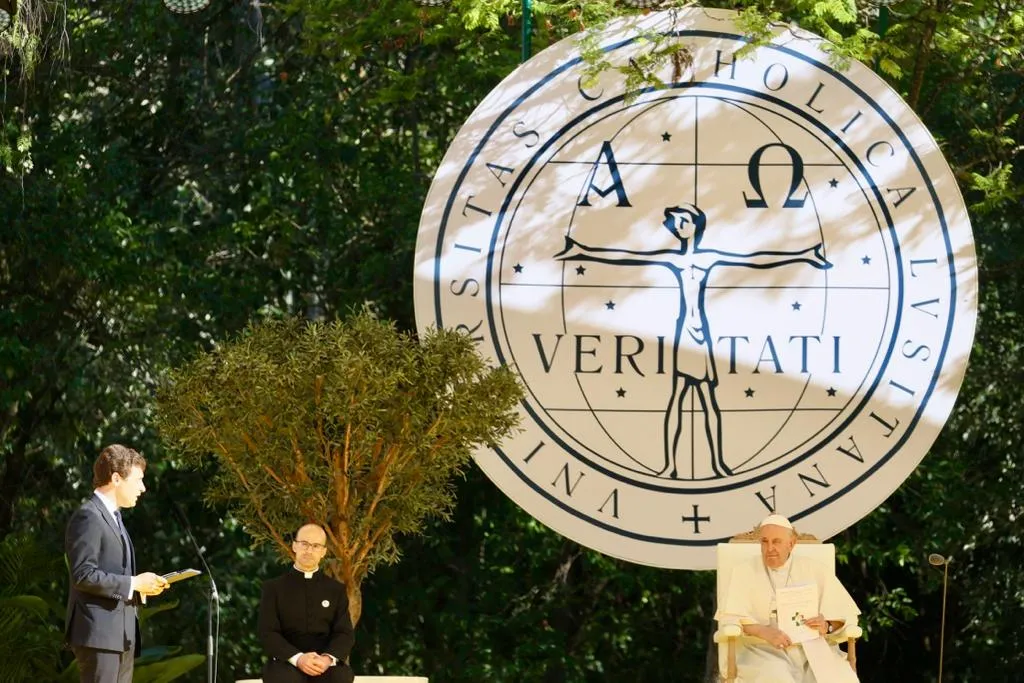
Pope Francis meets with students at the Portuguese Catholic University in Lisbon, Portugal, on Aug. 3, 2023. Daniel Ibáñez/CNA
Speaking of the responsibility of environmental stewardship, the Holy Father challenged students not to be content with mere “palliative” or “halfway measures” that “simply delay the inevitable disaster,” as he observes in Laudato Si’.
“Rather, it is a matter of confronting head-on what sadly continues to be postponed: the need to redefine what we mean by progress and development,” he explained.
“In the name of progress, we have often regressed. Yours can be the generation that takes up this great challenge. You have the most advanced scientific and technological tools, but please, avoid falling into the trap of myopic and partial approaches,” he stressed.
“Keep in mind that we need an integral ecology, attentive to the sufferings both of the planet and the poor. We need to align the tragedy of desertification with that of refugees, the issue of increased migration with that of a declining birth rate, and to see the material dimension of life within the greater purview of the spiritual,” he said.
“Instead of polarized approaches,” the pope underscored, “we need a unified vision, a vision capable of embracing the whole.”
Order out of ‘chaos’
Later in Cascais, a picturesque medieval town and popular coastal resort west of Lisbon, Pope Francis met with young members of the Portuguese chapter of Scholas Occurrentes, an international youth movement. It was the pope himself, as the archbishop of Buenos Aires, who founded the group, which promotes education in poor communities around the world.
A view of the “Life between Worlds” mural project at the Portuguese headquarters of the Scholas Occurrentes youth movement in Cascais, Portugal. Pope Francis visited with members of the community on Aug. 3, 2023. Daniel Ibáñez/CNA
While there, the pope was given a paintbrush he used to put the finishing touches on an elaborate “Life Between Worlds” mural that decorates the walls and ceiling of the group’s headquarters. “Old people and young people, rich and poor, children of different religions and nonbelievers, and young people of different nationalities participated in this work of art,” the group said in a statement.
In his unscripted remarks, the pope addressed the “chaos” some of the volunteers referenced in describing the challenges they face in their lives.
The pope reminded them that God always brings some good out of chaos, beginning with the first moments of creation.
“There it is in poetic language, how God makes light one day out of chaos, another day he makes man and goes on creating things and transforming chaos into cosmos,” he noted.
“The same thing happens in our lives. There are moments of crisis … that are chaotic … then the job of the people who accompany us, of a group like this, is to transform [that situation into] a cosmos,” he said.
After some time to eat and rest, the pope was set to arrive at the site of World Youth Day for a welcome service Thursday evening.





Leave a Reply