Los Angeles, Calif., Jun 7, 2017 / 11:33 am (CNA/EWTN News).- The Archbishop of Los Angeles has urged a prayerful and prudent response to a housing crisis in his city, relating the problem to the link between human and environmental ecology.
“The housing crisis is a reminder that in God’s creation, there is an ecology of the human person and an ecology of the natural environment. We cannot think about the one without the other,”Archbishop José Gomez said in a June 6 column for the Angelus.
His column follows outcry from fellow bishops and Catholic leaders who have criticized the Trump administration for withdrawing the United States from the Paris Agreement. The 2015 accord was signed by 191 countries dedicated to reducing greenhouse gas emissions by 2020.
Last Thursday, President Donald Trump announced that the US would exit the deal, calling the agreement destructive to workers and business interests in the nation.
Archbishop Gomez said the effects of climate change not only have a negative effect on the environment, but also the people who live in it.
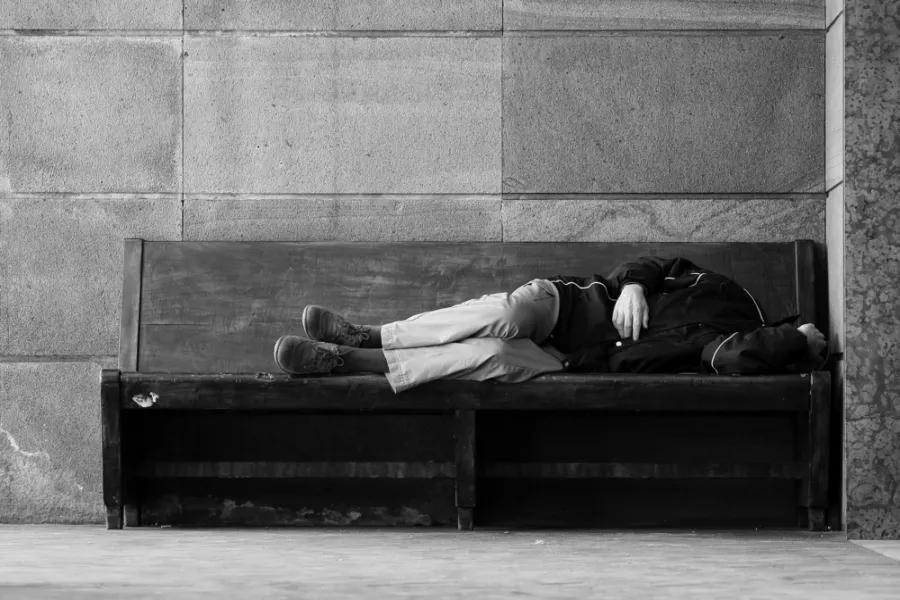
He cited a report by the Los Angeles Times which stated the city has seen a 23 percent increase in homelessness since last year.
The archbishop is concerned that the growing number represents a widening gap “between those who have what they need for a dignified life and those who do not.”
“I worry that we are getting accustomed to these sights in our city. We cannot allow ourselves to accept a Los Angeles where sidewalks become permanent residences for our neighbors.”
He said that “the lack of affordable housing is directly related to ‘the human ecology.’ This is true in the poorest nations of the world, but sadly it is also true here in the wealthiest.”
He continued to explain that “human life and human nature must be protected and cared for” and this means defending the environment as well by not participating in a “throw away culture”.
“The natural environment must also be protected and cared for. We are not put here to consume what we need and throw away what we do not, with no regard for the health of our communities or the needs of future generations.”
“God made this earth, not for its own sake, but to be a home for the human family. The good things of creation are meant to be shared, developed and used for the good of all of his children.”
Archbishop Gomez ended the column by asking the Holy Spirit to “inspire us to do what is right and guide us to find creative pathways to renew the face of the earth.”
If you value the news and views Catholic World Report provides, please consider donating to support our efforts. Your contribution will help us continue to make CWR available to all readers worldwide for free, without a subscription. Thank you for your generosity!
Click here for more information on donating to CWR. Click here to sign up for our newsletter.
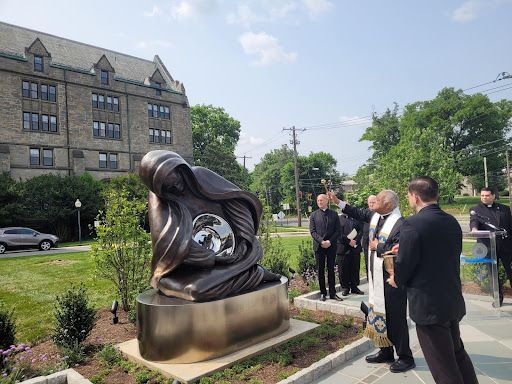
Cardinal Wilton Gregory of the Archdiocese of Washington, D.C., blesses the newly unveiled “National Life Monument” on the campus of The Catholic University of America’s Theological College on May 17, 2023. / Peter Pinedo|CNA
Washington D.C., May 17, 2023 / 15:58 pm (CNA).
The new “National Life Monument,” a larger-than-life bronze sculpture depicting the Blessed Virgin Mary pregnant with the Christ Child, was unveiled and dedicated today on the campus of The Catholic University of America’s Theological College in Washington, D.C.
According to the Canadian artist Timothy Paul Schmalz, the statue, titled “Advent,” is meant to be a symbol of beauty, a celebration of new life, and a bold pro-life statement in the nation’s capital.
Schmalz was present at the dedication ceremony along with the archbishop of Washington, Cardinal Wilton Gregory, and Canadian Cardinal Marc Ouellet. Gregory prayed over the monument, giving a special blessing to the statue and those present for the dedication.
Gregory praised the monument, saying, “Advent, as a pregnant Madonna, transcends bronze, revealing a deeper significance, deeper truths of God and of us, and his love for each of us, graced as we are in his image and likeness.”
The statue is entirely bronze except for the Blessed Virgin’s womb, which is made of reflective stainless steel. The Virgin Mother lovingly cradles her womb in which Jesus is depicted as an unborn baby. Our Lady is portrayed with a serene and peaceful countenance as she holds the Christ Child in her womb. The steel, which Schmalz describes as a “mystical material,” forms a type of halo around the unborn Christ Child.
“Advent: The National Life Monument,” a larger-than-life bronze statue by Canadian Catholic artist Timothy Paul Schmalz, depicts the Blessed Virgin Mary pregnant with an unborn baby Jesus. Peter Pinedo|CNA
“The hope with this sculpture is bringing a permanent, physical symbol that says ‘yes’ to life, that says life is great,” Schmalz told CNA. “To have it here in the nation’s capital is making a powerful statement. It’s saying that we have to celebrate all human life, and all human life is splendid and wonderful, and it’s mystical.”
Crafting a pro-life sculpture was something like solving a riddle, Schmalz said. For years he pondered how to create something that would send a bold pro-life message that wasn’t just “about the horror of abortion.”
“The idea is very difficult within a culture that, as Pope John Paul II said, we’re in a culture of death,” Schmalz said. “So, to put a sculpture called life in the center of Washington, D.C., is in a sense a peaceful weapon to persuade.”
By placing the monument in a high-traffic, public setting in Washington, D.C., Schmalz hopes his statue will not just “preach to the choir” but also touch the hearts of nonbelievers and even those who may be abortion supporters.
“Ideally, I’ll have people coming across here that might be ambiguous about their ideas of abortion, but they will come take a look at this and they will say, ‘You know, I have to say, that sculpture is beautiful,’ and if they’re saying the sculpture is beautiful, what it’s expressing is also beautiful,” Schmalz said. “If it touches one person, I think it’s done its job.”
To Schmalz, each sculpture he makes is a form of prayer that serves a specific function. As a Catholic artist, he believes that the work of faithful artists is about creating “visible ambassadors” of the faith to witness “in a culture that’s trying to remove Christianity.”
When it comes to his Life Monument, Schmalz’s depiction of the Madonna as a young, pregnant woman sends a very intentional message.
“If you look at the amount of positive life symbols out there, like even paintings of pregnant women or a new family, they’re becoming rare,” Schmalz said. “I’ve noticed over the last decade or so that we’re seeing less babies, less baby carriages, and less symbols around that. Our culture used to be filled with it. But now it’s becoming absolutely minimalized.”
This cultural shift, Schmalz believes, has led many young women to believe that having a child is something negative to be dreaded. The result of this anti-life mindset, Schmalz said, is having a devastating impact on society.
“Pope Francis said we’ve got to stop having pets and start having babies,” Schmalz said. “Elon Musk was basically suggesting the same thing, that we’re going to be in serious trouble if we don’t have babies.”
“We have to celebrate human life and that’s what this sculpture is saying,” Schmalz explained.
Schmalz is one of the most renowned Catholic artists of today. His work is displayed across the world from his “Angels Unawares” piece displaying immigrants at the Vatican to his “Homeless Jesus” in the Holy Land to a multitude of other works, religious and nonreligious, in the U.S. and beyond.
A smaller version of the National Life Monument is also on display in Rome’s Church of San Marcello al Corso. According to the statue’s website, Schmalz has plans to place life-sized copies of the National Life Monument in every state across the U.S.
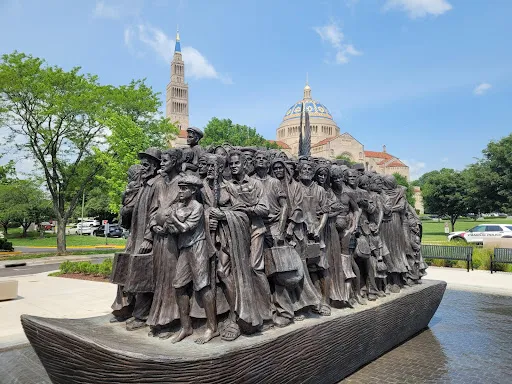
“Angels Unawares,” another work by Schmalz on The Catholic University of America’s campus, depicts 140 immigrants. Peter Pinedo|CNA
A second casting of Schmalz’s “Angels Unawares,” pictured above, is also on display on Catholic University’s campus.
Father Daniel Moore, provincial superior of the U.S. Society of St. Sulpice, who presided over the dedication ceremony, explained that he hopes Schmalz’s statues will help people realize the sacredness of life and the obligation to help pregnant women, mothers, and those in need.
Schmalz, Moore said, “is using his gift of sculpting, his artistry much like the masons did when they built the great cathedrals, and then the stained glass within the cathedrals. They have become ways of communicating God’s message to us, God’s love to us, the story of how much we are cherished by God.”
Washington D.C., Dec 15, 2017 / 02:45 pm (CNA/EWTN News).- <iframe width=”560″ height=”315″ src=”https://www.youtube.com/embed/dXoCmKN2XHo” frameborder=”0″ gesture=”media” allow=”encrypted-media” allowfullscreen></iframe>
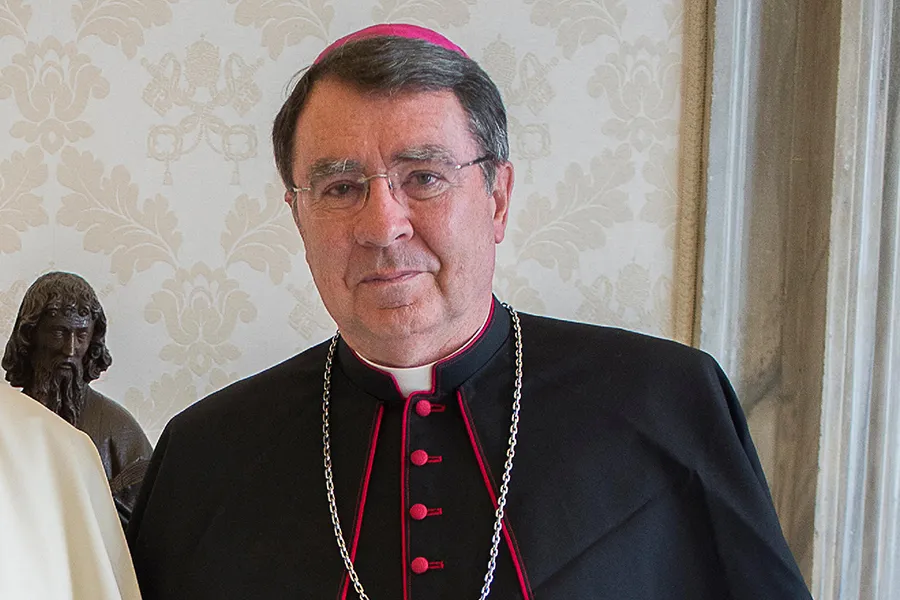
Archbishop Christophe Pierre, apostolic nuncio to the US, spoke with EWTN News Nightly’s Lauren Ashburn on Wednesday, discussing Pope Francis, his background, and his reception within the Church.
He mentioned the recently published work Jorge Mario Bergoglio: Una biographia intellettuale (Jorge Mario Bergoglio: An Intellectual Biography) by Massimo Borghesi, which discusses the influence on Pope Francis of Fr. Gaston Fessard, among others,.
Fr. Fessard was a French philosopher of the 20th century who has been called “a penetrating critic of Marxism.” He was central to the revival of Hegelian thought on history in France, and sought to be in dialogue with Hegel, considering his widespread influence in modern philosophy. Fr. Fessard was also active in the French Resistance and a critic of the collaborationist Vichy government.
Please read excerpts from the first half of Archbishop Pierre’s conversation with Ashburn, edited for clarity and length. The first half aired Dec. 14, and the second will air Dec. 15 on EWTN News Nightly.
Lauren: Archbishop Christophe Pierre, thank you so much for joining us this evening.
Archbishop Pierre: Thank you for the invitation.
Lauren: Archbishop, in the fast-moving four and a half years Pope Francis has been Pope, much has been written about him – his “option” for the poor, his evident pastoral approach, the reform of the Vatican. Now we seem to be witnessing a new phase of his interest: the intellectual and cultural roots that drive him. What are they?
Archbishop Pierre: Well, your observation is very interesting, you know, because we have to recognize that the coming of this Pope has created wonder, and a lot of questions. And if you allow me, I would say, during my one year and a half presence in this country, I’ve noticed this sense of wonder. Especially from the people themselves. They are happy to see this Pope. They feel that he is near them. They feel that he understands their problems. And I think this is one of the characteristics of the Pope. But may I say, many of us, a lot of people say, ‘Who is he? Where is he coming from?’ I would say there are two directions. One direction is coming from South America. This is his background. I’ve been living in four countries, and working in countries in South America.
(Lauren: Including Mexico) Including Mexico. And I arrived in Mexico at the time of the famous Aparecida conference of the Latin American bishops of the last century. This conference is very important to understand Pope Francis, because he was one of the main actors, because he was the Archbishop of Buenos Aires. But he was one of the main actors. So this is one aspect. The second one is intellectual background. And precisely a couple of weeks ago, an Italian author, Massimo Borghesi, published a book.
Lauren: That would be this book. (Laughter)
Archbishop Pierre: Ah, you read it.
Lauren: It’s in Italian, however, so you are going to have to tell me what it says. Let me talk to you about this book. It claims that behind this simplicity lies a “deep and original thinking,” based largely on French philosophers and theologians. That comes as a surprise to the Argentinian and populist stereotype of Francis. You are a Frenchman, who has spent years serving many different countries worldwide. What is this “deep and original thinking”?
Archbishop Pierre: Well first and foremost this Pope has been educated in our own time. The book tells us that maybe the first important author having contributed to his formation is the Jesuit Gaston Fessard. Maybe Gaston Fessard is not well known in the United States. I happened, when I was pursuing my master’s in theology in the French Catholic Institute of Paris, to make a credit on Gaston Fessard. [sic] So I was very happy when I read this book; I said, ‘My God!’
Lauren: You both are following after Gaston Fessard.
But there is unease among bishops over his approach. How can that be that be rectified?
Archbishop Pierre: I have read the Pope is not very precise. The Pope is not, eh, not a great intellectual, he is more pastoral than dogmatic. I would say these things are stereotypes. And maybe also prejudice. So I think there is a great — we especially with the bishops — we have a great responsibility, to try to understand our Pope. And to understand him in all aspects of his personality before making a judgment. And I think this is precisely what we should try to do. And not to remain with a superficial judgement of who he is or what he is supposed to be according to our own judgement. And by the way, he is also the Pope.
Lauren: Archbishop Christophe Pierre, thank you for joining us.
Raleigh, N.C., Feb 28, 2020 / 01:00 pm (CNA).- Democratic presidential candidate Amy Klobuchar would not say when she believes life begins when asked during a townhall event on Thursday evening. While repeating her openness to pro-life support, the sen… […]



Leave a Reply