No Picture
News Briefs

Mother Teresa was heroic – but maybe not for the reasons you think

June 7, 2017 CNA Daily News 1

Vatican City, Jun 7, 2017 / 06:01 am (CNA/EWTN News).- There are many things about Saint Mother Teresa of Calcutta that could be called heroic – her tireless service to the world’s most rejected and her courageous witness to millions of what it is to live the Gospel, just to name a couple.

But the priest who oversaw her path to sainthood said that for him, one thing stands out above all the rest: her experience of spiritual darkness and what she described as feeling totally abandoned by God for the majority of her life.

“The single most heroic thing is exactly her darkness. That pure living, that pure, naked faith,” Fr. Brian Kolodiejchuk, the postulator for Mother Teresa’s canonization cause, told CNA in an interview. Fr. Kolodiejchuk is a priest of the Missionaries of Charity Fathers, founded by Mother Teresa in 1989.

By undergoing the depth and duration of the desolation she experienced and doing everything that she did for others in spite of it, “that’s really very heroic,” he said.

Born Agnes Gonxha Bojaxhiu Aug. 26, 1910 in Skopje, in what is now Macedonia, Mother Teresa joined the Sisters of Loretto at the age of 17, but later left after she felt what she called “an order” from God to leave the convent and to live among the poor.

She went on to found several communities of both active and contemplative Missionaries of Charity, which include religious sisters, brothers, and priests.

The first community of active sisters was founded in 1950. An order of active brothers was founded nearly 20 years later in 1968. Then two contemplative orders came, one of women (in 1976) and one of men (in 1979).

In 1989 the Missionaries of Charity Fathers was established, and is a clerical religious institute of diocesan right whose members make promises of poverty, chastity, obedience, and wholehearted and free service to the poorest of the poor.

Additionally, an order of lay missionaries was also founded in 1984, and several movements who organize various works of charity have also been born as part of the Missionaries of Charity spiritual family.

One of the first steps in declaring someone a saint is to determine their heroic virtue. Fr. Kolodiejchuk said that Mother Teresa’s entire life was lived heroically, which was clear from what he had seen firsthand and heard from the testimonies of others, even though he himself has only been a part of the Missionaries of Charity family for 20 years.

He said the most heroic aspect of Mother Teresa’s life and vocation is the more than 50 years of darkness and abandonment she felt after receiving what she termed “a call within a call” to leave the Sisters of Loretto and found the Missionaries of Charity.

Although the Albanian nun is always seen beaming and smiling brightly in photos, she experienced a profound internal desolation during which she felt silence and rejection from God, who seemed distant.

In a letter to her spiritual director in 1957, Mother Teresa wrote that “I call, I cling, I want, and there is no one to answer. Where I try to raise my thoughts to heaven, there is such convicting emptiness that those very thoughts return like sharp knives and hurt my very soul.”

“Love – the word – it brings nothing. I am told God lives in me – and yet the reality of darkness and coldness and emptiness is so great that nothing touches my soul,” she said.

Mother Teresa had prayed fervently to share in Jesus’ suffering, and many, including her spiritual director, believed her feelings of rejection and abandonment to be a mirror of Christ’s own experience of loneliness and desolation during his Passion and death.

Because of the depth and duration of Mother Teresa’s spiritual desert, many have hailed her as a great mystic when it comes to topic of spiritual darkness.

Fr. Kolodiejchuk himself said Mother Teresa was “a great mystic, but also very concrete, very down to earth.”

The priest had met Mother Teresa in his early 20s while attending the vows of his sister, who had joined the active branch of the Missionaries of Charity sisters. He joined the order of priests a year later.

A lot of people “think that saints are somewhere in the mystical clouds,” he said, but cautioned that this wasn’t true of Mother Teresa, who was spiritual, but also observant and active in the lives of others.

From the first moment he met her, of Mother Teresa’s most distinguishing qualities was “this sense that she really was Mother,” he said, explaining that being a mother was something important to her, and was the only thing she was ever called.

When Mother Teresa was first elected superior general of the Missionaries of Charity, her immediate response after receiving congratulations, he noted, was to say “Oh that means nothing, the title. No, I want to be a mother.”

The nun also placed a heavy emphasis on God’s tenderness, Fr. Kolodiejchuk said, recalling that “tender” was one of her favorite words – even more so than mercy.

“She would talk more about Jesus’ tender love and mercy; his thoughtfulness, his presence, his compassion…So mercy was a word in her vocabulary, but with this quality especially of tenderness.”

“Even in the darkness she still had an intimate sense of God’s tender love for us,” he said, and recited a prayer that Mother Teresa would often teach and have others repeat: “Jesus in my heart, I believe in your tender love for me. I love you.”

The priest said that her canonization during the Jubilee of Mercy was providential since the core mission of the Missionaries of Charity is to respond to Chapter 25 in the Gospel of Matthew, which lists the works of mercy.

He noted how the day of Mother Teresa’s canonization also marked a special jubilee day for workers and volunteers of mercy.

Given the work the Missionaries of Charity do, “it’s appropriate” that the nun would become a patroness for all who carry out the same type of activities, he said.

Part of the reason Mother Teresa is such a strong example for the world today, Fr. Kolodiejchuk believes, is because “people like to see,” and the work the Missionaries do is something visible that others can easily touch and participate in, no matter what religion they profess.

“Mother was a great believer in that we receive in giving. So there’s something attractive about the work. And then you receive by sharing in it,” he said.


This article was originally published on CNA April 4, 2016.

[…]

No Picture
News Briefs

Pope: Don’t be afraid to call on the Father – he won’t abandon you

June 7, 2017 CNA Daily News 0

Vatican City, Jun 7, 2017 / 04:43 am (CNA/EWTN News).- On Wednesday Pope Francis said that one of the greatest mysteries of the Christian faith is that we have a God we are taught to call ‘Father’ – a father who never leaves us and who we can call on in prayer at any moment.

“The entire mystery of Christian prayer is summed up here, in this word: to have the courage to call God by the name of Father,” the Pope said June 7.

He pointed to Chapter 11 of the Gospel of Luke, in which the evangelist provides a somewhat shortened version of the “Our Father” prayer Jesus taught his disciples to pray, and which begins with the simple invocation: “Father.”

The fatherhood of God, which Francis called “the source of our hope,” formed the basis of his general audience catechesis. Addressing crowds gathered in St. Peter’s Square, the Pope  immediately recalled the parable of the “merciful father,” also known as the Prodigal Son.

The father in this story, he said, does not punish his son for his arrogance, but still gives him his share of the inheritance, later welcoming him back home even after he had squandered it.

“The father does not apply the criteria of human justice,” the Pope said, “but first he feels the need to forgive, and with his embrace makes the child understand that in all that long absence he missed him; he is painfully missed by his father’s love.”

“God is Father, Jesus says, but not in the human way, because there is no father in this world who would behave like the protagonist of this parable,” the Pope said, adding “What an unfathomable mystery is a God that nourishes this kind of love towards his children!”

However, despite this familiarity, to call God by the name of “Father” is not necessarily something we merit or understand, he said. In fact, sometimes it seems like we should use only the highest titles to address God, because it would be more respectful of his divinity.

“Instead, invoking him as ‘Father’ puts us in a relationship of trust with Him, as a child who turns to his dad, knowing he is loved and cared for by him,” Francis said, adding that despite the grand mystery and greatness of God, which can often make us feel small, we are not afraid.

This concept isn’t easy “to welcome in our human soul,” he said, noting that even the women who after the Resurrection first found the angel and the empty tomb of Jesus ran away, “because they were filled with fright and astonishment.”

“But Jesus reveals to us that God is a good Father, and He tells us, ‘Do not be afraid,’” Francis said, adding that perhaps this is the reason the Apostle Paul doesn’t translate into Greek the Aramaic word, “abba.”  

This phrase, he said, is “a term more intimate than ‘father,’” and is sometimes translated as “papa” or “daddy.”

Going on, Pope Francis said the Gospel reveals to us that no matter what, God the Father is there for us. When we need help, Jesus tells us to turn to the Father with confidence, never closing ourselves off, or becoming resigned, he said.

“All of our necessities, from the most obvious and every day – such as food, health and work, to being forgiven and sustained in temptations – are not the mirror of our solitude: there is a Father who is always there looking with love, and who surely does not abandon us,” he said.

The Pope concluded by making a proposal to the crowd before leading them in praying the ‘Our Father.’

“Each of us has so many problems and needs,” he said. “Let us think a little, in silence, about these problems and these needs. And all together, with confidence and hope, we pray, Our Father…”

[…]

No Picture
News Briefs

Salesians eager to recover relic of St John Bosco’s brain

June 7, 2017 CNA Daily News 0

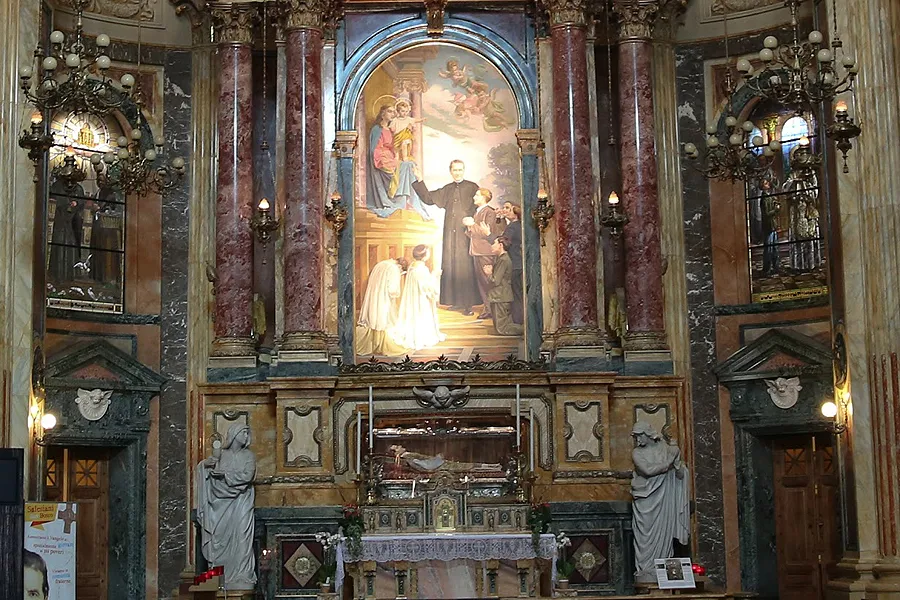
Turin, Italy, Jun 7, 2017 / 03:01 am (Church Pop).- Police in Italy are investigating the missing relic of the brain of St. John Bosco, which was reportedly stolen from its reliquary on Friday night.

The Salesians, the religious order founded by St. John Bosco, issued desperate pleas for prayers for its return after it was discovered missing June 2.

The reliquary was kept in the Basilica of John Bosco in Castelnuovo, fewer than 20 miles east of Turin. It contained a small piece of the saint’s brain.

“We are very saddened, along with the many devotees … for what happened,” Fr. Ezio Orsini, rector of the Basilica, said in a statement.

“We trust that John Bosco can touch the heart of (whomever committed this act) as he transformed the lives of young he met,” he said. “We are also confident that though you can steal a relic of John Bosco, as has happened, you can not steal John Bosco from us and from the many pilgrims who daily visit these places.”

St. John Bosco was a 19th century Italian priest who had a particular love and apostolate for at-risk and underserved youth. Today, the order serves youth throughout the world primarily in schools, homeless shelters, and community centers.

The basilica, located in the saint’s birthplace, has experienced some other minor thefts in recent weeks, though nothing of spiritual value.

Archbishop Cesare Nosiglia of Turin also commented on the missing relic, saying it was news “you would never want to hear, because it makes us think of a profound moral misery” that someone would steal something of spiritual and devotional value, he told an Italian news source.

The archbishop said that he asked all of his priests to say a special prayer during their Pentecost Masses for the Salesian family and the recovery of the relic, so that it can “continue to be a point of devotion for the millions of faithful who come to the sanctuary dedicated to him.”

He implored whomever stole the relic to return it immediately.

“I also invite those who have stolen the relic to return it immediately, without conditions: in order to close this painful chapter and in order to continue to honor the memory of John Bosco in his native place. “

[…]

No Picture
News Briefs

Irish bishops praise court ruling recognizing the dignity of work

June 6, 2017 CNA Daily News 0

Dublin, Ireland, Jun 6, 2017 / 04:47 pm (CNA/EWTN News).- Ireland’s Catholic bishops have praised a Supreme Court decision in the country that will allow asylum seekers to find work while their status is being decided.

The Republic of Ireland’s supreme court ruled May 30 that laws which indefinitely prohibit asylum seekers from gaining employment were unconstitutional.

The case was brought by a Burmese refugee who was in the asylum system eight years before he was given refugee status. He maintained that being allowed to work was vital to his self worth, dignity, and development.

The judgement considered the right to seek employment as “part of the human personality”, which cannot therefore be restricted to citizens.

Bishop John McAreavey of Dromore, chair of the Irish Bishops’ Council for Justice and Peace, said, “The words of the Court are powerful and profound, and speak to what we should aspire to: ‘This damage to the individual’s self-worth, and sense of themselves, is exactly the damage which the constitutional right [to seek employment] seeks to guard against.’”

He wrote in a June 5 statement that the decision reflects the values of Pope Francis, who has asked all countries for a “generous openness” to migrants, at a time when much of the world is experiencing what has been called a refugee crisis.

Millions of asylum seekers from the Middle East and elsewhere have poured into the European Union and other regions, seeking refuge from violence and economic hardship.

Countries throughout Europe have struggled to accommodate the large number of asylum seekers. Ireland has promised to accept 700 refugees this year, though the migration of some of these has been stalled due to vetting negotiations.

Bishop McAreavey noted that the physical and psychological welfare of migrants has been a concern of the bishops of the Council for Justice and Peace, which has publicly raised issues related to Direct Provision Centres, the Republic of Ireland’s system to care for asylum seekers.

“Removing the ban on work means that people in Direct Provision Centres are more likely to integrate and be part of a rich, diverse and yet more unified society; asylum seekers will recover their self-respect through work and we all will benefit from their skills and gifts,” Bishop McAreavey said.

He encouraged the government to “see the great merit – moral, civic, cultural and economic – of allowing migrants who are already in Ireland to participate and contribute to our society here. I would encourage policymakers to balance the Government’s duty to manage the resources of the State with the parallel duty to treat asylum seekers humanely.

The bishop noted that asylum seekers and their families have a “dear wish to integrate and contribute to the common good of Irish society.”

“I am grateful to the Supreme Court for reminding us, during these unsettled and cynical times, of what we must be about as a culture, namely, a society that both protects the person and allows his or her talents to flourish,” he concluded.

The ban on asylum seekers working was based on several laws, and can be corrected in a number of ways. Thus the court decided to wait six months to allow for executive and legislative fixes before making specific orders.

[…]

No Picture
News Briefs

Pope Francis warns against flattery and deceit

June 6, 2017 CNA Daily News 1

Vatican City, Jun 6, 2017 / 02:24 pm (CNA/EWTN News).- Pope Francis said Tuesday that truthfulness is the weapon against the temptation of hypocrisy, which destroys the community with lies and flattery.

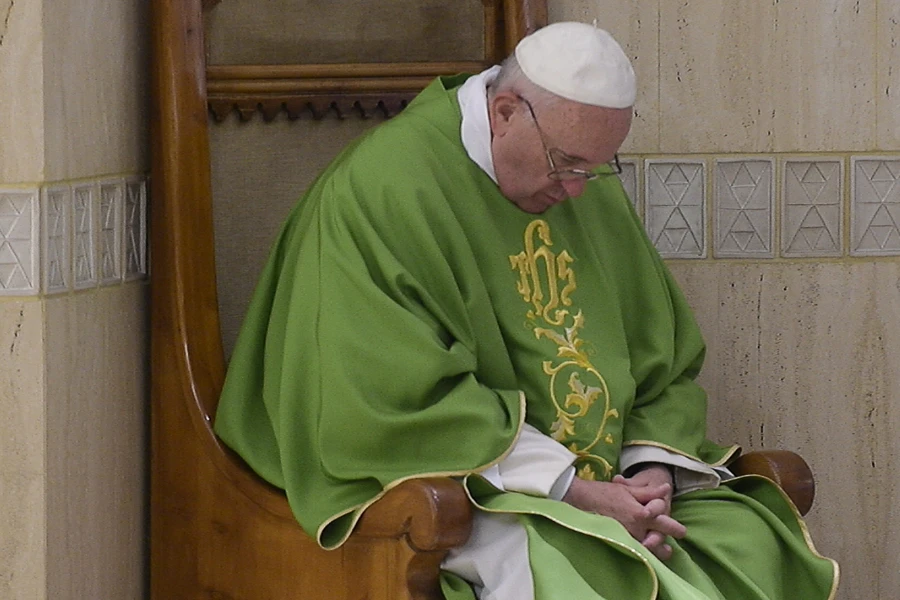
“The hypocrite is capable of destroying a community. While speaking gently, he ruinously judges a person. He is a killer,” said the Pope during his homily at Mass June 6 at the chapel of the Vatican’s Casa Santa Marta.

Pope Francis reflected on the Gospel passage in which the Pharisees and Herodians, who tried to ensnare Christ with his words, began by flattery.

“The hypocrite always uses language to flatter,” said the Pope, explaining that they will exaggerate the truth, “feeding into one’s vanity.”

He continued to the say that hypocrites are two-faced, and “the language of hypocrisy is the language of deceit, it is the same language the serpent used with Eve.”

He gave an example of a priest he met who “drank up all the flattery,” and he said that flattery is initiated by bad intentions. He said the Pharisees were trying to hide their true intentions, hoping to test Christ by asking him, “is it lawful to pay the census tax to Caesar or not?”

However, he said reality and truth are the tools to combat such hypocrisy, and it is Christ who exposes a lie with reality.

“Jesus always responds to hypocrites and ideologists with reality: ‘this is the reality; everything else is either hypocrisy or ideology.’”

He continued to say that “the reality was that the coin carried the image of Caesar.”

Hypocrisy not only destroys community, but he said it also “tears to pieces the personality and the soul of a person.”

Pope Francis ended his homily asking the Lord to strengthen a commitment to truth by the members of the Church.

“Let us ask the Lord to guard us from this vice, to help us be truthful, and if this is not possible to keep silent – but never to be a hypocrite.”

[…]