


What we really need, in Mass, is music to die for—that is, music that is appropriate to the full depth of our experience of human suffering and sin, the reality of death, and the promise of a glorious existence, as all bound up in Christ’s crucifixion and resurrection.
What we tend to get is music appropriate to cheerfulness rather than joy, balm for scratches rather than deep wounds, songs of contentment rather than of peace which passes all understanding, music aimed more at giving us a bit of a lift on Sunday morning, rather than drawing us into the perilous drama of salvation so we can make it through the week and the rest of life.
I don’t want to spend the reader’s time singling out songs for especial censure, or, by contrast, recommending music to take their place. Instead, I want to talk about the kind of music we need, and hope that this will inspire a change in what we hear.
So again, we need music to die for.
I don’t mean miserable music, or music about misery, but music that is so good, so beautiful, so moving that we are drawn down to the depths we need to experience to understand the real ravages of sin, and up to the ethereal heights from which (as Dante said in the Paradiso looking down from heaven) this poor earth looks small.
Music that is so excruciatingly good it hurts to listen to it, yet we would do anything to hear it again. Music which seems to come from somewhere else, some place that after hearing it one would fear to enter that somewhere.
Not music that blends in seamlessly with what we’ve just heard on the secular radio on the way to Mass.
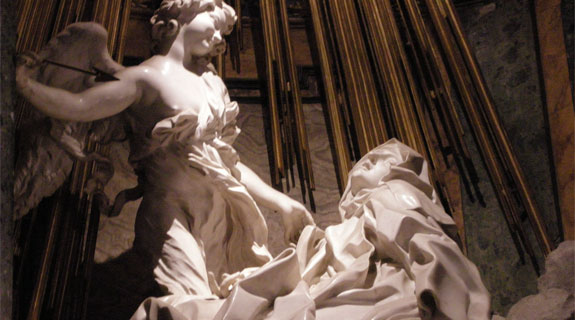
Look at the statue of St. Teresa by Bernini. The smiling angel, boyish in looks but ancient beyond all human reckoning, holding a near-deadly arrow from heaven, an arrow tipped with heavenly joy so powerful, truth so ravaging and pure, love burning so fresh and searing from the fires of the Holy Spirit, that St. Teresa’s merely mortal frame is shaken to the edge of shattering with each plunge into her heart.
Such is the Ecstasy of St. Teresa of Avila.
Where is the music that feels like that arrow? Where is the music that nearly shatters the mortal frame? Where is the music delivered by such a terrible creature as that angel?
This shaking of the human frame—how to understand it, in an age that would rather soothe, if not anesthetize?
The ancients and medieval had a kind of analogy to help capture it. Our merely mortal eyes can only stand so much light, they noted. Therefore, we cannot look directly at the sun. The direct, piercing rays would destroy our merely human eyes.
The same is true for our ears—there are sounds so loud we cannot bear them. For the sense of touch, there is heat so intense we must back away.
But there is still brighter light, greater sound, far more intense heat than our merely mortal frame could ever bear. We cannot experience very much of it without feeling the impending destruction if we try to bear too much.
Is there, then, the same thing in regard to the human soul? Is there love that burns so hot that even to feel it in the slightest would leave us scorched—in ecstasy? Is there joy so intense that merely to experience a scratch from the tip of its arrow is unbearably painful, as if the joy once entering our system through even the smallest opening is throwing itself against the walls of our soul and trying to stretch it to breaking? Is there truth so brilliant that even the glimpse caught by the eye of the soul brings blindness?
And so, is there music that is so painfully beautiful, so unworldly and merciless in its penetration of this world from a world above, that we almost fear to hear it? Music that very nearly unwinds the soul? Music that takes over the church with a legion of arrow-plunging angels?
That would be music to die for, because it would be music nearly to die from. It would not be music that merely lifts one up a little with the beat, or music that carries one along for a few minutes with a catchy phrase. It would not be music that jiggled the body, and thereby tickled the emotions.
That’s radio music. That’s our favorite music from our teen years. That’s the sound track from our favorite movie. That’s background music for an ordinary life where angels do not attack us from heaven (or demons attack us from hell). That’s the music of this-worldly satisfaction.
We need music that breaks through from another world. Not teen music, but music from eternity that draws us out of time. We need a soundtrack that fits the real drama of human life where angels do battle just above our heads and below our feet, and in and for our hearts, however numb and fat.
If you have heard even a mere snatch of such music, you’ll know exactly what I mean by speaking of it as “music to die for.” But how to get at it for those who haven’t?
It is something like the “stabs of joy” described by C.S. Lewis, that suddenly erupt without our bidding, but reveal a momentary flash of something so profoundly glorious as to dwarf our merely day-to-day experience.
Lewis recounted one such instance in his Surprised by Joy. One day his eyes happened to fall upon a picture from Arthur Rackham’s illustration of Siegfried and the Twilight of the Gods. In his words,
Pure “Northerness” engulfed me; a vision of huge, clear spaces hanging above the Atlantic in the endless twilight of Northern summer.…
And with that plunge back into my own past there arose at once, almost like heartbreak, the memory of Joy itself, the knowledge that I had once had what I had now lacked for years, that I was returning from exile and desert lands to my own country; and the distance of the Twilight of the Gods and the distance of my own past Joy, both unattainable, flowed together into a single, unendurable sense of desire and loss.… And at once I knew…that to “have it again” was the supreme and only important object of desire.
For Lewis, this taste of otherworldly joy, delivered through a pagan source, ultimately brought him back to Christianity, to the ultimate source of that Joy, to the supreme and only important object of desire, God.
Undoubtedly, St. Teresa’s “stab of Joy” was considerably more potent. But our concern is not to compare these two, but to capture what we must strive to have the music at Mass deliver.
Which is another way of saying, we must strive to have the music deliver us to the Mass, to the stab of the crucifixion that brings the Joy of the resurrection.
We Catholics believe something so entirely strange that even to utter it among ourselves should bring gasps of astonishment. The crucifixion and resurrection are present in the Mass—not presented again like a morality play, not referred to politely by way of visual metaphor. Here, before our eyes, in this Mass, time is broken into and out of, and we are standing in the presence of the being-crucified Christ. We are as “there” as those for whom it was, two millennia ago, “here and now.” The same is true of the resurrection. The astounding event, like the crucifixion, is, for a moment, no longer reported to us, but witnessed by us—both under a sacramental veil.
Now ask yourself. We have music in our movies that is intended to heighten and deepen the experience of the dramatic scene. What is the music that could accompany the actual crucifixion and resurrection? What musical arrow could, for just a moment, deliver a stab of Joy so sharp as to pierce the sacramental veil, tearing it enough to allow a glimpse of what is really going on before our own eyes at the Mass?
Perhaps we might discover what it is by sorting through what it isn’t. It could not be music that sounded exactly like popular secular music, because the Mass is sacred. Just as the words said at Mass are entirely defined by the Mass and can be uttered nowhere else, so also the music itself should be so indelibly sacred. Form and function, we might say, must be inextricably entwined.
It could not be music of the day, music that is so identifiably contemporary that (like fashions of the day) it soon passes into being identifiably dated, as is, e.g., popular music from the 50s, 60s, or 70s. (One of my Evangelical friends once kiddingly remarked, “The only place you can still hear 70s folk music on a Saturday night is the Catholic anticipatory Mass.”) It must be music that draws us away from our day to eternity.
It cannot be music that is merely cheerful, because we’ve got enough of that offered to us outside the church in our all-too-ordinary lives.
It must be music whose aim is to be extraordinary, in the way that a cathedral is extraordinary, entirely defined by what is beyond the veil of ordinary life so that we understand that even in our ordinary lives we are enmeshed in the great drama of salvation. It must, to say it one last time, be music to die for.
If you value the news and views Catholic World Report provides, please consider donating to support our efforts. Your contribution will help us continue to make CWR available to all readers worldwide for free, without a subscription. Thank you for your generosity!
Click here for more information on donating to CWR. Click here to sign up for our newsletter.
