

 “Clark on China”: An Introduction
In this Catholic World Report column, I will be providing monthly reports on the situation of the Church in China. Today, China has the world’s fastest growing economy, the fastest growing cities, the second fastest growing population, and probably the fastest growing number of Christians. When Chairman Mao Zedong declared the establishment of the People’s Republic in China in 1949 there were around four million Christians in China. Today, 63 years later, there are around 70 million.
I was in China a few months ago with several Catholic friends, with whom I discussed the situation of the Church in that country, prayed, and visited new places with histories both sad and joyful. During my many visits to China over the years, I have learned that faith is strong there, perhaps—who am I to judge?—even stronger than in my own country. In a country ostensibly cut off from the Holy Father, I have seen a deeper commitment to him than I have in any other place. In a country seemingly divided into two Catholic communities I have seen greater unity than I have observed elsewhere.
And in a country where Catholics have lived a life of, as they say, chiku (“eating bitterness”), I have seen countless faithful bear witness to Henry David Thoreau’s remark, “The smallest seed of faith is better than the largest fruit of happiness.”
It would be easy to write a column each month on the “suffering Church” in China—reporting arrests, church closures, and state-Church tensions. But that would be a misrepresentation of what Catholic life is like in China today in the 21st century. It would also be easy to read official state sources about religion in China and report on how China’s Catholics are thriving and happy under their new state leaders. But I shall attempt to report on what is really happening in China’s Catholic Church, taking as my motto Flannery O’Connor’s insightful quip, “The truth does not change according to our ability to stomach it.”
The Church in China Today
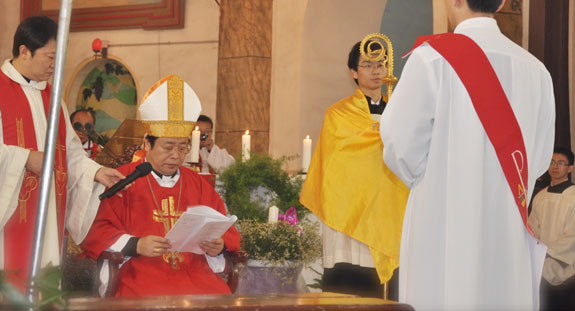
In the opening line of his 2007 encyclical, Pope Benedict XVI began with the words of St. Paul to the Romans: “Spe salvi facti sumus,” in hope we were saved. I think that one of the more positive trends in the Church in China today is the trend toward a sense of hope. And it was Benedict XVI who, on February 18, 2012, bestowed the red hat to Hong Kong’s Bishop John Tong, making him a cardinal. It marked an important moment in the future of the Catholic history of China; Tong is only the seventh Chinese man to be elected a cardinal in the history of the Catholic Church, and he is the first Hong Kong-born Chinese to receive this honor. Cardinal Tong’s appointment is significant, not only as he is in many ways the successor of his influential Chinese predecessor, Joseph Cardinal Zen, but because Tong is uniquely informed regarding the state of the Church in China today. 
During the 1998 “Asian Synod” of bishops, opened by a Mass at St. Peter’s offered by Pope John Paul II, Tong intervened to tell his fellow bishops a few stories about the Church in China. He recounted the story of Bishop Matthias Duan Yinming of Wanxian Diocese, ordained a bishop by Pope Pius XII in 1949, who suffered severe persecution for his faith during the Cultural Revolution (1966-1976). The Red Guards rushed into his cathedral and took down a statue of Our Lady, and ordered Bishop Duan to crush her image with a hammer. He refused, reportedly exclaiming, “You can take my head, but not my faith.” He was taken, tortured, imprisoned, and placed in a labor-reform camp until 1979. Tong also spoke of a young boy whose uncle, a priest, was publicly tried during the Cultural Revolution for being a Catholic. The young boy was in the large crowd when he heard the Red Guards sentence the priest to death, and he watched the bullets enter his uncle’s heart, and watched the blood flow from his chest. As Tong recalls, “At once he heard a voice inside him, calling him to the priesthood. He told himself, ‘I must become a priest to continue my uncle’s work’.” (Bishop John Tong, Asian Synod intervention, “The Church in China,” 1998). This is when the boy first heard his call to serve God as a priest in China. These are the stories of countless Chinese bishops, priests, nuns, and faithful, most of whose names are lost to history.
While problems persist, the present reality in China is not so bleak. I continue to hear reports from a priest friend of how far the Church in China has come since the Maoist era. In Shanxi, 45 catechumens were baptized in the cathedral recently on the Feast of the Holy Family, and the numbers of baptisms continues to rise. Priests at China’s seminaries are giving speeches to full crowds on the “new evangelization” taught and encouraged by Blessed John Paul II and Benedict XVI.
Bearing in mind that religious orders have been prohibited in China, it is astonishing that Fr. Xia Changzhou, a Franciscan, has begun spiritual instruction to 40 new Third Order Franciscans in Shanxi. Tianjin’s Catholic diocese has begun open celebrations of its 100-year presence in the city, and in the opening Masses—concelebrated by 17 local priests—the 1870 massacre of foreign nuns in Tianjin was openly discussed in the homily.
Meanwhile, the state authorities in Beijing are paying for the restoration of the large bishop’s residence beside the historic North Church. The residence will be returned to Beijing’s prelate once restoration is complete, after having been held by the government for decades. China’s Catholics are not ignorant of present struggles, but they are also not blind to recent improvements. One only has to remember that during the Maoist era China’s churches were boarded up or used as factories, warehouses, or restaurants. Today they are filled with the faithful who benefit once again from the sacramental presence of God in the Eucharist.
Some Recent Reports
As the Chinese often say, one can always find a little yin in the yang—that in life there are no purely good days or purely bad days. Just as we hear voices of hope among China’s Catholics, we also hear voices of caution, among them Cardinal Zen. In some recent remarks the Cardinal stated that “the Beijing Government has not changed one iota in its policy of religious oppression, it still wants absolute control of religion and, in the case of the Catholic Church, China wants to detach the Church from obedience to the Holy See” (Joseph Cardinal Zen, “What is the True Good of the Church in China,” February 8, 2012, Asia News). In unusually frank terms, Zen has asserted China’s political engine has become so intrusive in Catholic religious affairs that “we are on the verge of a schism, with these repeated statements of wanting to make an independent Church and continue to ordain bishops without papal mandate” (Ibid). And so Zen calls China’s Catholics to take a more firm stand against the state, as they did in the early 1950s. 
We might ask what precipitated the Cardinal’s firm remarks. As is quite common today, the Chinese government insists on selecting and ordering the ordination of bishops without the mandate of the Pope, which is canonically punishable with excommunication. On July 14, 2011, a new bishop was ordained in Shantou, China, against the Pope’s will, and among those bishops who participated in the rites was the coadjutor bishop of Nanchang, John Baptist Li Suguang. To date all of the bishops who participated in that ordination have apologized and received pardon from the Holy Father except for Bishop Li Suguang, who has neither apologized for nor recognized that this has created a division between himself and Rome. And to add to this, in an interview in 30Giorni (30 Days), he asserted:
I believe that from the beginning until now our Church in China has never changed a single iota of the Apostolic Tradition that was delivered to it. We have not changed a comma of the doctrine that concerns the faith and the great discipline of the Church. We are united around the same sacraments, recite the same prayers, in the continuity of the apostolic succession. This is the basis of authentic communion. Even with our limitations and all our failings and frailties, we are a part of, we are of the number of the Holy Universal Church (30Giorni, September 2011).
Without a single acknowledgment of his strained relationship with the Holy Father, Bishop Li appears to be lecturing the Vatican on the “authentic communion” of the Chinese Church with the universal Catholic Church.
The Challenge of China
Opinions and accounts are so varied as to make reporting on the Church in China extremely difficult, confounding, and frustrating. Here is one small example. While sharing lunch with an excited young priest in Tianjin, I heard countless stories of how his native village in northwest China has an active Catholic youth association, how the Tianjin cathedral cannot accommodate all of the people who attend Masses on Sundays, and how helpful visiting foreign priests have become in the ministry at Tianjin. Several weeks after that lunch I shared another meal with a Chinese priest in Rome, who stated repeatedly, “The priests and bishops in China are brainwashed with nationalism, and corruption in the hierarchy is rampant.”
Anyone who carefully watches the Church in China undoubtedly feels as Albert Einstein did when he said he was used to spending “weeks in a state of confusion” trying to solve complex problems. But what is clear is that the state of the Church in China is unusual, and that the current state of Catholic life there is restrained and distorted under the anti-religious pressures of the Communist authorities. Christianity is a religion of truth, and Chinese Christians often feel that their survival depends on either explicit untruth, or implicit distortion of the truth. 
In this column, then, I will attempt to fairly and honestly report on the current state of the Catholic Church in China, which is, we should remember, more than two centuries older than the Catholic Church in America. If we begin the Church’s life in China with the first Mass offered there, then it would be more than eight centuries old. And in those 800 years, the Church has suffered and flourished in turns, but it has always survived.
On a personal note, I love China. Let me say it this way, 我真愛中國! I have many friends who live there, both Catholic and non-Catholic, and I hope none of my columns ever suggests that I feel any other way. But as Confucius said, “The object of a noble person is truth.” The truth must be told of any place, America or China. I should end my first column, though, by admitting that getting at the truth is deeply challenging when discussing issues on China’s “sensitive” list, and Catholicism ranks highly on that list.
When describing Mount Lu in a poem, the famous poet and calligrapher, Su Dongpo, once wrote:
Gazing horizontally at its ridges, one imagines its peak,
Near and far, high and low, all are different,
Since you stand in the middle of the mountain,
You cannot see the true face of Mount Lu.
Su Dongbo’s depiction of how hard it is to describe a mountain so laden with craggy cliffs and varied heights, perhaps, is the best way to imagine the difficulties of discussing the Church in China. St. Paul’s words for the Church in Rome, written nearly 2,000 year ago, provide apt advice for the Church in China in the 21st century, “Rejoice in hope, be patient in tribulation, and be constant in prayer” (Rom 12:12).
Pax et bonum,
Anthony E. Clark, Ph.D.
25 February 2012
Spokane, Washington
If you value the news and views Catholic World Report provides, please consider donating to support our efforts. Your contribution will help us continue to make CWR available to all readers worldwide for free, without a subscription. Thank you for your generosity!
Click here for more information on donating to CWR. Click here to sign up for our newsletter.
