

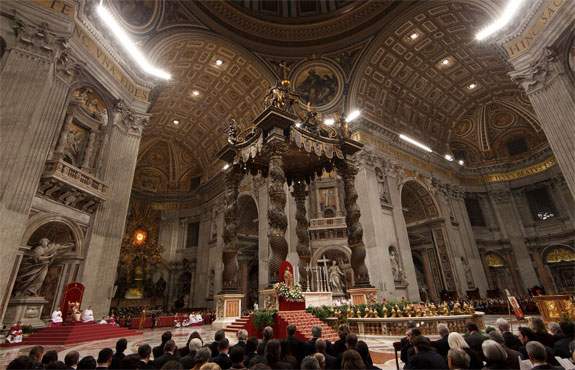

“We do not need a generic, indefinite god but rather the living, true God who unfolds the horizon of men’s future into a prospect of firm, well-founded hope, a home rich in eternity that enables us to face the present courageously in all its aspects.”
— Pope Benedict XVI, To University Students of Rome. (December 15, 2011, L’Osservatore Romano, December 21, 2011.)
I.
Just before Christmas every year, the Holy Father has a meeting with local university students in Rome. This year’s talk was centered about a passage in James (5:7) about patience. Essentially, patience is on the side of letting things happen in their own due time. We often wonder why God does not do things in a more tidy and speedy fashion. We set up our standard and wonder why God does not conform to it.
“There are many people in our time, especially among those you meet in university lecture halls, who voice the question of whether we should await something or someone, whether we should await another messiah, another god…” The implication is that the Messiah we have been given has not come through for us. We must look about, perhaps make our own redeemer. It is quite interesting to read that these impatient folks populate university lecture halls. We might speculate: why?
Everyone knows that university professors (and sometimes politicians) are constantly tempted to invent their own world in order to explain their private theory about how things should be. This Christian idea of receiving a revelation and waiting for the plan of God to unravel is much too inefficient. There has to be a speedier way. The trouble with such theories is that, once they are in effect, we end up gazing into the face of the professor and not into the Face of God.
We are created ultimately to behold God “face to face.” But salvation comes to us in God’s way and time, not ours. The meaning “in the depth of life and history” is that seeing the face of the Lord requires “patience, fidelity and constancy in seeking God and openness to him that he reveals his Face.” It is a subtle temptation, to compare what God does to what we think, if we were He, He ought to do.
Our individual question becomes: “Where can my search find the true Face of tis God?” The more basic question is: “Where does God himself come to meet me, showing me his Face, revealing its mystery to me…?” Looked at from this angle, we do not demand that God follow our terms. How we are to meet Him has been explained to us. We do not set the terms. Thus, we have room for patience, a patience that does not presume to set our parameters to God’s action.
If we look at our tradition, we realize that within it, “the certainty of the world’s great hope is given to us that we are not alone and we do not build history by ourselves.” We need to trust that God is present in history. We are not calling all the shots. We cannot put our hope on what is immediate.
Many put all their hope “in immediate, in a purely horizontal perspective or in projects that are technically perfect but far from the most profound reality, the one that gives the human person the loftiest dignity, the transcendent dimension, that of being a creature in the image and likeness of God and of carrying in our heart the desire to rise him.”
II.
Benedict frequently returns to the reality of the Incarnation. When we speak of God, we often have to use analogies or similitudes. The case of Christ is different. He was among us, at a given time and place. People saw Him, wrote about Him, and remembered Him. He was not a fantasy or an ideal form. “God, in the Incarnation of the Word, in the incarnation of his Son, experienced the time of human beings, their growth, their action in history.” We often underestimate the significance of this fact. The Son of Man, the Son of God, actually lived in time, at a definite, known period of time.
If God the Father, who created the world in the Word, sent this Son into the world, that fact is the most significant thing that has ever happened in the history of man in this cosmos. It not only says that the world is God’s creation and worth God’s immediate attention, it also recounts that this same Word was, in His manhood, crucified by men. We can speak of God’s patience from that point. The patience of God awaits the human actions that acknowledge sins and recognizes their relation to this Crucifixion of the Son of god.
“Being persevering and patient means learning to build history together with God, because it is only by building on him and with him that the construction is firmly founded, not exploited for ideological ends, but truly worthy of the human being.” How to “construct” worlds “worthy” of human beings? The answer is that we first have to remember how it is that we began and for what we are intended. We do not call ourselves into existence. We do not redeem ourselves.
“Our existence is no longer left to the impersonal forces of natural and historical processes; our house can be built on the rock; we can plan our history, the history of humanity, not in Utopia but in the certainty that the God of Jesus Christ is present and goes with us.” Again we have here the contrast of the Utopias of the professors and the patience of God, the way of God.
The pope finally “invites” the students to seek the real “Face of God.” “Seeking the Face of God is the profound aspiration of our heart and is also the answer to the fundamental question that continues to surface ever anew in contemporary society.” God is close to everyone; no one is excluded who does not choose to be excluded.
The pope ends with a brief prayer: “Your Face, Lord, do I seek. Come, do not delay.” We have here both a patience and an awareness of what it is that we seek.
We can reject the Face of God seen in Christ to replace it with our own constructions. Many insist that this taking charge is what we should be doing. They have given God time to correct things. He has failed. Or so they tell us. They give us another “face” to see. It is not the Face of God. It is but our own face to gaze on forever. It is an omen of despair that we are offered. Many will choose themselves. But it is the Face of God that they seek. Their lack of patience deceives them. They end up with the couple in Genesis who wanted themselves to have the power to define good and evil rather than discover it in the Face of God who walked in the Garden.
If you value the news and views Catholic World Report provides, please consider donating to support our efforts. Your contribution will help us continue to make CWR available to all readers worldwide for free, without a subscription. Thank you for your generosity!
Click here for more information on donating to CWR. Click here to sign up for our newsletter.
