No Picture
News Briefs

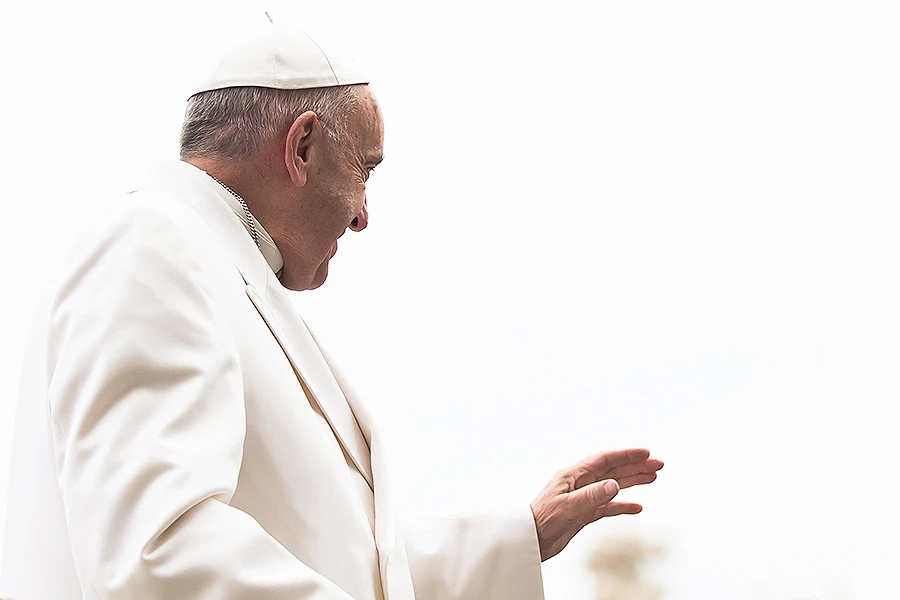
Pope: Mary’s ‘yes’ echoes the joy, suffering of every mother

May 10, 2017 CNA Daily News 0

Vatican City, May 10, 2017 / 05:56 am (CNA/EWTN News).- Days before his trip to Fatima, Pope Francis said Mary’s ‘yes’ at the Annunciation was more than a yes to bearing the Son of God, but was also an acceptance of everything she would endure after – something every mother experiences with a new child.  

“It was not easy to answer with a ‘yes’ to the angel’s invitation; yet she, a woman still in the flower of youth, answers with courage, despite not knowing anything about the fate that awaited her.”

“Mary at that moment looks like one of the many mothers of our world, brave to the extreme when it comes to welcoming in her womb the story of a new human being who is growing,” he said May 10.

Her ‘yes’ to the angel at the Annunciation was just the first step “in a long list of obedience” leading to the moment she stands at the foot of her Son’s cross, the Pope said.

During his general audience, Pope Francis centered his catechesis on the few lines from the Gospel of John that describe Mary “standing by the cross of Jesus.” Though Mary is largely a silent figure in the Gospels, she listens and “ponders every word and every event in her heart.”

“The Gospels are laconic, and extremely subtle. They record with a simple verb the presence of the Mother: She ‘was standing,’ she was standing,” he said, noting that “nothing is said of her reaction: if she weeps, if she does not weep … nothing; not even a brushstroke to describe her grief.”

Throughout history poets and painters have imagined this moment in art and literature, “but the Gospels just say, she was ‘standing.’ She was there, in the worst moment, in the cruelest time, and suffered with her son,” but “she was standing,” Francis said.

Though there had been a “slow eclipse” of her presence in the Gospels, she returns at this crucial moment when many others had fled.

“Mothers do not betray, and at that moment, at the foot of the cross, none of us can say whose was the cruelest passion; whether that of an innocent man who dies on the scaffold of the cross, or the agony of a mother who accompanies the last moments of her son’s life,” he said.

And she doesn’t get angry or protest: she simply stands and listens, Pope Francis said, pointing to the relationship between listening and the virtue of hope.

Despite everything, even the “deepest darkness,” Mary does not leave, but stands faithfully, he said. “That’s why we all love her as a Mother…We are not orphans: we have a Mother in heaven, who is the Holy Mother of God.”

Mary, he said, teaches to us “the virtue of waiting, even when everything seems meaningless: she is always confident in the mystery of God.”

Even though she didn’t know what the outcome of her Son’s Passion would be, she is loyal to the plan of God, just as she promised to the angel “on the first day of her vocation,” Francis said, explaining that it is also part of her motherly instinct to suffer for her child.

“The suffering of mothers: We have all known strong women that braved the many sufferings of their children!” he said.

Even in the first days of the Church, before Christ’s resurrection is known and the disciples are all afraid, the “Mother of Hope” stays, Francis said. “She was simply there, in the most normal of ways, as if it were a natural thing.”

Thus, he concluded, “in moments of difficulty, Mary, the Mother Jesus has given to us all, can always support our steps, can always say to our heart: ‘Get up! Look ahead, look at the horizon,’ because she is a Mother of Hope.”

[…]

No Picture
News Briefs

Vatican astronomer: If you’re afraid of science, you don’t have faith

May 10, 2017 CNA Daily News 3

Vatican City, May 10, 2017 / 03:04 am (CNA/EWTN News).- The Jesuit director of the Vatican Observatory, who has worked as an astronomer and planetary scientist at the Vatican for more than 20 years, told journalists Monday that faith and reason are hardly at odds.

“If you have no faith in your faith, that is when you will fear science,” Brother Guy Consolmagno, S.J., said May 8.

He spoke to journalists at a press conference ahead of a May 9-12 summit on “Black Holes, Gravitational Waves, and Space-Time Singularities” being held in Castel Gandolfo at the Vatican Observatory, just outside Rome.

Presser w/ Br. Guy Consolmagno (@specolations) & col. on Vatican conference on Black Holes, Gravitational Waves & Space-Time Singularities pic.twitter.com/Q8FYJMD2y5

— Hannah Brockhaus (@HannahBrockhaus) May 8, 2017

“The Vatican Observatory was founded in 1891 by Pope Leo XIII to show that the Church supports good science, and to do that we have to have good science,” Br. Consolmagno said, explaining the reasoning behind the conference.

The hope is that the encounter will foster good science, good discussion, and even friendship. Among the speakers will be a Nobel Prize winner in physics and a Wolf Prize winner.

Among the topics of papers being presented at the conference are Strong evidence for an accelerating universe; Black hole perturbations: a review of recent analytical results; and Observing the Signature of Dynamical Space-Time through Gravitational Waves.

“Those of us that are religious, will recognize the presence of God, but you don’t have to make a theological leap to search for the truth,” Br. Consolmagno said. “There are many things we know we do not understand. We cannot be good religious people or scientists if we think that our work is done.”

The summit is also taking place in recognition of Fr. Georges Lemaître, the Belgian physicist and mathematician who is widely credited with developing the “Big Bang” theory to explain the origin of the physical universe.

Addressing common misconceptions surrounding the Big Bang, such as the idea that it did away with the need for a creator, Br. Consolmagno said the solution isn’t just to put God at the beginning of things and call that good, either.

“The creative act of God is not something that happened 13.8 billion years ago,” he said. “God is already there before space and time exist. You can’t even say ‘before’ because he is outside of time and space.”

The creative act is happening continuously: “If you look at God as merely the thing that started the Big Bang, then you get a nature god, like Jupiter throwing around lightning bolts.”

“That’s not the God that we as Christians believe in,” he went on. “We must believe in a God that is supernatural. We then recognize God as the one responsible for the existence of the universe, and our science tells us how he did it.”

The organizer of the conference, Fr. Gabriele Gionti, S.J., said Fr. Lemaître always distinguished between the beginnings of the universe and its origins.

“The beginning of the universe is a scientific question, to be able to date with precision when things started. The origins of the universe, however, is a theologically charged question.”

Answering that question “has nothing at all to do with a scientific epistemology,” he added.

Br. Consolmagno commented that “God is not something we arrive at the end of our science, it’s what we assume at the beginning. I am afraid of a God who can be proved by science, because I know my science well enough to not trust it!”

“An atheist could assume something very different, and have a very different view of the universe, but we can talk and learn from each other. The search for truth unites us.”

He suggested that to demonstrate that the Church and science are not at odds, those who are both church-goers and scientists should make that fact more known to their fellow parishioners.

He threw out some practical ideas, such as setting up a telescope in the church parking lot or leading the parish’s youth group on a nature hike.

The Church, in a sense, developed science through the medieval universities she founded, he explained. For example, Bishop Robert Grosseteste, a 13th century Bishop of Lincoln and chancellor of Oxford University, helped develop the scientific method and was often cited by Roger Bacon.

“If there is a rivalry” between the Church and science, Br. Consolmagno said, “it’s a sibling rivalry.”

“And it’s a crime against science to say that only atheists can do it, because if that were true, it would eliminate so many wonderful scientists.”

[…]

No Picture
News Briefs

Vatican astronomer: If you’re afraid of science, you don’t have faith

May 10, 2017 CNA Daily News 0

Vatican City, May 10, 2017 / 03:04 am (CNA/EWTN News).- The Jesuit director of the Vatican Observatory, who has worked as an astronomer and planetary scientist at the Vatican for more than 20 years, told journalists Monday that faith and reason are hardly at odds.

“If you have no faith in your faith, that is when you will fear science,” Brother Guy Consolmagno, S.J., said May 8.

He spoke to journalists at a press conference ahead of a May 9-12 summit on “Black Holes, Gravitational Waves, and Space-Time Singularities” being held in Castel Gandolfo at the Vatican Observatory, just outside Rome.

Presser w/ Br. Guy Consolmagno (@specolations) & col. on Vatican conference on Black Holes, Gravitational Waves & Space-Time Singularities pic.twitter.com/Q8FYJMD2y5

— Hannah Brockhaus (@HannahBrockhaus) May 8, 2017

“The Vatican Observatory was founded in 1891 by Pope Leo XIII to show that the Church supports good science, and to do that we have to have good science,” Br. Consolmagno said, explaining the reasoning behind the conference.

The hope is that the encounter will foster good science, good discussion, and even friendship. Among the speakers will be a Nobel Prize winner in physics and a Wolf Prize winner.

Among the topics of papers being presented at the conference are Strong evidence for an accelerating universe; Black hole perturbations: a review of recent analytical results; and Observing the Signature of Dynamical Space-Time through Gravitational Waves.

“Those of us that are religious, will recognize the presence of God, but you don’t have to make a theological leap to search for the truth,” Br. Consolmagno said. “There are many things we know we do not understand. We cannot be good religious people or scientists if we think that our work is done.”

The summit is also taking place in recognition of Fr. Georges Lemaître, the Belgian physicist and mathematician who is widely credited with developing the “Big Bang” theory to explain the origin of the physical universe.

Addressing common misconceptions surrounding the Big Bang, such as the idea that it did away with the need for a creator, Br. Consolmagno said the solution isn’t just to put God at the beginning of things and call that good, either.

“The creative act of God is not something that happened 13.8 billion years ago,” he said. “God is already there before space and time exist. You can’t even say ‘before’ because he is outside of time and space.”

The creative act is happening continuously: “If you look at God as merely the thing that started the Big Bang, then you get a nature god, like Jupiter throwing around lightning bolts.”

“That’s not the God that we as Christians believe in,” he went on. “We must believe in a God that is supernatural. We then recognize God as the one responsible for the existence of the universe, and our science tells us how he did it.”

The organizer of the conference, Fr. Gabriele Gionti, S.J., said Fr. Lemaître always distinguished between the beginnings of the universe and its origins.

“The beginning of the universe is a scientific question, to be able to date with precision when things started. The origins of the universe, however, is a theologically charged question.”

Answering that question “has nothing at all to do with a scientific epistemology,” he added.

Br. Consolmagno commented that “God is not something we arrive at the end of our science, it’s what we assume at the beginning. I am afraid of a God who can be proved by science, because I know my science well enough to not trust it!”

“An atheist could assume something very different, and have a very different view of the universe, but we can talk and learn from each other. The search for truth unites us.”

He suggested that to demonstrate that the Church and science are not at odds, those who are both church-goers and scientists should make that fact more known to their fellow parishioners.

He threw out some practical ideas, such as setting up a telescope in the church parking lot or leading the parish’s youth group on a nature hike.

The Church, in a sense, developed science through the medieval universities she founded, he explained. For example, Bishop Robert Grosseteste, a 13th century Bishop of Lincoln and chancellor of Oxford University, helped develop the scientific method and was often cited by Roger Bacon.

“If there is a rivalry” between the Church and science, Br. Consolmagno said, “it’s a sibling rivalry.”

“And it’s a crime against science to say that only atheists can do it, because if that were true, it would eliminate so many wonderful scientists.”

[…]

No Picture
News Briefs

Kidnapped Indian priest pleads for help in new video

May 9, 2017 CNA Daily News 0

Vatican City, May 9, 2017 / 05:04 am (CNA/EWTN News).- Fourteen months after his kidnapping in March 2016, Salesian priest Fr. Tom Uzhunnalil has appeared in another video asking for help in obtaining his release, criticizing the response of a local bishop and the Indian government.

Opening with a word of thanks, Fr. Tom apparently references either a message he’s received, or the general concern surrounding his case.

“I received the message of concern that you sent to me, my dear family people. I’m thankful to you. Thank you very much,” he said in the video, published on YouTube May 8.

The video, which has not yet been authenticated, shows a cardboard sign with the date April 15, 2017, sitting on the lap of a thin-looking Fr. Tom, who appears with overgrown hair and a beard.

Speaking slowly in English, Fr. Tom said the Indian government has been contacted several times concerning his release. The bishop of Abu Dhabi in the United Arab Emirates has also been contacted, he said, claiming that he’s seen their responses, and they were “very, very poor.”

The priest indicated that he is in poor health, saying: “my health condition is deteriorating quickly, and I require hospitalization as early as possible,” he said.

He then made an appeal for his release, asking “my little family people” to do what they can “to help me be released. Please, please do what you can to help me be released. May God bless you for that.”

Fr. Tom was kidnapped in Yemen in March of last year during an attack on a Missionaries of Charity house that left 4 sisters dead. He garnered international attention last spring when rumors spread that he was to be crucified on Good Friday. Those rumors were later discredited.

A video was posted to YouTube Dec. 26, 2016, showing Fr. Tom personally appealing to Pope Francis, and bishops all over the world, for help.

“Dear Pope Francis…as a father, please take care of my life,” Fr. Tom said. The five-minute video was the first communication from Fr. Tom since his abduction. The priest had overgrown hair and spoke slowly from a prepared script.

Pope Francis did appeal for the priest’s release April 10, 2016, after his Sunday Regina Coeli address in St. Peter’s Square.

“I renew my appeal for the freeing of all kidnapped persons in armed conflict zones,” the Pope said. “In particular, I wish to remember Salesian priest Tom Uzhunnalil, who was abducted in Aden, Yemen last March 4.”

Since his kidnapping, Salesians in the Bangalore province of India have made continued efforts for his safety and release, including holding a prayer vigil Jan. 4 and a worldwide novena Jan. 15-23.

No one has claimed responsibility for the priest’s kidnapping, making it difficult for the Indian government to broker the priest’s release. In addition, the situation has been exacerbated by the political instability in Yemen.

Yemen has been embroiled in civil war since March 2015, when Shia rebels attempted to oust Yemen’s Sunni-led government. Saudi Arabia has led a pro-government coalition. Both al-Qaeda and the Islamic State have set up strongholds in the country amid the power vacuum. More than 6,000 people have been killed in the conflict, according to the United Nations.


Below is the video released of Fr. Tom, which has not been authenticated:

<iframe width=”560″ height=”315″ src=”https://www.youtube.com/embed/AGpa-tBUvuk” frameborder=”0″ allowfullscreen></iframe>

[…]

No Picture
News Briefs

Don’t let Venezuelans fall into despair, Pope tells bishops

May 8, 2017 CNA Daily News 0

Vatican City, May 8, 2017 / 04:22 pm (CNA/EWTN News).- In response to Venezuela’s violent riots, inflated prices, and political mistrust, Pope Francis urged the country’s bishops to continue promoting a culture of encounter.

“Dear brothers, I wish to encourage you to not allow the beloved children of Venezuela to allow themselves to be overcome by distrust or despair since these are evils that sink into the hearts of people when they do not see future prospects,” Pope Francis said in a May 5 letter to the bishops.

“I am persuaded that Venezuela’s serious problems can be solved if there is the desire to establish bridges, to dialogue seriously and to comply with the agreements that were reached.”

Riots have spiked in Venezuela in recent years, resulting from unemployment, food and medicine shortages, and President Nicolás Maduro’s authoritarian policies.

Price controls in 2003 caused inflation rates to sky rocket on basic necessities, baring the access of food and medicines to the people. Poor socialist policies have effected an estimated 160 products, and while they remain affordable on the shelf, they are soon swept off and sold on the black market at a triple digit inflation rate.

Violent riots have fluctuated since the death of the previous president Hugo Chavez in 2013, but gained even more traction after opposition leaders were arrested last year and Maduro’s attempt for more power by dissolving the legislature in March of this year.

Archbishop Ubaldo Santana of Maracaibo spoke gravely on the situation in an interview with Alpha and Omega news weekly earlier this year, calling it a “bloodbath of considerable proportions” fueled by riots and criminally charged activities.

“We’re talking about 30,000 people murdered a year, and if we don’t manage to find peaceful ways to understand each other, that number can increase.”

In the letter, Pope Francis commended the pastors who have shared in the suffering of their flock.

“I also know that you, dear brothers, share the situation of your people, who along with the priests, consecrated women and men and the lay faithful are suffering for the lack of food and medicines, and that some have even endured personal attacks and acts of violent acts in your Churches.”

But hunger and lack of basic necessities has also fueled violence among the people and looting has notably increased. According to The New York Times, shopping carts full of food and other supplies were stripped from supermarkets and liquor stores during riots among poor and working class communities.

Opposition leaders have also struggled with the violent riots, trying to channel the political unrest into peaceful demonstrations, but even the peaceful protests have been greeted by rubber bullets and tear gas.

Archbishop Diego Padrón Sánchez of Cumaná, President of Venzeuala’s bishop conference, said the government “carried out violence with the various persecutions conducted against different opposition leaders” in response to peaceful protests late last year.

Venezuela is noted to be one of the most politically corrupt countries in Latin America, and anger recently arose after the Supreme Court’s attempted to strip legislative power from the National Assembly. The move was identified by the United States and the United Nations as a power grab by Maduro, whose supporters hold seats in most of the court.

However, despite the political unrest the bishops have continuously called for people to avoid “any form of violence, to respect the rights of citizens and to defend and promote human dignity and fundamental rights,” Pope Francis said.  

“I urge you to continue doing everything necessary so that this difficult path may be possible, convinced that the communion among you and your priests will give you the light to find the right path.”

[…]

No Picture
News Briefs

Pope to seminarians: Let Mary help you fall in love with Jesus

May 8, 2017 CNA Daily News 0

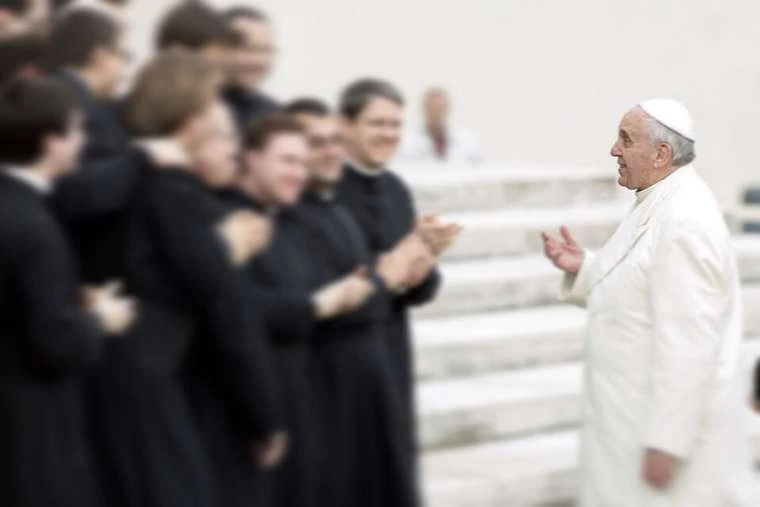
Vatican City, May 8, 2017 / 12:05 pm (CNA/EWTN News).- Pope Francis met with priests and seminarians from the Portuguese College in Rome, asking them to allow Mary to bring them closer to Christ – just like she did for the children at Fatima.

“The meeting with Our Lady was for (the shepherd children) a graceful experience that made them fall in love with Jesus,” he said Monday.

“I must wish the same to all of you, dear friends. Above every other goal that has brought you to Rome and keeps you here, there is always this: knowing and loving Christ – As the Apostle Paul would say – trying to conform more and more to him until a total gift of self.”

Pope Francis met with priests, seminarians and religious of the Pontifical Portuguese College of Rome at the Vatican May 8.

During the audience he referenced his imminent pilgrimage to Fatima, Portugal May 12-13 for the 100th anniversary of Our Lady’s appearance to three shepherd children, or “Pastorelli,” Francisco, Jacinta and Lucia.

In their meeting, Francis encouraged the Portuguese priests and seminarians to look to the example of the child visionaries, of which two, Francisco and Jacinta, will be canonized during his trip.

“Concretely you, dear priests, are called to progress, without tire, in your Christian, priestly, pastoral, and cultural formation,” he said.

“Whatever your academic specialty, your first concern always remains to grow on the path of priestly consecration, through the loving experience of God: a close and faithful God, as Blessed Francisco and Jacinta and the Servant of God Lucia felt him.”

In Mary, the children had a “tender and good teacher,” he continued, who introduces them to the “intimate knowledge of Trinitarian love and brings them to taste God as the most beautiful reality of human existence.”

“Today, contemplating their humble and yet glorious lives, we feel enticed to entrust us, too, to the praises of the same Master,” the Pope said.

Christ invites us to look for shelter under the mantle of Mary as well, who takes us by the hand like a mother, teaching us “to grow in the love of Christ and fraternal communion.”

Pope Francis said he was pleased to hear that since 1929, the chapel of the Portuguese College has had an image of Mary hanging near the altar.

“Look at her and let her look at him,” he said, “because she is your Mother and loves you so much. Let yourself be watched by her, to learn to be humble and even more brace in following the Word of God.”

It is a relationship with Our Lady that “helps us to have a good relationship with the Church,” he explained, because “both are Mothers.”

Through Mary, you can receive the embrace of Jesus, her son, he said, and having a strong friendship with Jesus, you can learn to love each person with the measure of the Heart of Christ.

He warned those present that to lack a relationship with Mary is to be like an orphan of the heart. For a priest to forget his Mother, especially in difficult times, is a very grave absence.

Concluding, Francis offered prayers for the community and their families, and asked Our Lady of Fatima to “teach us to believe, worship, hope and love like Blessed Francisco and Jacinta and Servant of God Lucia.”

[…]

No Picture
News Briefs

The Swiss Guard is more than an army – it’s a school of faith

May 6, 2017 CNA Daily News 0

Vatican City, May 6, 2017 / 10:46 am (CNA/EWTN News).- As 40 new Swiss Guards take an oath to defend and protect Pope Francis, their commander has emphasized that their role is not only to be a security force, but has a spiritual aspect as well.

“If someone in the (job) interview only talks about security and doesn’t know who they are giving security for…for me he is not a candidate,” Christoph Graf, Commander of the Swiss Guard, told journalists May 5. 

“For me a candidate must have a foundation in the faith, to be a practicing Catholic” who goes to Mass and prays, he said, adding that if a young man knows nothing of the faith, “I don’t know what he’s looking for (in the Swiss Guard).”

Because of the army’s ties to the Pope and to the Church, he said having a solid faith life is “fundamental,” and explained that it’s even possible “to help some on the path of faith” if they have only a minimal knowledge.

In addition to being a line of defense for the Bishop of Rome, the Guard must also be “missionary,” he said, saying they must protect the Pope “with weapons, but also the faith. With prayer.”

Graf, who has served as the 35th Commander of the Pontifical Swiss Guard since 2015, spoke at a press conference a day ahead of the official swearing-in of 40 new Swiss Guards, who take a special oath to defend and protect the Pope. 

With roughly 100 applicants for 30-35 spots each year, competition to be a Swiss Guard is tough, Graf said – there is a process of filtering the candidates in order to ween the list down to 40 or 50 people, who come to him for a final interview. 

After speaking with each of them for 15-20 minutes, “you know” who the real candidates are, he said. 

Those who are accepted serve for a minimum of two years, but can also stay in service for an additional year or two, which was the case for many guards during last year’s Jubilee of Mercy.

With a motto of “Courage and Loyalty,” the Pontifical Swiss Guard currently has just over 110 members, making it the smallest, though oldest army in the world.

<blockquote class=”twitter-tweet” data-lang=”en”><p lang=”es” dir=”ltr”><a href=”https://twitter.com/hashtag/Vaticano?src=hash”>#Vaticano</a>. <a href=”https://twitter.com/hashtag/GuardiasSuizos?src=hash”>#GuardiasSuizos</a> preparándose para su ceremonia dónde jurarán fidelidad al Papa. Fotos: <a href=”https://twitter.com/aciprensa”>@aciprensa</a> <a href=”https://t.co/Cx3bO3wMjZ”>pic.twitter.com/Cx3bO3wMjZ</a></p>&mdash; Daniel Ibáñez (@dibanezgut) <a href=”https://twitter.com/dibanezgut/status/860865593112711168″>May 6, 2017</a></blockquote>
<script async src=”//platform.twitter.com/widgets.js” charset=”utf-8″></script>

The official swearing-in ceremony takes place each year on the anniversary of the May 6, 1527 battle that has come to be known as the Sack of Rome, and which was the most significant and deadly event in the history of the Swiss Guard.

In the course of the battle, 147 guards lost their lives while fighting the army of the mutinous Holy Roman Empire in defense of Clement VII, who was able to escape through a secret passageway leading from the Vatican to Castel Sant’Angelo, which sits next to the Tiber River.

As part of the schedule this year, the family members of the new guards prayed Vespers the evening of May 5 in the church of Santa Maria della Pieta in the Vatican’s Teutonic College. Later, the “deposition of the crown” ceremony took place in commemoration of the guards who died during the Sack of Rome.

Before taking their official oath in the afternoon, the guards had 7:30 a.m. Mass with Cardinal Gerhard Muller, Prefect of the Congregation for the Doctrine of the Faith, at the Altar of the Chair in St. Peter’s Basilica. 

They then met with Pope Francis before getting ready for the swearing-in ceremony, which took place in the San Damasco courtyard of the apostolic palace and was attended by Graf and representatives of the Swiss Army and the Swiss government, as well as the Bishops Conference of Switzerland. 

During the event, each new recruit approaches the flag of the Swiss Guard when his name is called out. Firmly grasping the banner with his left hand, the new guard raises his right hand and opens three fingers as a sign of his faith in the Holy Trinity.

As he holds up his fingers, the guard proclaims this oath: “I, (name), swear diligently and faithfully to abide by all that has just been read out to me, so grant me God and so help me his saints.”

In English, the full oath reads: “I swear I will faithfully, loyally and honorably serve the Supreme Pontiff Francis and his legitimate successors, and also dedicate myself to them with all my strength, sacrificing if necessary also my life to defend them. I assume this same commitment with regard to the Sacred College of Cardinals whenever the see is vacant. Furthermore, I promise to the Commanding Captain and my other superiors respect, fidelity and obedience. This I swear! May God and our Holy Patrons assist me!”

In comments to CNA, one of the new guards, Filippo Inches, spoke of the connection between his service and the faith, saying that “without doubt my faith has increased and has been fortified.” 

“Because living 24/7 in this environment, in the context of the Vatican, surrounded by all these monsignors, archbishops and the Pope himself; participating at least one or twice a week in one of his events, listening to his preaching – inevitably and involuntarily something sticks,” he said.

Inches, who has served as a Swiss Guard for the past 11 months, is from the small Swiss town of Vacallo, which sits on the border with Italy, just 37 miles north of Milan. He took his official oath to protect and defend Pope Francis alongside 39 other guards this year.

By serving in the small army, “you also realize increasingly how important the role of the Church is as an institution,” he said, suggesting that while the Church is often criticized from the outside, being on the inside shows a different story. 

“On the inside, you are aware of how many efforts are made to seek for dialogue, and peaceful solution to the various controversies and conflicts, whether on a political level, an economic level, cultural with different forums and also at the scientific level,” Inches said.

The guard explained that he had wanted to join ever since he was young. He traveled to Rome often as a child, where he always noticed the Swiss Guard, but it wasn’t until he was studying humanities in university that he decided to jump into the “adventure” of becoming one. 

He said that for him, defending the Pope means “being a part of history” given the army’s ancient roots. 

“So belonging to this corps I am very proud,” he said, “you see the universality, both of the Church and of history.”

Inches said he has had the opportunity to see the Pope and speak with him on several occasions during events or while standing guard outside his room.

“It can happen that he greets you, extending his hand and exchanging some joke,” he said, adding that what moves him most is when he sees the Pope coming in and out of his room, because “he gives this look like there is always a certain familiarity between him and the guards.”

In his speech to the guards and their families before the official swearing-in ceremony, Pope Francis told the guards that while they might not be called to give their lives like the 127 who died during the Sack of Rome, they are called “to another sacrifice no less arduous: to serve the power of faith.”

“This is a true barrier to resist the various strengths and powers of this world and above all he who is the ‘prince of this world’,” the Pope said, telling the guards they are called to be “strong and valorous, sustained by faith in Christ and by his Word of salvation.”

He invited them to live their time in Rome with “sincere brotherhood,” supporting each other in an exemplary Christian life that is “motivated and supported by your faith.” 

“I’m sure that the strongest push to come to Rome to fulfill this service was given to you precisely by your faith,” he said, explaining that their mission comes primarily from their baptism, which allows them to bear witness to their faith in Christ. 

He urged them to practice charitable service toward one another, being “missionary disciples” in the daily tasks which might seem repetitive, but to which “it is important to always give new meaning.”

During his speech at the swearing-in, Graf noted that this year marks the 600th anniversary of the birth of one of the patron saints of the Swiss Guard, St. Nicholas of Flue, known as the “defensor Pacis et pater patriate,” or, “the defender of peace and the father of our country.” Other patron saints are St. Martin and St. Sebastian.

Graf encouraged the guards to look to Scripture and the lives of the saints for examples of how to give their lives generously and with humility, saying “whoever wants to successfully guide must first learn how to love people.”

He pointed to various economic and political crises taking place throughout Europe, including those of poverty, unemployment, terrorism, migration and “a growing Islamophobia,” which are causing “a certain sense of impotence and disorientation.”

“Must not a cause for this crisis also be sought in the growing disappearance of faith, in the growing lack of God?” he asked.

“Wake up, dear Christians!” he said. “The present world has a new need for examples, especially in our Europe.”

“The present world needs simple and humble people who live and bear witness to the faith. People who carry out their daily duties with love, who pray and do penance,” he said, asking for both prayer and fasting, saying “you will be surprised at what you can do with that.”
 

[…]