No Picture
News Briefs

Pope’s app ‘Click to Pray’ connects Catholics to a smartphone prayer network
January 20, 2019 CNA Daily News 1

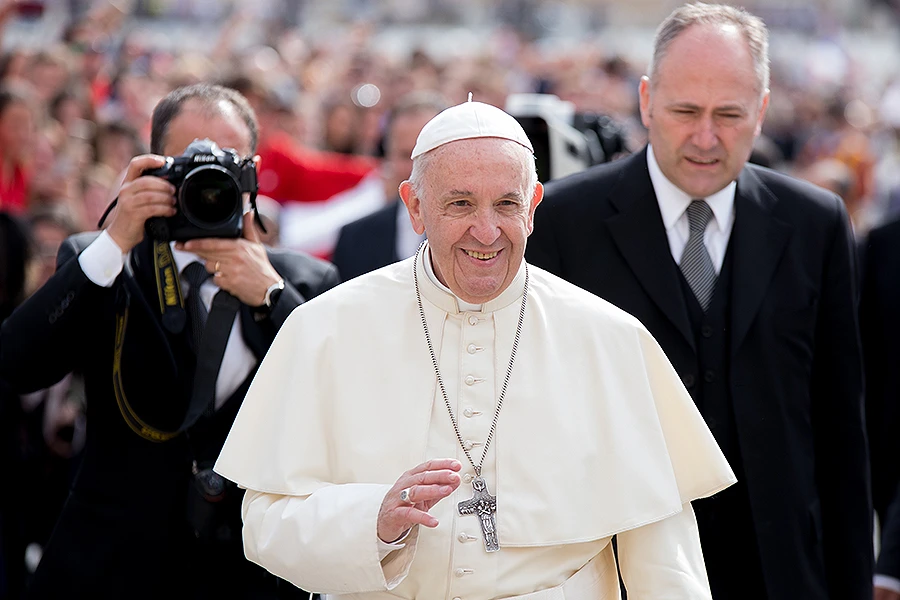
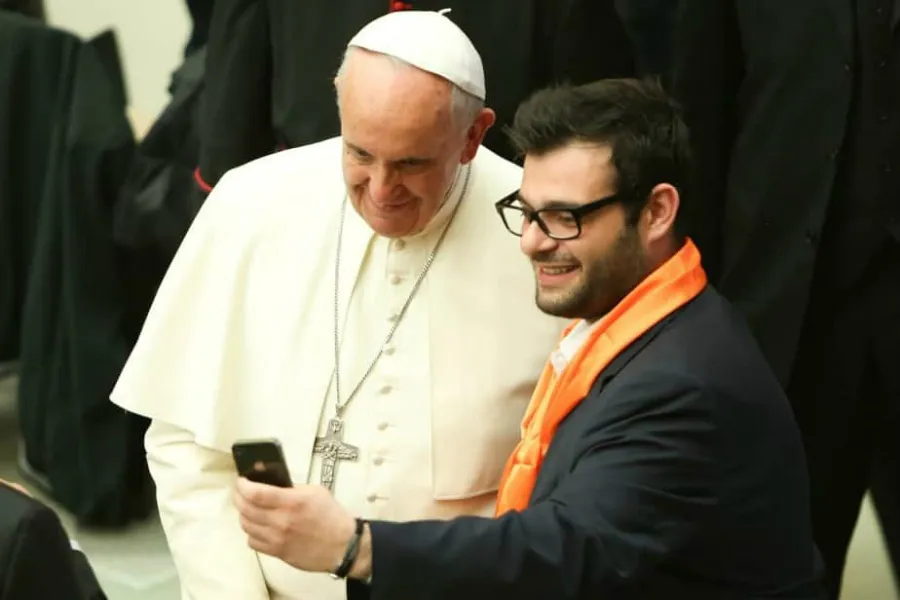
Vatican City, Jan 20, 2019 / 06:46 am (CNA/EWTN News).- Pope Francis launched an app Sunday called  “Click to Pray,” which connects Catholics to a global network to share prayer intentions via their smartphones.

The pope opened the new app using an iPad during his Angelus address Jan. 20 and encouraged young Catholics, in particular, to download the smartphone app to pray the “Rosary of Peace” ahead of World Youth Day.

“Click to Pray” allows users to post prayer intentions and view other prayer requests in six languages. After posting on the social network, one can track how many Catholics around the world have prayed for their request.

The Android and iOS app includes the pope’s monthly prayer intentions, all of the mysteries of the rosary, and daily prayers for morning, afternoon, and night. In each of these sections, users can click a box to indicate that they have completed the prayer and view how many others also prayed.

This month’s prayer intention is “for young people and the example of Mary.” In his Angelus address, Pope Francis reflected on Mary’s role in Sunday’s Gospel narrative of the wedding feast at Cana.

“Let us look at Mary: the words that Mary addresses to the servants come to crown the spousal framework of Cana, ‘Do whatever he tells you,’” Francis said. “These words are a precious inheritance that our Mother has left us.”

“To serve the Lord means to listen and practice His word. It is the simple, essential recommendation of the Mother of Jesus, it is the program of life of the Christian,” he continued.

Pope Francis explained that “it is not accidental that at the beginning of Jesus’ public life there is a wedding ceremony, because in Him God has married humanity.”

Jesus’ transformation of water into wine was also symbolic, Francis noted, “Water is necessary to live, but the wine expresses the abundance of the banquet and the joy of the party.”

He joked, “It would have been bad to continue the party with water! … A party without wine? I don’t know.”

The pope encouraged Catholics to turn to Our Lady when facing difficult situations, and to echo her words, “They have no wine.”

Francis explained, “When problems occur that we do not know how to solve, when we often feel anxiety and anguish, when we lack the joy, go to Our Lady and say, ‘We have no wine. The wine is finished: look how I am, look at my heart, look at my soul.’ Tell Mother, and she will go to Jesus to say, ‘Look at this, look at this: they have no wine.’ And then, she will come back to us and tell us, ‘Do whatever he tells you.’”

In a prayer to Mary after the Angelus, the pope expressed his grief and continued prayers for the Colombian people after the terrorist attack last Thursday at the National Police Academy, which killed 21 people.

The pope said that it “pained his heart” that an estimated 170 migrants are missing after two shipwrecks in the Mediterranean this weekend.

“They were looking for a future for their lives. Victims, perhaps, of human traffickers. We pray for them, and for those who are responsible for what happened,” he said.

The cheers at the end of the Angelus prayer were louder than usual as young people in St. Peter’s square waved Panamanian flags and raised a large banner reading, “Buon Viaggio.” The pope will depart Rome for Panama on January 23 for World Youth Day 2019.
 

[…]

No Picture
News Briefs

Vatican transfers task of Ecclesia Dei to the Congregation for the Doctrine of Faith

January 19, 2019 CNA Daily News 0

Vatican City, Jan 19, 2019 / 06:02 am (CNA).- Pope Francis issued a motu proprio Saturday ending the pontifical commission Ecclesia Dei and creating an office within the Congregation for the Doctrine of Faith to focus on doctrinal dialogue with traditionalist groups.

For over thirty years, the pontifical commission Ecclesia Dei has “facilitated the full ecclesial communion of priests, seminarians, communities or individual religious linked to Mgr. Marcel Lefebvre’s fraternity, who wished to remain united to the Successor of Peter in the Catholic Church, preserving their spiritual and liturgical traditions,” Pope Francis wrote in the apostolic letter published Jan. 19.

“The institutes and religious communities that usually celebrate in extraordinary form have found today their own stability of number and life,” the pope noted.

Pope Francis stated that the issues dealt with today by the pontifical commission Ecclesia Dei are of  “a predominantly doctrinal nature,” and therefore the complete transfer of the pontifical commission’s task to the Congregation for the Doctrine of Faith is with the desire that “these aims become more and more evident to the conscience of the ecclesial communities.”

Established in 1988 by St. John Paul II in order to carry on a dialogue with traditionalist parties, Ecclesia Dei was reformed by Benedict XVI in 2009 with the instruction Universae Ecclesiae, linking the commission to the Congregation for the Doctrine of the Faith (CDF).

The closing of Ecclesia Dei is the latest step in the pope’s wider project of reform of the Roman Curia. Administrative matters, including the pontifical commission’s budget, will now be included in the ordinary accounts of the Congregation for the Doctrine of Faith.

The Ordinary Session of the Congregation of the Doctrine of Faith on November 15, 2017 requested that “the dialogue between the Holy See and the Priestly Fraternity of Saint Pius X be conducted directly” by their congregation, the apostolic letter explained.

In November 2018, Fr. Davide Pagliarani, the superior general of the SSPX, met with CDF Prefect Cardinal Luis Francisco Ladaria Ferrer and Archbishop Guido Pozzo, secretary of the pontifical commission Ecclesia Dei.

During the meeting “it was recalled that the fundamental problem is actually doctrinal … Because of this irreducible doctrinal divergence, for the past seven years no attempt to compose a draft of a doctrinal statement acceptable to both parties has succeeded. This is why the doctrinal question remains absolutely essential,” according to a SSPX statement.

The SSPX was founded by Archbishop Marcel Lefebvre in 1970 to form priests, as a response to what he described as errors that had crept into the Church after the Second Vatican Council. Its relations with the Holy See became particularly strained in 1988 when Archbishop Lefebvre and Bishop Antonio de Castro Mayer consecrated four bishops without the permission of St. John Paul II.

The illicit episcopal consecrations resulted in the excommunication of the bishops involved. The excommunications of the surviving bishops were lifted in 2009 by Benedict XVI, and since then negotiations “to rediscover full communion with the Church” have continued between the SSPX and the Vatican.

There were indications in recent years of movement towards regularization of the priestly society, which has some 600 priest-members.

In March 2017, Pope Francis gave diocesan bishops or other local ordinaries the authorization to grant priests of the SSPX the ability to celebrate licitly and validly the marriages of the faithful who follow the Society’s pastoral activity.

And in September 2015, the pope announced that the faithful would be able to validly and licitly receive absolution from priests of the SSPX during the Jubilee Year of Mercy. This ability was later extended indefinitely by Francis in his 2016 apostolic letter Misericordia et misera.

[…]

No Picture
News Briefs

Pope Francis: ‘God loves you, even if you forget Him’

January 16, 2019 CNA Daily News 0

Vatican City, Jan 16, 2019 / 05:05 am (CNA/EWTN News).- God the Father will always be there for his beloved children, Pope Francis said Wednesday, with a reminder that the unconditional love of God is not limited by our own sense of guilt or unworthiness.

“God is looking for you, even if you do not seek Him. God loves you, even if you forget Him. God sees beauty in you, even if you think you have squandered all your talents in vain,” Pope Francis said in his general audience Jan. 16.

The pope reflected on the first two words of the “Our Father,” focusing on the depth of personal love for each person found within God’s fatherhood.

“It may be that we too happen to walk on paths far from God, as happened to the prodigal son; or  fall into a loneliness that makes us feel abandoned in the world; or, again, do wrong and are paralyzed by a sense of guilt,” Pope Francis explained.

In those moments, one’s prayer should simply start by saying the word, “Father,” with the tenderness of a child who calls out “Papa” or “Abbà,” in the original Aramaic, Francis said.

“You have a father who loves you!” Pope Francis said enthusiastically. Call out to God as “Father,” and God will answer you, he said.

If you respond to God by saying, “But, Father, I have done this …” God will answer, “‘I never lost sight of you. I saw everything. But I was always there, close to you, faithful to my love for you,’” Pope Francis said.

To call God “Father,” the pope explained, is to have  “the whole world of Jesus poured into one’s heart.”

Pope Francis described the intimacy of the Aramaic expression “Abbà” used twice in the letters of St. Paul. In his letter to the Galatians, St. Paul wrote, “As proof that you are children, God sent the spirit of his Son into our hearts, crying out, ‘Abba, Father!'”

Francis repeated the words that Italian children use, “Papa” and “Babbo,” which are equivalent to saying “Daddy” to exemplify the depth and closeness found in the word “Abba.”

“We continue to say ‘Our Father,’ but with the heart we are invited to say ‘Papa,’ to have a relationship with God like that of a child with his father, who says ‘Papa, Babbo,’” he said.

“These expressions evoke love, evoke warmth, something that projects us into the context of childhood: the image of a child completely enveloped by the embrace of a father who feels infinite tenderness for him,” he said.

Pope Francis continued, “dear brothers and sisters, to pray well, we must get to have a child’s heart … like a child in the arms of his father.”

[…]

No Picture
News Briefs

Pope advances sainthood causes of 17 women

January 15, 2019 CNA Daily News 1

Vatican City, Jan 15, 2019 / 11:12 am (CNA/EWTN News).- Pope Francis approved Tuesday the next step in the canonization causes of 17 women from four countries, including the martyrdom of 14 religious sisters killed in Spain at the start of the Spanish Civil War.

After meeting with the prefect of the Congregation for the Causes of Saints, Cardinal Angelo Becciu, Jan. 15, the pope gave his approval to the declaration of the martyrdom of Sr. Maria del Carmen and 13 companions, all religious sisters of the Order of Franciscan Conceptionists, who were killed in Madrid in 1936.

Francis also approved a miracle attributed to the intercession of the Swiss laywoman Bl. Marguerite Bays, paving the way for her canonization in 2019.

Bays, who was born in La Pierraz, Switzerland in 1815, was a member of the Secular Franciscan Order. She never married but gave her life to the needs of the people of her parish and neighborhood, especially the sick and dying, children and young girls, and the poor, whom she called “God’s favorites.”

After developing intestinal cancer at the age of 35, Bays asked Our Lady to intercede that her suffering from cancer would be exchanged for a suffering more directly connected to the suffering of Christ at his Passion.

The holy woman was miraculously healed of the cancer Dec. 8, 1854, the day Bl. Pius IX declared the dogma of the Immaculate Conception. After the healing, Bays began to experience a sort-of ecstatic immobilization every Friday, where she would relive physically and spiritually the events of Christ’s passion. Bays also received the stigmata.

Bays’ deep devotion to prayer, which had been a focus of her life since childhood, included a strong love for the Blessed Virgin Mary and for praying the rosary. She also loved the Eucharist and spent many hours in adoration.

Bays died at 3:00pm, on Friday, June 27, 1879, and was beatified by St. John Paul II in 1995.

Two women were also declared Venerable Jan. 15: Anna Kaworek, a Pole and cofounder of the Congregation of Sisters of St. Michael the Archangel (1872-1936); Maria Soledad Sanjurjo Santos (religious name Maria Consolata), a sister of the Congregation of the Servants of Mary Ministers of the Infirm (1892-1973) from Puerto Rico.

[…]