Members of the International Association of Exorcists gather for their 15th international gathering in Rome from Sept. 15–20, 2025. / Credit: Photo courtesy of the International Association of Exorcists
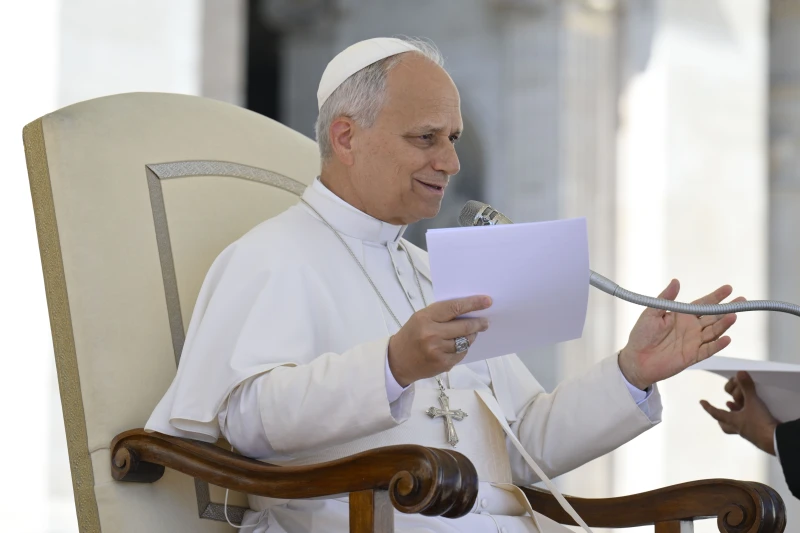
Pope Leo XIV in St. Peter’s Square at the Vatican for his weekly General Audience, September 24, 2025. / Vatican Media
Vatican City, Sep 24, 2025 / 07:24 am (CNA).
Pope Leo XIV renewed the Holy See’s support for a two-state solution in the Holy Land and voiced concern over rising tensions in Ukraine, speaking with reporters Tuesday before returning from Castel Gandolfo to the Vatican.
“The Holy See has supported the two-state solution for many years,” the pope recalled, pointing out that the Vatican formally recognized Palestine in 2015 with the signing of the Global Agreement. He added, “The Holy See recognized the two-state solution some time ago. That is clear: we must seek a path that respects all peoples.”
Asked whether broader international recognition of Palestine might help, he said: “It could help, but right now there is no real willingness to listen on the part of the other side; dialogue is broken.”
The pope confirmed that he had spoken by phone the same day with the Catholic parish in Gaza. “Thank God, the parish is fine, although the incursions are getting closer and closer… This afternoon I got in touch with them,” he said.
On Ukraine, he cautioned: “Someone is seeking an escalation. It’s getting more and more dangerous. I continue to insist on the need to lay down arms, halt military advances, and return to the negotiating table.” He stressed the importance of European unity, saying, “If Europe were truly united, I believe it could do a lot.”
Pressed on whether rearmament in Europe is necessary, the pope declined to weigh in directly: “These are political matters, also influenced by external pressure on Europe. I prefer not to comment.”
Regarding Vatican diplomacy, he explained: “We are in constant dialogue with ambassadors. We also try to speak with heads of state when they come, always seeking a solution.”
Rosary for peace in October
At his weekly general audience on Wednesday, Pope Leo XIV called on Catholics around the world to dedicate October to praying the Rosary for peace.
“Dear brothers and sisters, the month of October is now approaching, and in the Church it is dedicated in a special way to the Holy Rosary. Therefore, I invite everyone, every day of the coming month, to pray the Rosary for peace: personally, in the family, in the community,” he said.
The pope asked Vatican employees to join in this prayer daily at 7 p.m. in St. Peter’s Basilica. He also announced that on Saturday, Oct. 11, at 6 p.m., he will lead a Rosary in St. Peter’s Square during the vigil for the Jubilee of Marian Spirituality, marking as well the anniversary of the opening of the Second Vatican Council.
Catechesis: Christ descends to the depths
Continuing his catechesis for the Jubilee of 2025 on the theme Jesus Christ our Hope, the pope reflected on the mystery of Holy Saturday and Christ’s descent into the realm of the dead.
“Today, again, we will look at the mystery of Holy Saturday. It is the day of the Paschal Mystery in which everything seems immobile and silent, while in reality an invisible action of salvation is being fulfilled: Christ descends into the realm of the dead to bring the news of the Resurrection to all those who were in the darkness and in the shadow of death,” he said.
“This event, which the liturgy and tradition have handed down to us, represents the most profound and radical gesture of God’s love for humanity,” the pope said. “Indeed, it is not enough to say or to believe that Jesus died for us: it is necessary to recognize that the fidelity of his love sought us out where we ourselves were lost, where only the power of a light capable of penetrating the realm of darkness can reach.”
He noted that Christ’s descent is not just a past event, but one that touches every believer today: “The underworld is not only the condition of the dead, but also of those who live death as a result of evil and sin. It is also the daily hell of loneliness, shame, abandonment, and the struggle of life. Christ enters into all these dark realities to bear witness to the love of the Father. Not to judge, but to set free. Not to blame, but to save.”
The pope concluded: “Dear brothers and sisters, to descend, for God, is not a defeat, but the fulfillment of his love. It is not a failure, but the way by which he shows that no place is too far away, no heart is too closed, no tomb too tightly sealed for his love. This consoles us, this sustains us. And if at times we seem to have hit rock bottom, let us remember: that is the place from which God is able to begin a new creation.”
Taiwanese Catholic artist Hsieh Sheng-Min drew inspiration from traditional Chinese woodblock printing to create this depiction of the Sermon on the Mount, which includes a large Chinese character of the word “blessing” at its center. / Credit: … […]
Cardinal Giovanni Angelo Becciu in 2019. / Credit: Daniel Ibanez/EWTN
National Catholic Register, Sep 22, 2025 / 17:51 pm (CNA).
The appeal hearing for Cardinal Angelo Becciu, the former deputy Vatican secretary of state who was convicted in De… […]
In Pope Leo XIV’s first sit-down interview, published in Spanish on Sept. 18, 2025, the pope warned of the loss of humanity in the digital world of artificial intelligence (AI). / Credit: Daniel Ibañez/EWTN News
Pope Leo XIV meets with representatives of several women’s religious orders in the Vatican’s Apostolic Palace on Sept. 22, 2025. / Credit: Vatican Media
Vatican City, Sep 22, 2025 / 09:05 am (CNA).
Pope Leo XIV on Monday praised women religious… […]
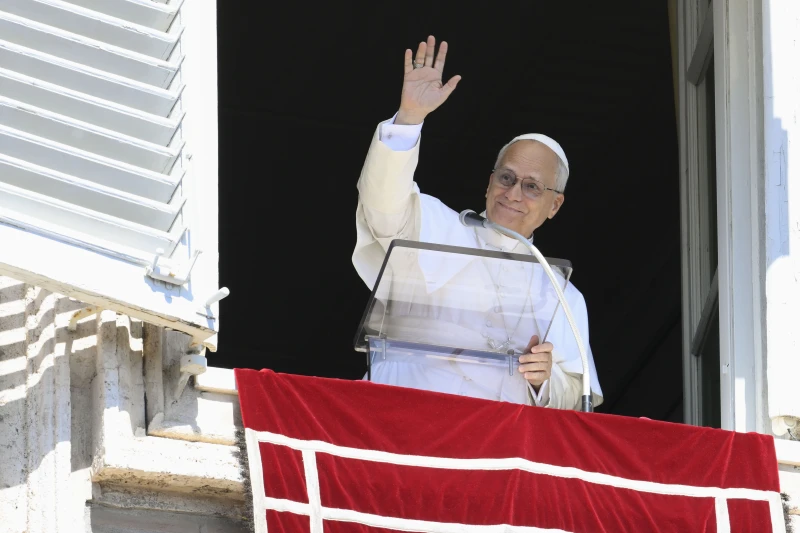
Pope Leo XIV waves to those gathered in St. Peter’s Square to pray the Angelus and listen to his Sunday message on Sept. 21, 2025. / Credit: Vatican Media.
Vatican City, Sep 21, 2025 / 10:34 am (CNA).
Those who really love the people living on the Gaza Strip will work to achieve peace in the Holy Land, Pope Leo XIV said on Sunday in his Angelus message.
The pontiff expressed his closeness to all those “suffering in that tormented land,” after leading the Marian prayer from a window of the Apostolic Palace overlooking St. Peter’s Square Sept. 21.
Leo also thanked the Catholic associations who are helping the people of the Gaza Strip: “Together with you and with the pastors of the Churches in the Holy Land, I repeat: there is no future based on violence, forced exile, or revenge. The people need peace; those who truly love them work for peace,” he said.
Pilgrims hold a sign reading, “Peace for Gaza,” during the Angelus of Sept. 21, 2025, in St. Peter’s Square. Credit: Vatican Media.
Sunday Angelus
In his message before the Angelus, which he leads weekly on Sundays, Pope Leo reflected on the use of material goods, and “how we administer the most previous good of all, our very life.”
In a parable in the Gospel of Luke, a steward who has only sought his own profit must give a report to his master of how he has managed his master’s property.
The Holy Father explained that, like the steward in the parable, “we are not the masters of our lives or of the goods we enjoy; everything has been given to us as a gift by the Lord, who has entrusted this to our care, our freedom, and our responsibility.”
“One day,” he continued, “we will be called to give an account of how we have managed ourselves, our possessions and the earth’s resources — before both God and humankind, before society, and especially before those who will come after us.”
In the parable, the steward realizes his mistake, so before he loses his job, he renounces the part of people’s debts that would go to him — giving up the profit, but gaining friendships instead.
“The parable invites us to ask ourselves: how are we managing the material goods, the resources of the earth and our very lives that God has entrusted to us?” Leo said.
We can choose selfishness, putting wealth and ourselves before all else, becoming isolated and spreading “the poison of competition,” he said, or “we can recognize everything we have as a gift from God, to be managed and used as an instrument for sharing — to create networks of friendship and solidarity, to work for the common good, and to build a world that is more just, equitable and fraternal.”
Mass at the Parish Church of St. Anne in the Vatican
In the morning, Pope Leo celebrated a Mass at the Parish Church of St. Anne in the Vatican, which, he pointed out in his homily, is in a special location “on the border” of the Vatican.
Pope Leo is pictured here speaking with a couple at the Parish Church of St. Anne in the Vatican on Sept. 21, 2025. Credit: Vatican Media
“Almost all those entering and leaving Vatican City pass by St. Anne’s,” he said. “Some pass for work, some as guests or pilgrims, some in a hurry, some with trepidation or serenity. May everyone experience that here are doors and hearts open to prayer, to listening, and to charity.”
He pointed out that the Gospel of the Day challenges us to examine our relationship with the Lord and with others.
“Jesus presents a stark alternative between God and wealth, asking us to take a clear and consistent position,” he said, because, “’No servant can serve two masters,’ therefore ‘you cannot serve both God and wealth.’”
“This is not a contingent choice,” Leo underlined. “We need to decide on a true lifestyle. It’s about choosing where to place our heart, clarifying whom we sincerely love, whom we serve with dedication, and what is truly our good.”
The pope also spoke about nations and wealth, and said, “the Church prays that leaders of nations may be freed from the temptation to use wealth against humanity, transforming it into weapons that destroy peoples and monopolies that humiliate workers.”
“Those who serve God become free from wealth, but those who serve wealth remain its slaves,” the Holy Father emphasized. “Those who seek justice transform wealth into the common good; those who seek domination transform the common good into the prey of their own greed.
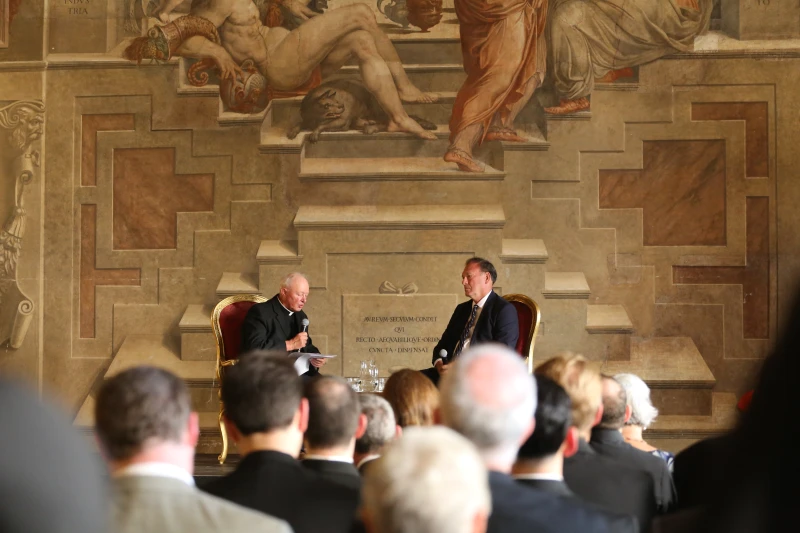
Judge Samuel A. Alito Jr., shares his perspective on how a legal system can provide for mercy during a conversation with Msgr. Laurence Spiteri (left) at the Vatican’s judicial headquarters on Sept. 20, 2025. / Credit: Hannah Brockhaus/CNA.
Vatican City, Sep 21, 2025 / 14:24 pm (CNA).
United States Supreme Court Justice Samuel A. Alito Jr., spoke about the role that mercy can play in the legal system during an event at the Vatican on Saturday.
The Sept. 20 discussion at the Vatican’s judicial headquarters was organized by the U.S. Embassy to the Holy See, the U.S. bishops’ conference, and the Vatican’s Dicastery for Evangelization. The event was part of the Jubilee of Justice, part of the Church’s yearlong Jubilee of Hope.
Earlier in the day, Alito, a Catholic, greeted Pope Leo XIV following an audience for the Jubilee of Workers of Justice in St. Peter’s Square.
During a one-hour afternoon conversation with Msgr. Laurence Spiteri, an American priest and retired judge on the Vatican’s appeals court for marriage cases, Alito shared his perspective on how a legal system can provide for mercy.
“Justice is what everyone has a right to, it is what they are due … Mercy is something that we don’t necessarily merit,” Alito said. “The complete reconciliation of those two things, I think, is a mystery that we can only dimly, perhaps, perceive in this world.”
The 75-year-old Alito, who has served on the Supreme Court since 2006, said, “Mercy should be built into the laws … the authority to make the laws rests with Congress and Congress should build in mercy when it enacts laws.”
“The responsibility of the executive [branch], headed by the president, is to enforce the law,” he continued. “But the enforcement of the law often involves a measure of discretion and someone who has discretion to enforce the law should enforce the law with mercy. Judges have to follow the law. Sometimes the law is framed in a way that allows the judge to exercise mercy,” for example, in criminal sentencing.
“A legal system, of course, is supposed to promote justice, and in human terms, completely reconciling mercy with justice is probably impossible. I think probably only God can do that,” he said.
The audience at Alito’s talk included Vatican officials, including Cardinal Raymond Burke, former prefect of the Supreme Tribunal of the Apostolic Signatura and Bishop Juan Ignacio Arrieta, secretary of the Vatican’s Dicastery for Legislative Texts.
Catholic lawyers on pilgrimage to Rome for the Jubilee of Justice were also in attendance for the discussion, held in a chamber of the Cancelleria, a 16th-century building in the center of Rome that is home to the Holy See’s three tribunals: The Apostolic Penitentiary, the Apostolic Signatura, and the Roman Rota.
Then-Archbishop Van Thuan meets St. Teresa of Calcutta during her first visit to Vietnam as mother superior of the Missionaries in Charity in 1991. / Credit: Photo courtesy of Elisabeth Nguyen
Vatican City, Sep 21, 2025 / 06:00 am (CNA).
The be… […]
Pope Leo XIV addresses thousands of Church and civil lawyers, judges, and others who work in the legal environment during the Jubilee of Workers of Justice, part of the yearlong Jubilee of Hope, in St. Peter’s Square on Sept. 20, 2025. / Credit: Vatican Media.
Vatican City, Sep 20, 2025 / 10:30 am (CNA).
Forgiveness is fundamental to the virtue of justice, Pope Leo XIV said to thousands of legal professionals gathered in Rome for the Jubilee of Workers of Justice on Saturday.
“It is the power of forgiveness, which is proper to the commandment of love, that emerges as a constitutive element of a justice capable of combining the supernatural with the human,” the pope said in St. Peter’s Square on Sept. 20.
Leo, who has a doctorate in Church law, explained that the evangelical virtue of justice is not a distraction from human justice, but “questions and redesigns it: It provokes it to go even further, because it pushes it towards the search for reconciliation.”
“Evil, in fact, must not only be punished, but also repaired, and to this end, a profound gaze toward the good of individuals and the common good is necessary,” he urged Church and civil lawyers, judges, and others who work in the legal environment.
“This is an arduous task, but not impossible for those who, aware that they are performing a more demanding service than others, are committed to leading an irreproachable life,” the pope added.
Pope Leo XIV addresses thousands of legal professionals gathered in St. Peter’s Square for the Jubilee of Workers of Justice on Sept. 20, 2025. Credit: Vatican Media.
An estimated 20,000 people from 100 countries took part in the Jubilee of Workers of Justice, part of the yearlong Jubilee of Hope, including a large number of pilgrims from the United States and Canada. U.S. Supreme Court Justice Samuel Alito was also in attendance.
Joshua McCaig, a lawyer and founding president of the Catholic Bar Association, traveled to Rome for the jubilee with a delegation of over 50 legal professionals from the U.S.
He told EWTN News he hopes the event “will be an opportunity for us all to reflect on what more we can do for the common good.”
“The Catholic Church brings resources, brings hope, brings community, brings values that are instilled in the teachings of Jesus Christ to help all individuals — but also those in the legal profession — further develop an understanding of how this world should be and the role we should play in it,” he said.
Before the audience with the pope, Archbishop Juan Ignacio Arrieta, secretary of the Dicastery for Legislative Texts, gave a lecture on the theme of “Iustitia Imago Dei: the operator of justice, instrument of hope.”
“Those who administer justice in the Church must also be pastors. … They must respect justice, but they are pastors who must also watch over the good of souls,” Arrieta told EWTN News this week.
In his message, Pope Leo emphasized that the function of justice “is indispensable both for the orderly development of society and as a cardinal virtue that inspires and guides the conscience of every man and woman.”
“Striving for justice, therefore, requires being able to love it as a reality that can only be achieved through constant attention, radical disinterest, and assiduous discernment,” he said.
He noted that the Jubilee of Workers of Justice is a chance to also reflect on an overlooked aspect of justice, the reality that many countries and people “hunger and thirst for justice” because their living conditions are gravely unjust and inhuman.
The pontiff cited St. Augustine, calling the saint’s words “timeless truths” to apply to the current international situation.
“’Without justice,’” the pope quoted, “’the state cannot be administered; it is impossible to have law in a state where there is no true justice. An act performed according to law is certainly performed according to justice, and it is impossible to perform an act according to law that is performed against justice […] A state where there is no justice is not a state. Justice is, in fact, the virtue that distributes to each his due. Therefore, it is not human justice that takes man away from the true God.’”
“May the challenging words of St. Augustine inspire each of us to always express the exercise of justice in the service of the people to the best of our ability, with our gaze turned to God, so as to fully respect justice, law, and the dignity of persons,” Leo said.
Matteo Ciofi, EWTN News Nightly Vatican producer, and Victoria Cardiel, Vatican Correspondent for ACI Prensa/EWTN News, contributed to this report.