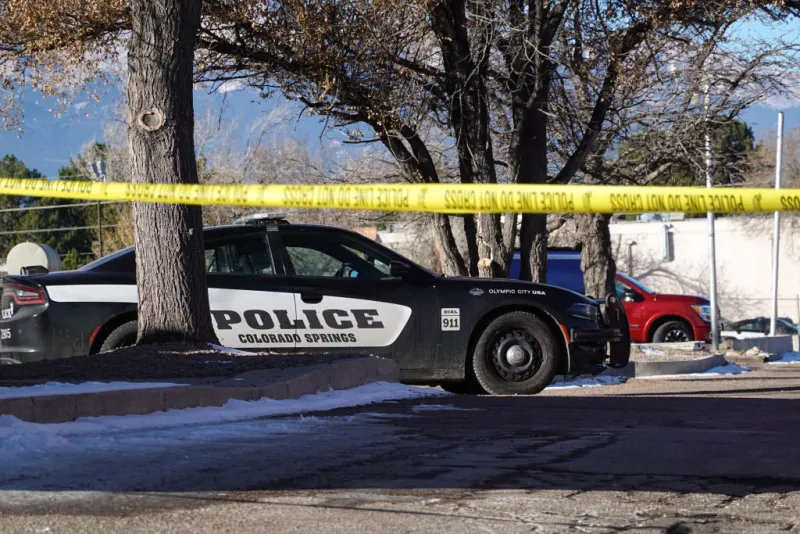
 Law enforcement officials continue their investigation into Saturday’s shooting at the Club Q nightclub on Nov. 21, 2022, in Colorado Springs, Colorado. On Saturday evening, a 22-year-old gunman allegedly entered the LGBTQ nightclub and opened fire, killing at least five people and injuring 25 others before being stopped by club patrons. / Photo by Scott Olson/Getty Images
Denver, Colo., Nov 21, 2022 / 15:00 pm (CNA).
Catholic bishops in Colorado have voiced their sympathies and prayers in the wake of a shooting over the weekend that killed five and injured 25 at a Colorado Springs LGBTQ nightclub.
“The recent shooting and killing is especially troubling as it appeared to target a specific part of our community,” Bishop James Golka of Colorado Springs said Monday afternoon. “The shooter appeared to target members of the LGBTQ community. Anytime specific members of the population are targeted for violence, we should all be concerned. As Christians and Catholics, we believe in the intrinsic dignity and value of all human life. We commit ourselves to protecting and defending that human life.”
“We extend our deepest sympathies and prayers for the victims, their families, and friends,” he said.
The alleged gunman entered Club Q just before midnight on Saturday and began shooting.
Several people at the club overpowered the gunman and subdued him. He was hospitalized for injuries sustained during the fight.
Two of the dead were bartenders, one of whom was a co-owner of the nightclub.
Police officials named the alleged gunman as 22-year-old Anderson Lee Aldrich. A man of the same name and age was detained by the El Paso County Sherriff’s Office last year after he threatened his mother with homemade bombs, weapons, and ammunition, Colorado Public Radio reported. In that incident, he had a lengthy standoff with sheriff’s deputies, who did not find any explosive devices when the standoff ended.
Authorities have not confirmed they are the same person.
The alleged nightclub shooter was being held on five counts of first-degree murder and five counts of bias-motivated crimes causing bodily injury, the Denver Post reported on Monday. Prosecutors have not officially filed charges, which means the charges could change.
Golka’s Nov. 21 statement noted that Colorado Springs police have investigated at least 34 homicides since the beginning of the year, a 100% increase over last year. He also cited the “disturbing” suicide rate in Colorado, the seventh-highest in the U.S., with El Paso County having the worst suicide rate in the state.
He cited the United States Conference of Catholic Bishops’ support for stronger gun control restrictions, including universal background checks and limits on the sales of high-capacity magazines. He also emphasized support for those suffering mental health issues and for addressing “the cultural roots of this increased violence, such as a lack of civility and increased polarization.”
He encouraged those in need of support to talk to their priest or church minister or to contact Catholic Charities of Central Colorado.
“Let us pray that all our beloved deceased will know the fullness of life in heaven. Let us pray and work so that through our actions and attitudes, God may bring peace and healing to our world and to our local community,” Golka said. He cited Jesus Christ’s words to the faithful, that they will have trouble in this world, adding “But take heart! I have overcome the world.”
Colorado Springs is about 70 miles south of Denver. Denver’s Archbishop Samuel Aquila joined the reaction, praying for “the peace of Christ” in the wake of the shooting.
In a Sunday afternoon statement, Aquila said: “I am saddened by this tragic and senseless act in Colorado Springs and pray that those impacted are able to find peace in Christ.”
He cited St. Paul’s Letter to the Romans, which urged “not to be overcome by evil, but to overcome evil with good.”
“As we seek to overcome evil with good, we must promote the dignity of every human being created in the image and likeness of God,” he said.
“While the motives remain unclear, what is clear is that evil incidents like this have become far too common in our society,” Aquila said. “The random acts of killing innocent human beings must be condemned by a civil society.”
Criticism of ‘anti-LGBTQ rhetoric,’ Catholic teaching
Club Q was set to host an “all-ages musical drag brunch” on Sunday, according to its Facebook page. Some drag events for children have come under criticism for sexualized displays in front of children or for encouraging them to adopt false or misleading views of sex and gender. They have also become targets of in-person protests and sometimes threats from those who contend the shows are equivalent to sexual grooming.
Even before initial charges were filed against the alleged shooter, some news reports and commentators sought to connect the attack to political opposition to transgenderism and other LGBT causes.
A Denver Post report on Monday appeared to suggest that the Denver Archdiocese’s policy on sexual orientation and gender identity in Catholic schools was part of a trend of “anti-LGBTQ rhetoric” ahead of the nightclub attack. Last week the Denver Post’s editorial board called for Catholic and other schools to be excluded from high school sports associations because of their policies on sexual orientation and gender identity.
The Denver Archdiocese policy has been in place since 2019 but drew critical coverage from the Denver Post in a Nov. 7 story. The story highlighted a section advising against the enrollment of students who reject their biological sex, especially if their parents are supportive of the student’s transition. It also considered how to handle students whose parent or parents are in a same-sex relationship.
“Ministry to students who experience same-sex attraction or gender confusion or are diagnosed with gender dysphoria, or to their families, should be carried out with charity and prudence, affirm God’s unconditional love for the person, be faithful to Church teachings, show compassion, and help students integrate their self-understanding with the truth,” the 2019 document said.
State Rep. Leslie Herod, who is running to become mayor of Denver in the 2023 elections, appeared to blame the Catholic school policy in Sunday comments posted to Twitter in response to the Club Q shooting.
“It’s not an accident that such an attack took place at the end of a week when we saw members of the LGBTQ+ community targeted for who they are and who they love,” she said. “From students denied entrance in schools to employees told they could not act on same-sex attraction and must conform to their biological sex, this community — my community, our community — has continued to suffer the ravages of discrimination.”
In response to the Denver Post story earlier this month, the archdiocese said: “We don’t expect everyone to ascribe to a Catholic worldview, but we strongly reject attempts to paint our position as bigoted or unloving.”
[…]