No Picture
News Briefs

Concerns of ‘anti-Catholic bigotry’ as judicial nominee questioned about faith
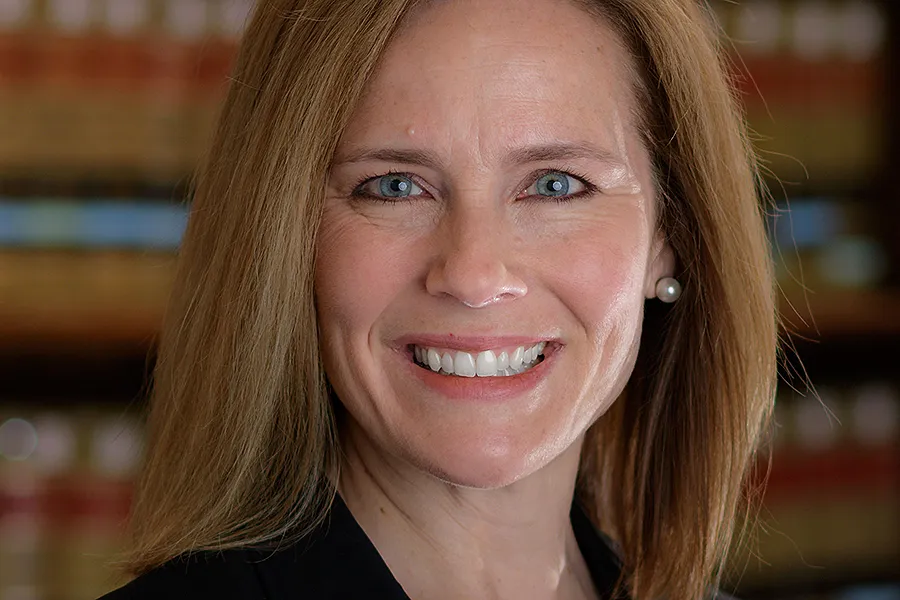
September 7, 2017 CNA Daily News 2

Washington D.C., Sep 7, 2017 / 09:25 am (CNA/EWTN News).- A Catholic nominee to a federal circuit court faced hostile questions about her faith from U.S. senators on Wednesday, prompting outrage from Catholic leaders.

“This smacks of the worst sort of anti-Catholic bigotry,” Dr. Chad Pecknold, a theology professor at The Catholic University of America, told CNA of questions asked by Sen. Dianne Feinstein (D-Calif.) of Amy Comey Barrett, a Catholic lawyer nominated to be a federal circuit court judge.

“Senator Feinstein’s shockingly illegitimate line of questioning sends the message that Catholics need not apply as federal judges,” added Ashley McGuire, senior fellow with The Catholic Association.

WATCH: Sen. Feinstein to appeals court nominee Amy Barrett, @NotreDame law prof/#Catholic mother of 7: “The dogma lives loudly within you.” pic.twitter.com/mpDgNZGRsa

— Jason Calvi (@JasonCalvi) September 6, 2017

Barrett, a professor at Notre Dame Law School, appeared before the Senate Judiciary Committee on Wednesday at her confirmation hearing to be a United States Circuit Judge for the Seventh U.S. Court of Appeals.

In the past, Barrett had clerked for Supreme Court Justice Antonin Scalia, and has twice been honored as “Distinguished Professor of the Year” at Notre Dame.

However, as she appeared before the Senate Judiciary Committee on Wednesday, some of the pointed questions directed at her by Democratic senators focused on how her Catholic faith would influence her decisions as a judge on cases of abortion and same-sex marriage.

Sen. Dianne Feinstein (D-Calif.), ranking member of the committee, told Barrett outright that her Catholic beliefs were concerning, as they may influence her decisions as a judge on abortion rights.

“Why is it that so many of us on this side have this very uncomfortable feeling that dogma and law are two different things, and I think whatever a religion is, it has its own dogma. The law is totally different,” Feinstein said.

“And I think in your case, professor, when you read your speeches, the conclusion one draws is that the dogma lives loudly within you. And that’s of concern.”

Feinstein began her round of questions by personally complimenting Barrett that she was “amazing to have seven children and do what you do,” but then called her “controversial” when she began to address Barrett’s record in law, “because you have a long history of believing that your religious beliefs should prevail” over the law.

“You’re controversial because many of us that have lived our lives as women really recognize the value of finally being able to control our reproductive systems,” she said. “And Roe entered into that, obviously.”

Barrett repeatedly said that as a judge, she would uphold the law of the land and would not let her religious beliefs inappropriately alter her judicial decisions.

At the beginning of the hearing, Senator Chuck Grassley (R-Iowa), chair of the committee, asked Barrett: “When is it proper for a judge to put their religious views above applying the law?”

“Never,” Barrett answered. “It’s never appropriate for a judge to impose that judge’s personal convictions, whether they derive from faith or anywhere else, on the law.”

Feinstein’s “anti-Catholic bigotry” in her questions to Barrett “is especially chilling because it defames and slanders such an accomplished woman in the legal guild,” Pecknold said.

Feinstein “reveals herself to be the sort of ideologue who never considers the substance of her interlocutor’s actual legal decisions, but rather projects false ideologies onto everyone who disagrees with her party on any point,” Pecknold charged.

In 1998, Barrett co-authored an article in the Marquette Law Review with then-Notre Dame law professor John Garvey, now the president of The Catholic University of America. The article focused on Catholic judges in death penalty cases.

Catholic judges, if their consciences oppose the administering of the death penalty, should, in accordance with federal law, recuse themselves from capital cases where a jury recommends a death sentence, Garvey and Barrett wrote. They should also recuse themselves from cases without a jury where they have the option of granting a death sentence, they wrote.

On Wednesday, Barrett was asked repeatedly about this article, published 19 years ago, and whether she still agreed with it today. Barrett answered that she was still a third-year law student during the article’s publication, and “was very much the junior partner” in writing it with her professor.

“Would I, or could I, say that sitting here today, that article in its every particular, reflects how I think about these questions today with, as you say, the benefit of 20 years of experience and also the ability to speak solely in my own voice? No, it would not,” she answered Senator Grassley’s opening question on the article.

She added that she still upholds “the core proposition of that article which is that if there is ever a conflict between a judge’s personal conviction and that judge’s duty under the rule of law, that it is never, ever permissible for that judge to follow their personal convictions in the decision of a case rather than what the law requires.”

Senator Grassley asked her later how she would recuse herself as a judge in a case, if necessary.

“Senator, I would fully and faithfully apply the law of recusal, including the federal recusal statute, 28 U.S.C. § 455, the canons of judicial conduct,” she replied, but added that “I can’t think of any cases or category of cases in which I would feel obliged to recuse on grounds of conscience.”

Garvey, in a Thursday op-ed in the Washington Examiner, explained the article’s conclusion in cases where judges face a conflict of interest between their own conscience and the law.

“Law professors less scrupulous than Prof. Barrett have suggested that sometimes judges should fudge or bend (just a little bit) laws that every right-thinking person would find immoral. In our article we rejected that course of action,” he said, pointing instead to the federal recusal statute.

Sen. Dick Durbin (D-Ill.) then grilled Barrett over her use of the term “orthodox Catholic” in the article, implying that she did not think persons who dissent from Church teaching on marriage to be real Catholics.

“I’m a product of 19 years of Catholic education. And every once in a while, Holy Mother the Church has not agreed with a vote of mine. And has let me know,” he told Barrett. “You use a term in that article – or you both use a term in that article — I’d never seen before. You refer to ‘orthodox Catholics.’ What’s an orthodox Catholic?”

Barrett pointed to a footnote in the article that admitted it was “an imperfect term,” and that the article was talking about the hypothetical case of “a judge who accepted the Church’s teaching” on the death penalty and had a “conscientious objection” to it.

“Do you consider yourself an orthodox Catholic?” Durbin asked Barrett, who replied that “I am a faithful Catholic,” adding that “my personal Church affiliation or my religious belief would not bear in the discharge of my duties as a judge.”

Durbin then said that “there are many people who might characterize themselves ‘orthodox Catholics,’ who now question whether Pope Francis is an ‘orthodox Catholic.’ I happen to think he’s a pretty good Catholic.”

“I agree with you,” Barrett replied, to which Durbin responded, “Good. Then that’s good common ground for us to start with.”

He also asked Barrett how she would rule on a case involving a “same-sex marriage,” given the late Supreme Court Justice Antonin Scalia’s dissent from the 2013 Obergefell decision that legalized same-sex marriage.

“From beginning to end, in every case, my obligation as a judge would be to apply the rule of law, and the case that you mentioned would be applying Obergefell, and I would have no problem adhering to it,” she said.

Durbin’s questions of Barrett’s faith were also disturbing, Pecknold said.

“So faithful Catholic is interchangeable with Orthodox Catholic. The fact that one definition is acceptable to Sen Durbin but one is not tells you that he thinks one can dissent from the Church’s teaching and be orthodox and faithful.”

“But why is a politician interested in that question when the only concern should be whether the nominee is a superb interpreter of the law? How has this become a religious inquisition rather than an adjudication of legal competence for the bench?” he asked.

“I submit that the real dogmatists in the room are the ones mounting an inquisition against one of the nation’s great legal scholars.”

Other Catholic leaders decried the questioning of Barrett’s faith.

“Such bigotry has no place in our politics and reeks of an unconstitutional religious test for qualification to participate in the judiciary. What these Senators did today was truly reprehensible,” said Brian Burch, president of CatholicVote.org.

“Imagine the universal outrage had a nominee of a different faith been asked the same questions; there is clearly a double standard at work,” commented Maureen Ferguson, senior policy advisor with The Catholic Association.

Garvey, in his op-ed for the Examiner, wrote that “I suspect what really troubled” Durbin and Feinstein “was that, as a Catholic, her [Barrett’s] pro-life views might extend beyond criminal defendants to the unborn.”

“If true, the focus on our law review article is all the more puzzling,” he wrote. “After all, our point was that judges should respect the law, even laws they disagree with. And if they can’t enforce them, they should recuse themselves.”


[…]

No Picture
News Briefs

Did this group lose its fundraising page because of its view on marriage?

September 6, 2017 CNA Daily News 1

Lake Charles, La., Sep 6, 2017 / 03:57 pm (CNA/EWTN News).- A non-profit group dedicated to studying and explaining the effects of the sexual revolution claims that its ability to process donations online was cancelled because of its views on sexuality.

“The Ruth Institute’s primary focus is family breakdown and its impact on children: understanding it, healing it, ending it. If this makes us a ‘hate group,’ so be it,” Dr. Jennifer Roback Morse, founder of the Ruth Institute, said on Friday.

Morse said that on Aug. 31 she received a letter from Vanco Payments, which processed the Ruth Institute’s donations online, telling her that the service would be discontinued that day.

The reason Vanco gave for cutting their service was that the Ruth Institute “has been flagged by Card Brands as being affiliated with a product/service that promotes hate, violence, harassment and/or abuse. Merchants that display such attributes are against Vanco and Wells Fargo processing policies.”

“We surmise that Vanco dropped us because we hold views about marriage, family and human sexuality that are considered ‘Anti-LGBT’,” Morse said.

Vanco did not reach out to discuss or inquire about allegations that the institute “promoted hate, violence, harassment, and/or abuse,” prior to sending the Ruth Institute a notice that service was being terminated, she said.

“We’ve never had any incidents or problems” with Vanco, Morse told CNA of their years-long relationship with the payment service. She said that the sudden termination of service without any prior notice was “rude” and “uncivil.”

Asked about the decision to cut ties with the Ruth Institute, a Vanco representative on Sept. 1 told CNA, “Vanco depends on the assessment of its banking partners to guide its decisions on continuing customer relationships that those partners believe violate processing policies. Accordingly, based on that assessment, we terminated our processing relationship with the Ruth Institute on Thursday, August 31.”

On Sept. 5, the representative retracted that statement, and issued a new statement saying, “Vanco terminated its processing relationship with the Ruth Institute on Thursday, August 31. Otherwise, we have no additional comment on the issue.”

Vanco did not specify how it had determined that the Ruth Institute “promoted hate, violence, harassment, and/or abuse,” Morse said. However, groups including the Human Rights Campaign, GLAAD, and the Southern Poverty Law Center (SPLC) have criticized the Ruth Institute’s stance against same-sex marriage.

The SPLC was founded in 1971 and originally monitored persons and groups fighting the civil rights movement. It began to track racist and white supremacist groups like neo-Nazis and affiliates of the Ku Klux Klan in the 1980s. It also claims to monitor other “extremist” groups like “anti-immigrant” and “anti-Muslim” groups.

More recently, the SPLC has listed mainstream Christian groups like the Family Research Council and Alliance Defending Freedom as “hate groups” for their “anti-LGBT” stance. The Ruth Institute has also been included in this list by SPLC.

The Ruth Institute has faced consequences for this designation. Morse told the National Catholic Register that the institute was denied its application for the “Amazon Smile” program, which sends portions of purchases to charities in the program, because of the SPLC’s “hate” designation.

SPLC has recently faced questions regarding its financial administration, after reports that the non-profit has transferred millions of dollars to offshore accounts and investment firms.

Morse voiced concern that one group like SPLC holds so much power in the public sphere for its designations.

Still, she said, the Ruth Institute will not be deterred in its mission of speaking out against “the sexual revolution in all its forms” – from divorce to the hookup culture to same-sex marriage – because these things are harmful to the human person.

“What the sexual revolution promotes is irrational,” she said.


[…]

No Picture
News Briefs

Bishops decry Trump administration’s decision to end DACA

September 5, 2017 CNA Daily News 4

Washington D.C., Sep 5, 2017 / 03:23 pm (CNA/EWTN News).- Bishops condemned the Trump administration’s decision Tuesday to end a program that benefited hundreds of thousands of undocumented immigrants who entered the U.S. as minors.

“The cancellation of the DACA program is reprehensible,” leading U.S. bishops said in a joint statement released Sept. 5.

Cardinal Daniel DiNardo of Galveston-Houston, president of the U.S. bishops’ conference, as well as vice president Archbishop Jose Gomez of Los Angeles, migration committee chair Bishop Joe Vasquez of Austin, and Bishop Joseph Tyson of Yakima, chair of the subcommittee on pastoral care of migrants, refugees, and travelers, all contributed to the statement on the Trump administration’s ending of the Deferred Action for Childhood Arrivals program.

Young immigrants eligible for DACA have worked in the U.S., served in the U.S. military, and attended U.S. educational institutions, the bishops said, yet now “after months of anxiety and fear about their futures, these brave young people face deportation.”

Attorney General Jeff Sessions had announced Tuesday morning that the Trump administration, in an anticipated move, would be ending DACA, which had begun under the Obama administration.

Under the program, eligible immigrants who were brought to the U.S. illegally as minors by their parents could receive a two-year stay on their deportation. In that time period, they could be eligible for work permits and Social Security.

The program was announced in 2012 by President Obama and implemented by the Department of Homeland Security, in the memorandum “Exercising Prosecutorial Discretion with Respect to Individuals Who Came to the United States as Children.”

Congress had several times tried and failed to pass the Development, Relief, and Education for Alien Minors Act, or a version of it, that would help young immigrants who came to the U.S. illegally before the age of 16 to lawfully remain in the U.S. and even have a path to citizenship.

The most recent version has been introduced this year by Sens. Dick Durbin (D-Ill.) and Lindsey Graham (R-S.C.) and would grant permanent legal status to more than 1 million eligible persons.

DACA was expanded to include eligible parents who brought their children illegally to the U.S. in a program called “Deferred Action for Parents of Americans and Lawful Permanent Residents.” In 2016, the Supreme Court upheld a halt on that program going into effect, and Sessions warned Tuesday that DACA could get struck down in court.

On Tuesday, the administration announced it would end DACA by phasing it out. Sessions said that it was an “unconstitutional” overreach of executive power, especially since Congress refused several times to grant such benefits to undocumented immigrants.

“In other words, the executive branch, through DACA, deliberately sought to achieve what the legislative branch specifically refused to authorize on multiple occasions,” Sessions stated.

Sessions also blamed the program for contributing to the recent surge in unaccompanied minors coming to the U.S.-Mexico border from Central America, as well as allowing undocumented immigrants to take jobs that could have been open to U.S. citizens.

Secretary of Homeland Security Elaine Duke stated that the courts would have overturned DACA, and so the administration was trying to “wind the program down in an orderly fashion that protects beneficiaries in the near-term while working with Congress to pass legislation.”

The bishops, in their statement, called on Congress to pass a law to protect the immigrants who would have been eligible for DACA, and promised to continue advocating for DACA youth.

“We strongly urge Congress to act and immediately resume work toward a legislative solution,” the bishops stated. “As people of faith, we say to DACA youth – regardless of your immigration status, you are children of God and welcome in the Catholic Church. The Catholic Church supports you and will advocate for you.”

Other bishops also issued statements expressing disappointment in the Trump administration’s decision.

Archbishop Gomez, in a separate statement, said “as a pastor” that ending DACA would result in the possible deportation of 800,000 and would be “a national tragedy and a moral challenge to every conscience.”

“It is not right to hold these young people accountable for decisions they did not make and could not make. They came to this country through no fault of their own,” he said. “Most of them are working hard to contribute to the American dream — holding down jobs, putting themselves through college, some are even serving in our nation’s armed forces.”

Bishop Michael Burbidge of Arlington said that “while the issue of immigration is complicated …  “offering special protection to those who only know the United States as home is a reasonable measure of compassion.”

Hundreds of protesters gathered in front of the White House Tuesday morning to protest the administration’s announcement.

Carlos, 31, of northern Virginia, told CNA he currently works two jobs to pay for his college tuition and is nine months from finishing school. Without his degree, he would not be able to pursue a nursing career, he said.

“DACA protects young immigrants like myself to achieve their full potential,” he said. “The young people of this country are the future, we are the future of America. And everyone that has a dream, everyone that has a purpose that wants to help someone is also a dreamer, not just myself.”

“Dreamers” are not asking for handouts, Edvin, another immigrant protesting the end of DACA, told CNA.

“I came to this country with nothing,” Edvin said, “now I’m trying to give something back to this country. I am a business owner, I became a home owner, and I contribute to this country.”

“We are not asking for money. We are not asking for food or anything else,” he said. “We just want a chance to work here legally. Just give us documentation to do it in a safe way, no hide under the shadows. Just let us be us.”

Fr. Kevin Thompson, OFM Cap., parochial vicar at the Shrine of the Sacred Heart in Washington, D.C., said many DACA recipients are parishioners there.

“They’re just doing so well and advancing,” he said, and are “adding to this country.”

It is vital “to keep families together,” he said. He also pointed to the Old Covenant, at which time God told the Israelites  to “treat the foreigner well, as you were once foreigners in Egypt.”

The Catholic Legal Immigration Network called the announcement a “a heartbreaking disappointment.” Jeanne Atkinson, the group’s executive director, said many young people have benefited from DACA, with 60 percent of those approved for the program contributing to their family’s finances, 45 percent in school, and 16 percent having bought a home.

“Ending DACA will break apart families, throw potentially millions into impoverished living conditions and shatter the dreams of a better life for young people who did nothing wrong,” Atkinson said.

John Garvey, president of the Catholic University of America, said ending DACA without Congress providing a sufficient legislative solution would be problematic.

“Our country’s moral quality is measured by the way we treat those who most need our assistance. DACA has given young people a shot at an education and a better life. Elimination without a more comprehensive solution means abandonment,” he said.

[…]

No Picture
News Briefs

In Labor Day message, bishops call for ordered understanding of work

September 4, 2017 CNA Daily News 1

Washington D.C., Sep 4, 2017 / 04:01 am (CNA/EWTN News).- In their 2017 statement for Labor Day, the U.S. Conference of Catholic Bishops stressed a properly ordered understanding of work, which prioritizes the worker and the family.

This vision of work must ensure safe working conditions, show solidarity with those in poverty, and seek to emphasize the dignity of the worker rather than solely economic gain, the statement emphasized.

“Economic stresses contribute to a decline in marriage rates, increases in births outside of two-parent households, and child poverty,” said Bishop Frank Dewane of Venice, chairman of the Committee on Domestic Justice and Human Development at the U.S. bishops’ conference.

He called for legal safeguards to protect workers’ rights and defend against exploitation.

However, “(l)egal protections cannot solve all problems when the culture itself must also change,” he said, and these changes must extend beyond politics, and aim to recover the understanding of work as “a cooperation with God’s creative power.”

The bishop expressed concern that despite a growing economy, there is still a “stagnant or … decreasing [wage] for the vast majority of people” and that the newly generated wealth is only going to a small percentage of people.  

“The dignity of the individual and the demands of justice require, particularly today, that economic choices do not cause disparities in wealth to increase in an excessive and morally unacceptable manner, and that we continue to prioritize the goal of access to steady employment  for everyone,” said the bishop, repeating the words of Benedict XVI in Caritas in veritate.

That encyclical has also been echoed by Pope Francis, the bishop noted, pointing to Francis’ challenge “to confront a twisted understanding of the purposes of labor which does not recognize talents as gifts from God.”

“With such a mindset, it becomes possible to improperly justify economic and societal injustices,” he added, and warned that “merit” can be used to unjustly excuse inequality in the work place.

“The poor person is considered undeserving and therefore to blame. And if poverty is the fault of the poor, the rich are exonerated from doing anything,” said the bishop, repeating the words of Pope Francis.

Seeing wealth as the basis for right or wrong, Bishop Dewane said, opposes the message of the Gospel and aligns itself to the opinions of Job’s friends, who saw Job’s misfortune as the result of his sin.

Pope Francis has said that this view contradicts God’s “gaze of love” which is best reflected in the parable of the Prodigal Son, whose father “thinks no son deserves the acorns that are for the pigs,” even when the son has failed.

However, this potential crisis is also an opportunity to regain the true nature of work, Bishop Dewane said, highlighting the importance of legal protections, unions, and rest.

He said laws should be ordered to protect compensation in wage and injuries, worksite safety, easy access to information on workers’ legal rights, and the right to unionize.

“Migrants and refugees should receive careful consideration,  including the conditions that allow for dignified work and protections against trafficking,” he said, also giving special attention to closing the wage gap between sexes.

Unions must regain the voice of the unheard and be a line of defense for the vulnerable, especially the foreigners and the discarded, he said.

“Thus, the union should resist the temptation of ‘becoming too similar to the institutions and powers that it should instead criticize,’” said the bishop, quoting a statement to the Italian trade unions issued by the Holy Father last month.

Additionally, he said, the whole wellbeing of the worker, including their family life, should be promoted, respecting a proper amount of rest necessary for recovery and a parent’s bonding with their children.

A properly ordered understanding of work is crucial, the bishop said, “not only to understanding our work, but also to coming to know God himself.”

[…]