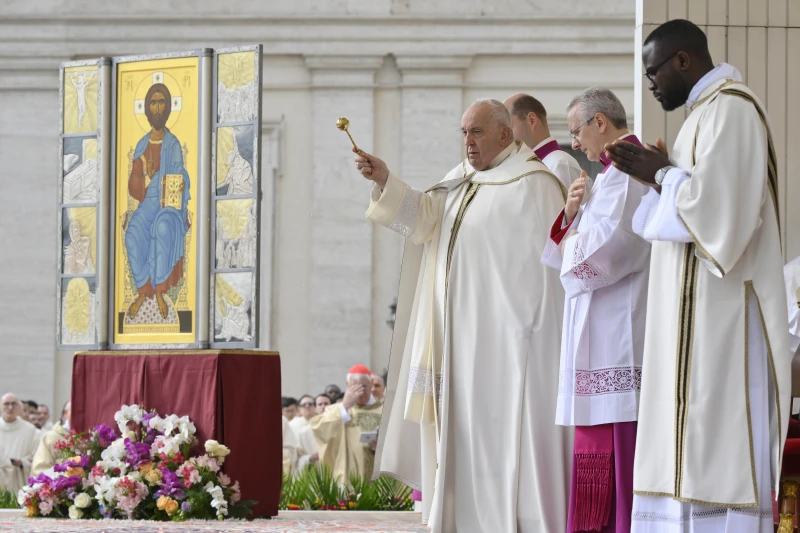
Pope Francis presides over Easter Sunday Mass in St. Peter’s Square on March 31, 2024. / Credit: Vatican Media
Vatican City, Mar 31, 2024 / 08:15 am (CNA).
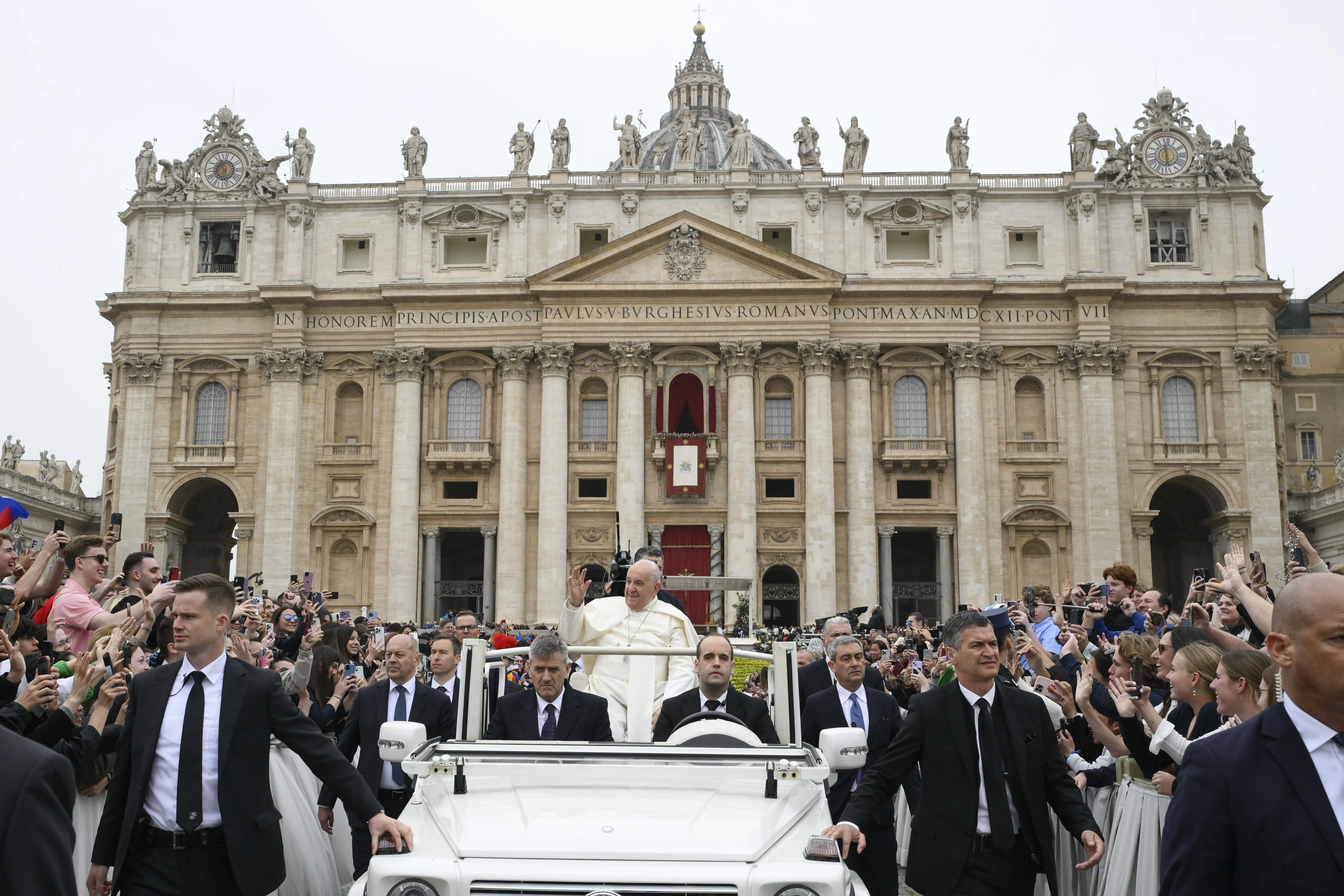
Pope Francis presided over Mass in St. Peter’s Square on Easter Sunday 2024 before giving the traditional urbi et orbi blessing in the presence of approximately 60,000 people.
On a warm and windy Easter Sunday at the Vatican, Pope Francis proclaimed: “Jesus Christ is risen! He alone has the power to roll away the stones that block the path to life. He, the living One, is himself that path. He is the Way.”
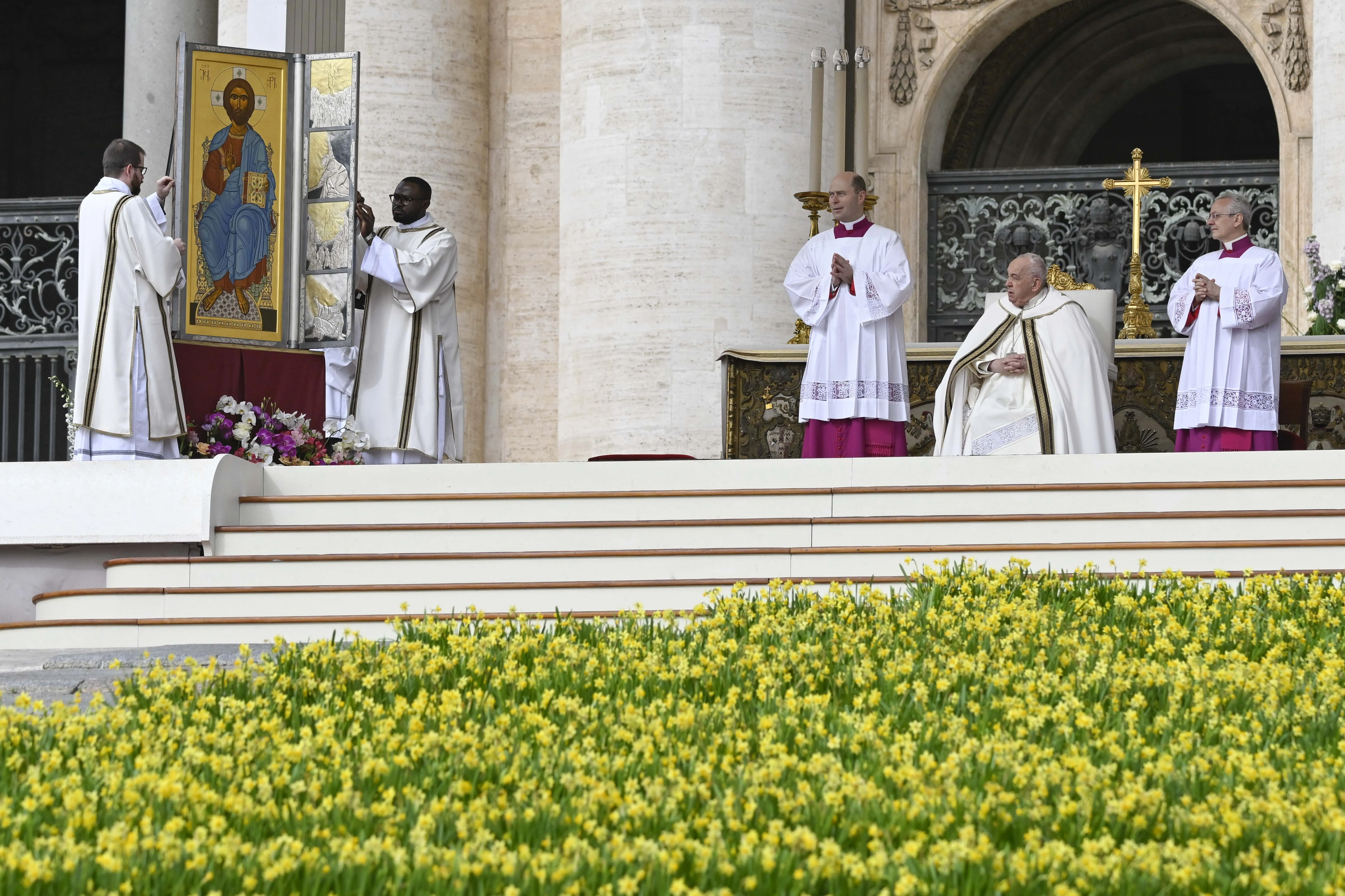
An icon of Christ was blown over by strong winds during Easter Sunday Mass in St. Peter’s Square. Vatican Media
“Only the risen Christ, by granting us the forgiveness of our sins, opens the way for a renewed world,” the pope added.
Speaking from the central balcony of St. Peter’s Basilica in his urbi et orbi blessing, Pope Francis said that “today throughout the world there resounds the message proclaimed 2,000 years ago from Jerusalem: ‘Jesus of Nazareth, who was crucified, has been raised!’”
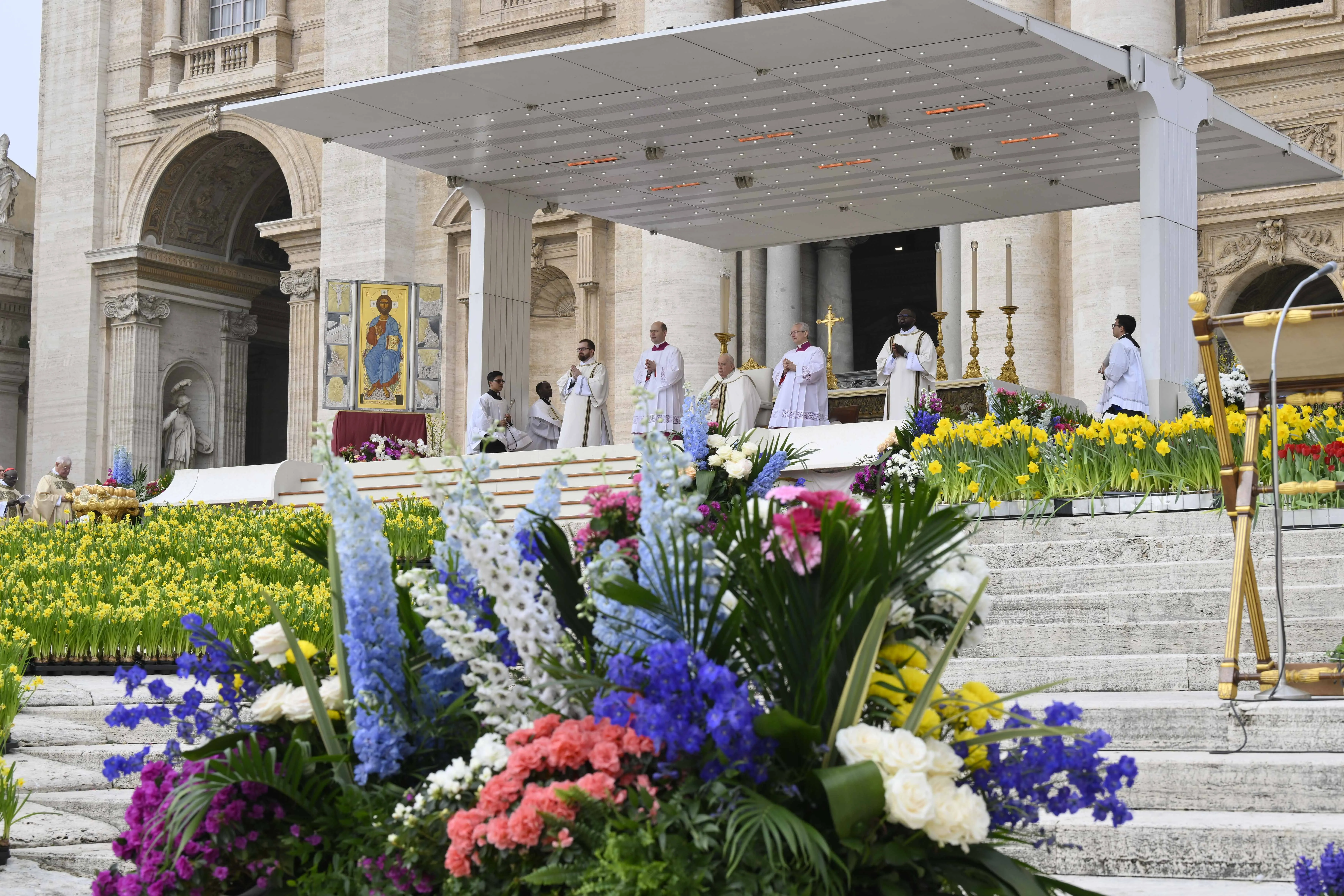
St. Peter’s Square was adorned with an array of over 21,000 flowers and plants from the Netherlands for the Easter Sunday Mass on March 31, 2024. Credit: Vatican Media
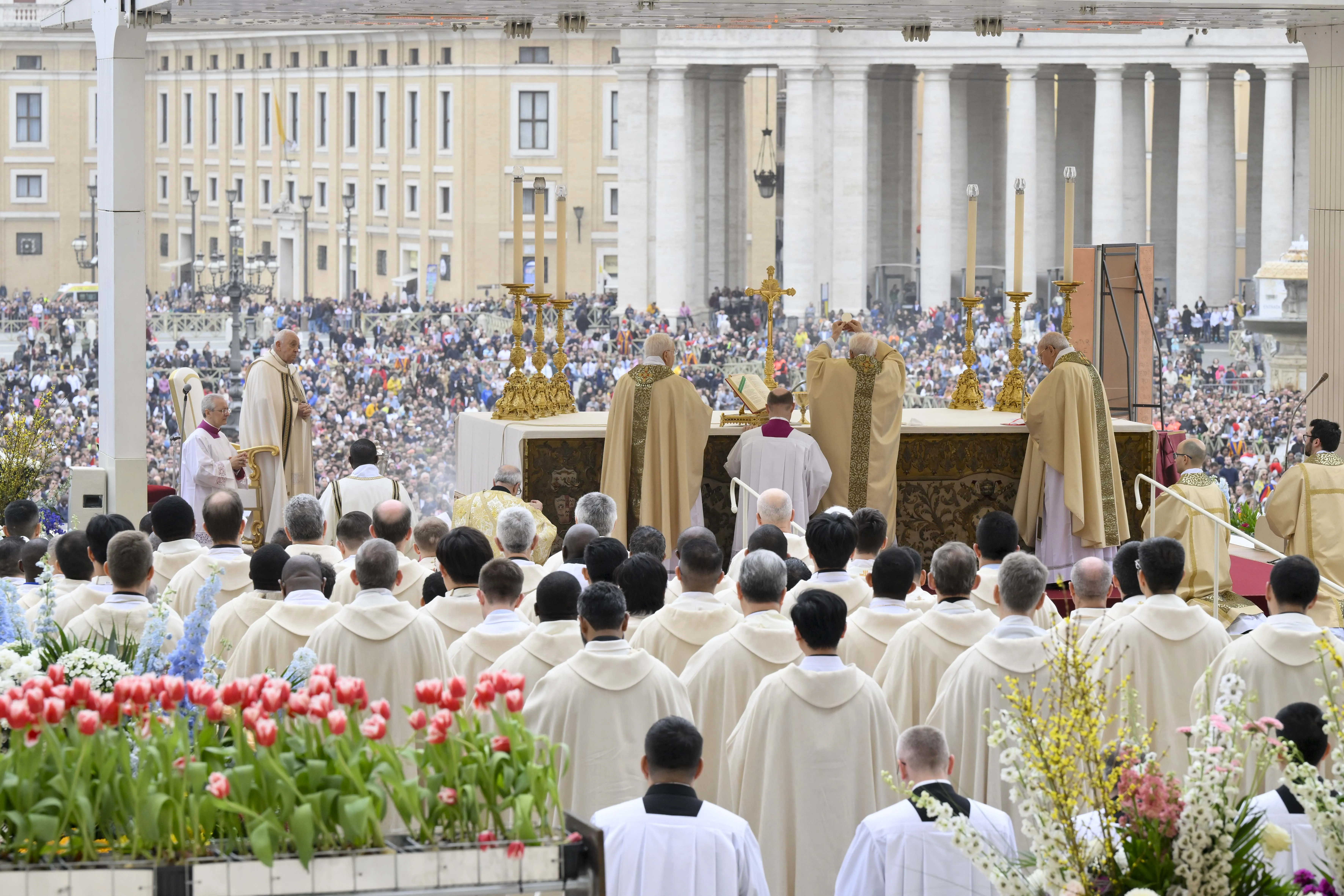
Three hundred priests, 18 bishops, and 34 cardinals concelebrated the Easter Sunday Mass on March 31. Cardinal Giovanni Battista Re celebrated at the altar due to Francis’ difficulty walking and standing.
The Gospel reading, John 20:1-9, was proclaimed in Latin and Greek. The passage recounts the moment in which Mary Magdalene and the apostles Peter and John found the empty tomb after Jesus’ resurrection.
As is his custom, Francis did not give a homily after the Gospel but stayed a few moments in silent prayer. Pope Francis gave a homily at the Easter Vigil Mass, which can be read here.
The pope also participated in the “Resurrexit,” an ancient rite honoring an icon of the Holy Savior. At the conclusion of the liturgy, Pope Francis rode through St. Peter’s Square on the popemobile greeting enthusiastic pilgrims who waved flags and cheered.
Three hundred priests, 18 bishops, and 34 cardinals concelebrated the Easter Sunday Mass on March 31, 2024, with Pope Francis. Cardinal Giovanni Battista Re celebrated at the altar due to Francis’ difficulty walking and standing. Credit: Vatican Media
In his urbi et orbi message following the Mass, the pope reflected on the “amazing discovery of Easter morning” as the women discovered an empty tomb.
“The tomb of Jesus is open and it is empty! From this, everything begins anew!” Pope Francis said.
“A new path leads through that empty tomb: the path that none of us but God alone could open: the path of life in the midst of death, the path of peace in the midst of war, the path of reconciliation in the midst of hatred, the path of fraternity in the midst of hostility.”
Pope Francis prayed for peace in Israel, Palestine, Ukraine, and other parts of the world suffering from war and violence.
At the end of Easter Sunday Mass, Pope Francis rode through St. Peter’s Square on the popemobile greeting enthusiastic pilgrims who waved flags and cheered. Vatican Media
“On this day when we celebrate the life given us in the resurrection of the Son, let us remember the infinite love of God for each of us: a love that overcomes every limit and every weakness,” he said.
“And yet how much the precious gift of life is despised! How many children cannot even be born? How many die of hunger and are deprived of essential care or are victims of abuse and violence? How many lives are made objects of trafficking for the increasing commerce in human beings?”
“May the light of the Resurrection illuminate our minds and convert our hearts, and make us aware of the value of every human life, which must be welcomed, protected, and loved. A happy Easter to all!” Pope Francis said.
Pope Francis presides at the Vatican’s Easter Vigil, Saturday, March 30, 2024 / Daniel Ibanez/CNA
Rome Newsroom, Mar 30, 2024 / 17:22 pm (CNA).
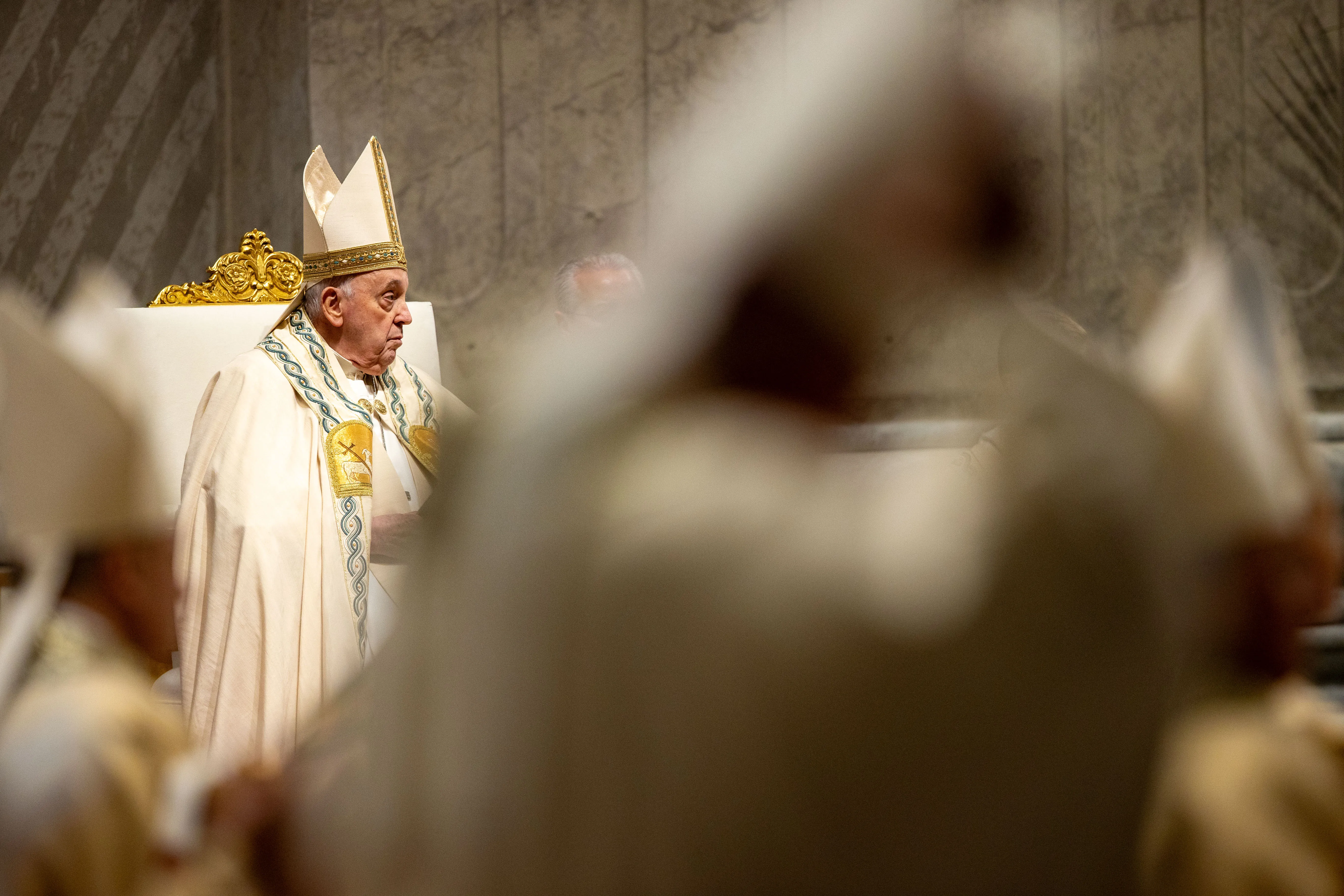
Pope Francis on Saturday evening presided over the Easter Vigil Mass at Saint Peter’s Basilica, reflecting on the gravity of Easter as a symbol of God’s reborn hope and the ultimate testament of life over death.
There were some concerns on Friday night about the pope’s wellbeing after the Holy Father canceled his attendance at Rome’s Via Crucis (Way of the Cross) at the last minute. The Holy See Press Office said the pope made the decision “to conserve his health” for the lengthy Easter Vigil liturgy.
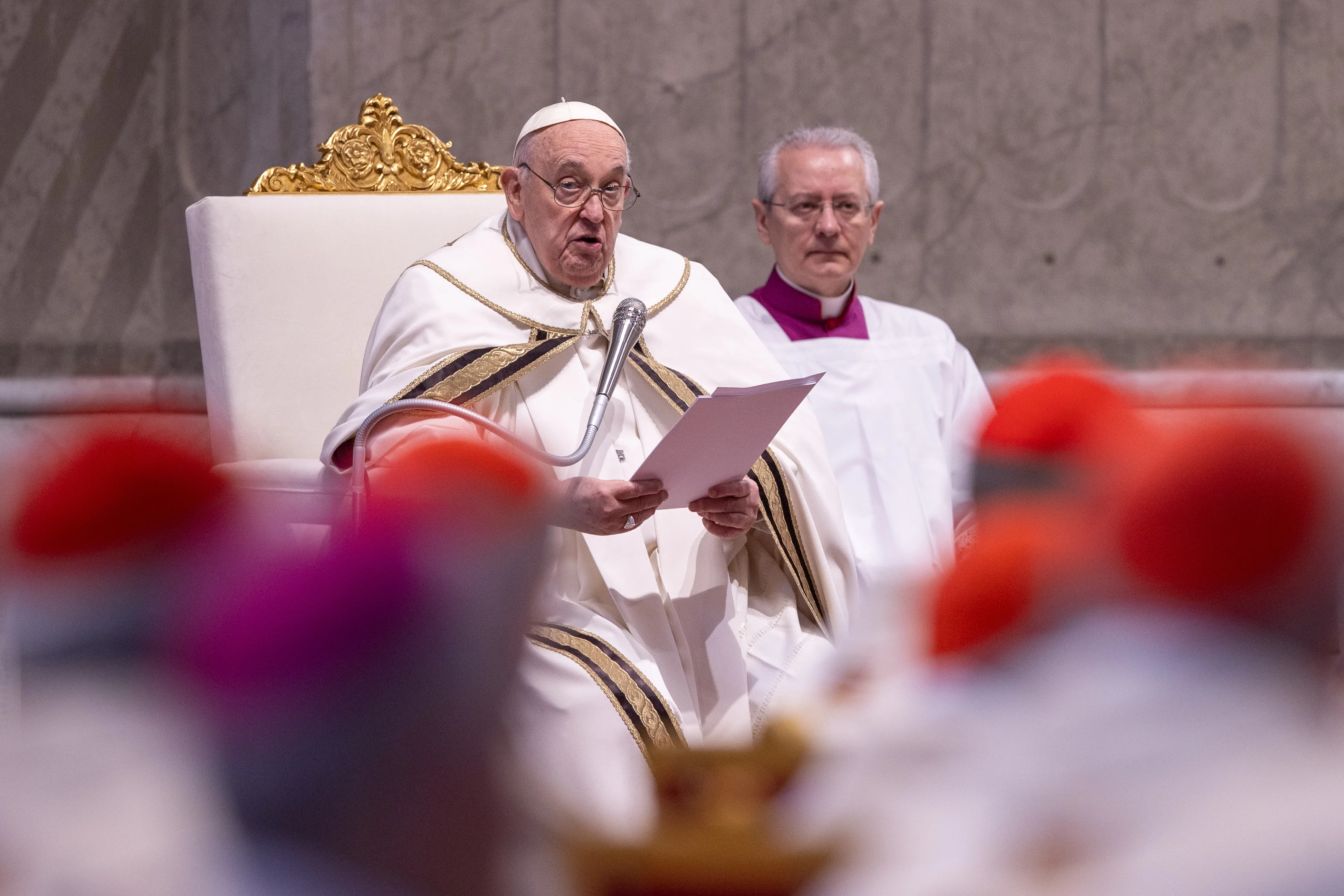
“This is the Pasch of Christ, the revelation of God’s power: The victory of life over death, the triumph of light over darkness, the rebirth of hope amid the ruins of failure. It is the Lord, the God of the impossible, who rolled away the stone forever,” the pope said on Saturday in front of nearly 6,000 faithful gathered in Saint Peter’s Basilica.
Pope Francis celebrates the Vatican’s Easter Vigil, Saturday, March 30, 2024. Daniel Ibanez/CNA
“He is the one who brings us from darkness into light, who is bound to us forever, who rescues us from the abyss of sin and death, and draws us into the radiant realm of forgiveness and eternal life,” the pope continued in his homily.
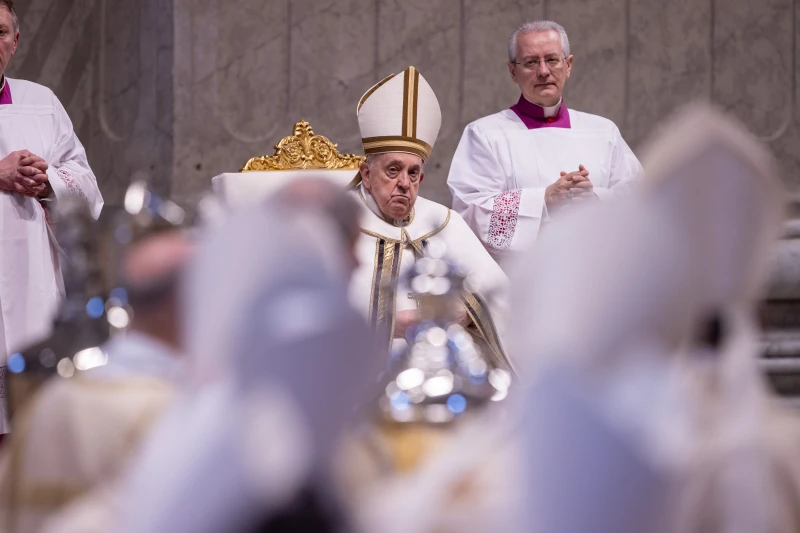
The dramatic liturgy opened with Saint Peter’s Basilica shrouded in darkness. The Holy Father was positioned in front of the 15th century Filarete Door (covered in a white curtain and an embroidered tapestry of the resurrected Christ).
The pope inscribed a cross and the alpha and omega (the first and last letters of the Greek alphabet) on the white paschal candle, symbolizing Christ’s resurrection and the Christian hope of a new life in him.
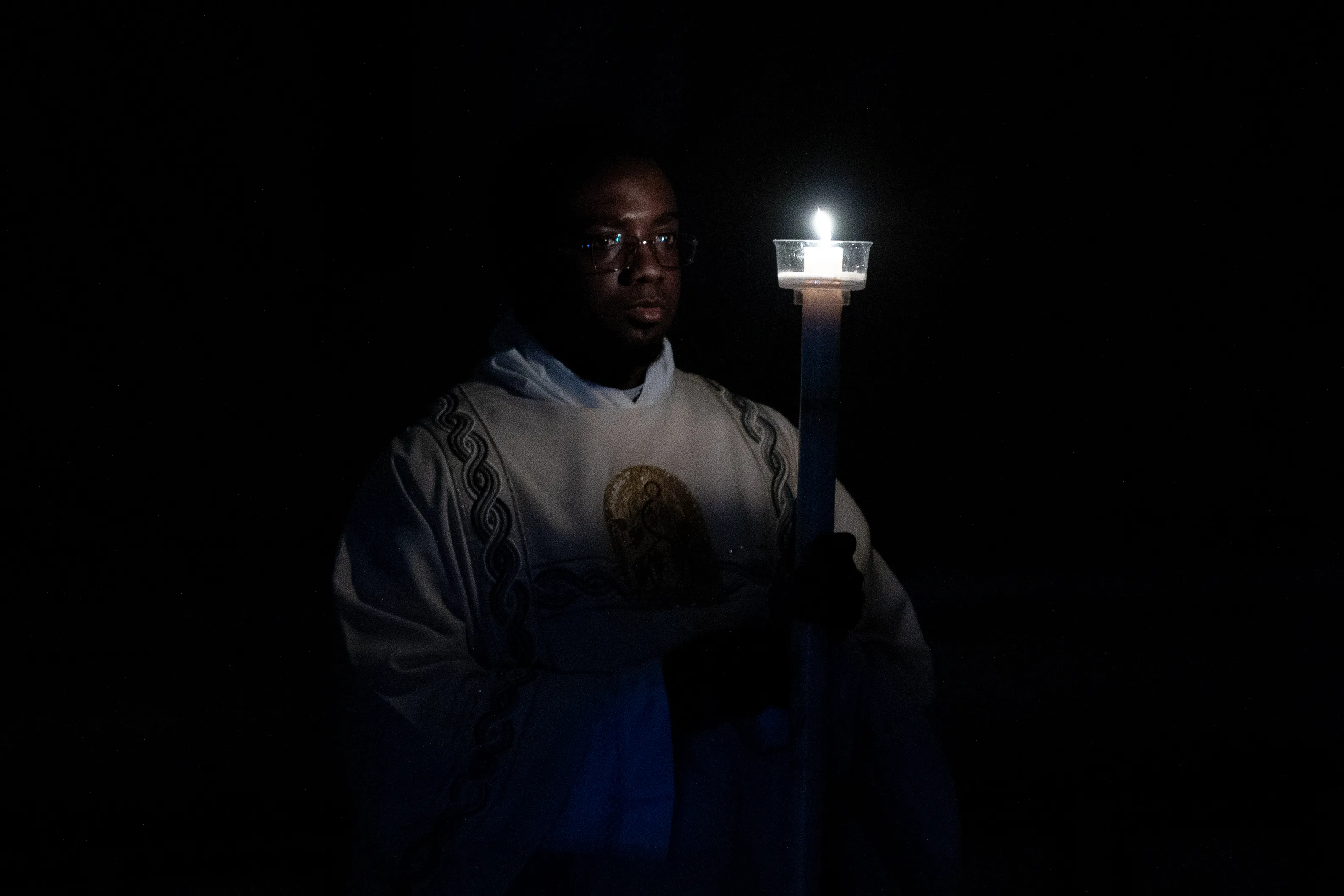
Processing up the central nave of the basilica, a deacon carried the candle, pausing and chanting at three different times “Lumen Christi” (Light of Christ) to which the congregation responded “Deo Gratias” (Thanks be to God).
The paschal candle is processed at the Vatican’s Easter Vigil, Saturday, March 30, 2024. Daniel Ibanez/CNA
This moment was followed by the chanting of the Exultet, or the Easter proclamation, an ancient prayer which invites the faithful to join the church in celebrating Christ’s resurrection.
Pope Francis opened his homily by reflecting on the anguish and consternation of the women depicted in the Gospel who with “the tears of Good Friday … not yet dried” approached the tomb that had been obstructed with a stone.
“That stone, an overwhelming obstacle, symbolized what the women felt in their hearts. It represented the end of their hopes, now dashed by the obscure and sorrowful mystery that put an end to their dreams.”
“That stone marked the end of Jesus’ story, now buried in the night of death. He, the life that came into the world, had been killed,” the pope continued.
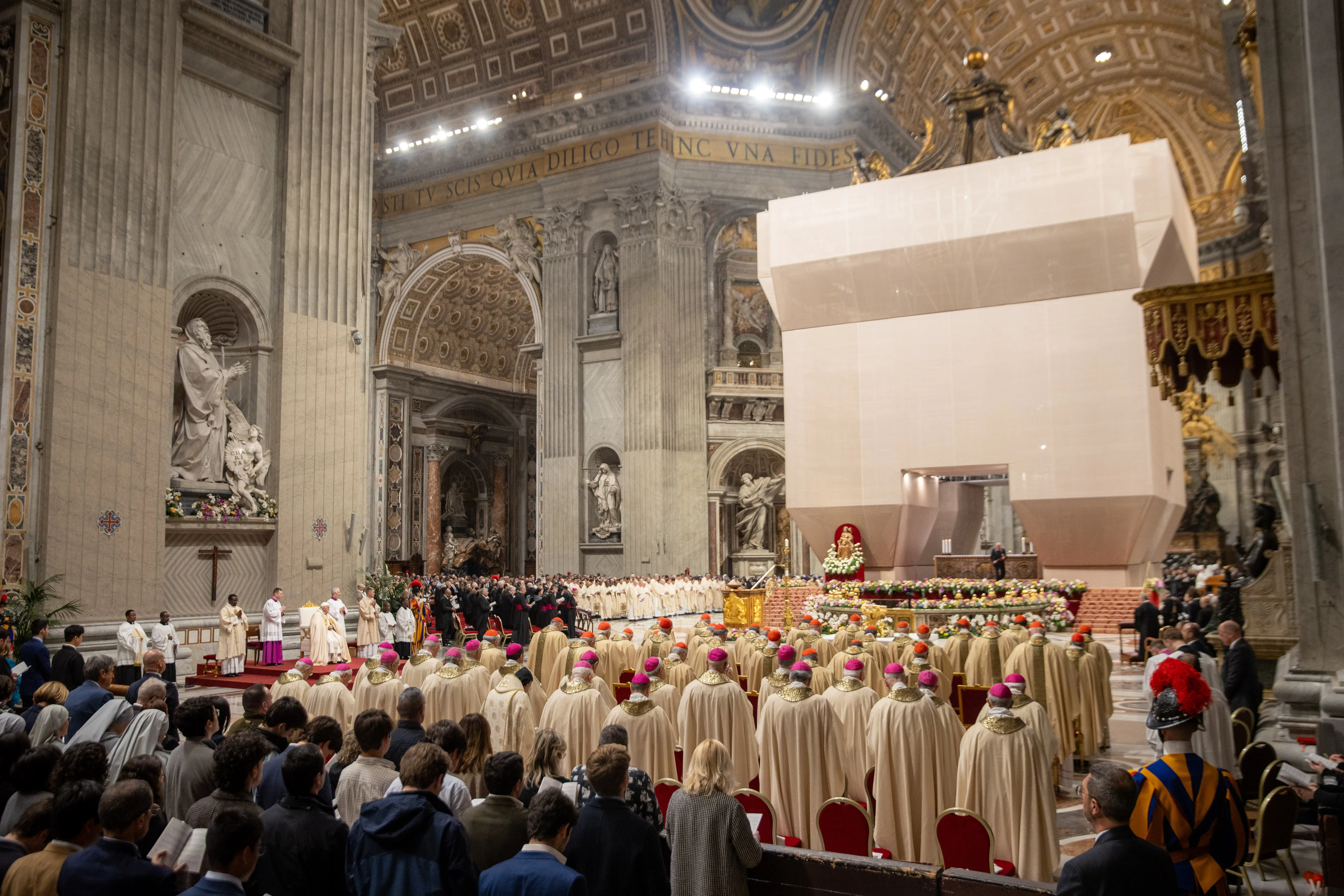
Clergy and visitors assemble at the Vatican’s Easter Vigil, Saturday, March 30, 2024. Daniel Ibanez/CNA
But, the pope noted, the women, upon casting their gazes upward, found the stone rolled away, a moment showcasing “the victory of life over death, the triumph of light over darkness, the rebirth of hope amid the ruins of failure.”
The pope related the initial anguish, and hope, of the women present at the sepulchre, noting that today we each “encounter such ‘tombstones’ on our journey through life in all the experiences and situations that rob us of enthusiasm and of the strength to persevere.”
Yet the pope implored the faithful to not succumb to despondency but instead draw hope from the resurrection.
“If we allow Jesus to take us by the hand, no experience of failure or sorrow, however painful, will have the last word on the meaning and destiny of our lives. Henceforth, if we allow ourselves to be raised up by the Risen Lord, no setback, no suffering, no death will be able to halt our progress towards the fullness of life.”
“Then no stone will block the way to our hearts, no tomb will suppress the joy of life, no failure will doom us to despair,” the pope continued. “Let us lift our eyes to him and ask that the power of his resurrection may roll away the heavy stones that weigh down our souls.”
Following a brief moment of reflection at the end of the homily, Pope Francis opened up the baptismal rite. With the blessing of the water, and a public recitation of vows, the Holy Father personally baptized eight adults: four Italians, two Koreans, a Japanese man, and an Albanian.
Tens of thousands gather outside of the Colosseum in Rome for the Via Crucis, the Way of the Cross, on Good Friday, March 29, 2024. / Credit: Daniel Ibañez/CNA
Vatican City, Mar 29, 2024 / 19:00 pm (CNA).
In an apparent last-minute decision, Po… […]
Pope Francis celebrates the Passion of the Lord on Good Friday in St. Peter’s Basilica in Rome. March 29, 2024. / Credit: Daniel Ibañez/CNA
Vatican City, Mar 29, 2024 / 15:20 pm (CNA).
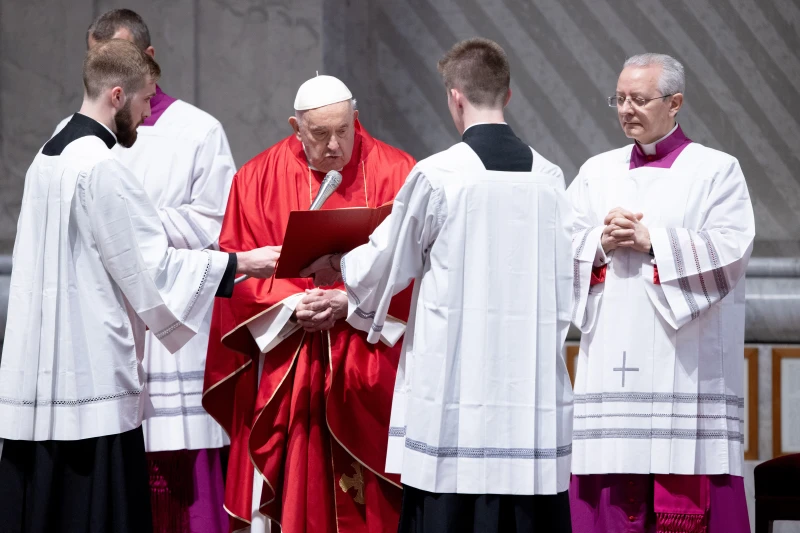
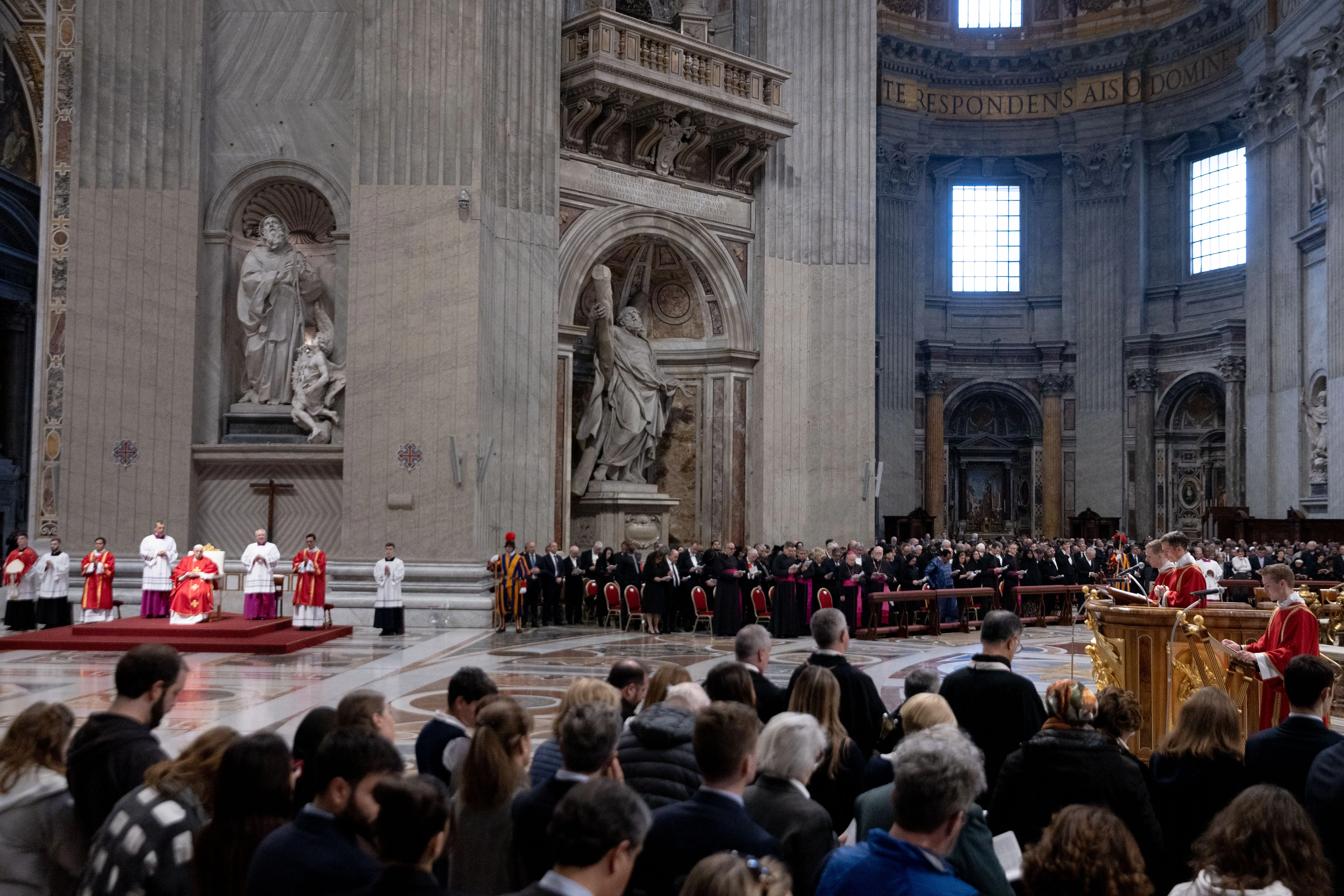
During the Good Friday liturgy at the Vatican, presided over by Pope Francis, the papal preacher reflected on the triumph of the cross, noting that it is an event that changed the universal perception of God’s omnipotence, revealing his humility.
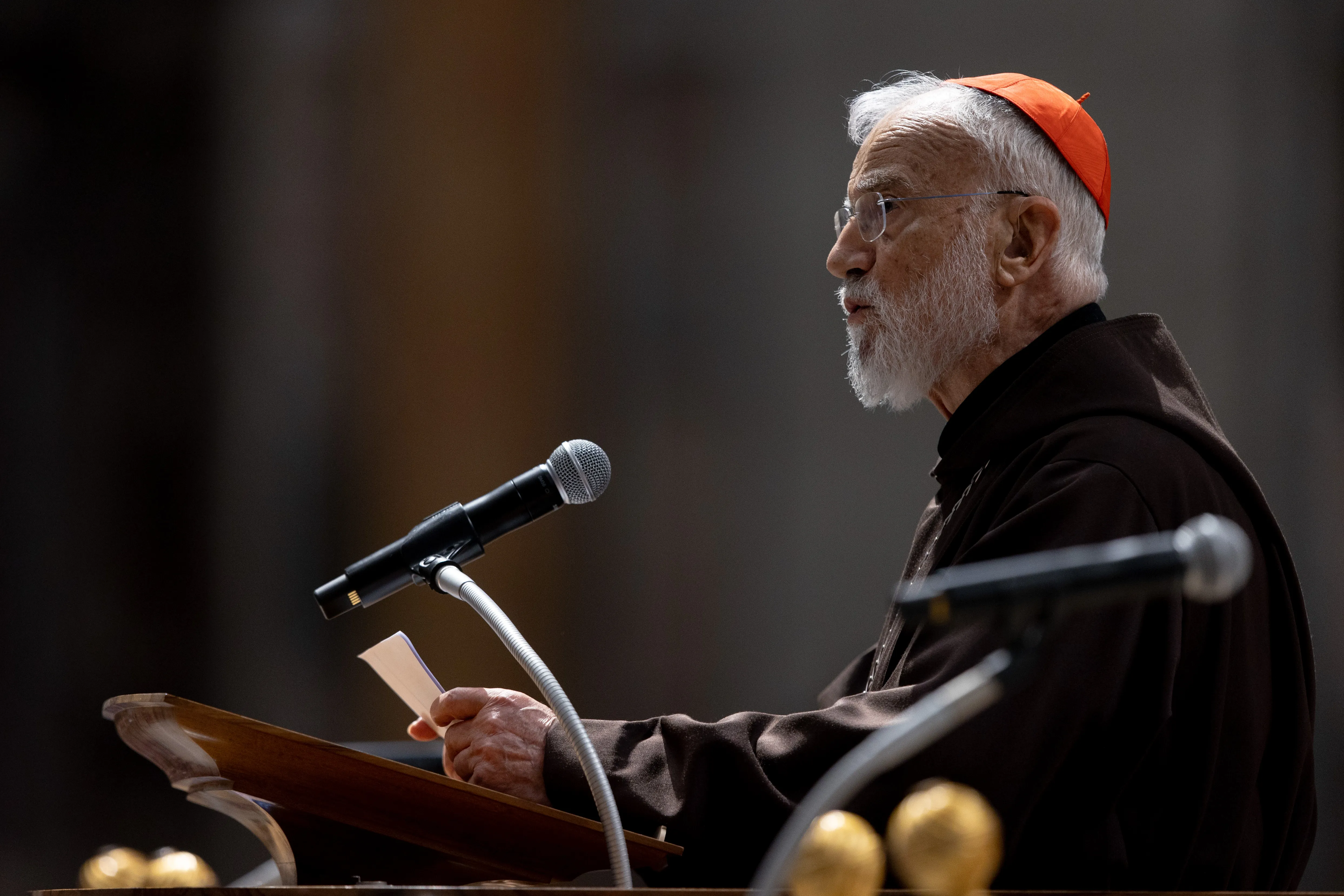
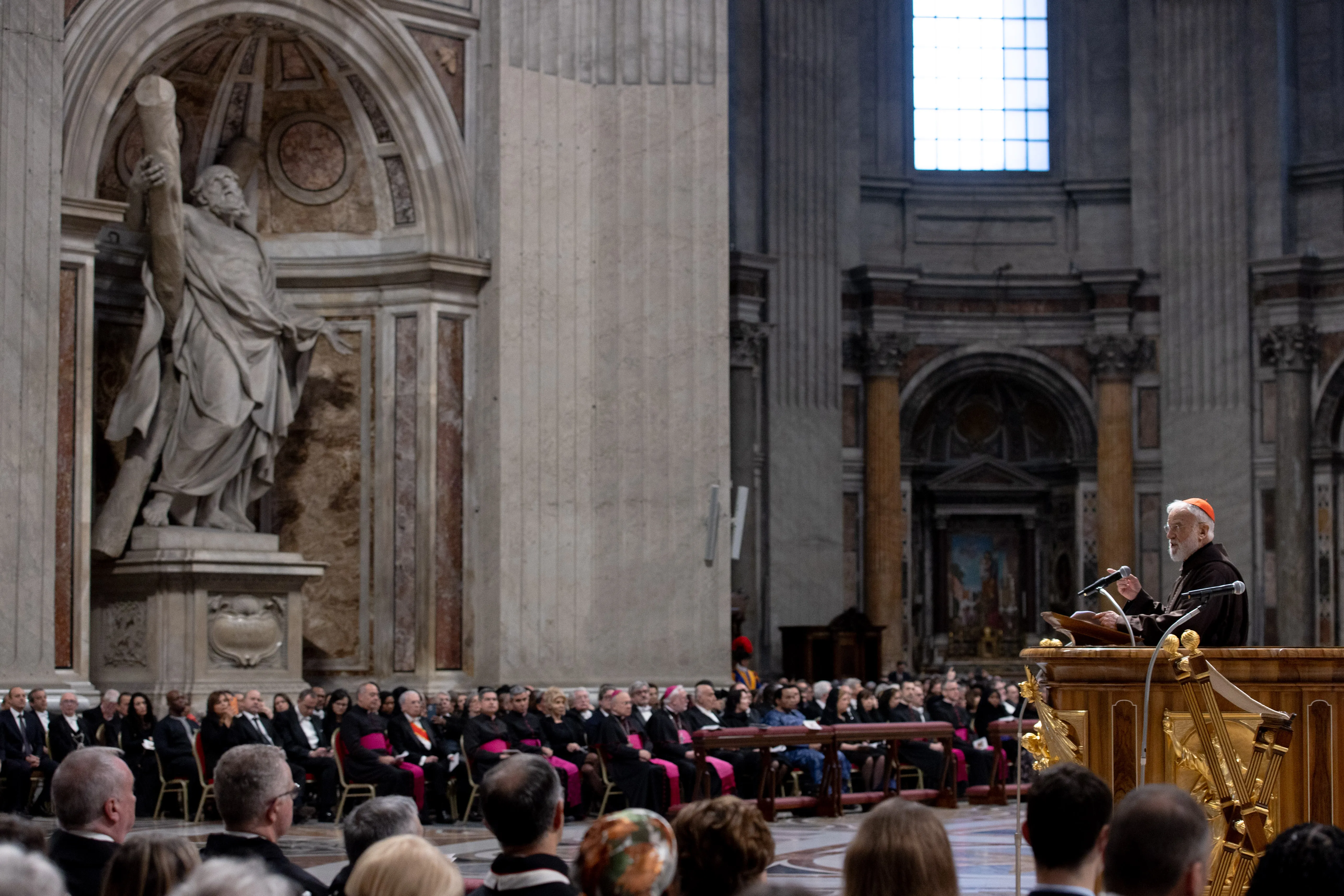
“The true omnipotence of God is the total powerlessness of Calvary,” Cardinal Raniero Cantalamessa, O.F.M. Cap., said during his homily.
Celebration of the Passion of the Lord on Good Friday in St. Peter’s Basilica, Rome. March 29, 2024. Credit: Daniel Ibañez/CNA
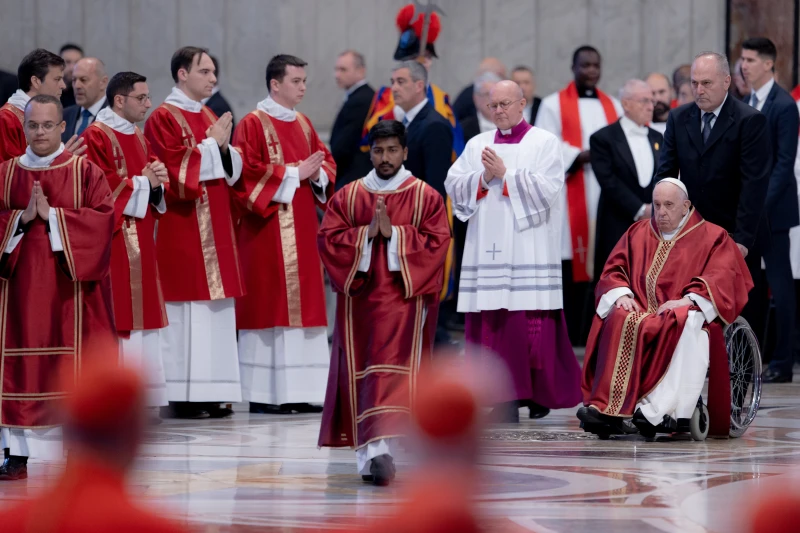
At approximately 5 p.m. Rome time, Pope Francis made his way into Saint Peter’s Basilica, in a wheelchair, vested in a red chasuble. Cast against the backdrop of complete and palpable silence, the Holy Father paused in meditation before the Papal Altar underneath Bernini’s Baldacchino (covered in scaffolding for its restoration), while the congregation knelt.
For the past several years the pope has been unable to lay prostrate due to his fragile health, which includes persistent knee problems and several bouts of pulmonary inflammation.
After the chanting of the passion from the Gospel of John, Cantalamessa — who was made a cardinal in 2020 after more than 40 years as Preacher of the Papal Household — opened his homily reflecting on Christ’s self-affirmation of “I am,” words he said come without any qualification and carry “an absolute, metaphysical significance” and is an “unprecedented novelty.”
“Jesus did not come to retouch and perfect the idea that men had of him God, but, in a certain sense, to overturn it and reveal the true face of God,” Cardinal Raniero Cantalamessa, O.F.M. Cap. said during his homily at the Good Friday liturgy in St. Peter’s Basilica in Rome. March 29, 2024. Credit: Daniel Ibañez/CNA
The cardinal stressed that this new paradigm can only be understood by looking at Christ’s preceding words heard in the passion: “When you have lifted up the Son of Man.”
Observing that “to be lifted up” refers to the crucifixion, the cardinal noted that the sum of these words express a “total reversal of the human idea of God,” revealing “the true face of God.”
“Jesus did not come to retouch and perfect the idea that men had of him, but, in a certain sense, to overturn it and reveal the true face of God,” he said. ““He humbly behaves in the glory of the resurrection as in the annihilation of Calvary. The concern of the risen Jesus is not to confuse his enemies, but to immediately go and reassure his lost disciples and, before them, the women who had never stopped believing in him.”
“The true omnipotence of God is the total powerlessness of Calvary,” Cardinal Raniero Cantalamessa, O.F.M. Cap. said during his homily at the Good Friday liturgy in St. Peter’s Basilica in Rome. March 29, 2024. Credit: Daniel Ibañez/CNA
“Understood in this light,” Cantalamessa continued, “the word of Christ takes on a universal significance that challenges those who read it, in any era and situation, including ours.”
The cardinal warned not to conflate God’s omnipotence, and the “definitive and irreversible triumph” of the cross with temporal triumphs, as God’s triumph showcases humility.
“It takes little power to show off,” the cardinal noted, “Instead, it takes a lot to step aside, to cancel. God is this limitless power of self-concealment.”
“The resurrection takes place in the mystery,” he continued. “As a resurrected one, Jesus appears only to a few disciples, out of the spotlight. With this he wanted to tell us that after suffering, we must not expect an external, visible triumph, like an earthly glory.”
Pope Francis celebrates the Passion of the Lord on Good Friday in St. Peter’s Basilica in Rome. March 29, 2024. Credit: Daniel Ibañez/CNA
At the end of Cantalamessa’s homily, the faithful sat in a moment of deep silence and reflection. This was followed by the reading of the Oratio Universalis, the universal prayer also known as the Solemn Intercessions.
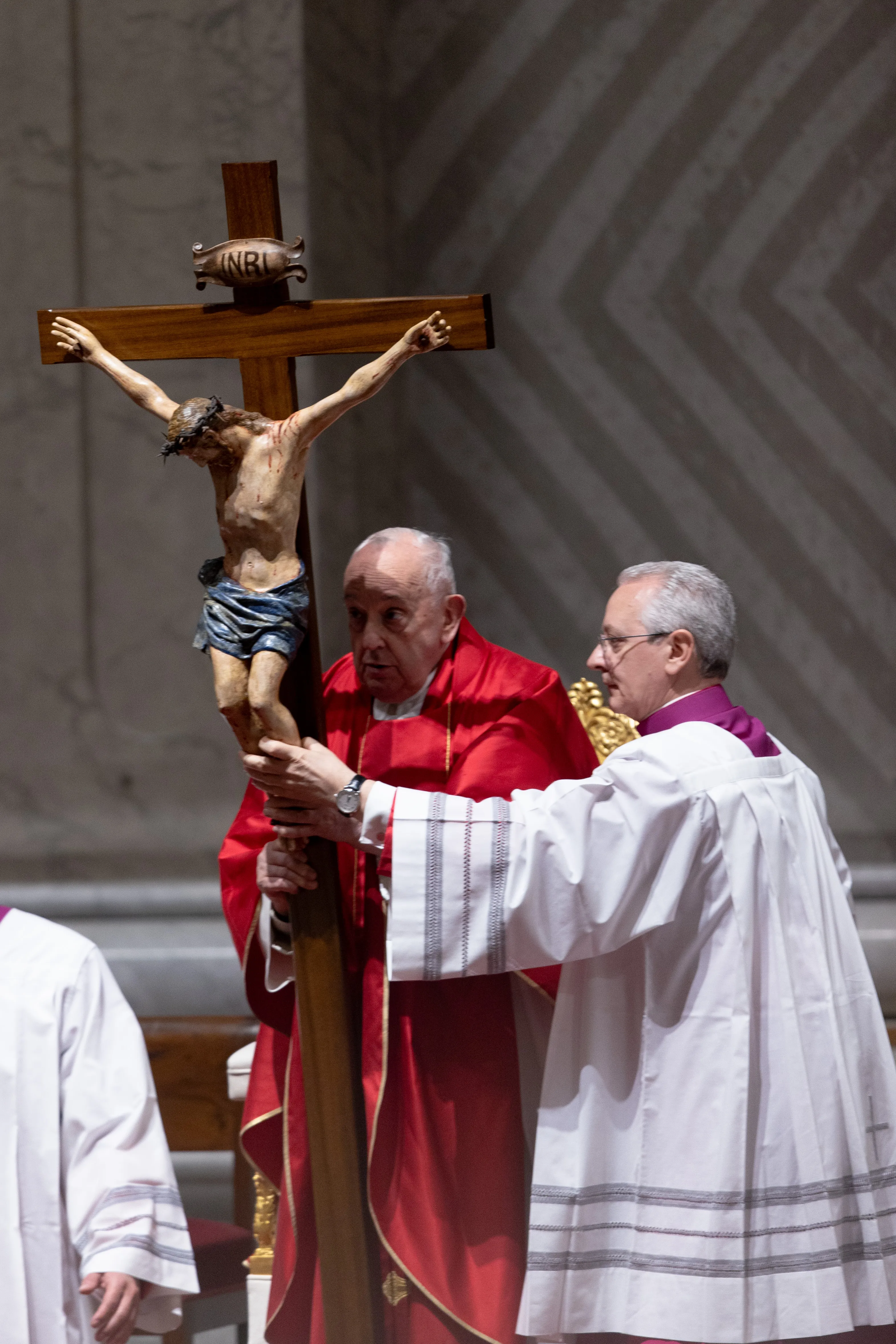
Then, a deacon, flanked by two candle bearers, stopped at three separate points in the central nave of the basilica, proclaiming, with an increasing pitch, “Ecce lignum crucis” (“behold the wood of the cross”). After the third proclamation, the deacon, holding an unveiled crucifix, brought it to the papal chair for the pope’s veneration.
Once the crucifix was fixed in a central place, the Sistine Chapel Choir chanted the Improperia, or the Good Friday Reproaches, a series of antiphons sung in alternating manner between a cantor and the choir. The cardinals, who sat opposite the pope, filed in line to kneel before and kiss the crucifix.
After the final prayer over the people, the pope left the basilica just as he entered: solemn, and in silence.
Pope Francis arrives at the Liturgy of the Lord’s Passion in St. Peter’s Basilica on Good Friday on April 7, 2023. / Credit: Daniel Ibanez/CNA
Rome Newsroom, Mar 29, 2024 / 08:00 am (CNA).
The Good Friday liturgy commemorates the apex of Christ’s passion with a remembrance of his crucifixion and death at Calvary.
The Good Friday Reproaches are a series of antiphons, known also as the “Improperia” or “Popule Meus” (“My people”), coming from the opening lines of the Latin text of the recitation.
Dating back to the ninth century, though not gaining a permanent place in the Roman Orders until the 14th century, the Good Friday Reproaches have long been an essential part of the Roman liturgy. But they largely disappeared from many parishes following the liturgical reforms of the Second Vatican Council.
The antiphons have, however, retained their prominence at the Vatican — and they will be chanted by the Sistine Chapel Choir during the Good Friday service presided over by Pope Francis on Friday in St. Peter’s Basilica.
In the moment leading up to the dramatic recitation, the priest chants three times, in an increasing pitch, “Ecce Lignum Crucis,” or “Behold the wood of the cross,” each time gradually unveiling the cross that hitherto has been covered in a purple veil.
Once the crucifix is placed in a central location at the edge of the sanctuary, cast against a bare altar, the faithful are invited to kneel before — and kiss — it, a powerful remembrance of Christ’s passion but also a recognition of the cross as an instrument of salvation.
During the adoration of the cross, the Good Friday Reproaches are chanted in an alternating manner between a cantor and choir. It opens: “Popule meus, quid feci tibi? Aut in quo contristavi te? Responde mihi” (“My people, what have I done to you? How have I offended you? Answer me”).
This hauntingly sorrowful and beautiful text is followed by the first reproach: “Quia eduxi te de terra Aegypti: parasti Crucem Salvatori tuo” (“Because I led thee out of the land of Egypt: thou hast prepared a cross for thy Savior”), showcasing the world’s fatal rejection of Christ despite his love and saving acts.
The following is the full text of the reproaches:
Popule meus, quid feci tibi? Aut in quo contristavi te? Responde mihi. (O my people, what have I done to thee? Or how have I offended you? Answer me.)
Quia eduxi te de terra Aegypti: parasti Crucem Salvatori tuo. (Because I led thee out of the land of Egypt: thou hast prepared a cross for thy Savior.)
Hagios o Theos. Sanctus Deus. Hagios Ischyros. Sanctus fortis. Hagios Athanatos, eleison himas. Sanctus immortalis, miserere nobis. (O holy God! O holy God! O holy strong One! O holy strong One! O holy and immortal, have mercy upon us. O holy and immortal, have mercy upon us.)
Quia eduxi te per desertum quadraginta annis: et manna cibavi te, et introduxi te in terram satis bonam: parasti Crucem Salvatori tuo. Hagios . . . (Because I led thee through the desert for forty years: and fed thee with manna, and brought thee into a land exceeding good: thou hast prepared a cross for thy Savior. O holy God! . . .)
Quid ultra debui facere tibi, et non feci? Ego quidem plantavi te vineam meam speciosissimam: et tu facta es mihi nimis amara: aceto namque sitim meam potasti: et lancea perforasti latus Salvatori tuo. Hagios . . . (What more ought I to have done for thee, that I have not done? I planted thee, indeed, my most beautiful vineyard: and thou hast become exceeding bitter to me: for in my thirst thou gavest me vinegar to drink: and with a spear thou hast pierced the side of thy Savior. O holy God! . . .)
Ego propter te flagellavi Aegyptum cum primogenitis suis: et tu me flagellatum tradidisti. Popule meus . . . (For thy sake I scourged the firstborn of Egypt: Thou hast given me up to be scourged. O my people . . .)
Ego te eduxi de Aegypto, demerso Pharone in mare Rubrum: et tu me tradidisti principibus sacerdotum. Popule meus . . . (I led thee out of Egypt, having drowned Pharaoh in the Red Sea: and thou hast delivered me to the chief priests. O my people . . .)
Ego ante te aperui mare: et tu aperuisti lancea latus meum. Popule meus . . . (I opened the sea before thee: and thou hast opened my side with a spear. O my people . . .)
Ego ante te praeivi in columna nubis: et tu me duxisti ad praetorium Pilati. Popule meus . . . (I went before thee in a pillar of cloud: and thou hast led me to the judgment hall of Pilate. O my people . . .)
Ego te pavi manna in desertum: et tu me cedisti alapis et flagellis. Popule meus . . . (I fed thee with manna in the desert: and thou hast assaulted me with blows and scourges. O my people . . .)
Ego te potavi aqua salutis de petra: et tu me potasti felle et aceto. Popule meus . . . (I gave thee the water of salvation from the rock: and thou hast given me gall and vinegar to drink. O my people . . .)
Ego propter te Chananeorum reges percussi: et tu percussisti arundine caput meum. Popule meus . . . (For thy sake I struck the kings of the Canaanites: and thou hast struck my head with a reed. O my people . . .)
Ego dedi tibi sceptrum regale: et tu dedisti capiti meo spineam coronam. Popule meus . . . (I gave thee a royal scepter: and thou hast given a crown of thorns for my head. O my people . . .)
Ego te exaltavi magna virtute: et tu me suspendisti in patibulo crucis. Popule meus . . . (I exalted thee with great strength: and thou hast hanged me on the gibbet of the cross. O my people . . .)
Pope Francis kisses the foot of one of the 12 women whose feet he washed at the Rebibbia Women’s Prison in Rome on Holy Thursday, March 28, 2024. / Credit: Vatican Media
CNA Staff, Mar 28, 2024 / 14:30 pm (CNA).
Pope Francis on Thursday washed … […]
Pope Francis presides at the Vatican’s chrism Mass on Holy Thursday, March 28, 2024. / Credit: Daniel Ibanez/CNA
Vatican City, Mar 28, 2024 / 09:30 am (CNA).
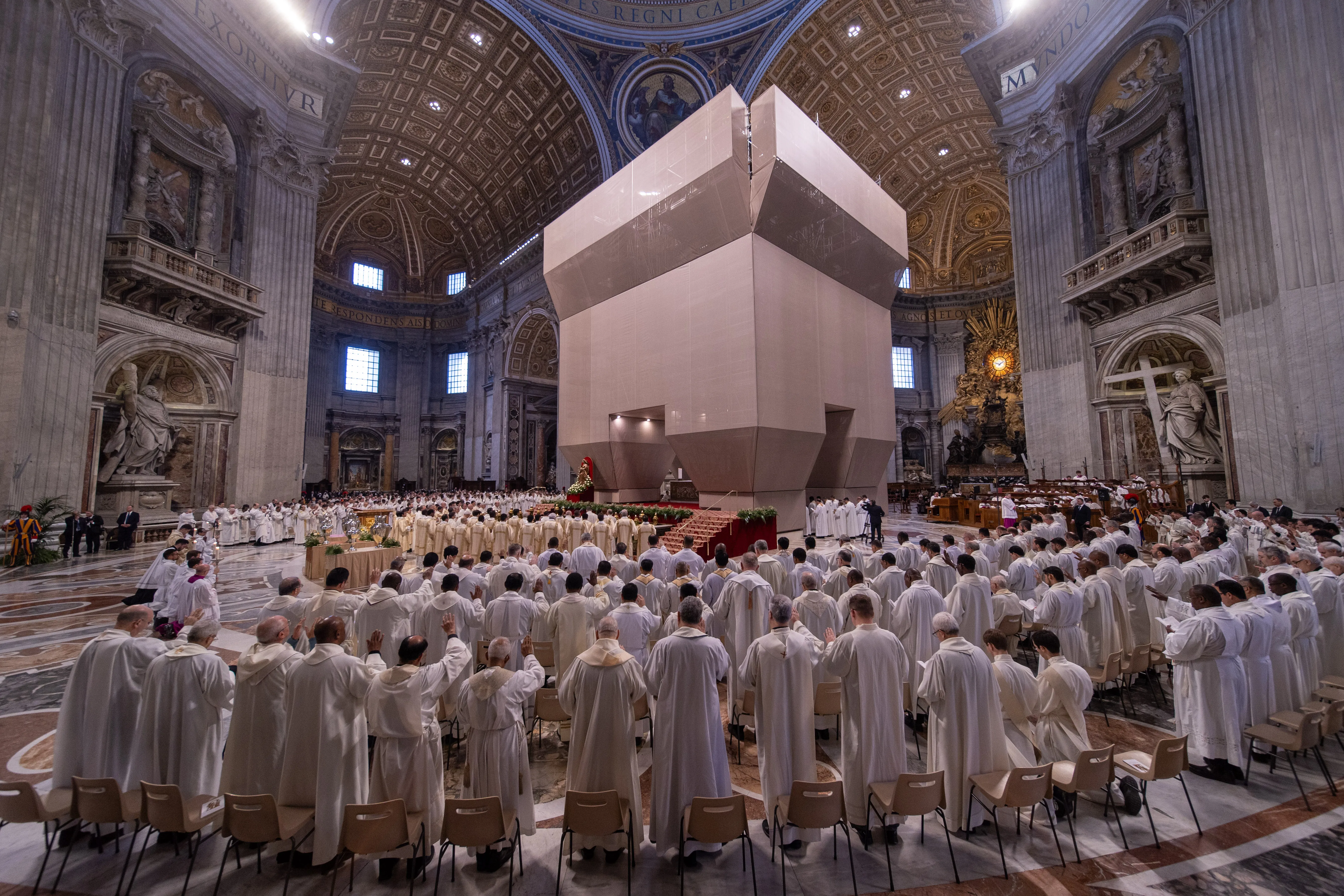
On Holy Thursday, Pope Francis presided over a chrism Mass at which more than 1,880 priests, bishops, and cardinals renewed the promises made at their ordinations.
Pope Francis encouraged the priests to turn their gaze upon the crucified Lord and to weep over their sins in repentance, saying that tears can “purify and heal the heart.”
“Once we recognize our sin, our hearts can be opened to the working of the Holy Spirit, the source of living water that wells up within us and brings tears to our eyes,” Francis said on March 28.
Pope Francis speaks at the Vatican’s chrism Mass on Holy Thursday, March 28, 2024. Credit: Daniel Ibanez/CNA
“The Lord seeks, especially in those consecrated to him, men and women who weep for the sins of the Church and the world and become intercessors on behalf of all,” he added.
Forty-two cardinals, 42 bishops, and 1,800 priests living in Rome concelebrated the Mass with the pope in St. Peter’s Basilica.
Holy Thursday marks the institution of the Eucharist and institution of the sacrament of the priesthood at the Last Supper. Pope Francis will also preside over a Mass of the Lord’s Supper on Thursday evening at a women’s prison in Rome.
The 87-year-old pope arrived in St. Peter’s Basilica on Thursday morning in a wheelchair. Before giving his more than 20-minute homily, the pope took a sip of water and put on his reading glasses.
Pope Francis reflected in his homily on Peter’s tears after denying the Lord three times as recorded in the Gospel of Luke: “Peter remembered the word of the Lord … and went out and wept bitterly.”
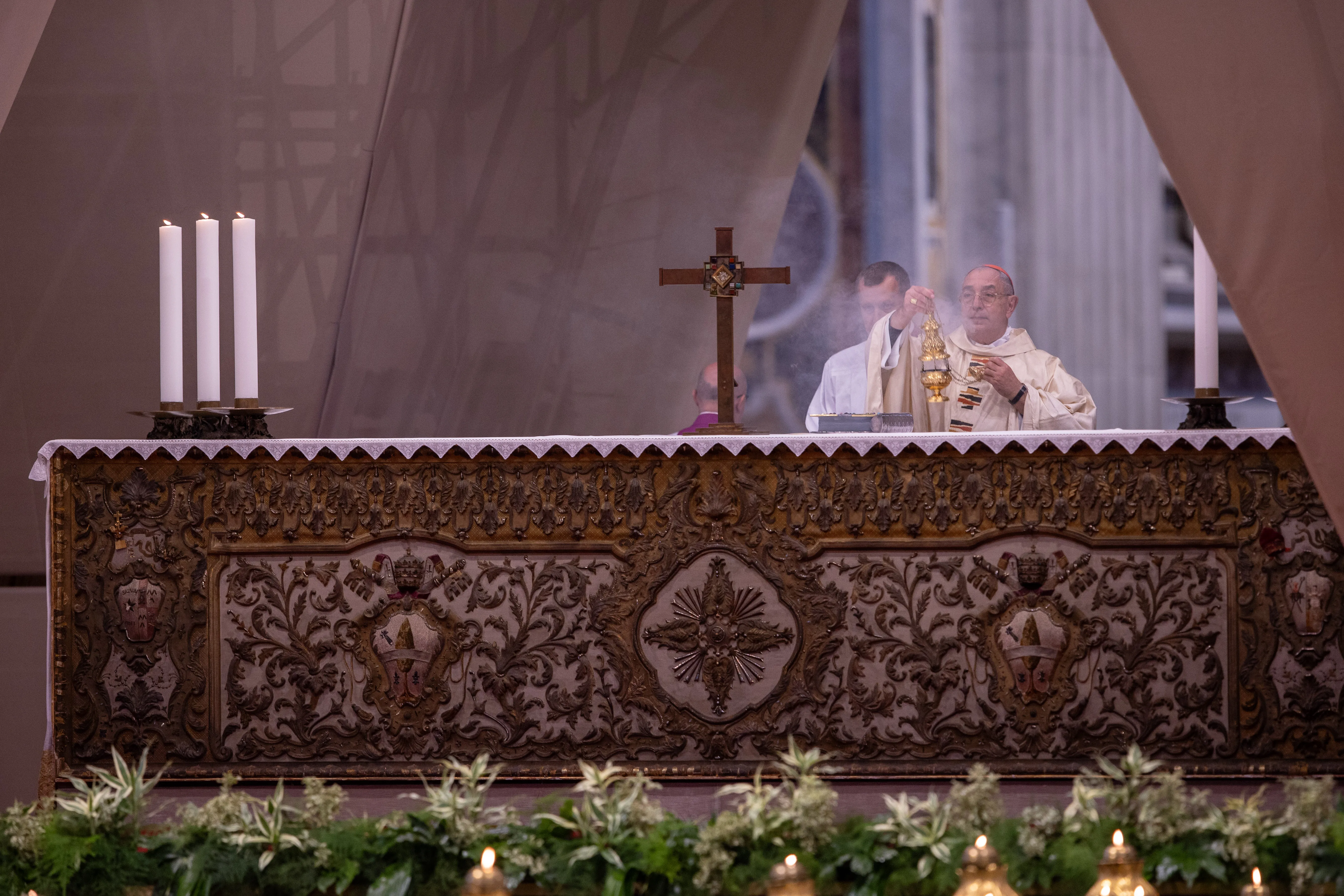
Cardinal Angelo De Donatis presides at the altar during the Vatican’s chrism Mass on Holy Thursday, March 28, 2024. Credit: Daniel Ibanez/CNA
“Dear brother priests, the healing of the heart of Peter, the healing of the apostle, the healing of the pastor, came about when, grief-stricken and repentant, he allowed himself to be forgiven by Jesus. That healing took place amid tears, bitter weeping, and the sorrow that leads to renewed love,” he said.
Compunction
Pope Francis said that he wanted to speak to the priests about the importance of compunction — an awareness of guilt due to sin — which the pope admitted is a “somewhat old-fashioned” term and “an aspect of the spiritual life that has been somewhat neglected, yet remains essential.”
The pope added that compunction “is not a sense of guilt that makes us discouraged or obsessed with our unworthiness, but a beneficial ‘piercing’ that purifies and heals the heart.”
“Compunction demands effort but bestows peace. It is not a source of anxiety but of healing for the soul, since it acts as a balm upon the wounds of sin, preparing us to receive the caress of the heavenly physician, who transforms the ‘broken, contrite heart,’” Pope Francis said.
Clergy assembled at the Vatican’s Chrism Mass on Holy Thursday, March 28, 2024. Credit: Daniel Ibanez/CNA
The pope said that through compunction “the natural tendency to be indulgent with ourselves and inflexible with others is overturned and, by God’s grace, we become strict with ourselves and merciful toward others.”
“Weeping for ourselves … means seriously repenting for saddening God by our sins … It means looking within and repenting of our ingratitude and inconstancy, and acknowledging with sorrow our duplicity, dishonesty, and hypocrisy — clerical hypocrisy, dear brothers, that hypocrisy which we slip into so much — beware of clerical hypocrisy,” Francis said.
“How greatly we need to be set free from harshness and recrimination, selfishness and ambition, rigidity and frustration, in order to entrust ourselves completely to God and to find in him the calm that shields us from the storms raging all around us,” he added.
“Let us pray, intercede, and shed tears for others; in this way, we will allow the Lord to work his miracles. And let us not fear, for he will surely surprise us.”
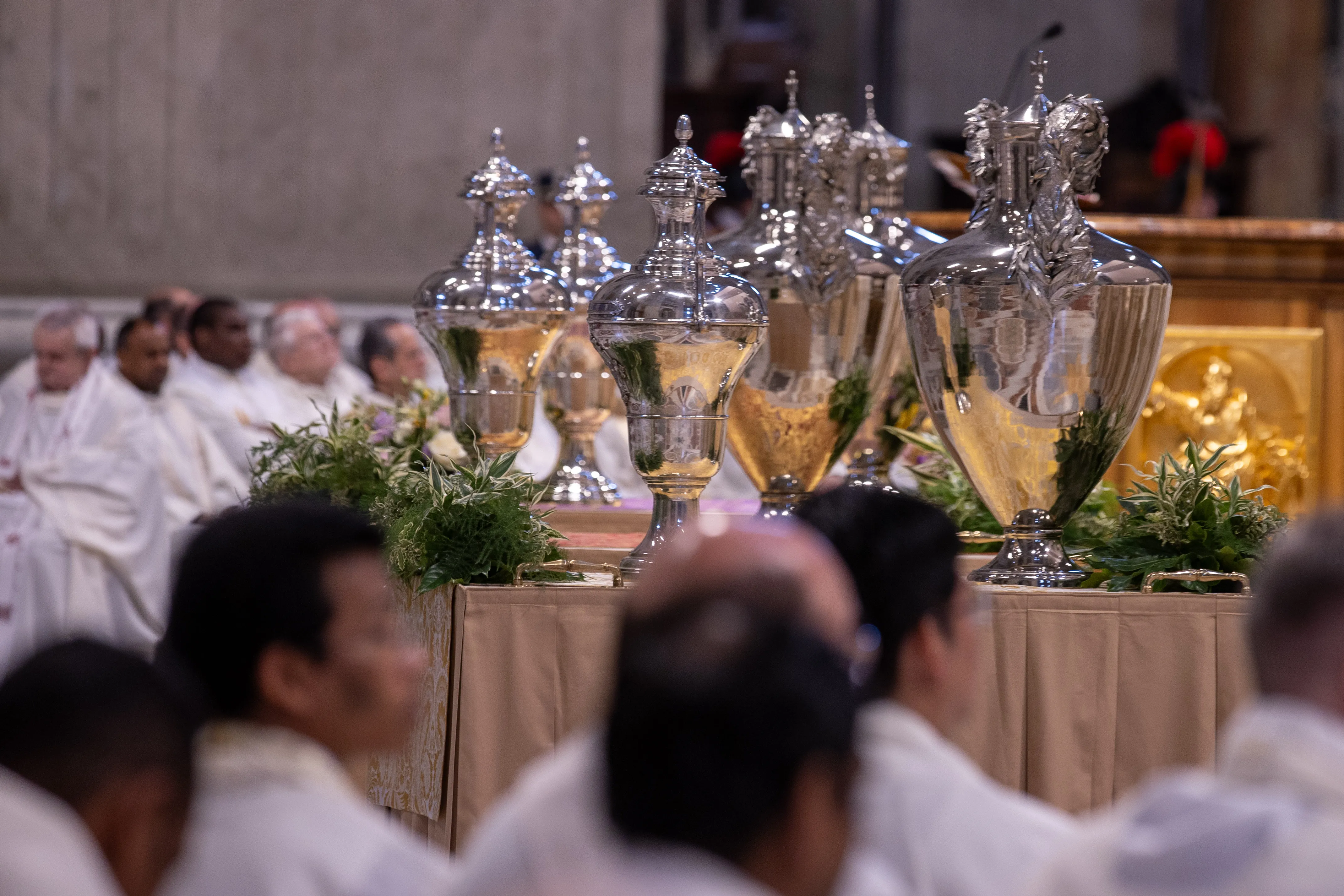
During the Vatican’s chrism Mass, the pope, as the bishop of Rome, blessed the oil of the sick, the oil of catechumens, and the chrism oil, which will be used in the diocese during the coming year. Cardinal Angelo De Donatis served as the celebrant at the altar.
The oils were processed up the main altar of St. Peter’s in large silver urns as the hymns of the Sistine Chapel Choir filled the basilica.
Urns of oil are displayed at the Vatican’s Chrism Mass on Holy Thursday, March 28, 2024. Credit: Daniel Ibanez/CNA
Pope Francis prayed over the oil of the sick: “O God, Father of all consolation, who through your Son have willed to heal the infirmities of the sick, listen favorably to this prayer of faith: Send down from heaven, we pray, your Holy Spirit, the Paraclete, upon the rich substance of this oil, which you were pleased to bring forth from vigorous green trees to restore our bodies, so that by your holy blessing this oil may be for anyone who is anointed with it a safeguard for body, mind, and spirit, to take away every pain, every infirmity, and every sickness.”
The blessed oil will be used for the anointing of the sick in Rome throughout the year.
Pope Francis thanked the priests gathered in St. Peter’s Basilica for all they do to bring “the miracle of God’s mercy” to the world today.
“Dear priests, thank you for your open and docile hearts; thank you for your labors and thank you for your tears; thank you because you bring the miracle of mercy … you bring God to the brothers and sisters of our time,” he said. “Dear priests, may the Lord console you, confirm you, and reward you.”