No Picture
News Briefs

Christmas: When does it end?
January 5, 2022 Catholic News Agency 3
Pope Francis says Mass in St. Peter’s Basilica, Dec. 24, 2021 / Vatican Media

Washington, D.C. Newsroom, Jan 5, 2022 / 17:00 pm (CNA).

“And I keep my Christmas lights on, on my front porch all year long/and I know all the words to every Charlie Daniels song…” 

While Gretchen Wilson was probably (hopefully?) not being literal in the lyrics to her 2004 Grammy Award-winning single “Redneck Woman,” she actually has a bit of a point. There’s nothing wrong with keeping the Christmas decorations up longer than December and keeping the Christmas spirit flowing past December 25. 

But just how many days is Christmas? When should you finally take those lights off the porch, or remove the tree? Read on for some of the arguments for and against commonly agreed-upon end dates for Christmas.

“Christmas is one day”

This, of course, is the simplest answer. Christmas is typically celebrated on Dec. 25 for most of the world, and on Jan. 7 for Churches using the Julian calendar, and on Jan. 6 for yet another, considerably smaller, part of the world. On this day, the liturgy celebrated is the “Feast of the Nativity of Our Lord.” Priests wear white vestments on Christmas, which is different from the violet they wear during Advent. 

So there you have it. Christmas is one day, either at the end of December or in the first week of January. 

Or is it? 

“Christmas is eight days”

There’s also an argument to be made that Christmas is eight crazy nights eight days long. The Church regards Christmas as an octave, or eight-day celebration. The octave of Christmas begins on the Feast of the Nativity of Our Lord and concludes on the Solemnity of Mary, Mother of God on Jan. 1. 

During the eight days of Christmas, clergy wear white, except during the St. Stephen’s Day and the Feast of the Holy Innocents, when they wear red. 

In a liturgical sense, Christmas is eight days. 

But wait, there’s myrrh!  

“Christmas is 12 days”

We’ve all heard the Christmas carol “Twelve Days of Christmas.” While it’s unclear as to why someone would give someone 23 separate birds, a pear tree, and the services of 50 people over a 12-day period, there actually is a liturgical precedent for claiming that Christmas is 12 days long. 

Twelve days after Christmas is the Feast of the Epiphany. This day marks when the Magi arrived to Jesus, Mary, and Joseph, and gave Jesus the gifts of gold, frankincense, and myrrh. 

In the Latin Rite of the Catholic Church, Epiphany celebrates the revelation that Jesus was the Son of God. It focuses primarily on this revelation to the Three Wise Men, but also in his baptism in the Jordan River and at the wedding at Cana. 

In the Eastern rites of the Catholic Church, Theophany – as Epiphany is known in the East – commemorates the manifestation of Jesus’ divinity at his Baptism in the River Jordan.

But here’s where it gets a little confusing: While the traditional date for the feast is Jan. 6, in the United States, the celebration of Epiphany is moved to the second Sunday after Christmas in the Novus Ordo.

During the 12 days of Christmas, clergy wear white, except during the St. Stephen’s Day and the Feast of the Holy Innocents, when they wear red. 

So, there. By the liturgical calendar, one can argue Christmas is also 12 days. 

“Christmas ends January 13”

In the usus antiquior of the Roman rite, per the general rubrics of the Roman Breviary, “Christmastide” includes both “the season of Christmas” – the 12 days seen earlier – and “the season of Epiphany” – the eight days from the Epiphany on Jan. 6 to the commemoration of the Baptism of the Lord on Jan. 13. 

And what is now called the season of Epiphany was, until 1955, observed as the Octave of the Epiphany.

What do the U.S. bishops say?

According to the United States Conference of Catholic Bishops, the liturgical season of Christmas ends with the celebration of the Baptism of the Lord. 

The Baptism of Christ, which the USCCB states is the end of Christmas, is observed on the first Sunday after Jan. 6 in the Novus Ordo.

After the Baptism of Christ, clergy are to wear the green vestments of Ordinary Time. 

What about other customs? 

“Christmas is from the day after Thanksgiving until Jan. 15” 

In the eyes of my condominium association, that is. 

While most places do not have a hard-and-fast date like my complex, it is not uncommon for regions to have either secular or religious traditions centered around Christmas decorations. 

For instance, in Colorado, it is supposedly customary to keep Christmas lights up until after the National Western Stock Show, which goes until the third week of January. 

In parts of the world that do not observe Thanksgiving in November, Christmas markets open around the second week of November, kicking off the holiday season. 

In these cases, Christmas is synonymous with “start of winter. Ish.” 

In the liturgical calendar, clergy wear violet and rose vestments during Advent, followed by the white and red of the Octave of Christmas.

Does the celebration of Christmas always have to start in winter? 

Here’s looking at you, Southern Hemisphere.

“Christmas goes from mid-October until after the first week of January”

This is only true if you are decorating a Disney theme park. 

There is no liturgical or traditional basis for this timeline. However, the decorations are nice, the mood is festive, and I’m not going to complain. 

What’s the absolute last possible concrete day of Christmas? 

“Christmas is until Candlemas” 

Now we’re talking. 

Candlemas, or the Feast of the Presentation of the Lord, is Feb. 2. On this day, many Catholics bring candles to the church to be blessed. They can then light these candles at home during prayer or difficult times as a symbol of Jesus Christ, the Light of the World.

Candlemas is the last day that the Alma Redemptoris Mater is the Marian antiphon appended to hours of the Divine Office. The Alma Redemptoris Mater is used from the beginning of Advent through Feb. 2, and so Candlemas has come to be associated with the close of the Christmas season. 

Candlemas is still observed with public, Christmas-esque celebrations throughout the world, including in Peru, Puerto Rico, France, and Belgium. 

On the other hand, Septuagesima Sunday – which is definitely not part of Christmas – has been known to fall before Feb. 2, giving the lie to the ‘Christmas is until Candlemas’ party.

Is that all, though?

“If there is love in your heart and your mind, you will feel like Christmas all the time”

Now you’re just singing the lyrics to Faith Hill’s “Where Are You Christmas.” 

To be clear, this song is a bop, but it is not exactly relevant for this discussion. Using this line is an excuse, albeit a very creative excuse, for why there’s still a wreath on your door in June. By this point, you’re well into Ordinary Time, and it’s time to put the decorations away. 

There should, however, be love in your heart and in your mind at all times, as you are a child of God and loved by your creator. 

So when does Christmas end? When should the decorations come down? 

That is largely a personal call, based on your own traditions, customs, and other factors. For safety reasons, CNA recommends that you take your tree down as soon as it starts shedding a ton of pine needles, but other than that, there’s an argument for leaving things up as late as Feb. 2. Of course, your neighbors may disagree, but that’s a them problem, not a you problem. 

Merry Christmas!

[…]

Essay

Are There Limits to Papal Power?

October 13, 2021 John A. Monaco 62

Following the publication of Traditionis Custodes, there have been numerous pieces written in defense of the usus antiquor, as well as others claiming that Traditionis Custodes was necessary and much-needed. Much of the frenzy surrounding […]

No Picture
News Briefs

‘Sancta Nox’ album of Christmas Matins debuts at #1 on Billboard Traditional Classical Albums chart

October 8, 2021 Catholic News Agency 2
Seminarians of the FSSP’s International Seminary of St. Peter. / Photo courtesy of Sophia Institute Press.

Denver Newsroom, Oct 8, 2021 / 17:01 pm (CNA).

On Sept. 28, a community of seminarians from the Priestly Fraternity of Saint Peter’s European seminary released an album of Christmas Matins, “Sancta Nox: Christmas Matins from Bavaria”. This week, the 17-song collection topped the Billboard’s Traditional Classical Albums chart.  

“We are very surprised and grateful that people have already found this recording, and humbled that they have decided to add this music to the Christmas experience and traditions,” said Manuel Vaz Guedes, one of the singers, who is from Lisbon.  

Recorded in surround sound at St. Magnus Abbey, Bad Schussenried in Germany, the album features mostly Gregorian chant, sung by seminarians of Saint Peter Wigratzbad Seminary. The abbey was built in the 12th century, with acoustics “perfect” for recording Gregorian chant, said Vaz Guedes. 

The seminarians go to the abbey from time-to-time to celebrate special feast days, said Vaz Guedes. 

“It was a very inspirational setting for recording this music,” he said.

The album includes a multi-lingual arrangement of “Stille Nacht”, along with several songs arranged by the seminarians themselves. 

“We set about bringing our very best to recording music that was representative of the beauty found in the truth,” said Vaz Guedes, who discovered he could sing through Gregorian chant. “I think music is one of the most perfect ways of exteriorizing the faith and one of the most profound ways to pray to God.” 

Matins are part of the Divine Office, which priests and monks pray every single day. In the album, Vaz Guedes said, listeners will find the “life and prayer of a seminarian” during Christmas.

“Christmas Matins have a great importance because they precede, immediately, the Christmas night Mass and one of the most solemn and beautiful moments of the liturgical year,” Vaz Guedes said.  “We wanted to share how we pray on Christmas night.”

The seminarians recorded the album under the direction of Christopher Alder, a Grammy Award-winning classical music producer and Christian Weigl, a Grammy Award-winning engineer. 

“The uniqueness of this recording resides in the fact that we are very young singers singing very ancient and venerable music,” said Vaz Guedes. “The average age of our group is 25 and the average age of the music we are singing is probably 800. That’s a very gratifying collaboration to be part of.”

The music, Vaz Guedes said, can be enjoyed by a wide audience, including listeners who prefer traditional sacred music, as well as those who want to experience peace. 

“We must be attentive to the words we are saying and to the beauty of the melody we are singing,” he said. “ We can meditate on the words because they are the formal part of the prayer—they are the prayer we address to God—But we have the opportunity to do it [while]  enjoying the beauty of the melody or the harmony, because the beauty of music is a participation of the perfect beauty that is God.” 

The FSSP’s North American seminary, Our Lady of Guadalupe, had in 2017 released an album featuring the chants of the Requiem Mass.


[…]

No Picture
News Briefs

Churchgoing Catholics disapprove of limits on Traditional Latin Mass, but Pope Francis still popular

October 8, 2021 Catholic News Agency 2
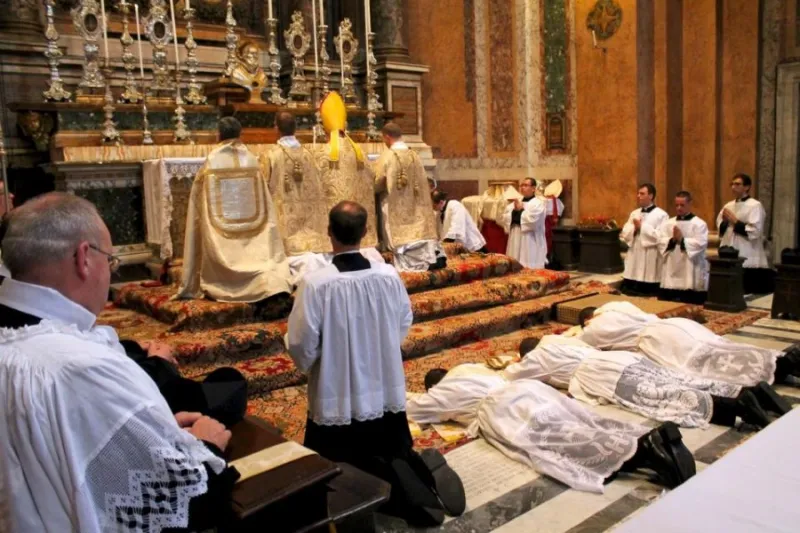
The prostration of the ordinandi during the Litany of the Saints at Santissima Trinità dei Pellegrini, the FSSP’s parish in Rome, June 22, 2013. / CNA

Denver Newsroom, Oct 8, 2021 / 16:50 pm (CNA).

Pope Francis’ restrictions on the Traditional Latin Mass appear to be unpopular among regularly practicing Catholics, but most American Catholics have not even heard of the changes, a survey reports.

“Catholics who attend Mass weekly are both more likely to be aware of the new restrictions and more inclined to oppose them than Catholics who attend less frequently,” the Pew Research Center, which conducted the survey, said Oct. 7

About 58% of Catholics who attended Mass weekly had heard about the restrictions. Regular Mass attendees were the most sceptical of the Pope’s move. Of these, 29% disapproved of the new restrictions, 11% approved, while 17% had no opinion. However, 42% had not heard of the changes.

On July 16, in Traditionis custodes, Pope Francis issued rules giving a bishop “exclusive competence” to authorize the Traditional Latin Mass in his diocese. Bishops with groups celebrating this form of the liturgy in their dioceses are to ensure that the groups do not deny the validity of the Second Vatican Council. The council, held in the 1960s, preceded major changes in the Roman Catholic liturgy. These changes were codified in 1970 with St. Paul VI’s Roman Missal, the missal used in most Catholic parishes in vernacular languages.

The restrictions on the traditional Latin Mass are a break from the practice established in a 2007 apostolic letter from Benedict XVI, Summorum Pontificum, which had acknowledged the rights of all priests to offer the Mass according to the Roman Missal of 1962, promulgated by St. John XXIII.

Overall, some two-thirds of Catholics told Pew that they had heard “nothing at all” about the changes from Pope Francis, 28% had heard “only a little,” while 7% had heard “a lot.” Overall, 9% approved, 12% disapproved, and 14% declined to answer.

Catholics who attend Mass monthly or yearly slightly favored the new restrictions rather than opposed them. Respondents’ opinions appeared not to differ significantly by age. Besides religious practice, Catholics’ favorability towards Traditional Latin Mass restrictions broke along partisan lines.

Among Catholics who are Republicans or lean Republican, only 4% approved the pope’s move, while 20% disapproved. Another 15% had no opinion, while 61% had not heard of the change. By contrast, 13% of Catholics who are Democrats or lean Democrat supported the move, 6% opposed it, 13% had no opinion and some 68% had not heard of it.

Pope Francis said he had issued the restrictions on the Traditional Latin Mass “in defense of the unity of the Body of Christ,” saying, “I am constrained to revoke the faculty granted by my predecessors.” He said permission to celebrate this form of the liturgy had led to “distorted use” that was contrary to the intentions that had allowed it.

In response to the papal action, some bishops have said that priests may continue to offer the Traditional Latin Mass in their dioceses, while others have banned it. Still others have said they need more time to consider their response.

Laity and clergy who support the traditional Latin Mass had their own reactions.

Joseph Shaw, the chairman of the Latin Mass Society of England and Wales, told CNA that many priests and lay Catholics have worked to combine an interest in the Traditional Latin Mass with “sincere loyalty and affection for the hierarchy and the Holy Father.” He said they have been “let down by this document.”

Cardinal Raymond Burke, the former prefect of the Apostolic Signatura, told the National Catholic Register that the text was “marked by a harshness” towards those who attend extraordinary form Masses.

New York Times columnist Ross Douthat was also critical, contrasting the action with Francis’ stress on accompanying people: “Accompaniment for some, slow strangulation of their rites for others.”

It is unclear how many Traditional Latin Mass parishes will be affected by the pope’s new limits and how the limits will affect diocesan clergy and laity who seek to celebrate the Traditional Latin Mass going forward. Catholic parishes that celebrate this Mass are a small minority. As of Oct. 8, the Latin Mass Directory website lists 662 venues in the U.S. By comparison, there are over 16,700 parishes in the U.S., according to the Center for Applied Research in the Apostolate.

Pew’s survey also asked respondents whether they had a favorable or unfavorable view of Pope Francis.

American Catholics’ favorability of the pope hovered at about 83%, with Catholics who attend Mass monthly or yearly slightly more favorable towards Pope Francis. Democratic or Democrat-leaning Catholics gave the pope 91% approval, compared to 71% of Republicans or Republican sympathizers. Overall, only 14% of Catholics had an unfavorable view of the pope.

However, 49% of Republican or Republican-leaning Catholics described the pope as too liberal. Only 30% of all Catholics, and 16% of Democratic or Democrat-leaning Catholics said the same.

Strong majorities of Catholic respondents tended to agree that Pope Francis should be described as compassionate, humble, and open-minded, and tended to reject describing him as out of touch or naïve. However, only 52% said he is in good physical health, and Republican or Republican-leaning respondents tended to be less positive in their descriptions of the pope.

American Catholics tend to be more favorable towards Pope Francis than Americans overall. Only 60% of all U.S. respondents had a favorable view of the pontiff, with 28% voicing an unfavorable view.

The Pew Research Center’s survey of 6,485 U.S. adults, 1,374 of whom are Catholic, was conducted Sept. 20-26 as part of Pew’s American Trends Panel. Pew said the survey is weighted to be representative of the U.S. adult population by sex, race, ethnicity, party affiliation, education, religious affiliation and other categories.

The survey claims a margin of error of plus or minus 1.9 percentage points for all Americans, plus or minus 4.3 percentage points for all Catholics, and plus or minus 8.4 percentage points for Catholics who attend Mass at least weekly.


[…]