No Picture
News Briefs

Pope Francis urges Sicily’s Catholic priests to be moral guides — but to drop the lace
June 9, 2022 Catholic News Agency 27
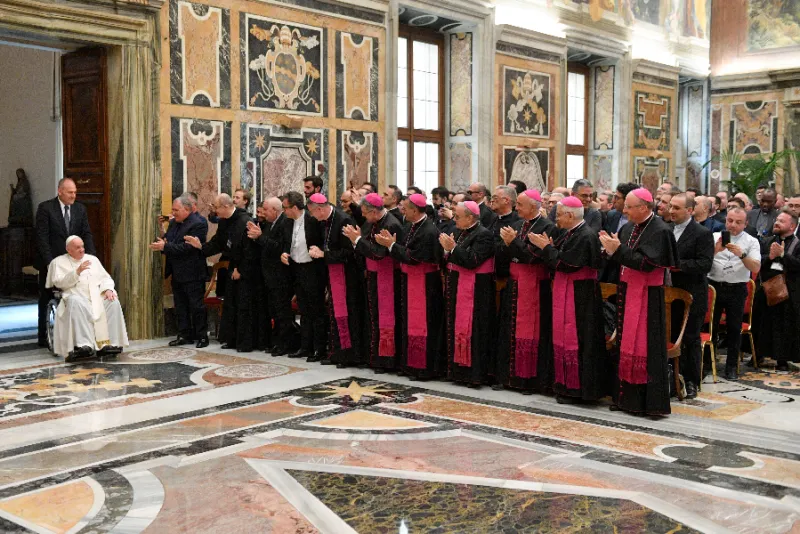
Pope Francis meets the bishops and priests of the churches of Sicily, Italy, in the Vatican’s Clementine Hall on June 9, 2022. / Vatican Media.

Vatican City, Jun 9, 2022 / 09:00 am (CNA).

Pope Francis told priests and bishops from the Italian island of Sicily on Thursday to be strong moral guides, and to update their art and vestments in conformity with Church reforms.

“In Sicily, people still look to priests as spiritual and moral guides, people who can also help to improve the civil and social life of the island, to support the family, and to be a reference for growing young people. High and demanding is the Sicilian people’s expectation of priests,” the pope said during a June 9 meeting at the Vatican.

In improvised comments during his speech, Francis also addressed a topic that he said “worries” him: the progress of the reforms of the Second Vatican Council, particularly relating to the liturgy.

“I don’t know, because I don’t go to Mass in Sicily and I don’t know how the Sicilian priests preach, whether they preach as was suggested in [the 2013 apostolic exhortation] Evangelii gaudium or whether they preach in such a way that people go out for a cigarette and then come back,” the pope said.

He suggested that after eight minutes of a homily, most people’s attention begins to wane.

Noting that he had seen photos from Masses in Sicily, Francis appeared also to comment on the use of lace on the vestments priests wear while celebrating Mass.

“Where are we 60 years after the Council,” he said. “Some updating even in liturgical art, in liturgical ‘fashion.’”

“Yes, sometimes bringing some of grandma’s lace is appropriate, sometimes. It’s to pay homage to grandma, right?” he continued. “It’s good to honor grandma, but it’s better to celebrate the mother, Holy Mother Church, and how Mother Church wants to be celebrated. So that insularity does not prevent the true liturgical reform that the Council sent out.”

Sicily, a southern Italian island region, has a population of 5 million people. The Catholic Church in the region is divided into 18 dioceses.

Around 300 of the island’s 2,078 priests, and 20 bishops, are in Rome for a pilgrimage and meeting with Pope Francis to mark the 30th anniversary of the Church in Sicily’s Regional Marian Priests’ Day.

Sicily, like the rest of Italy, is facing a decline in vocations to the priesthood, with 30% fewer seminarians compared with a decade ago.

In his speech in the Apostolic Palace, Pope Francis reflected on the changing times, including the decline in vocations.

The 85-year-old pope, who has made public appearances in a wheelchair since May 5 due to knee pain, said that priests and bishops needed to make courageous choices, with the discernment of the Holy Spirit, about how to share the Gospel of Christ today.

“We witness in Sicily behaviors and gestures marked by great virtues as well as cruel heinousness,” he said. “As well, alongside masterpieces of extraordinary artistic beauty we see scenes of mortifying neglect.”

He noted the declining social situation, including the fall in population due to a low birthrate and the exodus of young people looking for work.

“We need to understand how and in what direction Sicily is experiencing the change of age and what paths it could take, in order to proclaim, in the fractures and joints of this change, the Gospel of Christ,” he said.

“This task, while entrusted to the entire people of God, asks of us priests and bishops full, total, and exclusive service,” Pope Francis commented.

“Please, do not stand in the middle of the road,” he urged. “Faced with the awareness of our weaknesses, we know that the will of Christ places us in the heart of this challenge.”

“The key to everything is in his call,” he underlined, “on which we lean to take to the sea and cast our nets again. We do not even know ourselves, but if we return to the call, we cannot ignore that Face who has met us and drawn us behind Himself, even united us to himself, as our tradition teaches when it states that in the liturgy we even act ‘in persona Christi.’”

“This full unity, this identification, we cannot limit it to the celebration, but rather we must live it fully in every moment of life, mindful of the Apostle Paul’s words: ‘No longer do I live, but Christ lives in me,’” he said.

[…]

No Picture
News Briefs

Easter isn’t over yet. Here’s when it ends.

April 21, 2022 Catholic News Agency 1
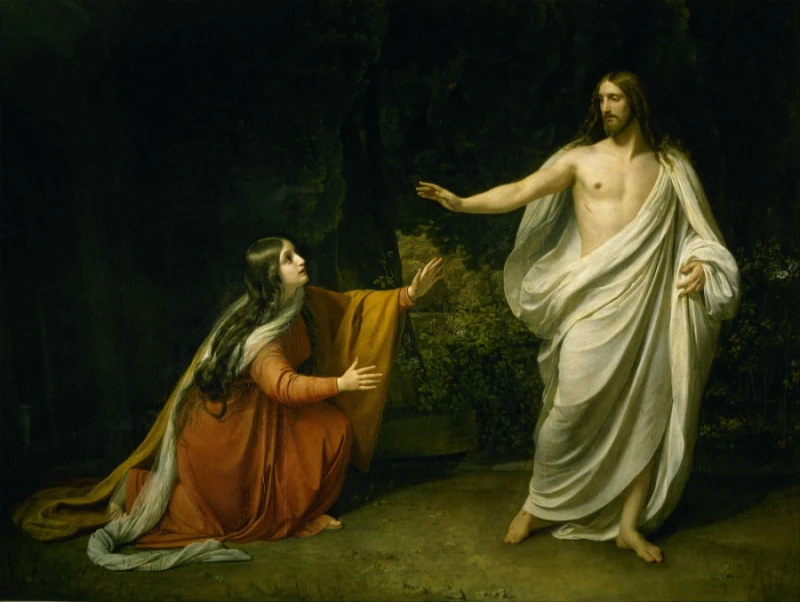
Alexander Andreyevich Ivanov’s Appearance of Christ to Mary Magdalene (1835)

Washington, D.C. Newsroom, Apr 21, 2022 / 17:00 pm (CNA).

Catholics recognize Easter — when Christ rises from the dead after sacrificing his life for all of humanity — as the first Sunday after the first full moon on or after the spring equinox. But, as it turns out, they can continue saying “Happy Easter” into June.

Easter lasts for a total of 50 days, from Easter Sunday until the feast of Pentecost, when the Holy Spirit comes upon the apostles, Mary, and the first followers of Christ. 

This year, 2022, Easter runs from April 17 until June 5. 

Easter explained

Catholics observe Easter in different stages. Easter Sunday is the greatest Sunday of the year, and it marks the start of the “Easter Octave,” or the eight days that stretch from the first to the second Sunday of Easter (also known as Divine Mercy Sunday). The Church celebrates each of these eight days as Solemnities of the Lord — a direct extension of Easter Sunday.

The entire Easter season lasts 50 days, and includes the Solemnity of the Ascension of Christ, which falls on the 40th day of Easter, which this year is May 26. It ends with Pentecost, which is derived from the Greek word “pentecoste,” meaning “50th.” 

“The fifty days from the Sunday of the Resurrection to Pentecost Sunday are celebrated in joy and exultation as one feast day, indeed as one ‘great Sunday,’” according to the United States Conference of Catholic Bishops. “These are the days above all others in which the Alleluia is sung.”

The USCCB calls Easter “the most important of all liturgical times.”

“It celebrates Jesus’s victory of sin and death and salvation for mankind,” the U.S. bishops say. “It is God’s greatest act of love to redeem mankind.”

In the traditional Roman rite

In the traditional form of the Roman rite, Easter is known properly as Paschaltide, which includes three parts: the season of Easter, Ascensiontide, and the Octave of Pentecost. It thus lasts one week longer than the Easter season in the calendar of the Missal of St. Paul VI.

The season of Easter begins with the Easter Vigil on Holy Saturday, and runs through the afternoon of the Vigil of the Ascension. 

Ascensiontide begins the evening before the Ascension, with First Vespers of the feast, and ends the afternoon of the Vigil of Pentecost – marking the first novena.

The Octave of Pentecost is an extension of the feast of Pentecost, beginning with the Vigil Mass of Pentecost and ending the afternoon of the following Saturday, which this year falls June 11.

[…]

No Picture
News Briefs

What is the FSSP?

February 21, 2022 Catholic News Agency 2
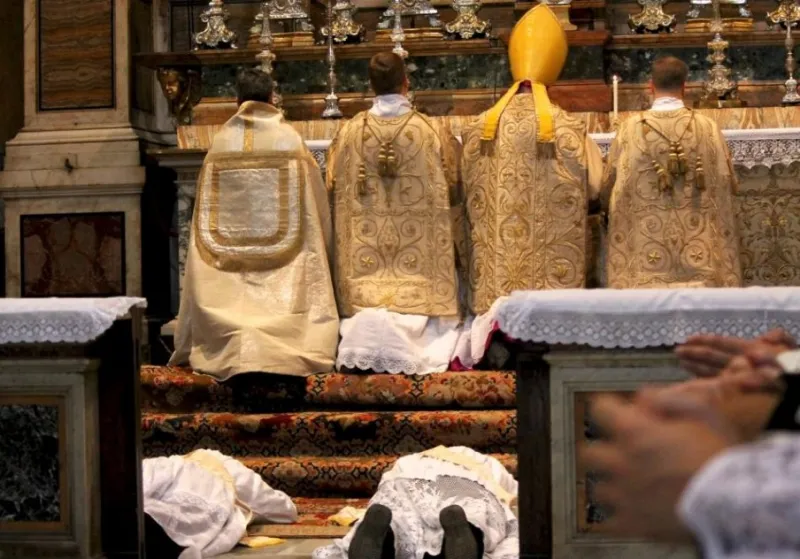
The prostration of the ordinands at the Fraternity of St. Peter’s Roman Parish, Santissima Trinità dei Pellegrini, June 27, 2013 / Alan Holdren/CNA

Denver Newsroom, Feb 21, 2022 / 10:02 am (CNA).

The Priestly Fraternity of St. Peter, a society of apostolic life which celebrates the Roman rite according to the liturgical books in force in 1962, published Monday a papal decree confirming their faculty to use those books.

The FSSP forms priests for the use of the traditonal form of the Roman Rite, and having formed them, deploys priests in parishes for the service of the Church.

The priestly fraternity was founded in July 1988 by 12 priests of the Society of St. Pius X, and several seminarians. The founders left the SSPX to establish the FSSP after the society’s leader, Archbishop Marcel Lefebvre, consecrated four bishops without the permission of St. John Paul II.

Its founding was under the auspices of St. John Paul II’s 1988 motu proprio Ecclesia Dei, which set up a pontifical commission to facilitate the “full ecclesial communion of priests, seminarians, religious communities or individuals” who had been linked to the SSPX and “who may wish to remain united to the Successor [of] Peter in the Catholic Church, while preserving their spiritual and liturgical traditions.”

The Pontifical Commission Ecclesia Dei was suppressed in 2019, and its competence transferred to the Congregation for the Doctrine of the Faith. Competence for the former Ecclesia Dei communities, such as the FSSP, was later transferred to the Congregation for Institutes of Consecrated Life and Societies of Apostolic Life by Pope Francis’ 2021 motu proprio Traditionis custodes.

There are currently about 340 priests and 180 seminarians in the FSSP. It has parishes and chapels in 147 dioceses in North America, Europe, Oceania, Nigeria, and Colombia.

The FSSP is governed by a superior general, who is aided by assistants, counselors, a general secretary, and a bursar. The current superior general is Fr. Andrzej Komorowski, who is the fourth man to hold that office. The fraternity is arranged into a North American province and three districts: French, German-speaking, and Oceania.

It has two houses of formation: the Seminary of St. Peter in Wigratzbad, Germany, and Our Lady of Guadalupe Seminary, outside Lincoln, Neb.

[…]