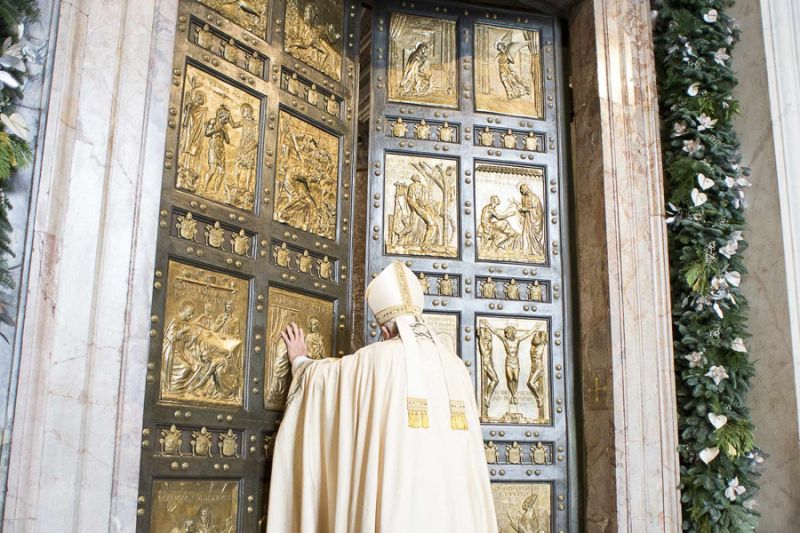
 Pope Francis opens the Holy Doors at St. Peter’s Basilica to begin the Year of Mercy, Dec. 8, 2015. / Credit: L’Osservatore Romano
Rome Newsroom, May 13, 2024 / 14:43 pm (CNA).
The Vatican issued a decree on Monday outlining the many ways that Catholics can obtain a plenary indulgence during the 2025 Jubilee Year.
The decree signed on May 13 by Cardinal Angelo De Donatis, the new head of the Apostolic Penitentiary, provides Catholics with the opportunity to gain indulgences by making pilgrimages, prayerful visits to specific churches, or by practicing works of mercy during the holy year.
A plenary indulgence is a grace granted by the Catholic Church through the merits of Jesus Christ to remove the temporal punishment due to sin.
The indulgence applies to sins already forgiven. A plenary indulgence cleanses the soul as if the person had just been baptized. Plenary indulgences obtained during the Jubilee Year can also be applied to souls in purgatory with the possibility of obtaining two plenary indulgences for the deceased in one day, according to the Apostolic Penitentiary.
To obtain an indulgence, the usual conditions of detachment from all sin, sacramental confession, holy Communion, and prayer for the intentions of the pope must be met. (See end of article for more on this.)
Here are some of the many ways one can obtain indulgences during the 2025 Jubilee Year:
Make a pilgrimage to Rome
Catholics who make a pilgrimage to Rome during the 2025 Jubilee Year can obtain a plenary indulgence by visiting at least one of the four major papal basilicas: St. Peter’s Basilica, the Archbasilica of St. John Lateran, St. Mary Major, or St. Paul Outside the Walls.
In addition, an indulgence can be obtained by spending time in prayer in several other churches in Rome:
-
Rome’s Basilica of the Holy Cross in Jerusalem
-
Basilica of St. Lawrence Outside the Walls
-
Basilica of St. Sebastian
-
Sanctuary of Divine Love (the “Divino Amore”)
-
Church of the Holy Spirit in Sassia
-
Church of St. Paul at Tre Fontane (the site of St. Paul’s martyrdom)
-
The Roman Catacombs
The Apostolic Penitentiary also grants a plenary indulgences specifically for making pilgrimage to churches in Rome connected to great female saints:
-
Basilica of Santa Maria Sopra Minerva (tomb of St. Catherine of Siena)
-
St. Brigid at Campo de’ Fiori (St. Brigid of Sweden)
-
Santa Maria della Vittoria (St. Teresa of Ávila)
-
Trinità dei Monti (St. Thérèse of Liseux)
-
Basilica of St. Cecilia in Trastevere (St. Cecilia)
-
Basilica of Sant’Augustino in Campo Marzio (St. Monica)
Perform works of mercy
The jubilee year is a time when Catholics are especially encouraged to practice the corporal and spiritual works of mercy. The Apostolic Penitentiary lists visiting prisoners, spending time with lonely elderly people, aiding the sick or disabled, and helping those who are in need as instances to obtain an indulgence. Practicing the works of mercy, it says, is “in a sense making a pilgrimage to Christ present in them.”
Indulgences for works of mercy can be received multiple times throughout the jubilee year, even daily, according to the decree.
If the indulgence is being applied to the deceased, two plenary indulgences can be obtained on the same day.
The decree says: “Despite the rule that only one plenary indulgence can be obtained per day, the faithful who have carried out an act of charity on behalf of the souls in purgatory, if they receive holy Communion a second time that day, can obtain the plenary indulgence twice on the same day, applicable only to the deceased.”
Fast from social media, defend life, volunteer
Acts of penance can also obtain a plenary indulgence. The Vatican lists several options, including:
-
Abstaining for at least one day a week from “futile distractions,” such as social media or television
-
Fasting
-
Donating “a proportionate sum of money to the poor”
-
Supporting religious or social works, especially in the defense of life in all phases
-
Offering support to migrants, the elderly, the poor, young people in difficulty, and abandoned children
-
Volunteering in service to your community
“The jubilee plenary indulgence can also be obtained through initiatives that put into practice, in a concrete and generous way, the spirit of penance which is, in a sense, the soul of the jubilee,” the decree states.
Visit your local cathedral
Catholics can also gain a plenary indulgence by making a pious pilgrimage to their cathedral or to another church or shrine selected by the local bishop.
The Apostolic Penitentiary asks bishops to “take into account the needs of the faithful as well as the opportunity to reinforce the concept of pilgrimage with all its symbolic significance, so as to manifest the great need for conversion and reconciliation.”
Vatican II formation
The Vatican decree also says that Catholics can get a jubilee indulgence “if with a devout spirit, they participate in popular missions, spiritual exercises, or formation activities on the documents of the Second Vatican Council and the Catechism of the Catholic Church, held in a church or other suitable place, according to the mind of the Holy Father.”
Pray in these basilicas
In addition to the churches already listed, other sacred places around the world have also been designated as places of pilgrimage where one can obtain a plenary indulgence:
In Italy:
-
Basilica of St. Francis of Assisi
-
Basilica of Our Lady of the Angels in Assisi
-
Basilica of Our Lady of Loreto
-
Basilica of Our Lady of Pompeii
-
Basilica in St. Anthony in Padua
In the Holy Land:
-
Basilica of the Holy Sepulcher in Jerusalem
-
Basilica of the Nativity in Bethlehem
-
Basilica of the Annunciation in Nazareth
The decree further indicates that “any minor basilica, cathedral church, co-cathedral church, Marian sanctuary, any distinguished collegiate church or sanctuary designated by the diocesan bishop or Eparchy for the benefit of the faithful” can be designated. Bishops’ conferences can also indicate national or international sanctuaries as sacred sites for a jubilee indulgence.
Conditions in all cases
In order to obtain any of the plenary indulgences listed above, the following conditions must be fulfilled:
1. Detachment from all sin, even venial.
2. Sacramental confession, holy Communion, and prayer for the intentions of the pope. These three conditions can be fulfilled a few days before or after performing the works to gain the indulgence, but it is appropriate that Communion and the prayer take place on the same day that the work is completed.
A single sacramental confession is sufficient for several plenary indulgences, but frequent sacramental confession is encouraged in order to obtain the grace of deeper conversion and purity of heart.
For each plenary indulgence that is sought, however, a separate holy Communion and a separate prayer for the intentions of the Holy Father are required.
The prayer for the intentions of the Holy Father is left up to the choice of the individual, but an Our Father and Hail Mary are suggested.
[…]



