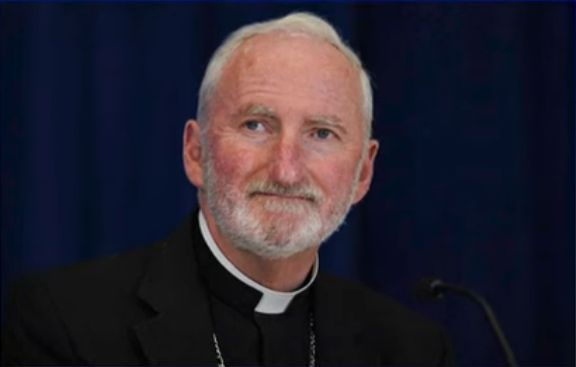
 Bishop David O’Connell. / Credit: KTLA screenshot
St. Louis, Mo., Feb 21, 2023 / 10:40 am (CNA).
David O’Connell, an auxiliary bishop of Los Angeles who was shot and killed over the weekend, is being mourned in his home country of Ireland.
O’Connell was born in 1953 in County Cork, on Ireland’s southern coast. He was baptized at Sacred Heart Church in the village of Glounthaune, where he later served as an altar boy. Sacred Heart was also where he celebrated his first Mass following his ordination in 1979, RTÉ reported.
Father Tom Hayes, a priest of the local Diocese of Cork and Ross, said his entire parish — about an hour’s drive from O’Connell’s — is talking about the tragic killing. O’Connell maintained close ties to Cork, returning at least once a year, most recently last summer, Hayes said.
“[His murder] is a front-page story here in Ireland since it happened, and it’s on the television and radio news, and so it’s getting quite a lot of news attention,” Hayes told CNA.
“So almost everybody has heard about it. And, yeah, people are shocked. I met one young woman today, and her issue was that she just couldn’t understand how one human being could take up a gun in close proximity to somebody else and kill them. But that’s kind of a reflection of maybe the difference in cultures as well, because in Ireland, we don’t have gun violence for the most part.”
Appointed a bishop in 2015, O’Connell ministered to immigrants, the poor, and victims of gang violence for 45 years in the South Los Angeles area. O’Connell was 69 when a deacon found him dead in his home Saturday in Hacienda Heights with at least one gunshot wound to the chest. A suspect has been arrested and on Monday was identified as 65-year-old Carlos Medina, the husband of O’Connell’s housekeeper. The investigation is ongoing.
Father Damian O’Mahony, co-pastor of O’Connell’s home parish of Sacred Heart, told CNA that “Bishop Dave never forgot his native home here in Cork,” describing him as “a proud Corkman, and he always let people know.”
“Naturally, those parishioners who knew Bishop Dave and those who know his family here in the parish were very shocked and upset and there was an air of disbelief,” O’Mahony told CNA.
“A Memorial Mass will be held in the Sacred Heart Glounthaune at a later date where those in his native parish will gather to pray for, remember, and celebrate the life of a good man who was taken so tragically and so cruelly from this life. It will also be an opportunity to show our continued support for his family as they come to terms with the loss of someone much loved and who will be missed dearly.”
At the regularly scheduled Mass on Feb. 20, O’Mahony noted that O’Connell has several surviving family members in County Cork, including a brother.
“We also pray for and remember his family at this time in the parish … his many, many friends in this time of heartbreak, shock, tears, sadness, and sorrow and all here in the parish who would have known him as well,” O’Mahony said, as reported by RTÉ.
The local bishop of O’Connell’s home diocese also spoke out in remembrance of the murdered bishop, urging prayers for him and for his family.
“Since his ordination in 1979 Bishop David has served as a priest in Los Angeles but has always maintained his connection with family and friends here in Cork, where has been a regular visitor. We pray that the Lord will console Bishop David’s many friends in Cork and throughout Ireland,” Bishop Fintan Gavin of Cork and Ross said in a Feb. 19 statement.
“We will pray for Bishop David at Mass throughout the Diocese of Cork and Ross in the coming days, asking the Lord to comfort his family, his colleagues, and all the bereaved. Bishop David worked tirelessly for peace and harmony in communities; may he now rest in the peace of the Lord.”
O’Connell was ordained during an era when many of the young men from Ireland becoming priests were sent abroad as missionaries, Hayes noted. For his part, O’Connell decided to come to the United States due in part to meeting fellow Irishman Cardinal Timothy Manning, who was then the archbishop of Los Angeles.
“In that providential conversation, the cardinal convinced him that Los Angeles was where he should go. So then he went and trained for the priesthood here in Ireland. The college that he trained at in Dublin is called All Hallows College, and the vast majority of seminarians who studied in that college studied to serve in dioceses in other countries,” Hayes said.
Many priests of a similar age to O’Connell came from Ireland to the United States and continue to minister throughout the country, he said. Beyond his visits back to Ireland, O’Connell was a very faithful supporter of his home diocese’s missions to Peru and Ecuador. Hayes said O’Connell would always warmly welcome Irish missionary priests to his parishes in the U.S., allowing them to preach and fundraise for their mission.
Hayes said his parishioners remain shocked that a person who made such a positive effort in his community could be the victim of such a crime.
“A lot of the people as well, and they’re also just shocked at the loss of what we see as somebody who was contributing very significantly to the life of his diocese and to the people that he was ministering to. And to have his life cut short is just such a shame,” Hayes said.
He said that if anything at all good can come from O’Connell’s murder, it would be a wider recognition of the peacemaking work he did for so many years in Los Angeles.
“It may inspire others to pick up some of the issues that he was advocating for — justice for the people on the margins of society — and to create a world of peace and fairness where people don’t have to be violent to one another. I think if that message gets amplified both in Ireland and in L.A., then that in itself would be a blessing.”
[…]