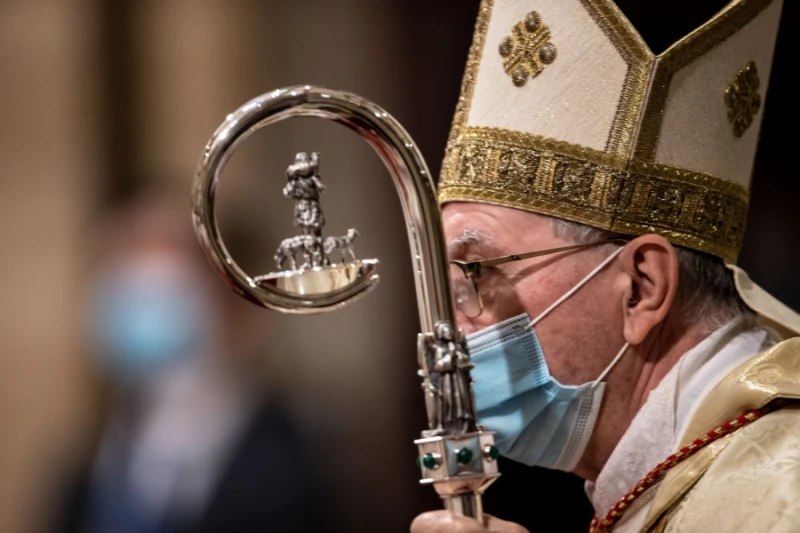
 Cardinal Pietro Parolin attends an ordination at the Basilica of Sant’Eugenio in Rome, Sept. 5, 2020. / Daniel Ibáñez/CNA.
Verona, Italy, Nov 30, 2021 / 04:00 am (CNA).
Commenting on protests against Italy’s vaccine rules, the Vatican’s Secretary of State said that the Church’s message is clear that vaccination is an “act of love.”
In an interview with Vatican News published on Nov. 28, Cardinal Pietro Parolin was asked about “No Vax” and “No Pass” demonstrations in cities across Italy.
“No Vax” refers to demonstrators who object to COVID-19 vaccines, while “No Pass” protesters focus on the Italian government’s decision in October to require all workers to possess a Green Pass proving that the holder has been vaccinated, tested negative every 48 hours, or recently recovered from COVID-19.
Parolin was asked specifically to comment on the actions of a priest, Father Floriano Pellegrini, who blessed the crowd of more than 1,000 demonstrators before a “No Vax” march in Verona on Nov. 27.
“It seems to me that the message is clear and well known, there is no need to repeat it, it is what the Holy Father has always said,” said Parolin, who was attending an event promoting the Church’s social doctrine in the northern Italian city where the march occurred.
“I refer to his statements, his admonitions, to experience the reality and the issue of the vaccine with a sense of responsibility.”
He went on: “I believe this is what it is: a responsible freedom. Because many call for freedom, but freedom without responsibility is empty, indeed it becomes slavery.”
“Therefore, responsibility towards oneself, because we see how the No Vax [people] are affected by the disease, and responsibility, above all, towards others, which then the pope summed up with this beautiful expression that I like so much but that, in the end, goes in this sense, of an act of love.”
Italy was one of the countries worst hit by the first wave of the coronavirus pandemic. The nation of almost 60 million people has recorded more than 5 million COVID cases and 133,000 related deaths as of Nov. 30, according to the John Hopkins Coronavirus Resource Center. Almost 73% of the population is vaccinated.
The Italian authorities have announced plans to introduce a “super Green Pass,” entering into force on Dec. 6. The move will bar unvaccinated people from dining indoors at restaurants, going to the gym, visiting museums and other tourist sites, or attending weddings or other public ceremonies until at least Jan. 15.
The new rules will remove the possibility for people to offer proof of a negative test within the past 48 hours to enter the venues, meaning that only those who have been vaccinated or recently recovered from COVID-19 will be allowed access.
Father Pellegrini, a priest from Coi, a hamlet in the northern Italian province of Belluno, has gained media attention for his opposition to the Green Pass.
Pellegrini has been supporting a dock workers’ strike in the port city of Trieste in protest against the government’s COVID rules.
The priest of the Diocese of Belluno-Feltre wrote an open letter to the Italian bishops, questioning their willingness to protect religious freedom from state power.
“For a year and a half now, the vast majority of the Italian Catholic faithful have been disconcerted and scandalized by your incomprehensible silence, by your lack of ability to indicate the path of faith,” Pellegrini wrote in September.
“You seem, for all intents and purposes, salt that has lost its flavor and, as Christ says, ‘is good only to be thrown away and trampled on by men.’ You have yielded to almost everything that the Italian government has asked of you and continues to suggest and you have transformed the Church from a divine reality into a society manipulated by the government.”
The priest, who is a champion to the Trieste dockers, has criticized Pope Francis for promoting vaccination and regards Archbishop Carlo Maria Viganò, the controversial former apostolic nuncio to the United States who is also an outspoken critic of vaccine mandates, as a “hero.”
Italian media reported that the country’s Catholic bishops took aim at No Vax protesters in their message for Italy’s Day for Life, issued on Nov. 17.
They praised Italians’ response to the pandemic, but said that “there were also manifestations of selfishness, indifference, and irresponsibility, often characterized by a misunderstood affirmation of freedom and a distorted conception of rights.”
“Very often, these were understandably frightened and confused people who were essentially also victims of the pandemic,” they wrote.
“In other cases, however, these behaviors and speeches expressed a vision of the human person and social relations that was far removed from the Gospel and the spirit of the [Italian] constitution.”
The Vatican’s doctrinal office said in December 2020 that it is “morally acceptable” to receive COVID-19 vaccines produced using cell lines from aborted fetuses when no alternative is available.
The Congregation for the Doctrine of the Faith also said that vaccination “must be voluntary,” while noting that those who refuse to receive vaccines produced with cell lines from aborted fetuses for reasons of conscience “must do their utmost to avoid … becoming vehicles for the transmission of the infectious agent.”
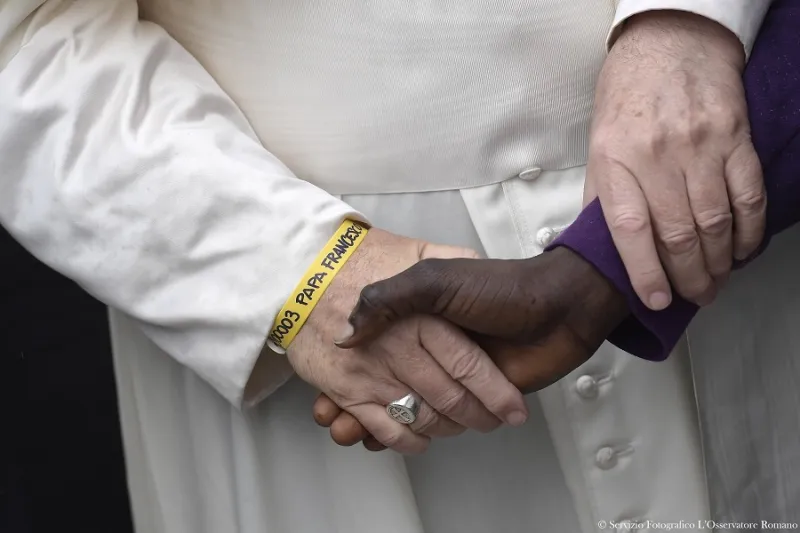
Pope Francis called vaccinations an “act of love” in a public service announcement issued in collaboration with the Ad Council in August.
He said: “Getting the vaccines that are authorized by the respective authorities is an act of love. I pray to God that each one of us can make his or her own small gesture of love, no matter how small, love is always grand.”
The pope was asked about the sharp differences among Christians over vaccines during an in-flight press conference as he returned from Slovakia to Rome in September.
He said that he did not know how to explain the opposition to COVID-19 vaccines.
“Some say it comes from the diversity of where the vaccines come from, which are not sufficiently tested and they are afraid. We must clarify and speak with serenity about this,” he said.
“In the Vatican, everyone is vaccinated except a small group which they are studying how to help.”
The Pontifical Swiss Guard, charged with protecting the pope, has required all 135 of its guards to get a COVID-19 vaccine. It emerged in October that three Swiss Guards had quit after refusing to comply with the requirement.
[…]