Christians assess damage on Iraq’s Nineveh plain, ravaged by ISIS

January 24, 2017 CNA Daily News 0

Erbil, Iraq, Jan 24, 2017 / 12:03 am (Aid to the Church in Need).- “I don’t understand how people can harm each other so much,” sighs security guard Louis Petrus. Petrus recently returned to his hometown for the first time: the Christian city of Qaraqosh, near Mosul, which he had to flee in August 2014, when Islamic State captured the largest Christian city on the Nineveh plain.

He told international Catholic charity Aid to the Church in Need: “Look at my house: it is damaged, most of my furniture has been stolen and my household effects are broken. Other inhabitants of Qaraqosh had prepared me for what I would find in the city. I had heard stories and seen pictures of the destruction caused by the jihadists. Now that I am seeing the city with my own eyes, I do not know what to feel. The terrorists have destroyed a lot of my possessions.”

Father Sharbil Eeso, a 72-year-old Syrian Catholic priest, also returned to the town, also known as Bakhdida. He found the seminary in shambles. In search of hidden treasures, the occupiers brought down ceilings and destroyed statues.

“We are not allowed to clear up the mess yet,” the priest said, adding that “first the damage needs to be assessed carefully and documented thoroughly, and that can only start when the city is safe. Last week, a jihadist emerged from the tunnel system which ISIS has built underneath the city. The army immediately shot and killed him: it was a 13-year-old boy.”

The jihadists made full use of the churches in Qaraqosh, even writing battle instructions on church walls. St. George’s Syrian Catholic Church was turned into a bomb factory; hundreds of bombs and grenades, in all shapes and sizes, are still lying there. There are also supplies of deadly chemicals, ingredients to make powerful explosives.

Like Father Eeso, Louis Petrus firmly intends to return to Qaraqosh. He said: “I don’t want to leave Iraq, unless all the inhabitants stay away and leave. But if two or three families return to Qaraqosh, I will too. This is my country. As soon as it is safe in the city and we receive permission to live here again, I want to rebuild my life in Qaraqosh. This is my place, I shall remain here until I die.”

“We really want to return to Qaraqosh, with our children,” said the mayor of the city, Nisan Karromi. But he added, “it will be a long time before all damages will be repaired.”

“We not only have to reconstruct and rebuild this city, but we also have to compensate the people for the damages they have suffered,” he said. “Now that the Iraqi government is in crisis, the international community will have to help make Iraq habitable again.”

Another concern Christians have is that both the Iraqi government and the Kurds – whose forces chased out the Islamic State – have designs on their land.

Manal Matti recently visited the blackened church of the Immaculate Conception. She is surprised by the mannequins that are spread out across the church grounds, shot through with bullets.

“The jihadists used the church as a shooting range, and the mannequins as targets,” she said, horrified. The woman used to run a beauty salon, just steps away from the church. She pondered: “I do not know when I will ever be able to see the inhabitants of Qaraqosh coming again to my beauty salon.”


Jaco Klamer writes for Aid to the Church in Need, an international Catholic charity under the guidance of the Holy See, providing assistance to the suffering and persecuted Church in more than 140 countries. www.churchinneed.org (USA); www.acnuk.org (UK); www.aidtochurch.org (AUS); www.acnireland.org (IRL); www.acn-aed-ca.org (CAN) www.acnmalta.org (Malta)
[…]

Mafia crime is ‘radically opposed’ to the Gospel, Pope says

January 23, 2017 CNA Daily News 0

Vatican City, Jan 23, 2017 / 07:41 am (CNA/EWTN News).- Frequently an outspoken critic against organized crime, Pope Francis again came out with harsh words for those involved in the mafia and other criminal activities, which he said are “stained with blood” and go directly against the faith.

“The phenomena of the mafia, which is an expression of a culture of death, is (something) to oppose and to fight,” the Pope said Jan. 23.

Mafia activity “is radically opposed to the faith and to the Gospel, which are important for life,” he said, adding that true followers of Christ “have thoughts of peace, fraternity, justice, welcome and forgiveness.”

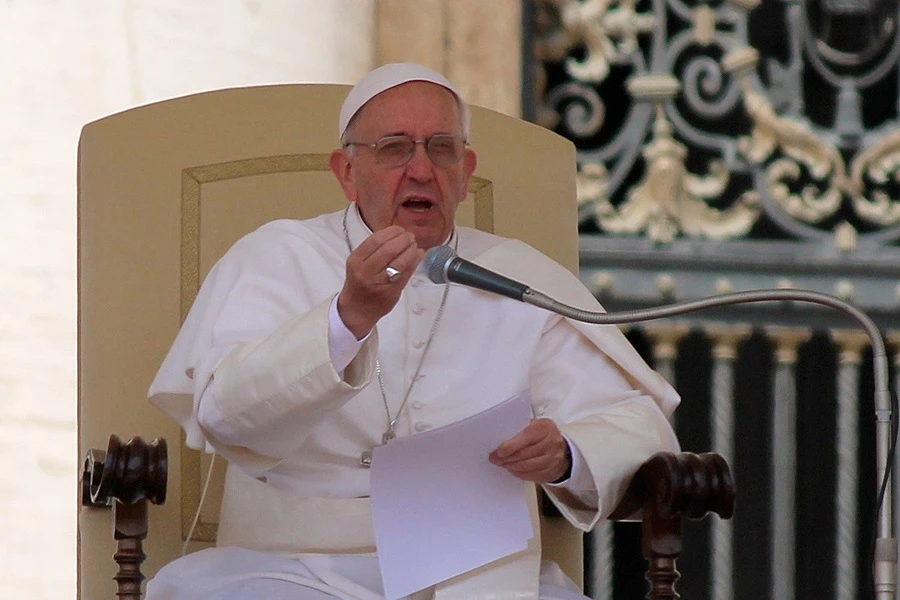
Pope Francis spoke to members of the National Anti-Mafia and Anti-terrorism Bureau during an audience with the organization in the Vatican’s Apostolic Palace.

He initially made headlines regarding the mafia in June 2014 during his visit to the southern Diocese of Cassano all’Jonio, during which he slammed mafia members for being “adorers of evil” and declaring that because they follow a path contrary to the Gospel, they are “excommunicated.”

While the Pope’s words didn’t necessarily imply an official canonical excommunication, they shocked many, especially given the fact that many “mafiosi” claim to be devout Christians and even go to Mass, while at the same time carrying out their crimes.

In his speech to the Anti-Mafia Bureau, Francis pointed to the three main criminal organizations that operate in Italy, mostly in the south: the Mafia, who operate mainly Sicily; the Camorra, who run criminal activities largely in Italy’s Campagna region, particularly in Naples; and the ‘Ndrangheta, who mostly work in Calabria.

In addition to these three main criminal circles in Italy, another more specific organization, the Sacra Corona Unita, operates largely in Puglia, also in the southern half of the country.

These criminal groups are “increasingly assuming a cosmopolitan and devastating aspect” by exploiting economic, social and political weaknesses, which Francis said are “fertile ground to achieve their deplorable projects.”

Now more than ever, increased effort is needed in order to combat the activity and power of these groups, “which are responsible for violence and oppression stained by human blood.”

Society needs to be healed from corruption and exploitation, he said, naming human trafficking and the drug and arms trade as examples. Francis pointed specifically to the impact these have on children, who are often “reduced to slavery.”

Calling organized crime a “social wound,” the Pope said these groups also constitute global challenges that the international community must face “with determination,” and urged greater collaboration among States.

He also turned to the plight of migrants, many of whom fall victim to traffickers, and exhorted leaders “to dedicate every effort especially in combating the trafficking of persons and of the smuggling of migrants.”

“These are very serious crimes that affect the weakest of the weak,” he said, and called for an increase in initiatives aimed at both protecting victims of trafficking and providing assistance to incoming migrants.

“Those who leave their own countries due to war, violence and the persecutions have a right to find adequate welcome and appropriate protection in the countries that call themselves civil,” he said.

All sectors of society, particularly educational programs, families, schools, Christian communities and sporting and cultural activities, ought to promote an honest and fraternal lifestyle, he said, adding that these will “little by little overcome evil and pave the way for good.”

Pope Francis closed his speech pointing to the work many parishes already do in these areas, and prayed that the Lord would give them the strength to continue going forward in their fight against mafia, violence and terrorism.

He assured of his prayers and support, asking that “the just and merciful Lord touch the hearts of the men and women of the various mafias in order to stop, to cease doing evil, to convert and to change their lives.”

“The money of dirty affairs and mafia crimes is blood money and produces an unequal power,” he said, noting that “we all know that the devil ‘enters the pockets:’ the first corruption is here.”

[…]

On Trump presidency, Pope says we must ‘wait and see’

January 22, 2017 CNA Daily News 0

Vatican City, Jan 22, 2017 / 08:05 am (CNA/EWTN News).- In a new interview published Saturday, Pope Francis said he will wait to see what U.S. President Donald J. Trump does before making any judgments, emphasizing God’s own patience with him and his faults.

In an interview with Spanish newspaper El Pais Jan. 20, the same day as the U.S. presidential inauguration, Pope Francis said he doesn’t like to get ahead of himself “or judge people prematurely.”

“We will see how he acts, what he does, and then I will have an opinion. But being afraid or rejoicing beforehand because of something that might happen is, in my view, quite unwise. It would be like prophets predicting calamities or windfalls that will not be either,” he said.

“We will see. We will see what he does and will judge.” The world is so upside down, that it needs a fixed point, grounded firmly in reality: “what did you do, what did you decide, how do you move. That is what I prefer to wait and see.”

Asked if he wasn’t worried about things he had heard about Trump, Francis responded again that he is waiting. “God waited so long for me, with all my sins…” he said.

In the wide-ranging interview, the Pope was questioned about issues ranging from immigration to economics to Vatican diplomacy to the Gospel, among other things.

On the issue of immigration Francis was clear about his position, that “everyone does what they can or what they want. It is a very hard judgment.”

The most important thing is that those in dire need are helped and rescued, he said. After that we should welcome migrants and refugees and help them to integrate into their new country.

In the context of 1930s Germany, where the people were “in crisis” and looking for a charismatic leader, someone who could give them a clear identity, “we all know what happened,” he said. But what is important is that people did not talk to one another, there was no conversation.

“Yes,” borders can be controlled, he said. Countries have a right to control “who comes and who goes, and those countries at risk – from terrorism or such things – have even more the right to control them more, but no country has the right to deprive its citizens of the possibility to talk with their neighbors.”

Asked about Vatican diplomacy and its image, including the public thanks of Barack Obama and Raúl Castro on the one hand, and the parties that criticize the Vatican’s interference, on the other, the Pope said that he asks the Lord “that he give me the grace of not taking any measure for the sake of image.”

“Honesty, service, those are the criteria.” Mistakes are sometimes made, your image suffers, “but it doesn’t matter if there was goodwill. History will judge afterwards,” he said.

For him, he said, the clear, guiding principle for both pastoral action and Vatican diplomacy is that they are “mediators, rather than intermediaries.”

“We build bridges, not walls. What is the difference between a mediator and an intermediary?” he said. An intermediary is someone who enters a business agreement, renders a service and then is compensated, “and rightly so, because it is his job.”

The mediator, on the other hand, “is the one who wants to serve both parties and wants both parties to win even if he loses,” the Pope said. “Vatican diplomacy must be a mediator, not an intermediary. If, throughout history, it has sometimes maneuvered or managed a meeting that filled its pockets, that was a very serious sin.”

“The mediator builds bridges that are not for him, but rather for others to cross.”

Asked if his changes to the Vatican, sometimes criticized both by the more traditional sectors of the church and by the more progressive, are a “revolution of normalcy,” or already contained in the “Gospel’s essence,” as he has said, Pope Francis responded simply that he is a “sinner and not always successful.”

“I try – I don’t know if I succeed – to do what the Gospel says. That is what I try,” he said.

“The true heroes of the Church are the saints. That is, those men and women that devoted their lives to make the Gospel a reality,” he said. “The saints are the specific examples of the Gospel in daily life!”

With the emphasis on going out to the peripheries, how would Francis respond to those Catholics that feel that he ignores the people who have remained faithful to the Church and her teachings, was also questioned.

“I know that those who feel comfortable within a Church structure that doesn’t ask too much of them or who have attitudes that protect them from too much contact are going to feel uneasy with any change, with any proposal coming from the Gospel,” he said.

“The novelty of the Gospel however astonishes because it is essentially scandalous,” he continued. “Saint Paul tells us about the scandal of the cross, the scandal of the Son of God become man. But the evangelical essence is scandalous by those days’ criteria. By any worldly criteria, it is an outrageous essence.”

Once questioned by a German journalist about why he never talks about the middle class, “those who pay their taxes…” Francis said he thinks that maybe he is always talking about the middle class, just without calling it that.

“I use a term coined by the French novelist Malègue, who talks about ‘the middle class of sanctity,’” he said.

“I am always talking about parents, grandparents, nurses, the people who live to serve others, who raise their kids, who work… Those people are tremendously saintly!” he said.

“And they are also the ones who carry the Church onward: the ones that earn their living with dignity, that raise their children, that bury their dead, that care for their elders, instead of putting them into an old people’s home: that is our saintly middle class.”

From an economic point of view, the middle class is vanishing more and more, he said. But “the father, the mother, who celebrate their family, with their sins and their virtues, the grandfather, the grandmother,” he continued. “The family. At the center. That is ‘the middle class of sanctity.’”

A final comment reflected that Francis seems to be a very happy Pope. “The Lord is good and hasn’t taken away my good humor,” he said.

[…]