Justice Alito warns seminarians religious liberty is in danger
May 22, 2017 CNA Daily News 0

Philadelphia, Pa., May 22, 2017 / 03:04 am (CNA/EWTN News).- In his address to graduating seminarians on Wednesday, United States Supreme Court Justice Samuel A. Alito, Jr. emphasized the importance of religious freedom and the dangers it faces today.

Religious freedom means that “no one is forced to act in violation of his own beliefs,” Alito said, according to Catholic Philly. “Most of my life Americans were instilled in this,” he added, and urged the audience “keep the flame burning.”

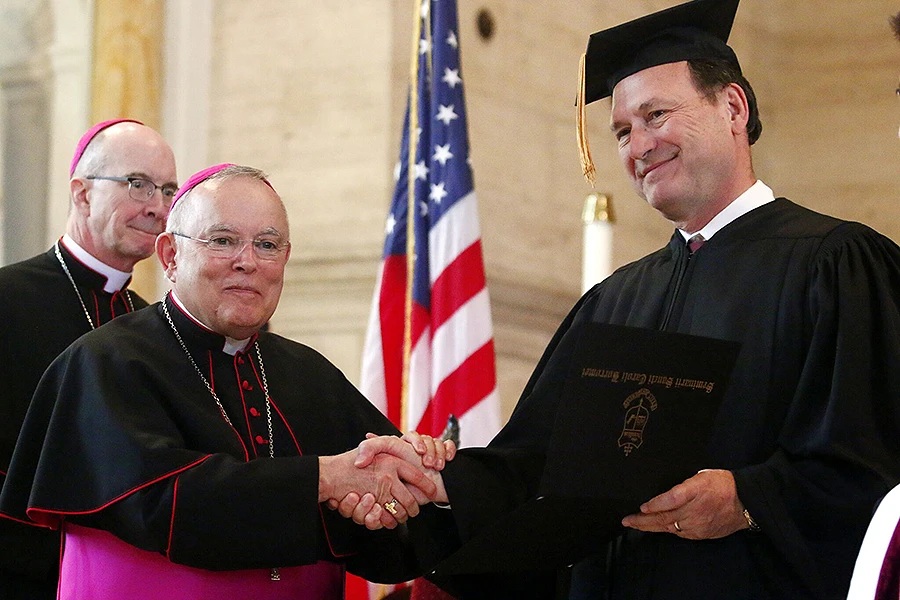
Alito gave the keynote address at the concursus ceremony for the graduating class of St. Charles Borromeo Seminary in Philadelphia May 17, where he also received the degree of Doctor of Humane Letters, Honorus Causa, from Archbishop Charles Chaput of Philadelphia.

He was awarded the degree “in testimony to and recognition of his many outstanding contributions to society … especially in protecting the sanctity and dignity of human life, the full responsibilities of the human person and promoting true justice and lasting peace,” Archbishop Chaput said.

Alito, 67, is a practicing Catholic from an Italian family in Trenton, New Jersey, and was nominated to the Supreme Court by President George W. Bush, where he has served since January 2006.

He wrote the majority opinion for the 2014 Burwell v. Hobby Lobby Stores, Inc. case, in which the court allowed for closely-held, for-profit corporations to be exempt from a regulation its owners religiously object to if there is a less restrictive means of furthering the law’s interest, according to the provisions of the Religious Freedom Restoration Act.

He also wrote a dissent from the majority opinion in the 2015 Obergefell v. Hodges case, in which the Supreme Court held that the Constitution guarantees the right to same-sex marriage.

Prior to his address, in an interview with the St. Charles Borromeo blog Seminarian Casual, Alito again spoke about religious freedom as well as the effect his faith and family has had on his career.

Religious freedom is “one of the most fundamental rights” in the United States, Alito said, and the founding fathers “saw a vital connection between religion and the character needed for republican self-government.”

“What the founders understood more than 200 years ago is just as true today,” he said, though “(t)here is cause for concern at the present time.”

In his Obergefell dissent, Alito said he “anticipated that… ‘those who cling to old beliefs will be able to whisper their thoughts in the recesses of their homes, but if they repeat those views in public, they will risk being labeled as bigots and treated as such by governments, employers, and schools.’”

There is already evidence of this happening, he said, such as in a case the Supreme Court declined to hear, in which a pharmacy was being forced to sell emergency contraceptives despite their religious beliefs against them. He said he anticipates even more struggles for religious freedom in the years to come.

“This is not an easy time to be a priest, but priests are desperately needed,” he said.

In particular, priests of the 21st century are needed to “express what is essential about the faith in a way that registers with a culture that speaks a different language. It is a daunting task, but that is essentially what was done by brave priests in the past who took the faith to every corner of the globe,” he said.

“One priest who especially stands out in my memory is the pastor of the church in New Jersey that we attended before moving to Washington. He had a marvelous way of speaking to the parishioners in a way that was seemingly simple but attractive and ultimately profound.”

When asked how his Catholic faith has shaped him, Alito said his faith provides him meaning and purpose.

“The title of a book by Tolstoy has been translated as What Then Should We Do? My faith gives me an answer. It would be terrible to think that life has no meaning, that we are going nowhere, and that what we do until we die is a matter of indifference. That is what tortures so many today.”

He added that the strong family values with which he was raised influenced the way he raised his own family, and that he is grateful for a career that allows him some flexibility to be able to spend time with his family.

“Nothing on this Earth is more important to me than my family,” he said.

“I have been fortunate to have jobs that allowed me to control my work schedule to a very great degree,” he said. “Very few people today have this luxury, and it is hard for busy people to balance work and family life. Our society needs to do a better job of making this possible.”
[…]

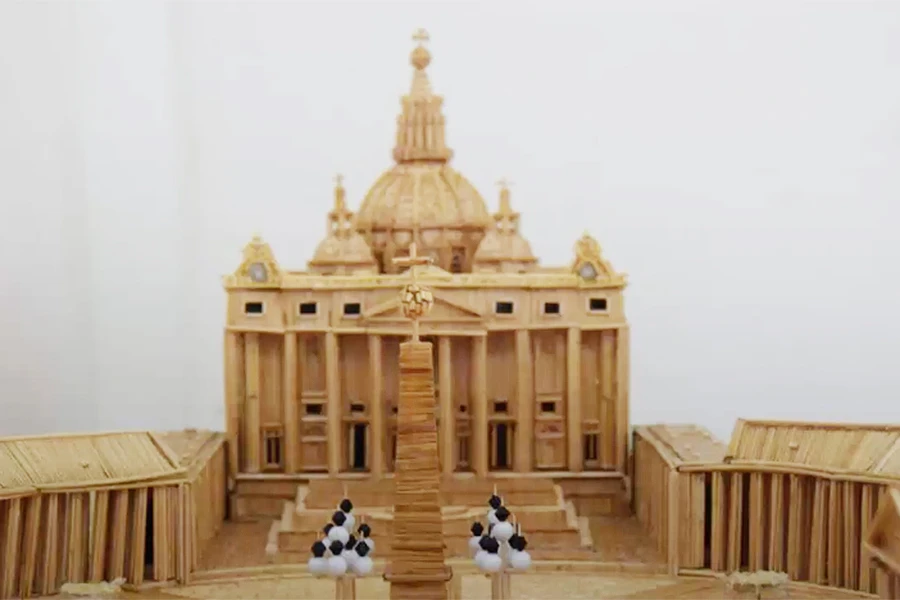
Man builds replica of St. Peter’s Square with 36,000 toothpicks

May 21, 2017 CNA Daily News 0

Vatican City, May 21, 2017 / 04:23 pm (CNA/EWTN News).- The Eiffel Tower, the Roman Coliseum, the Statue of Liberty, the Taj Mahal; are just some of the universal monuments that a Colombian teacher makes to scale out of little wooden sticks (toothpicks).

One of his recent works is Saint Peter’s Square and he dreams of showing it to Pope Francis during the visit the pontiff will make to this country in September.

Alberto Antonio Cruz Serna has been building models with toothpicks since he was 12.

He currently resides in the town of Puerto Berrio, in the Antioquia district teaches natural science to high school students at the Antonio Nariño Educational Institution, and has built more than 200 artistic creations with his own unique style.

Among his works there are also small-scale replicas of Catholic buildings such as Our Lady of Sorrows Parish in Puerto Berrio and Saint Peter’s Square in the Vatican.

Cruz, who is the father of five children, has displayed his works in a number of cities in Colombia, such as Medellín and Barrancabermeja. He has also won several awards.

“What motivates me to build these works of art in toothpicks is the challenge of it. The structure is spectacular. It’s not like the wood you cut and set in place. Here it’s about joining stick to stick, seeing the lengths and making shapes. The degree of difficulty makes it more interesting,” the 59-year-old teacher told CNA.

Cruz revealed that he has never visited the monuments he has reproduced with toothpicks. Nor has he studied architecture or design. He just does research on the Internet and in books on every detail of the artwork he wants to reproduce.

His tools? A nail clipper and special wood glue.

Cruz commented that his motivation for building the replica of Saint Peter’s Square was that in late 2015, he learned that Pope Francis might be visiting Colombia. The Vatican would later confirm the trip, which is scheduled for this September.

The construction of the artwork took 17 months. Cruz spent about five hours a day on the project. On weekends, he worked almost all day. 

The Saint Peter’s Square model was made of more than 36,000 toothpicks. It measures about 6 feet long by 3 feet wide.

Cruz said that one of the most beautiful characteristics of St. Peter’s Square are the columns because “they are like arms that welcome Catholics from all parts of the world each time that the Pope celebrates a Mass or appears. The shape of the plaza is like a hug.”

While he was working on this structure, Cruz also made a reproduction of the Leaning Tower of Pisa and the Roman Coliseum.

Regarding the pontiff’s visit to his country, Cruz said that “we Colombians are waiting for the moment when the pope visits. It is critical to the process we are going through (as a nation).”

He added that the Pope is important to him because “I’m Catholic, my family is too. And so, who would not want to meet the Pope? If he is the closest representative of God that we have on Earth? For Catholics, who would not want to be at his side?

Cruz said that he would like to display the model of St. Peter’s Square and the other works of art in Medellin during Pope Francis’ apostolic visit.

“My dream is that wherever the Holy Father is, I’d be nearby with my artwork and so he could take a look at them…That is the dream I want to fulfill. So he would be with me for just a few seconds.”

The teacher hopes that the Antioquia political and religious authorities will take an interest in his work and he will have the opportunity to display them. “I’ll keep on persevering and knocking on doors,” he said.

Cruz said that the governor of Antioquia will soon be visiting the school where he teaches, and he will take advantage of the occasion to show him the Saint Peter’s Square, the Leaning Tower of Pisa and the Roman Coliseum.

His upcoming projects include the Sagrada Familia in Barcelona, Spain, the Shrine of Our Lady of the Rosary of Las Lajas, and Notre Dame Cathedral.
 

[…]

Pope prays for victims of spiked violence in Central African Republic

May 21, 2017 CNA Daily News 0

Vatican City, May 21, 2017 / 06:10 am (CNA/EWTN News).- On Sunday Pope Francis offered his prayer and support for victims of a recent jump in violence in the Central African Republic, repeating his frequent call for the use of dialogue, rather than weapons, to solve conflicts.

“Painful news unfortunately comes from the Central African Republic, which I carry in my heart, especially after my visit in November 2015,” the Pope said May 21, noting that recent clashes “have caused numerous victims and displaced, and threaten the process of peace.”

He voiced his closeness to the people, the bishops, and to “all those who work for the good of the people and for peaceful coexistence” in the CAR.

Francis then prayed for the deceased and the wounded before renewing his appeal that “weapons be silenced and the good will of dialogue prevail in order to give peace and development to the country.”

The Pope’s words come after a spike in violent fighting this week between mainly Muslim fighters from the former Seleka rebel coalition that in 2013 overthrew former CAR president Francois Bozize, and anti-balaka militias, formed mainly of Christians.

At least 22 people, including 17 civilians, were killed during fighting between the two groups this week in the western town of Bria. Nearly 10,000 others were forced to flee to avoid further bloodshed.

Pope Francis visited the CAR from Nov. 29-30 at the end of his tri-nation tour to Africa, which also included stops in Kenya and Uganda. One of the highlights of his visit was his opening the Jubilee Holy Door in the capital city Bangui, ahead of the official Dec. 8 start of the Year of Mercy.

Francis’ trip to the CAR marked his first time as Pope in an active war zone. The country became embroiled in violence in December 2012 when several bands of mainly Muslim rebel groups formed an alliance, taking the name Seleka. They left their strongholds in the north of the country and made their way south, seizing power from then-president Francois Bozize.

In reaction, some Central Africans formed self-defense groups called the anti-balaka. Some of these groups, mainly composed of Christians, began attacking Muslims out of revenge, and the conflict took on a sectarian character. Thousands of people have been killed in the fighting, with many more displaced.

In his brief speech before praying the Regina Coeli, the Pope focused love of God and neighbor as “the greatest commandment” in the Gospel.

He turned to the days’ Gospel reading from John, in which the Evangelist recounts Jesus’ promise to send another “paraclete,” or “advocate,” in reference to the Holy Spirit.

Jesus’ assurance to his disciples that “I will never leave you orphans” transmits “the joy of a new coming of Christ: he, risen and glorified, dwells in the Father and, at the same time, comes to us in the Holy Spirit,” Francis said.

By reflecting on these words, we understand that we are part of the People of God in communion with Jesus through the Holy Spirit, he said, adding that it is precisely in this union that the Church discovers the “inexhaustible source of her own mission, which is realized through love.”
Pope Francis then pointed to Jesus’ words that “whoever loves me keeps my commandments,” saying it’s love that brings us to knowledge of Jesus thanks to the action of the Holy Spirit.

“Love of God and neighbor is the greatest commandment of the Gospel,” he said, adding that today the Lord asks us to respond to the call to love by “putting God at the center of our lives and dedicating ourselves to the service of our brothers, especially those most in need of support and consolation.”

Noting how difficult it can be to love at times, the Pope said that “if there is an attitude that is never easy, is never a given even for the Christian community, it’s knowing how to love, to love one another well based on the example of the Lord and with his grace.”

“At times conflict, pride, envy and division leave their mark even on the beautiful face of the Church,” he said, explaining that a Christian community must live in the charity of Christ.

However, it is exactly there where the devil comes and tries to fool us, Francis said, adding that those who allow themselves to fall for his delusions are “the most spiritually weak people.”

Even for Christians, knowing how to love is never a given “once and for all,” he said. Rather, we must begin again each day and put in the effort so that the love we have for the brothers and sisters we meet “becomes mature and purified by those limits or sins that leave it partial, selfish, sterile and unfaithful.”

“Every day we must learn the art of loving, every day we must follow with patience the school of Christ, with the help of his Spirit,” he said, and led pilgrims in praying the traditional Regina Coeli prayer, recited during Easter instead of the Angelus.

After, Francis noted that on May 24, the same day as his meeting with U.S. President Donald Trump, Catholics in China will celebrate the feast of Mary, Help of Christians, who is venerated in the shrine of Sheshan in Shanghai.

“To the Chinese Catholics I say: let us raise our gaze to Mary our Mother, so that she help us to discern the will of God regarding the Church’s concrete path in China and sustain us in welcoming with generosity her project of love.”

“May Mary encourage us to offer our personal contribution for communion among believers and for the harmony of society as a whole,” he said, urging Chinese Catholics not to forget to “bear witness to the faith with prayer and with love, always remaining open to encounter and dialogue.”

[…]

Pope Francis announces new June 28 consistory

May 21, 2017 CNA Daily News 0

Vatican City, May 21, 2017 / 04:56 am (CNA/EWTN News).- During his Regina Coeli address Sunday, Pope Francis announced to pilgrims that he will be holding a June 28 consistory to create 5 new cardinals he said represent the “catholicity” of the Church.

“Brothers and sisters, I wish to announce to you that Wednesday, June 28, I will hold a consistory for the nomination of 5 new cardinals,” the Pope said May 21, adding that “their origin from different parts of the world manifests the catholicity of the Church, spread throughout the earth.”

The day after the consistory, on the June 29 Solemnity of Sts. Peter and Paul, the new cardinals will concelebrate Mass with Pope Francis in St. Peters Basilica alongside the new metropolitan archbishops named during the previous year, who traditionally receive the pallium from the Pope on that day.

The five new cardinals appointed by Pope Francis are: Archbishop Jean Zerbo, of Bamako, Mali; Archbishop Juan José Omella of Barcelona, Spain; Bishop Anders Arborelius of Stockholm, Sweden; Bishop José Gregorio Rosa Chávez, auxiliary bishop of San Salvador, El Salvador and Bishop Louis-Marie Ling Mangkhanekhoun, Apostolic Vicar of Pakse, Laos and Apostolic Administrator of Vientiane.

Keeping true to Francis’ style, the new appointments represent not only the weight key European dioceses such as Stockholm carry, but also the Pope’s acute attention to the peripheries.

A key example of this is the appointment of a cardinal to communist Laos. In 2015 Pope Francis advanced the causes of canonization of 12 potential saints, two of whom were martyred by communist revolutionaries in Laos in 1960.

The Pathet Lao defeated the royalist forces in 1975, and Laos has been a communist state ever since. Foreign missionaries were expelled or fled that year, and now fewer than two percent of Laotians are Christian.

Also noteworthy is his appointment of San Salvador’s auxiliary bishop, marking the first time he has tapped an auxiliary as cardinal. Bishop Chávez was chosen over his Archbishop, Jose Luis Escobar Alas, for the red hat, showing that Francis, as seen in his previous appointments, is willing to skip over “cardinal sees.”

San Salvador is also the diocese Bl. Oscar Romero led before being shot during Mass in 1980. He was recognized as a martyr and beatified in 2015. Chávez is known to have been a close collaborator of Romero before the archbishop’s death.

Rumors have been going around that Romero will be canonized sometime this year, however, so far there has been no confirmation.

All of the new cardinals are under 80, and therefore eligible to vote in the next conclave.

They will join the 17 other prelates who got a red hat during Francis’ most recent consistory, held Nov. 19, 2016, to coincide with the close of the Jubilee of Mercy.

On that occasion, the Pope named 13 new cardinals of voting age, including three Americans, and five who had already passed the voting age of 80, making them ineligible to be elected Pope or to vote in the next conclave.

The Americans named by the Pope in November were Archbishop Blase Cupich of Chicago, Archbishop Joseph Tobin of Newark, and Bishop Kevin Farrell, prefect of the new Congregation for Laity, Family and Life.

Others of voting age include: Archbishop Mario Zenari, who is and will remain apostolic nuncio to the “beloved and martyred” Syria; Archbishop Dieudonné Nzapalainga of Bangui; Archbishop Carlos Osoro Sierra of Madrid; Archbishop Sergio da Rocha of Brazil; Archbishop Patrick D’Rozario of Dakha, Bangladesh; Archbishop Baltazar Enrique Porras Cardozo of Merida, Venezuela; Archbishop Joseph de Kesel of Malines Brussels; Bishop Maurice Piat of Port-Louis, Mauritius Island; Archbishop Carlos Aguiar Retes of Tlalnepantla, Mexico and Archbishop John Ribat of Port Moresby, Papua New Guinea.

Non-voters elevated were: Anthony Soter Fernandez, Archbishop Emeritus of Kuala Lumpur, Malaysia; Renato Corti, Archbishop Emeritus of Novara and Sebastian Koto Khoarai, O.M.I, Bishop Emeritus of Mohale’s Hoek, Lesotho.

Additionally, Francis also nominated Fr Ernest Simoni, an Albanian priest from the diocese of Shkodra, whose testimony of the persecution of the Albanian Church under the communist regime the Pope cried at during his 2014 daytrip to the country.

[…]

How the ‘Mini Pope’ moved the hearts of pilgrims at Fatima

May 21, 2017 CNA Daily News 0

Fatima, Portugal, May 21, 2017 / 03:02 am (CNA).- The photo of a baby dressed up as the pope at the Fatima Shrine rocked social media during Pope Francis’ pilgrimage to Portugal for the centenary of the apparitions of the Virgin Mary.

But what many do not know is the moving story behind this tender picture.

Diego Guerreiro is from the Portuguese city of Pinhal Novo, located some 25 miles from the capital, Lisbon. He was born prematurely at 33 weeks, weighed three pounds eleven ounces and measured 16 inches.

Speaking to Tvi24, his mother Carla said that after the birth she could not see her baby. “They had to immediately resuscitate him and take him away to the intensive care unit,” she said.

The little one “had trouble breathing. None of the doctors could explain why he was struggling to breathe so much,” said Carla, who has another seven-year-old son.

She said that Diego was in the Santa Maria Hospital for 76 days, where he experienced both many improvements and setbacks in his health. The baby spent half that time in neonatal intensive care with respiratory assistance.

MiniPope is doing the rounds on social media. Born premature, mother promised to bring him to #Fatima100 if he lived. Grandma made costume pic.twitter.com/0DWTdFxYIT

— Filipe d’Avillez (@Favillez) May 12, 2017

The evening of the day he was to be discharged, Diego again had a severe reversal and was returned to intensive care. At that time, Carla asked Pope Francis to intercede for her son and promised that when the pontiff went to Fatima on May 12-13, she would bring the baby to the shrine.

On Thursday May 11, they arrived at Fatima and spent the night in their car in order to go to the Shrine at 8:00 a.m. the following day. They got a place near the security barrier installed along the route where the popemobile would pass.

For this occasion, the mother and the grandmother had the idea of dressing him up like Pope Francis. They both searched the Internet for a pattern that “would be easy to make” and the grandmother sewed the outfit.

To complete the ensamble, Carla put around his neck a rosary that Pope Emeritus Benedict XVI gave to the baby’s father when he was at the Fatima Shrine as part of the security detail of the pontiff.

Diego is still having problems, with his mother saying “actually he can faint at any moment.” Meanwhile, she remains steadfast and alert to help her son when needed.

[…]

Rome hosts annual March for Life

May 20, 2017 CNA Daily News 0

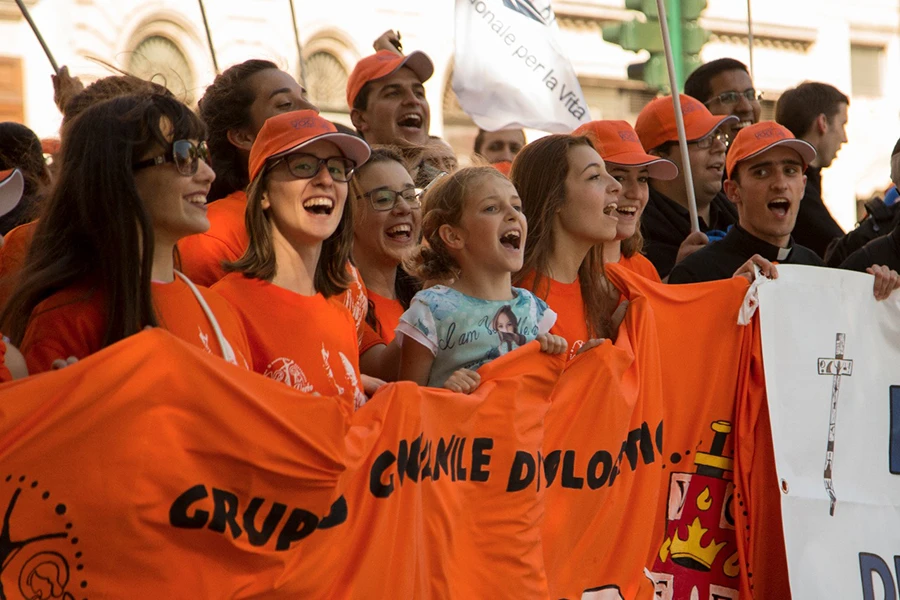
Rome, Italy, May 20, 2017 / 11:15 am (CNA/EWTN News).- Held this year on May 20, Rome’s seventh annual March for Life was a chance for pro-life advocates of any faith to share their convictions about the sanctity of life and how it is founded in a love of life and family.

“It is the seventh edition of the March and as in the past years, we expect thousands of people to come and create a joyful atmosphere,” Alessandro Elia, one of the event’s organizers, told CNA ahead of Saturday’s event.

“In fact, we are against abortion because we love life and we love the family, a natural institution which is fundamental for every human society.”

This year was Rome’s sixth – and Italy’s seventh – annual March for Life. The event’s tagline was “For life without compromise.”

Pope Francis gave his apostolic blessing to participants in the pro-life event. In a written message signed by Vatican Secretary of State Cardinal Pietro Parolin, Pope Francis voiced his hope that the March for Life would promote the dignity of human life in Italy.

More than 6 million babies have been aborted in Italy since abortion on demand was legalized in the country in 1978.  Since that time, “it seems like being contrary to abortion is not permitted,” Elia said. 

“Many Catholics and non-Catholics are very determined to end abortion and the March for Life is an annual occasion to prove that we exist and that our requests need to be taken into account by the civil and political world.”

First held in Rome on Mother’s Day in 2012 – previously held in another part of the country on one other occasion – the annual event was modeled after the U.S. March for Life held each year in Washington D.C.

Over the past four years, thousands of people have traveled from around the world to take part.

This year’s March for Life began its peaceful demonstration at the Piazza della Repubblica, marching down Via Cavour, a major thoroughfare of the city, to arrive at the Piazza della Madonna di Loreto, located next to the busy Piazza Venezia of the well-known Altare della Patria national monument.

Thought open to people of all faiths, the night before the March Eucharistic Adoration was held at the Basilica of Sant’Andrea delle Fratte to pray for the reparation of the crime of abortion.

Though there were heavy rain showers off-and-on the morning and early afternoon of the day of the March, by the time it began in the afternoon blue skies and sunshine prevailed.

Euthanasia is a current pro-life issue in Italy at the moment, as the Italian Chamber has voted in favor of a bill that would effectively force doctors to follow directives from patients or their trustees – no matter made how many years earlier – to even include the withholding of food and water.

Next the bill to be passed by the Italian Senate. The law, on advanced healthcare directives (in Italian called DAT), “requires the doctor to be bound by an anticipated declaration of a patient who requests the suspension of nutrition and hydration,” Elia explained.

In this case, he said, the so-called “‘right to die’ for the patient equals the duty to kill for the doctor. This is unacceptable.”

Besides forcing doctors to participate in what is essentially a form of assisted suicide, “the death of patients by starvation and dehydration is extremely cruel,” he said.

[…]