Dating apps and the death of romance – what’s a Catholic to do?

June 23, 2017 CNA Daily News 3

Denver, Colo., Jun 23, 2017 / 03:22 am (CNA/EWTN News).- If a recent Vanity Fair issue is to be believed, there’s some disheartening news for single people: the “dating apocalypse,” brought on by wildly popular dating apps like “Tinder,” is upon us.

Young singles are too busy swiping left and right on their phones making shallow, transient connections, rather than finding real love with real people. Romance is dead, proposes author Nancy Jo Sales, in the September 2015 issue of the publication.

What sets Tinder apart from most other dating app or online dating experiences is speed and brevity. Based on a photo, first name, and age alone, users decide whether to swipe left (to pass) or right (to like). With GPS tracking, the app also tells users exactly how far away potential matches may be, making life even easier for those just looking for a quick hook-up. 

Shallowest dating app ever?

The biggest criticism of Tinder? It’s a seriously shallow app that turns people into quickly-judged commodities on a screen.

In a 2013 article by The Guardian, “Tinder: the shallowest dating app ever?” author Pete Cashmore explains the ick-factor, yet addictiveness, of Tinder when compared to another dating app called Twine.

“Of the two apps, though, Tinder sounded worse, just because it seemed so contemptuously superficial. There are hundreds upon thousands of women, about whom you know almost nothing, and you snap-appraise them with a single swipe. It’s a finger-flicking hymn to the instant gratification of the smartphone age. It’s addictive.”

Matt Fradd is a Catholic speaker and author and founder of The Porn Effect, a website with a mission to “expose the reality behind the fantasy of pornography and to equip individuals to find freedom from it.” In his ministry, he’s heard a lot of stories from young people about their struggle to overcome objectifying people through porn.

Fradd had some harsh words for Tinder.

“Tinder exists for those who would rather not purchase a prostitute,” he told CNA.

“I would imagine most people who use that app aren’t there because they’re looking for a chaste relationship,” he added. 

And indeed, quite a bit of colloquial evidence backs him up. Alex in the Vanity Fair article said dating apps have turned romance into a competition of “Who’s slept with the best, hottest girls?”

“You could talk to two or three girls at a bar and pick the best one, or you can swipe a couple hundred people a day—the sample size is so much larger,” he said. “It’s setting up two or three Tinder dates a week and, chances are, sleeping with all of them, so you could rack up 100 girls you’ve slept with in a year.”

But Tinder doesn’t always have to be that way, users argue. It is possible to find people on the app who want to go on some good old-fashioned dates.

Tinder users speak

Ross is a twenty-something Nebraska-to-New York City transplant and a cradle Catholic who’s used his fair share of both dating apps and sites. When signing up for Tinder, Ross said, probably the most important factor in whether someone will find potential dates or hook-ups is location, location, location.

“Your region matters so much,” he told CNA in an e-mail interview. “In Nebraska, women date on Tinder. They really do… In New York, (most) want a distraction, attention, and/or a hook up. Not emotion or connections.”

Holly, a twenty-something devout Catholic living in Kansas City, said she has had success finding a date – and a pretty decent one at that – on the app.

“I went on a great Tinder date. Granted it was the only Tinder date, but we even went out a few times before things ended. At the time Tinder sort of freaked me out, but I decided to jump in head first and it was an enjoyable experience over all,” she said. 

Many young people who’ve used Tinder also argue that the “shallow” critique is a bit overblown, considering that dating always takes into account whether or not a potential mate is physically attractive.

“How is me swiping right on a guy that I find attractive, and swiping left (on those) that I’m not that into any different than someone approaching a guy that I find attractive in a bar? We make snap judgements all the time. Why is it suddenly so much worse if I’m doing it online?” asked Michelle, a twenty-something practicing Catholic who lives in Chicago.

While she’s definitely experienced the creepier side of Tinder – with guys sending her “rankings” on a scale of 1 to 10 and other, um, less-than-endearing messages, she said she found the app could be used as a way to maybe meet some new people in person and to get recommendations of things to do in the city.

“I think to immediately classify Tinder or any other dating app as a ‘hook-up’ app or as a very bad thing goes against the idea that things are morally neutral,” Michelle said. “Just like alcohol is not inherently bad but can be used for evil, I don’t think Tinder is inherently evil as well. I definitely think you can use Tinder if you’re using it to meet people – not to hook up with people.”

The morality of Tinder

It’s admittedly a bit difficult to find someone who can speak with moral authority specifically to dating apps in the Catholic world. Because of the very recent explosion of smartphones, followed by the subsequent explosion of dating apps, or because of vows of celibacy, many clergy and moral experts have actually never used dating apps themselves.

Fr. Gregory Plow, T.O.R., falls into that category. Even though he’s a young priest and friar who’s never used Tinder, Fr. Plow works with hundreds of young people every day as the director of Households at Franciscan University of Steubenville, Ohio (kind of like Greek houses, but faith-based).

Fr. Plow said when Catholics determine the morality of any act or tool, like Tinder, three things must be considered.

“Whenever discerning the morality of an act not explicitly defined by Church teaching, we must examine the object, the intention, and the circumstances,” he said, referencing paragraph 1757 of the Catechism of the Catholic Church.

“Regarding the ‘object,’ apps – in general, as an invention – are not bad in and of themselves. Like most other technologies, they are morally neutral in and of themselves,” he said. “Apps do, however, possess a certainly quality of being transitory that can factor in to the other two components (intention and circumstances) that factor in to judging the morality of an act.”

The transitory, cursory nature of swiping based on one picture in Tinder can be morally dangerous if that same mentality transfers to relationships with people, he said. Instead of pausing and taking the time to form real relationships, some people may decide to move on to the next best thing because they have so many options.

“Therefore, in as much dating apps are impersonal and transitory, or are used with the intention for receiving gratification and pleasure, they are immoral,” he said. “If, however, online dating apps or services assisting people in leading them to find another person to share the love of God with in the uniqueness of a dating relationship or marriage, it can be (morally) good.”

Mary Beth Bonacci, a Catholic speaker and author on John Paul II’s Theology of the Body, said what’s concerning about Tinder when compared to online dating sites such as CatholicMatch is the rapidity with which people can be turned into objects.

“The entire realm of dating is full of opportunities to turn a human person into a commodity. We get so wrapped up in thinking about what we want for ourselves that we forget we are dealing with another human person – and image and likeness of God. It’s always been a temptation,” she said.

“But the rapid-fire nature of Tinder’s ‘scan and swipe’ makes it easy to turn many, many human persons into commodities in a short period of time. That is what is scariest to me.”

Bonacci said while it’s possible to find someone who’s interested in a virtuous dating relationship through apps like Tinder, the chances of that happening are probably pretty low when compared with online dating sites that have more extensive profiles.

Meeting someone in person as soon as possible is also key, she said, in determining whether or not a match made online or in an app has a chance of turning into a dating relationship. But apps like Tinder aren’t exactly helping breathe new life into romance, she said.

“Everything is instant. The nearly-anonymous sex is of course the antithesis of anything romantic or respectful. In the old days of the ‘meat market’ singles’ bar, a person had to get dressed up, leave the house, buy a few drinks and at least pretend to have some real interest in the other person.”

The Church has a duty, she said, to offer young people better alternatives in the dating world than the instant gratification that they find in the current culture.

“The Vanity Fair article reminded me once again that we have to offer teens and young adults an alternative to the degrading, hook up world that surrounds them. We can’t scare them out of it. They need to be inspired, to fall in love with the real beauty of the Christian vision of human sexual morality,” she said.

“They need to see their own dignity, their own importance, and how respecting their bodies and the beautiful language of human sexuality is the only way to finding real love. We have to. We can’t allow another generation of kids to fall into this cesspool.”


This article was originally published on CNA Sept. 13, 2015.

[…]

Stop sharing fake news, Filipino bishops implore

June 22, 2017 CNA Daily News 0

Manila, Philippines, Jun 23, 2017 / 12:01 am (CNA/EWTN News).- Fake news is a problem everywhere, including in the island nation of the Philippines.

So much so that the bishops of the Catholic-majority country have released a first-of-its-kind pastoral letter to their people imploring them: Please stop sharing fake news.  

“At (Jesus’) trial, the question of truth figured prominently. ‘What is truth?’ asked a bewildered Pilate, because he failed to recognize in Jesus, THE TRUTH!” the bishops said.

Therefore, they said, Christians are called to recognize truth in all forms, and to not participate in deceit for falsehoods in any way.

“A fact,” the bishops helpfully explain, “is anything that is or that happens.”

“If one man kills another, it cannot but be a fact that the deed was done, and any ‘alternative fact’ that would have it so that no killing was done is simply false, and, when meant to deceive, a lie!”

The bishops lamented that there are those “who have given themselves to the service of reporting what never happened, concealing what really happened, and distorting what should be presented in a straightforward manner.”

They also observed that social media “has become the unfortunate site of ‘alternative facts’ and ‘fake news’. Not only does this offend against the orientation of the human intellect to the truth. It is, more fundamentally, a sin against charity because it hinders persons from making right and sound decisions and induces them, instead, to make faulty ones!”

The letter, issued by Archbishop Socrates Villegas of Lingayen-Dagupan, president of the Filipino bishops’ conference, includes four obligations for Catholics regarding the truth.

“Catholic faith obliges us to: 1. To refrain from patronizing, popularizing and supporting identified sources of ‘alternative facts’ or ‘fake news,’” they said, referencing a phrase from a media faux pas made by Kellyanne Conway, counselor to U.S. President Donald Trump, earlier this year.

Secondly, Catholics are obliged “To rebut and refute falsehood whenever they are in possession of facts and of data.”

Catholics also must “refuse to be themselves purveyors of fake news and to desist from disseminating this whether on social media or by word of mouth or through any other form of public expression.”

And finally, Catholics must “identify the sources of fake news so that our brothers and sisters may be duly alerted and may know which media and which sites to shun,” they said.

The letter comes during the same month that a “fake news blocker” was launched in the country by the National Union of Journalists of the Philippines and the Center for Media Freedom and Responsibility. Their newly-created Google Chrome plug-in “Fakeblok” flags fake news and misinformation on Facebook.

A recent study found that Filipinos spend the most time online and on social media of any country in the world.

The pastoral letter also comes at a time when opposing political camps in the Philippines are using fake news to advance their agenda, including controversial President Rodrigo Duterte, according to Philippine news source Rappler.

“A number of officials and agencies of the Duterte administration, such as Communications Assistant Secretary Mocha Uson, have also been accused of spreading fake news. Uson and many pro-Duterte bloggers have also discredited legitimate journalists as ‘presstitutes,’” Rappler reported.

The bishops of the country went so far as to say that sharing fake news is not only an offense against human intellect, but a “sin against charity” because “it hinders persons from making right and sound decisions and induces them, instead, to make faulty ones!”

“We your bishops join the Lord Jesus in His prayer that we all be consecrated in the truth, because the Word of the Lord is truth!”

[…]

Calif. court drops 14 charges against Planned Parenthood investigator

June 22, 2017 CNA Daily News 0

San Francisco, Calif., Jun 22, 2017 / 04:43 pm (CNA/EWTN News).- A California court on Wednesday dismissed 14 of 15 criminal charges against an undercover journalist behind the video exposé of Planned Parenthood’s role in the fetal tissue trade.

“This is a huge victory to have 14 criminal counts dismissed,” Mat Staver, founder and chairman of Liberty Counsel, which defended Sandra Merritt in court as she faced 15 felony charges. One charge of conspiracy to invade privacy has still not been dismissed.

“We will now turn our attention to dismissing the final count,” Staver continued. “Sandra Merritt did nothing wrong. The complaint by the California Attorney General is unprecedented and frankly will threaten every journalist who provides valuable information to the public.”

In March, California Attorney General Xavier Beccerra charged Merritt and her colleague David Daleiden with 14 criminal counts of recording others without their consent in a confidential conversation, and one count of conspiracy to invade privacy.

Merritt and Daleiden were undercover journalists at the Center for Medical Progress, a group which seeks to expose the role of Planned Parenthood clinics and tissue harvesters in the trade of fetal tissue of aborted babies. The group began releasing videos in July of 2015 that were undercover video recordings of conversations with Planned Parenthood officials.

CMP alleged that Planned Parenthood clinics illegally broke the law by profiting off of the transfer of the fetal tissue to harvesters. Federal law does allow for reasonable compensation for fetal tissue in cases where it is procured for medical research purposes. The compensation cannot be for “valuable consideration,” but may cover operating expenses like storage and transfer costs.

The recorded conversations Merritt and Daleiden had took place as they posed as representatives of a tissue procurement company BioMax seeking to possibly partner with Planned Parenthood clinics and other representatives in the abortion industry to obtain body parts of aborted babies.

In the criminal complaint against Merritt and Daleiden, Beccerra had alleged that both persons had recorded confidential conversations without the consent of other parties involved. Each of the 14 counts involved a separate conversation that allegedly took place.

Eight of the charges had to do with secretly recorded conversations with attendees at a National Abortion Federation conference in San Francisco. Other conversations with Planned Parenthood officials and tissue procurement representatives were recorded at other times.

California is a “two-party consent” state, which means that both parties of a conversation, where it is expected to be private and confidential, must agree to it being recorded.

An affidavit from a California Peace Officer claimed that, according to accounts from multiple persons to whom Daleiden and Merritt allegedly talked, they recorded conversations that were believed to be confidential by the other party.

Liberty Counsel, on the other hand, said that the “the videos produced by Merritt and Daleiden exposed unethical and potentially illegal conduct by Planned Parenthood, and Planned Parenthood itself has admitted, under oath, that the recorded conversations took place in ‘non-confidential’ and public venues,” such as restaurants.

Beccerra also charged Daleiden with conspiracy to invade privacy, alleging that Daleiden used a password from a former employee at the tissue procurement company StemExpress, accessed the company’s email system, and took documents.

The affadavit also alleged that Daleiden and Merritt set up a tissue procurement company of their own – BioMax Procurement Services, LLC – and used false names to “pose” as representatives of the company and to be admitted to a National Abortion Federation conference in San Francisco, “where they secretly video recorded conference speakers, vendors, and attendees.”

On Wednesday, the San Francisco Superior Court dismissed the 14 recording charges, but the charge for conspiracy to invade privacy has not yet been dropped.

Beccerra, a former Democratic congressman, had previously received small donations from Planned Parenthood as a candidate for Congress amounting to around $6,000 over the last 20 years, according to the Center for Responsive Politics.

“Sandra did not break any law and the criminal complaint against her is legally deficient, vague and full of inconsistencies,” Horatio Mihet, Liberty Counsel’s vice president of legal affairs and chief litigation counsel, stated.

“No other citizen journalist or organization has ever been charged with a crime for undercover recordings,” he added.

After Center for Medical Progress began releasing its recorded conversations with officials at Planned Parenthood and tissue procurement companies, Congress and several states launched investigations into Planned Parenthood to find out whether it broke the law in the fetal tissue trade.

A final report from a House select investigative panel released in January detailed various abuses in the abortion industry in the fetal body parts trade.

Consent forms required by law were not obtained from mothers to have the fetal tissue of their aborted child used for research. Private medical information may have been shared between abortion clinics and tissue procurement companies in a violation of the Health Insurance Portability and Accountability Act of 1996.

In another case, the University of New Mexico established a possibly illegal relationship with a local abortion clinic where students and fellows performed abortions at the clinic and the clinic’s abortionists were reportedly granted “volunteer faculty” status at the university where they received benefits like insurance coverage and access to university facilities.

[…]

Youssef Absi elected Patriarch of Melkite Greek Catholic Church

June 22, 2017 CNA Daily News 2

Beirut, Lebanon, Jun 22, 2017 / 12:07 pm (CNA/EWTN News).- The synod of the Melkite Greek Catholic Church elected on Wednesday Archbishop Youssef Absi as the Church’s new patriarch, who received ecclesiastical communion from Pope Francis the following day.

Elected June 21, Patriarch Absi, 71, succeeds Patriarch Gregorios III Laham, who retired May 6 at the age of 83.

The new patriarch was born in Damascus in 1946. He was ordained a priest of the Missionary Society of St. Paul in 1973. He became superior general of the society in 1999, and two years later was appointed curial bishop of the Melkite Patriarchate of Antioch. In 2007, he was appointed the Patriarchal Vicar of of the Melkite Archdiocese of Damascus.

The Melkite Greek Catholic Church is an Eastern Catholic Church of the Byzantine rite, and it consists of some 1.5 million members. It is based in Syria and Lebanon, and most of its eparchies are in the Arab world. It also has structures to serve the Melkite diaspora in Australia, Turkey, Canada, Mexico, the United States, Argentina, Brazil, and Venezuela.

The Melkite Church traces its roots to the earliest days of Christianity, when Sts. Peter and Paul first evangelized the peoples of Syria, where followers of Christ were first called “Christians.”

During the 2010 Synod on the Middle East, Patriarch Absi lamented the strife among the Eastern Catholic Churches, calling the struggle a “fount of impairment and false testimony,” according to Vatican Insider.

“The Christians of the East,” he said, “are all on the same boat, and confront the same struggle. They cannot be disinterested each in the other.”

The new patriarch holds licentiates in philosophy and theology, and a doctorate in musical sciences and Byzantine hymnography from the Holy Spirit University of Kaslik in Lebanon. He has taught philosophy, Greek, and musicology at the university level.

Pope Francis wrote to Patriarch Absi the day after his election, congratulating him and granting him ecclesiastical communion.

Francis also noted the tribulation facing Christians in the region.

“The election of Your Beatitude comes at the time of a delicate situation for the venerable Greco-Melkite Church and when many Christian communities in the Middle East are called to bear witness in a special way to their faith in the dead and risen Christ,” the Roman Pontiff said. “In this particularly difficult time, Pastors are called upon to manifest communion, unity, closeness, solidarity and transparency before the suffering people of God.”

“I am certain that your Beatitude, in fraternal harmony with all the Synod Fathers, will know, in all evangelical wisdom, how to be not only ‘Pater et Caput’ in the service of the faithful of the Greco-Melkite Church, but also a faithful and authentic witness to the Risen One.”

[…]

‘A saint for our times’ – the inspiring story of Chiara Corbella Petrillo

June 22, 2017 CNA Daily News 2

Manchester, N.H., Jun 22, 2017 / 09:05 am (CNA).- Chiara Corbella Petrillo lived a short life. 


She met her husband Enrico Petrillo at age 18, became the mother of three children, and died at the age 28. 


But what happened within those 10 years has touched the hearts of thousands across the globe. Chiara’s sainthood cause was opened last week, five years after her death. Her story is told in the 2015 book, “Chiara Corbella Petrillo: A Witness to Joy,” published by Sophia Institute Press. 


“In the story of the Petrillo couple, many people recognize a providential consolation from heaven,” said Simone Troisi and Christiana Paccini, close friends of the Petrillo’s who wrote the biography of Chiara’s life. 


“They discover that in any situation, there is no real reason to be sad. This is because Chiara shows that if you have God as your guide, misfortunes do not exist,” they told CNA.  


Chiara and Enrico married in Italy on September 21, 2008 after having met at Medjugorje in 2002. During the early years of their marriage, the young Italian couple faced many hardships together, including the death of two children, who both died only 30 minutes after birth. 


Chiara became pregnant a third time with their son, Francesco. However, the joyful news of their pregnancy also came with a fatal diagnosis of cancer for Chiara. Her cancer was an unusual lesion of the tongue, which was later discovered to be a carcinoma. 


Chiara rejected any treatment that could have saved her life during pregnancy because it would have risked the life of her unborn son. As the cancer progressed, it became difficult for Chiara to speak and see clearly, eventually making her final days on earth particularly excruciating. 


“Her [Chiara’s] suffering became a holy place because it was the place where she encountered God,” Troisi and Paccini recalled.


Although many couples face hardships, Troisi and Paccini remembered something different about the Petrillos – they leaned on God’s grace which made their family particularly serene. They made peace with the reality that Chiara would never grow old with Enrico or watch Francesco grow up. 


During Chiara’s last days, Enrico embraced God’s grace just as Chiara did, saying, “If she is going to be with Someone who loves her more than I, why should I be upset?”  


Chiara died on June 13, 2012 at home in her wedding gown, surrounded by her family and friends. Although her earthly life was over, Chiara would continue to be a witness to joy.


Troisi and Paccini believe that Chiara’s legacy is still living on because she gave witness to the truth that “love exists.” Neither she nor Enrico were afraid of love, marriage, or of committing themselves to their family. 


According to the authors, the young couple showed how “the purpose of our life is to love… to be married is a wonderful thing, an adventure that opens you up to Heaven in the home.” 


Chiara and Enrico’s remarkable story is “a story of salvation in which God shows himself as a faithful God: they trust in Him and are not disappointed,” they stated. 


However, they were quick to note that Chiara was not “an extraordinary young woman, in a way that makes her different from us.” Rather, she struggled with many human fears and anxieties, especially with thoughts of pain, vomiting, and purgatory. 


“She had the same questions that we have, the same objections and struggles, the same fears,” Troisi and Paccini noted, saying what made her different was her “capacity to cast everything on the Father, to welcome the grace needed for whatever step she had to make.”


With Chiara, the ordinary always became the extraordinary. Troisi and Paccini have fond memories of everyday life with the Petrillos, when a conversation about cooking chicken would end in talking about heaven. 


“We would share simple things like dinner, chatting, games on the rug with little Francesco… always very simple, without masks,” they remembered.


“But when we were together, there was no difficulty in believing that eternal life was here and now!” 


Chiara has been called “a saint for our times.” Although her death was only five years ago, her legacy lives on and has inspired others around the world to be the same witness to joy.


“Today, this joy is visible in those that lived alongside her: even if they miss her, they experience a mysterious and profound joy,” Troisi and Paccini stated.


“We cannot insist enough on the fact that Chiara did what she did, not trusting in her own strength, but trusting in the grace and the consolation of God… She never doubted God’s faithfulness to His promise of happiness for her story.”


An earlier version of this article was originally published on CNA Dec. 2, 2015.


[…]

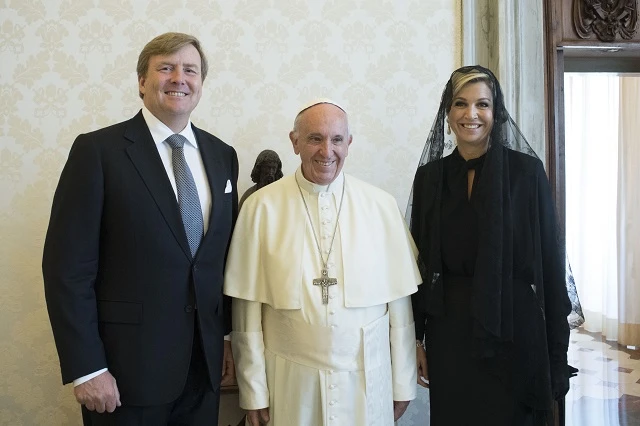
Pope Francis meets with the King and Queen of the Netherlands

June 22, 2017 CNA Daily News 0

Vatican City, Jun 22, 2017 / 07:32 am (CNA/EWTN News).- On Thursday Pope Francis met with King Willem-Alexander and Queen Máxima of the Netherlands, discussing issues surrounding migration, poverty and the protection of the environment.

According to a June 22 Vatican communique, the three cordially discussed topics “of shared interest,” including protection of the environment, the fight against poverty and how the Holy See and Catholic Church are contributing in these areas.

Particular attention, it stated, was paid to “the phenomenon of migration, underlining the importance of peaceful co-existence between different cultures, and joint commitment to promoting peace and global security, with special reference to various areas of conflict.”

They also shared reflections on the prospects of the European project. The private portion of the audience, which included both the King and the Queen, lasted 35 minutes.

Queen Máxima, who was born in Buenos Aires, Argentina, greeted Pope Francis in “porteño,” a dialect of Spanish spoken by people from the Río de la Plata basin of Argentina.

“How are you? Delighted to see you again,” she said.

During the visit Pope Francis gifted the royal couple a medallion depicting St. Martin of Tours, in the classic image of the saint dividing his cloak to give to a poor man.

He also gave them the customary gift of copies of his environmental encyclical Laudato Si, his 2015 Apostolic Exhortation on the family “Amoris Laetitia,” and his 2013 exhortation “Evangelii Gaudium,” as well as a copy of his message for the 2017 World Day of Peace.

For their part, King Willem-Alexander and Queen Máxima gave the Pope a gift of Dutch flowers, white and yellow tulips from their country.

Giving the gifts, they told Pope Francis that tulips aren’t only for Easter, but could be planted in the Vatican.

Afterward, the two met with Secretary of State Cardinal Pietro Parolin and Secretary for Relations with States Archbishop Paul Richard Gallagher.

The Royal couple are in the midst of a state visit to the Italian Republic, taking place June 21-23.

Before their meeting with the Pope, the King and Queen visited the Church of Saints Michael and Magnus, the national church of the Netherlands in Rome. Located next to the Vatican, it was built in 1140 in the place where pilgrims from the Netherlands met back in the 8th century.

According to church statistics, Catholics currently make up 23 percent of the population of 17 million in the Netherlands.

[…]

We must speak, act more on criminal justice reform, Christian leaders insist

June 21, 2017 CNA Daily News 5

Washington D.C., Jun 22, 2017 / 12:04 am (CNA/EWTN News).- With the justice system rife with abuse, there is still much work to be done to call the faithful to minister to prisoners, victims, and their families, Christian leaders maintained on Tuesday.

“We need to raise this as a priority within the Church,” Karen Clifton, executive director of the Catholic Mobilizing Network to End the Death Penalty, told CNA of criminal justice reform and ministries to prisoners and their victims.

“Our Pope has been very outspoken about that, and spoken numerous times about our need to visit those imprisoned, and then accompany and journey with those that are affected by crime, all aspects, the perpetrators family, and the victims’ families,” she continued.

Clifton was one of a number of Christian leaders who spoke out against injustice in the justice system during a June 20 press conference at the National Press Club in Washington, D.C.

The panel included Dr. Russell Moore, president of the Ethics and Religious Liberty Commission of the Southern Baptist Convention, as well as Harry Jackson of the International Communion of Evangelical Churches. They unveiled the “Justice Declaration,” which calls for “a justice system that is fair and redemptive for all.”

It also calls for Christians to be more active in advocating for more humane conditions in prisons, “proportional punishment” for offenders, better educational and economic opportunities for poor people as crime prevention, and to “invest in the discipleship” of prisoners.

Christians must “treat every human being as a person made in God’s own image, with a life worthy of respect, protection, and care,” they stated.

“The Church has both the unique ability and unparalleled capacity to confront the staggering crisis of crime and incarceration in America and to respond with restorative solutions for communities, victims, and individuals responsible for crime,” the declaration said.

Bishop Frank Dewane of Venice, chair of the U.S. bishops’ domestic justice and human development committee, is among the signatories, along with Karen Clifton.

Over-incarceration, racial disparity, and disproportionate sentencing are only some of the injustices that underscore the urgency for reform of the justice system, panel members insisted.

The U.S. is home to five percent of the world’s population, but holds 25 percent of the world’s prison population. 2.2 million are behind bars, leaving 2.7 million children with an incarcerated parent. African-Americans are incarcerated at a rate six times that of whites, according to the NAACP. 65 million Americans suffer from the collateral consequences of a conviction, which include difficulty in finding a job or renting a home even after they serve their prison sentence.

All this has produced a “crisis” to which the Christian community must respond, the leaders insisted.

The Catechism of the Catholic Church paragraph 2266 states that “punishment has the primary aim of redressing the disorder introduced by the offense. When it is willingly accepted by the guilty party, it assumes the value of expiation. Punishment then, in addition to defending public order and protecting people’s safety, has a medicinal purpose: as far as possible, it must contribute to the correction of the guilty party.”

Pope Francis has also advocated for the eventual reintegration of prisoners into society, warning against only focusing on justice as an “instrument of punishment.”

Criminal justice reform measures had been gaining bipartisan momentum at the federal level as members of Congress in both parties supported various policies like ending mandatory minimum sentencing and limiting the use of solitary confinement in federal prisons.

However, with the advent of the new administration that momentum has slowed.

Attorney General Jeff Sessions dropped the Obama administration’s “Smart on Crime” initiative and has directed prosecutors to pursue stricter mandatory minimum sentences, which reform advocates say gives judges less flexibility to adjust one’s sentence based on the details of their case.

“We believe that it removes from the judge the ability to do his or her job,” James Ackerman, CEO of Prison Fellowship Ministries, said on Tuesday.

Christians are be on board with certain aspects of criminal justice reform, but for many there still remains a “disconnect” between their views on justice and reform of the justice system, Prison Fellowship claims in its report “Responding to Crime & Incarceration: a Call to the Church.”

In a recent poll commissioned by Prison Fellowship, 88 percent of practicing Christians answered that the primary goal of the justice system should be “restoration for all involved: the victim, the community, and the person responsible for the crime.”

However, in the same poll, 53 percent of practicing Christians answered that “it’s important to make an example out of someone for certain crimes” even if that entailed punishing them more harshly than they deserved.

“Disproportional punishment is not consistent with our values,” Ackerman stated.

How can the Church better bridge this “disconnect” in polling answers?

The Church must educate laypeople on the importance of the issue, and mobilize them to act through parish ministries, Clifton insisted.

“I want to say, ‘where are our resources?’” she asked. “There is so little funding for prison ministry, for care for victims, for programs for victims,” she said, and for incarceration prevention programs.

There is a “challenge to the churches to bring the stories to the pulpit,” she said, “to convert those in the pews, and know that this is the Gospel message, to be a voice to the voiceless and to go to the margins and the peripheries and be present in accompanying those back into society.”

Russell Moore, president of the Southern Baptist Convention’s public policy arm, agreed.

“Our criminal justice system exists in order to restrain evil, and in order to rehabilitate and to reform those who have committed crimes,” he said.

If, however, the system “doesn’t stop crime, but in many cases actually furthers crime, making criminals out of those who are not yet criminals, ignoring those who have been victims of crime, not dealing with issues of addiction,” he continued, “then we have a criminal justice system that doesn’t work and ought to be fixed.”

“When we have family members who are left behind, waiting for those who are incarcerated and wondering if anyone remembers them, the church of Jesus Christ needs to be at the forefront of that,” he said.

Harry Jackson maintained that Christians must be actively fighting the racial disparity in the justice system.

“In this hour of racial tension, the most important step of healing that we could take at this point is to deal with the fact that there is an increasing, permanent underclass that’s coming out of black and Hispanic people being incarcerated,” he said, “and their lives being in a sense marked off the list of potential, or the list of achievers in our culture.”

“We have the opportunity now to make a difference,” he added. “I believe this is the most important civil rights step that we will take in our lifetimes.”

[…]