Baltimore, Md., Nov 11, 2018 / 04:01 pm (CNA/EWTN News).- Sr. Thea Bowman was the first African American woman to address the U.S. bishops’ conference. Most likely, she was also the first person to get them to hold hands and sing and sway to a Negro Spiritual.
“We shall overcome,” she intoned at their 1988 spring meeting in her signature rich voice, before exhorting the bishops to join in with a hearty “Y’all get up!”
Sr. Thea, a Franciscan Sister of Perpetual Adoration, a daughter of the Deep South and the granddaughter of a slave, was sick from battling cancer and confined to a wheelchair at the time.
But that didn’t stop the 51 year-old from doling out more instructions when the stiff group still wasn’t swaying to her satisfaction: “Cross your right hand over your left hand, you gotta move together to do that,” she said as the bishops crossed arms and held hands before continuing the song.
“See in the old days you had to tighten up so that when the bullets would come, so that when the tear gas would come, so that when the dogs would come, so that when the horses would come, so that when the tanks would come, brothers and sisters would not be separated from one another,” she told the bishops, referring to the days of the Civil Rights movement.
“And do you remember what they did with the bishops and the clergy in those old days? Where’d they put them? Right up in front. To lead the people in solidarity with our brothers and sisters in the Church,” she said.
That keynote showcased Sr. Thea in her element – sharing her faith and love of God, urging racial awareness and reconciliation within the Catholic Church, joyfully belting out Gospel hymns and convincing everyone around her to join in.
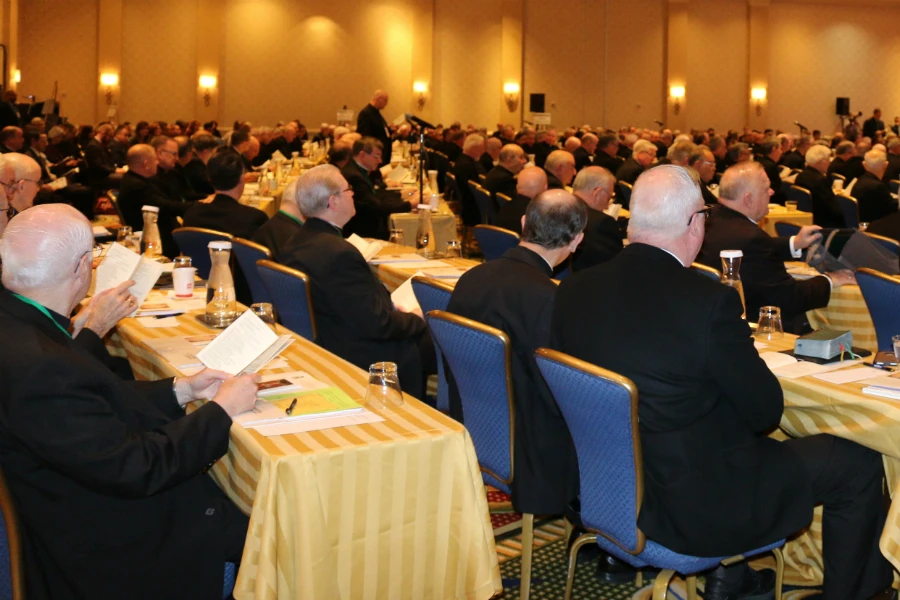
Now, nearly 30 years after her death, Sr. Thea will once again feature at the U.S bishops’ conference – but this time, they will be voting to approve the opening of her cause for canonization.
The precocious ‘old folks child’
Sister Thea was born Bertha Bowman on December 29, 1937 in Yazoo City, Mississippi, the only daughter to her father, a family doctor, and her mother, an educator. The family resided in Canton, a town 30-some miles to the south and east of Yazoo City.
She was the granddaughter to slaves, and her maternal grandmother was a prominent educator in the area after whom the local school was named.
From an early age, Bertha self-identified as an “old folks child”, her parents having been middle-aged by the time she was born. She was doted on by aunts, uncles, and grandparents during her childhood. Her mother taught her to read, her father taught her some of the basics of First Aid.
One thing Bertha learned early on from the “old folks” in her life was what she would affectionately call “old time religion.” Her parents were Methodist, and the Bible belt town was full of active parishes of all Christian denominations.
In the book Sister Thea: Songs of my People, she recalled: “Many of the best (religion) teachers were not formally educated. But they knew scripture, and they believed the Living Word must be celebrated and shared…Their teachings were simple. Their teachings were sound,” she said. “Their methodologies were such that, without effort, I remember their teachings today.”
The religious vitality of her surroundings sent the young Bertha on her own “spiritual quest” of sorts, and she sat in on religious services at many of the different churches in town. At the Catholic Church, she was one of just a few black people there, relegated at the time to the back pews.
Ultimately, it was the witness of the love and service of Catholic sisters, specifically the Franciscan order that she would eventually join, that convinced her to become Catholic at the young age of 9.
“Once I went to the Catholic Church, my wanderings ceased. I knew I had found that for which I had been seeking. Momma always says, God takes care of babies and fools,” she wrote in an autobiography in 1958.
By all accounts, her parents were supportive of the little convert, and enrolled her in Holy Child Catholic school following her conversion, where she became enthralled with the Franciscan Sisters of Perpetual Adoration from Wisconsin who were serving there.
Besides her religious seeking, her heart for God also manifested itself in other ways, said Father Maurice Nutt, a Redemptorist priest and former student of Sr. Thea who is now the diocesan promoter of her cause for canonization.
“When lunchtime would come, she would notice children who didn’t have any food, and so she would take her lunch and she would give it to them. And they would say Bertha, don’t you want to eat? And she would say no, I’m not very hungry today,” he said.
“So her concern as a child was to feed the poor, she wanted to help those who were marginalized in any way.”
Her mother soon caught on that Bertha was coming home from school hungry, and so the two of them began making extra peanut butter and jelly sandwiches for Bertha to give to her friends at lunchtime.
“So you’re seeing from a very early age that this woman Thea Bowman walked with God, she was close to God, God was everything to her so she was his servant.”
Bertha becomes Thea
That strong sense of religiosity and wanting to serve others never left Bertha, and at the age of 15 she was determined to join the order of FSPA sisters that had taught at her school.
Her parents, neither yet Catholic, pleaded with her to reconsider, or to at least consider joining traditionally black orders of sisters that were much closer to home.
But the determined Bertha staged a hunger strike until her parents relented. She was accompanied by another sister on the long train ride to the FSPA motherhouse in La Crosse, Wisconsin with special permission to sit in the white passenger cars rather than in the baggage cars, as was mandated for blacks in the pre-civil rights movement days.
A couple years into formation, Bertha took the religious name of Thea, which she would have for the rest of her life.
Sister Rochelle Potaracke, FSPA, was a young sister at the time that Thea joined the convent in 1953.
She told CNA that she remembers Thea as a happy and energetic young postulant, who stuck out in the state of Wisconsin, where very few black people lived at the time. Her blackness even made news in the local Catholic paper that summer: “Negro Aspirant” read the headline.
“When I was growing up I never saw a black person, that was in the early ’40s, and that’s the same for many areas I know,” Potaracke told CNA.
“But I think we accepted (Thea) very well. We loved her dearly, she fit right in with all of us, she always had her singing and her enthusiasm,” she said.
“But it must have been terribly hard for her. I think of it now, I didn’t think of it then. I didn’t think ‘Oh, the poor dear, but I think now it had to be a challenge for her, she was in a whole new almost different country so to speak.”
According to a biography, Thea’s Song, after the newness of the convent experience wore off, Thea experienced culture shock and blatant racism, within and without the convent walls.
Sister Helen Elsbernd, who went through formation with Thea at the FSPA motherhouse, said Sr. Thea didn’t mention anything to her fellow sisters about racial discrimination at the time.
“She didn’t talk about it. In the early years of formation she tried very hard to fit in with the culture here,” Elsbernd recalled.
Her first years as a sister were also challenging for another reason – in 1955, two years into formation, Thea was stricken with tuberculosis, and spent most of that year in the sanatorium.
“I marvel at her constant cheerfulness,” one sister wrote to Thea’s parents during her illness.
‘Black is beautiful’: Sr. Thea’s racial advocacy grows
Sr. Thea’s cheerful energy would remain her signature trait as her passionate advocacy for racial integration in the Catholic Church began to further develop.
Potaracke, who spent time studying with Sr. Thea during graduate school at Catholic University of America, said that for years, the sisters had been going to school at CUA, where they were simply known as the Franciscan sisters from Wisconsin.
That changed when Sr. Thea came on the scene. Early into their days at CUA, Sr. Thea and her fellow sisters attended a student event, during which Thea leapt up to tell her story as a young black woman growing up in the South.
“Thea could just grab an audience any time she wanted, she could just spark life into the group that was in front of her,” Potaracke recalled.
“She started singing these songs and everyone was clapping and dancing and jumping around. And after that time we were no longer the FSPA’s, it was oh – you’re Sister Thea’s group. I point that out because that’s the impression she made on people,” she said.
As a CUA student, Sr. Thea helped to found the National Black Sisters Conference and became a noted public speaker and advocate for African Americans in the Church. She advocated for encounter between white and non-white Catholics, for increased representation in Church leadership for non-whites, and for an embrace of music and traditions from different cultures into the Church.
As her racial advocacy grew, one of Sr. Thea’s signature phrases became “black is beautiful.”
“‘Black is beautiful,’ that’s what she would say all the time,” said Potaracke.
It was a phrase that came from Thea’s mother, who had tried to teach her from an early age to handle the racial discrimination that she experienced with love rather than hate.
“Her mother always said that she had to be honest and good to people. Her mother said: ‘You can’t hate, because if you hate you will become like the people you want to hate. Remember, black is beautiful.’”
An impressive scholar, Sr. Thea would eventually get her doctorate in English, and spent several years teaching at Viterbo College in La Crosse, which was staffed by many FSPA sisters. During her time there, she formed singing groups of African American students who became popular throughout the area, Elsbernd said.
In 1978, Sr. Thea moved back to Mississippi, to help her aging parents and to serve in outreach ministry to non-white communities for the Diocese of Jackson. During this time, she continued to expand her speaking and singing ministries, and travelled extensively to give talks nationally and internationally about the importance of racial awareness and acceptance in the Church.
In 1980, she helped to found the Institute for Black Catholic Studies at Xavier University in New Orleans, where she taught until nearly the end of her life. It was during that time that Fr. Maurice Nutt met Sr. Thea at a conference for black Catholic clergy and religious, at which Sr. Thea was the speaker.
“I was so impressed by her. No one really meets Sr. Thea, they encounter her,” Nutt said.
Her talk was the first time that Nutt really considered what it meant to be black and Catholic, and the unique gifts that the black community could bring to the Church, he said.
“It was a cathartic moment for me, because she really enabled me to bring my very best self, my African American self, to the Church, to give my life in service to the Church,” Nutt recalled.
He was so moved by her that he joined the next cohort at the Institute.
“She would always say that we are an integral part of the Church, that as African American Catholics, we have gifts to share, we have our spirituality, we have our witness of struggle and suffering. We have the joy of knowing Jesus even in times of sorrow,” he said.
“And so what she taught me was to bring my gifts to the Church. She taught me to be very intentional in my expression of spirituality, to share what it means to be black and Catholic, that we should not hide those gifts, but that there’s a mutuality, that integration means that you have something to share but I also have something to share.”
Nutt remembers Sr. Thea as a brilliant teacher who demanded excellence, but also as a warm and caring woman who embraced her students as her own children.
“Thea became my spiritual mother, and I became her spiritual son, and she would call me son,” Nutt said. “She would say that the seminarians she encouraged, she said ‘These are the sons that I give to the Church.’ And I am so grateful that I was counted in that number.”
In 1984, Sr. Thea’s parents died within months of each other. Not long after, she received a diagnosis of breast cancer.
“That was crushing,” Nutt said. “She was the only child of this elderly couple, it seemed like her whole world had fallen apart, and then she received the challenge of cancer.”
While many would be tempted to give up, Sr. Thea made a decision: “I’m going to live until I die,” she said.
And she did. She kept up her speaking engagements and outreach ministry at full-bore. She recorded songs and helped compile the African American hymnal “Lead Me, Guide Me”, gave numerous biographical interviews including a “60 Minutes” segment, and spoke to the U.S. bishops in 1989.
“We as Church walk together,” she told the bishops. “Don’t let nobody separate you, that’s one thing black folks can teach you, don’t let folks divide you. The Church teaches us that the Church is a family, a family of families, and a family that can stay together. And we know that if we do stay together…if we walk and talk and work and play and stand together in Jesus’ name we’ll be who we say we are, truly Catholic. And we shall overcome – overcome the poverty, overcome the loneliness, overcome the alienation, and build together a holy city, a new Jerusalem, a city set apart where…we love one another.”
While she was sick, Nutt said Sr. Thea would pray “that God will heal my body. If God will heal my body, I’ll say thank you Lord. But I also know that if God doesn’t give me what I ask of him, God will give me something better.”
And on March 30, 1990, “that something better was to call her home,” Nutt said.
The legacy of Sr. Thea
Nutt said he thinks Sr. Thea will be remembered for her passionate advocacy on behalf of blacks and other minorities in the Church.
“She spoke about the fact that African American Catholics, we have a deep and abiding history. She told the history that we come from the Ethiopian eunuch, we come from Simon of Cyrene…that we are not late in joining the Church but that people of African descent have been there from the early days of Catholicism, and that this is our home,” he said.
Potaracke said she remembers Thea as a warm woman who had a strong sense of self and wasn’t afraid to advocate for herself and others.
“She was a spark, and she spoke her voice, if she didn’t like something she said it strong and clear, no matter what meeting you were at, she would speak her voice,” Potaracke said.
“It was her inner belief that she was a beautiful woman, that she had a place in this world, and that she was going to go out and change the people she met, and she did. Whether you were penniless or whether you were the wealthiest person, she just had lots of friends in every corner of the world.”
He said he believed she would also be remembered for her love of God, from which flowed her joy and love for others.
“You knew in her midst that you were in the presence of someone extremely special, who had a deep connection with God. Thea said she grew up in a world where God was so alive, and she shared that joy with everyone, that God is real, that God is love, that God is alive, and anyone who met her experienced the presence of God,” he said.
As for Sr. Thea herself, she once said that she wanted to be remembered simply as someone who tried.
“Think of all the great things she did, and she simply said: I want to be remembered as someone who tried. She said she wanted on her tombstone: ‘She tried,’” Nutt said.
“That speaks of her humility. That speaks of her love for God and that she never proclaimed herself to be holy or righteous. She was a disciple of Jesus Christ who tried to love one another, to love other people, to try to lift her service to God and the Church.”
Nutt encouraged Catholics to ask for Sr. Thea’s intercession as her cause gets underway.
“I would encourage people to seek her intercession, especially if they’re struggling with their faith, if they’re struggling with family issues. I would encourage students to pray to her when they’re taking tests, I would also say anyone battling cancer of any kind to seek her encouragement, to seek her inspiration, as they journey through their battle with cancer.”
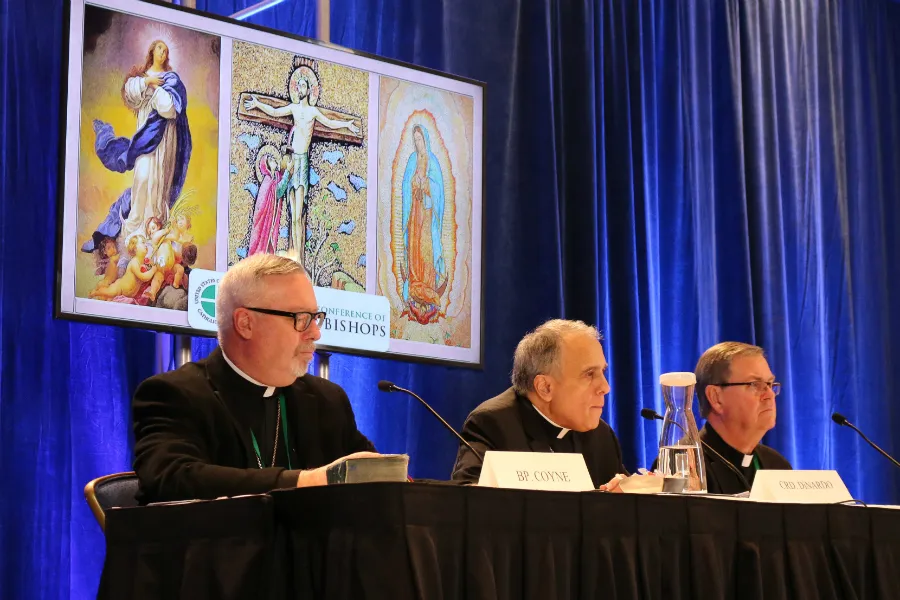
As is customary, when a bishop begins the preliminary phases of someone’s cause for canonization, the cause must be put to a vote of the U.S. bishop’s conference. At their meeting Nov. 12-14, the bishops are expected to endorse the opening of the cause of Sr. Thea Bowman, which is being overseen by Bishop Joseph Kopacz of Jackson.
 […]
[…]