Transcipt of Cardinal Blase Cupich interview on Vigano
August 29, 2018 CNA Daily News 0

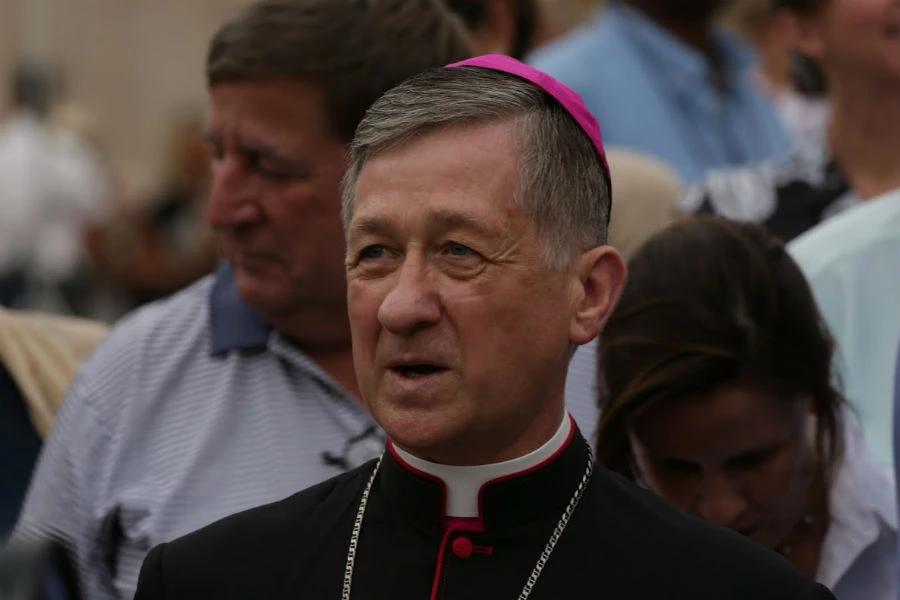
Chicago, Ill., Aug 29, 2018 / 03:03 pm (CNA).- On Aug. 27, Cardinal Blase Cupich of Chicago was interviewed by Chicago NBC 5 reporter Mary Ann Ahern, about an Aug. 25 testimony published by a former Vatican ambassador to the U.S., Archbishop Carlo Vigano. That testimony alleged that Archbishop Theodore McCarrick was instrumental in Cupich’s appointment as Archbishop of Chicago in 2014.

After airing a story containing portions of that interview, NBC 5 published five videos which contain more footage of Ahern’s conversation with Vigano. For clarity, CNA has transcribed those videos.

Video one:

NBC: Does the pope need to tell Catholics exactly what he knew about Cardinal McCarrick and when he first knew it?

Cupich: Well I think that the Holy Father on the airplane had exactly the kind of answer that was needed.

He was asked about the letter of the Archbishop Vigano. He said he read it. He encouraged the media to read it carefully and to come to their own conclusions. And that he would not have any final statement – any other statement on it. I think what he was signaling is two things; the first is that, you have to see whether or not these remarks stand up to scrutiny.

There are so many things in there that he says about so many people that it’s impossible to try to get into the weeds on this. And he [the pope] trusts the media to use their skills, their expertise, and, he said, their maturity to explore these questions.

For instance, look at the language of the letter and compare it to the language that’s in these websites and news outlets that released the document. There’s so many parallels there in terms of the kinds of things that they’re attacking the Holy Father and other people about. The other is look at, look at- look at these things that were said on an individual basis.

That’s why I clarified it. I offered a statement that addressed the three areas that he said about me. I suspect others are going to be doing the same thing.

So the news media now needs to go and press him for information. I read the Washington Post and other major newspapers and their first line always is, he’s made these accusations but offered no proof. Let’s let the news media do their job here.

But for the Holy Father, I think to get into each and every one of those aspects, in some way is inappropriate and secondly, the pope has a bigger agenda. He’s gotta get on with other things of talking about the environment and protecting migrants and carrying on the work of the Church. We’re not going to go down a rabbit hole on this.

NBC: But, does there also need to be an independent investigation from top to bottom of who knew what when?

Cupich: Oh, in fact, you know the president of our bishops’ conference has already called for that weeks ago in saying that we need to know what happened here of how he was promoted, what happened in terms of McCarrick, but also we need to find out what happened in Pennsylvania. Let’s not overlook that. Let’s not let this letter take us away from the fact that there was something flawed in the way that the Charter, which should have been followed from 2002 on, was implemented. We have done it here in Chicago, and we’re proud of it. I’m deeply disappointed and somewhat angry that there were people in another state, in another jurisdiction, that were not doing the things that we promised to do. We should hold each other accountable and we need an independent review of that too.

NBC: By an independent review, would that be Lisa Madigan and the attorney general’s office? (ed note: Lisa Madigan is Illinois’ attorney general)

Cupich: Well, no no no. Independent review of what, nationally, has happened. I think, for instance, we need to call on lay people who are skilled to find out what happened.

Now, with regard to Lisa Madigan and the attorney general, we talked this morning. And I assured her of our full cooperation. I said, “First of all, we don’t mind at all because they have all our documents anyway. We turned them over in ‘14 and ‘15. We also have all the names of people who have any credible accusation against them through our review board that have been released to the officials. So we’re – The only thing I said is that if we’re going to move in this direction, let’s make child protection the priority. It’s not just about the Catholic Church. Let’s look at all the agencies and institutions that deal with children on a day-to-day basis because we’re seeing in the newspapers every day inappropriate behavior in various institutions, schools systems and so on, with regard to child safety. So let’s make sure that everybody who deals with children opens their files and their records . . . (video cuts off)

Video 2:

NBC: So does the rule that those who knew but did nothing, or perhaps worse – it is worse – covered if up, does that apply to everyone? For instance, if the pope knew something, some time ago, about these allegations, should he resign?

Cupich: Well I think that my answer to that would be very simple. My experience with the pope is that as soon as he knows about something, he acts on it. As soon as he’s given evidence about this, he acts on it. Let’s remember the accusation of Archbishop Vigano is that this information was known under the pontificate of John Paul II and Benedict XVI. But who was the one who took action? It was Pope Francis. When Pope Francis received the report from Cardinal Dolan, who did his job in accord with our Charter, he acted right away. So I think that the record shows that whenever there’s actionable information, Pope Francis acts.

NBC: Does that same rule apply to you?

Cupich: Oh well, I think that yes, I think that my record shows that I have acted. I’ve been in three dioceses now and if you look at the newspaper reports in Rapid City and Spokane about my handling of situations. And here in the archdiocese, even when there’s adult misbehavior by clerics. We’re public about it. We have been all the time. We’ve always put out information to parishes. So I’m fairly – I’m very sure that we have always followed those procedures.

NBC: So you did have a critical role as the chairman of the committee protecting children. Wouldn’t an allegation involving a bishop or a cardinal, including McCarrick, wouldn’t that have come to your attention?

Cupich: Yes, if somebody made it, it would have come to my attention. I can say that when I was chairman, and I have never had any knowledge of this ahead of time about this about this, I surely would have acted. For instance, he was invited to various events in the Church, life of the Church, that I attended with. If I had known that he was abusing people, either adults or children, I surely would have acted on it. That’s the way I have always done things.

So I think that – I think that it’s – but, you know, somebody told me something very interesting. They said, you know, there’s this business of grooming victims by predators. They kind of get them in a position. But the psychologist told me there’s also grooming of people around him or her, so that they are put in such a position that they can never, ever believe that something like that is true.

But you have that in your own industry. You have people who have been news anchors and heads of communications systems who have for years abused people and they have created this atmosphere that nobody would ever believe any rumor and so nobody acted on it. So I think that it is part of the illness, but also part of the clever tactics of abusers to build that scenario around themselves.

Video 3:

NBC: When did you become aware of the McCarrick allegations?

Cupich: Well after- right when, uh – right when the decision, I think I had a few days ahead of time that it was going to be announced, that it was going to be announced. And that’s – at the time, at the time that when the decision was made by the Holy See that to have him not only removed from public life as a cleric, but also to make it public, I was told that.

NBC: So, because of Archbishop Vigano’s claims that McCarrick had lobbied for you.

Cupich: Yeah.

NBC: I know you responded by a statement, but what do you say to that?

Cupich: Well, I would say – first of all – I’ve been appointed by three popes. Not just by Francis. I was appointed in 1998 by John Paul II, 2010 by Benedict XVI. It’s not as though I just fell out of the sky.

I worked at the Vatican embassy in the ‘80s, I was the rector of the pontifical seminary, the only pontifical seminary in the United States, so it’s not as though I was a newcomer. People knew me in Rome, and so on. I don’t think that I needed one person to be my advocate and I believe that- I believe that the pope wanted someone who was pastoral, as he said, and I was a candidate that he looked at seriously.

NBC: Were you involved in choosing Cardinal McCarrick for the Catholic Extension St. Francis Award?

Cupich: Yeah, I was consulted about that and I agreed to it and, in fact, had I known any of this I surely wouldn’t have. I think that’s a good indication that I didn’t have prior knowledge. I surely wouldn’t choose somebody that had that kind of record behind them and, and yes I was.

NBC: So those allegations, then, did not – they weren’t common knowledge, as some have suggested.

Cupich: No, they were not to me. I mean, if they were common knowledge, I don’t know who had that information. Maybe on the East Coast, where he was, on a day-to-day basis, but I surely did not know that. And I wouldn’t be so stupid and foolish as to allow him to be recognized by Catholic Extension, which does enormously good work, and have their reputation threatened if I knew this information about him.

Video 4:

NBC: Is this the Catholic Church’s #MeToo scandal with adult clergy in positions of power not just abusing children but adults like seminarians who are subordinate to them?

Cupich: Right. Mary Ann, you are hitting the nail on the head, because this is not about sex. It’s about power and clericalism. That’s what has to change in the life of the Church, and that’s what the pope is talking about.

But let’s also be clear that people who want to make this about sex, in terms of homosexuality and all the rest of it, are a diversion from the real issue that we need to attack in the life of the Church. And that is that there are some people who believe that they are both privileged and protected. That has- that wall has to come down.

Any institution, like the Church or other larger institution, that have that kind of insular protection for their members, always gets in trouble. I have told other people that I’ve talked to, who have asked me to come to talk about the issue from their own perspective of kind of a lay clerical culture in their industries, is that if you circle the wagons when you have an issue, you’re gonna end up circling the drain. And that’s what’s happening.

Video 5:

NBC: Is there a Catholic civil war underway? I mean, today you would think the headlines are so-

Cupich: Well, I would say, I would say not a civil war. There’s a small group of insurgents, who have not liked Pope Francis from the very beginning.

They don’t like the fact that he’s calling for more lay involvement. They don’t like the fact that he is calling for a synodal Church, where we get the advice of people. They don’t like that he’s talking about the environment or the poor or the migrants or that the death penalty is something that we should outlaw. They don’t like the fact that he is saying that economies kill. There are people who don’t like that message. And so there’s an insurgency of people who don’t like that. And, quite frankly, they also don’t like him because he’s a Latino and that he is bringing Latino culture into the life of the Church, which we have been enriched by and I think that that’s part of all of this too.

NBC: When’s your next visit to Rome and do you believe that all of these issues – Archbishop Vigano, Cardinal McCarrick, the grand jury – will this something that will be discussed between you and the pope?

Cupich: I don’t think so. I’ll tell you why, because I know that the president of our conference is going to be going to Rome, as he said, to talk to the pope. He represents our conference. I’m consulted from time to time by our conference leadership and directly by the Holy See and I stand ready to do my part.

But let’s be clear, I think it’s important right now, in view of the letter that was issued today by the president of our conference, that this is not on the pope’s plate to fix. This is on us.

We, as the bishops’ conference of the United States, obviously need to look at what went wrong here and hold each other accountable. So before we give the pope another task to do, let’s look at what we’re supposed to do. What’s on our agenda to fix this? That’s where the failure is.


CNA’s Kate Veik transcribed these interviews.

 

[…]

Catholic agencies continue to assist victims of Kerala floods

August 29, 2018 CNA Daily News 0

Thiruvananthapuram, India, Aug 29, 2018 / 11:10 am (CNA/EWTN News).- As flood waters in India’s southwestern state of Kerala recede, Catholic aid agencies are helping provide aid materials to those affected by the disaster.

“The SVP in India has been extremely busy working with local fisherman to help rescue people trapped in flooded homes. SVP volunteers are collecting and coordinating the distribution of aid materials, using resources available from British donations together with their own money to buy vital goods,” Johnson Varghese, president of the St. Vincent de Paul Society in India, said Aug. 28.

“We desperately need donations as the rescue effort goes on. As people move back to their damaged homes, we’ll be using funds to help rebuild their houses, purchase household utensils, school materials such as uniforms, books, and even livestock to replace lost farm animals.”

Severe rains led to flash floods and landslides in Kerala, with some 400 people killed and more than 1 million displaced from their homes.

Those now returning to their flooded homes are encountering snakes and insects, contaminated water, and ruined crops.

The St. Vincent de Paul Society is raising and distributing funds for the displaced, and purchasing for them food, clothing, and livestock.

Cardinal Oswald Gracias of Bombay wrote to the people of his diocese Aug. 18 to “make a fervent appeal to all our churches, convents and other institutions to join in the relief efforts.”

“First of all, by prayer for the victims, their families and the rescue teams,” he suggested. “We could add this intention in the Prayer of the Faithful at Mass. We also urgently need financial assistance to continue and extend our relief efforts being coordinated by Caritas India.”

The cardinal said that his local Church, located in Maharashtra state, “cannot stay silent, while our brothers and sisters are going through harrowing times in Kerala.”

“Caritas India, the Catholic Church’s social arm, has already placed teams in different parts of Kerala to assist and coordinate relief operations,” said Cardinal Gracias.

Catholic Relief Services has provided water purifying tablets for clean drinking water, buckets for safe water storage, hygiene items, such as soap and sanitary napkins, and shelter kits that include tarps and blankets, to more than 2,000 families in Kerala’s Wayanad district.

Earlier in August, India’s bishops issued a statement expressing their support for the relief efforts and offering their prayers for all those affected by the floods.

“We pray for all those affected and also for all who are actively or through contributions helping the people in dire distress,” they said.

While they noted several Catholic relief efforts already underway, they also expressed their “ardent desire to work with the Government and all like-minded agencies to provide relief and help in all possible ways to the suffering people.”

[…]

Pittsburgh priest: Catholics angered by abuse reports deserve a hearing

August 29, 2018 CNA Daily News 0

Pittsburgh, Pa., Aug 29, 2018 / 03:01 am (CNA/EWTN News).- Catholics who are demoralized, angered, or scandalized by revelations about sex abuse must feel free to talk to clergy and other Catholics, and other Catholics must reach out to them, a priest of the Diocese of Pittsburgh has said.

“I would invite those who are wavering to be open about their concerns – their anger, their frustration, their questions – so that someone can respond to them,” Father Nicholas Vaskov, executive director of communications for the Pittsburgh diocese, told CNA.

“I would also encourage them to stay close to God in prayer so that he can hear their calls to him and respond with his compassion and love.”

Father Vaskov, who is also administrator St. Mary of Mercy parish in downtown Pittsburgh, reflected on the tendency of some people scandalized by abuse allegations to stop going to Mass. He encouraged Catholic clergy and laity to “be patient with those who are scandalized by the reports.”

“Listen attentively as they share what is on their heart,” he said. “I would also suggest that clergy and laity reach out to those who they know are particularly troubled by what they have learned. Thoughtful conversation can be such an effective way to process what is troubling us.”

On Aug. 14 a Pennsylvania grand jury released its report claiming to have identified more than 1,000 victims of 300 credibly accused priests from 1947 to 2017 across six Pennsylvania dioceses. It presented a portrait of efforts by Church authorities to ignore, obscure, or cover up allegations, either to protect accused priests or to spare the Church scandal.

Approximately two-thirds of the accused priests have died. Due to laws regarding the statute of limitations, nearly every abuse allegation cannot be criminally prosecuted, although two indictments have been filed. One priest named in the report was convicted of sexually assaulting a student in the early 1990s.

Before the report’s release, Bishop David Zubik of Pittsburgh confirmed that some of the priests named in the Pennsylvania grand jury report into sexual abuse remain in active ministry, but stressed that none faced substantiated allegations of child sexual abuse.

Responding to the report, Zubik emphasized that “the Diocese of Pittsburgh today is not the Church that is described in the grand jury report,” and that “it has not been for a long time.” Data from the diocese showed that more than 90 percent of abuse incidents took place before 1990.

The bishop apologized to victims of clergy sex abuse and to “any person or family whose trust, faith and well-being has been devastated by men who were ordained to be the image of Christ.”

The Catholic response is ongoing. The grand jury report could affect the future of Cardinal Donald Wuerl of Washington, a previous Bishop of Pittsburgh. Wuerl is already a center of controversy as critics ask what he knew of allegations of sex abuse and sexual exploitation against his predecessor, Archbishop Theodore McCarrick.

On Aug. 20 National Public Radio and its member stations had sought comment from listeners, asking, “Have you stopped going to Mass as often, left your church or left the Catholic faith entirely because of these revelations or ones that were previously reported?”

Pittsburgh-area couple Andy and Courey Leer were among those who had responded to NPR about their reaction.

“So it goes beyond just the priests and their superiors,” Courey, 31, told NPR. “It leads me to question entire Catholic communities. Who knew what? And not only why didn’t they expose them, but, how long have people been turning the other way?”

Courey attended part of  Mass with her two-year-old daughter after the report was released but they didn’t stay.

“I think a part of me was thinking I’m going to go to Mass and I’m going to get an okay to leave and not come back,” she said. “And of course that’s not going to happen. Part of me just wanted someone to say ‘we really messed up, it’s all on us, and you guys use your own moral discretion to decide what’s best because we have no moral authority’.”

According to NPR, she said the priest acknowledged the report and “offered little more than prayers.” She stood up with her daughter and left after the homily.

“And I’m thinking ‘is this our last Mass?’ And it’s hard. I can’t fathom when she’s eight years old saying ‘no we don’t go to church, sorry you can’t receive Communion, even though your mom and dad did, your grandparents did, you don’t get to do that’.”

The Leers told NPR that they will miss the sacraments, community dinners, and the music ministry. They said they want to see Church leaders push for more investigations into sex abuse in dioceses around the country.

“They don’t need to be worried about our spirituality right now,” said Andy, 32. “They need to be worried about dealing with the corruption, and dealing with the priests that are out there that need to answer for what they’ve done, and the people that have potentially covered up and withheld information.”

Andy, 32, was a teenager when decades-old claims against his priest, Father Joseph Pease, surfaced. He thought the “bad apple” had been removed. He later watched the movie “Spotlight,” about sex abuse in the Archdiocese of Boston, but he said the issue “doesn’t really hit until it’s in your backyard.”

The Leers said they don’t know what it will take for them to go back to church.

Father Vaskov cited his experiences with churchgoers who went to Mass in the wake of the latest news. He thought there was an upturn in attendance for the Aug. 15 feast of the Assumption, a holy day of obligation which came a day after the release of the Pennsylvania grand jury report.

He also reflected on what churchgoers told him, such as one woman at Mass last Sunday.

“She said that while it was difficult for her to go, she knew that she couldn’t be anywhere else because it is only in the Eucharist that we can be renewed,” the priest said. “Another conversation with a recent convert to the Catholic faith revealed the depth of his love for Christ and His Church and his desire to stay close to the sacraments when he felt his frustration was getting the better of him.”

Fr. Vaskov said that in response to the abuse scandals, many parishes had organized holy hours, days of Eucharistic adoration, discussion groups, and listening sessions. He said he has had “beautiful moments” praying with people for “strength in their lives and in the lives of those who have been harmed by abuse.”

“I have also had some very fruitful conversations with parishioners, friends and strangers over the past weeks because they were willing to open up about their concerns,” the priest said. “That doesn’t mean that every issue is resolved or every suffering is healed, but it is the beginning of an important discussion that needs to happen.”

Participation in Mass on Sundays is “at the heart of the Church’s life”, the Catechism of the Catholic Church states, and “participation … in the Sunday Eucharist is a testimony of belonging and of being faithful to Christ and to his Church.”

By attending Sunday Mass the faithful together “testify to God’s holiness and their hope of salvation. They strengthen one another under the guidance of the Holy Spirit,” according to the Catechism.

Participation in the sacrifice of the Mass is the means by which “we already unite ourselves with the heavenly liturgy and anticipate eternal life” and render worship to God.

The Catechism adds that “the institution of the Lord’s Day helps everyone enjoy adequate rest and leisure to cultivate their familial, cultural, social, and religious lives.”

Father Larry Adams, a priest at St. Ursula’s Church in the Pittsburgh diocese, told NPR that he understands the frustration of his fellow Catholics, but the struggle to confront abuse is why he became a priest.

“To a certain extent. I’m kind of a ‘spotlight’ priest — the movie Spotlight,” he said. “When this broke, (it) was kind of the time when I was discerning what my vocation would be. And in a certain way, what has formed me is the desire to be part of this Church, and be part of the solution.”

[…]

After controversy, Calif. bishop to put planned retirement home up for sale

August 28, 2018 CNA Daily News 3

San Jose, Calif., Aug 28, 2018 / 07:01 pm (CNA/EWTN News).- A 73-year-old bishop in California has changed his retirement plans after media reports sparked criticism of his decision to purchase a five-bedroom home for $2.3 million in California’s overheated housing market.

While Bishop Patrick McGrath of San Jose said the purchase made economic sense as a good investment, he said he “erred in judgment” to purchase the house.

“I failed to consider adequately the housing crisis in this valley and the struggles of so many families and communities in light of that crisis,” he said Aug. 27. “I have heard from many on this topic and I have decided that I will not move into this house.”

The diocese will put the house up for sale “as soon as possible” and any profits will go to Charities Housing, under Catholic Charities of Santa Clara County.

“I assume full responsibility for this decision and I believe that the sale of the house is the appropriate action. I thank those who have advised me,” he said.

The 3,300 square-foot home sits on one-third of an acre in San Jose’s Willow Glen neighborhood.
The bishop first considered living in a diocese-owned house on cemetery property, but the retrofitting would have been too expensive.

Liz Sullivan, communications director for the Diocese of San Jose, told CNA the renovation’s exact costs are not certain but the return on investment would not be good, “since few people would choose to live in a cemetery.” The house’s future would have been uncertain after the bishop left.

“The bishop is in good health for a man of 73, but a single-level house was desirable because of the stairs,” Sullivan added.

McGrath said the Diocesan Finance Council and the College of Consultors approved the home purchase which later became a matter of controversy.

“I agreed with them that in economic terms the purchase of the home made sense in terms of financial return on investment,” said the bishop.

The median sale price of a home in the city is now over $1 million, compared to a California-wide home price of $600,000, a record high as of May 2018, Business Insider reports. In the last year, the median sale price of San Jose homes increased by 24 percent ($210,000), the real estate site Trulia reports.

The bishop, who became head of the Diocese of San Jose in 1999, said when his retirement planning began he wanted to stay in the diocese.

“This has been my home for nearly 20 years,” he said.

Under policy set by the U.S. bishops’ conference, the Diocese of San Jose is responsible for paying the bishop’s housing and upkeep when he retires.

McGrath said the home was purchased using a fund dedicated to housing retired bishops and using proceeds from the sale of a Menlo Park condominium where his predecessor, Bishop Pierre DuMaine, had lived before he moved into assisted living.

“The fund is a fund that can be used for nothing else,” the bishop said. “When I’m not around anymore, the house can be sold. It’s a good investment in that sense. It probably makes more money this way than if it were in the bank.”

One McGrath critic said that the house purchase “seems very inappropriate.”

“Our diocese is greatly underfunded as it is,” said the parishioner, who asked the Mercury News not to be identified to avoid harming relationships with other Catholics.

The Mercury News’ report cited Bishop McGrath’s own advocacy for affordable housing, such as a 2016 commentary piece backing a $950 million bond measure for affordable housing.

In his initial remarks, McGrath said he had looked at places “way out in the East Bay,” but he liked the valley.

“I thought it would be nice to be here, to be of assistance if I can,” he said.

The bishop has not announced a retirement date, though he has asked the Holy See permission to retire before the required retirement date of 75 years to allow a younger man to become bishop.

Bishop Oscar Cantú, 51, was named Coadjutor Bishop of San Jose in July; as such, he will succeed as Bishop of San Jose upon Bishop McGrath’s retirement.

The retiring bishop had looked forward to a house with a yard.

“I like to putter around in the garden,” McGrath said. “So I think it would be good for me.”

McGrath acknowledged to the Mercury News that many retired clerics live in retirement communities, in rectories, or in other accommodations.

“But I’d like to live in a house so I would have the freedom to help the diocese but not disturb the priests in the rectories,” he said.

[…]

Gänswein: Benedict did not ‘confirm’ Vigano testimony

August 28, 2018 CNA Daily News 2

Vatican City, Aug 28, 2018 / 05:10 pm (CNA).- Pope Emeritus Benedict XVI’s personal secretary said Tuesday that the former pope has not commented on a testimony released Saturday by a former Vatican ambassador, and that he has no plans to do so.

Archbishop Georg Gänswein told German newspaper Die Tagepost Aug. 28 that accounts Benedict had “confirmed” Vigano’s testimony were “fake news.”

On Aug. 25, Archbishop Carlo Maria Viganò, 77, who served as apostolic nuncio in Washington D.C. from 2011 to 2016, published an 11-page document which called for the resignation of Pope Francis and several cardinals and bishops, whom he accused of covering-up of sexual misconduct allegations against former cardinal Theodore McCarrick.

In the testimony, Viganò wrote that Benedict had “imposed on Cardinal McCarrick sanctions similar to those now imposed on him by Pope Francis” and that Viganò personally told Pope Francis about those sanctions in 2013.

Edward Pentin, a National Catholic Register correspondent, reported Aug. 25 that the Register had “independently confirmed that the allegations against McCarrick were certainly known to Benedict, and the Pope Emeritus remembers instructing Cardinal Bertone to impose measures but cannot recall their exact nature.”

In a blog post published Tuesday, Pentin wrote that that the Register’s sources confirmed only Vigano’s statement that sanctions had been issued against McCarrick by Pope Benedict. Gänswein’s report, Pentin said, did not deny the Register’s reporting.

Pentin also mentioned a New York Times interview with Tim Busch, a board member of EWTN, in which Busch is reported to have told the Times that “leaders of the publication [the Register] had personally assured him that the former pope, Benedict XVI, had confirmed Archbishop Viganò’s account.”

“What Archbishop Gänswein said is entirely accurate,” Pentin wrote. “Any assertion that the Pope Emeritus had seen the entire testimony, and confirmed it, is untrue.”

CNA and the National Catholic Register are both owned by EWTN News, Inc


[…]