Guernsey legislature rejects efforts to prevent disability discrimination in abortion

June 23, 2020 CNA Daily News 1

CNA Staff, Jun 23, 2020 / 12:01 pm (CNA).- Several amendments which sought to reduce the proposed time limit on abortions or to maintain limits on the abortion of unborn children with disabilities were defeated Friday on the Channel Island of Guernsey.

A bill is being considered to ‘modernize’ the territory’s abortion law and increase the abortion time limit to 24 weeks, as it is in the UK. The existing law, adopted in 1997, permits abortion up to 12 weeks.

The territory is a self-governing Crown Dependency for which the UK is responsible, located off the coast of Normandy. It sets its own laws on abortion. The draft law would extend to Guernsey and its associated islands, but not Alderney and Sark, which are also part of the Bailiwick of Guernsey.

During a June 19 debate deputies of the territory’s parliament, the States of Guernsey, rejected four amendments to the bill. These would have retained the same time limits for the abortion of children with disabilies as of all unborn children; made clear that non-fatal conditions such as Down syndrome or cleft palate are not considered fatal foetal abnormalities; and changed the time limit for abortions to 16 or 22 weeks, rather than 24.

“The main debate continues and it remains to be seen whether any of the amendments are supported and so mitigate some of the worst excesses of the proposed amendments to Guernsey’s abortion law,” Bishop Philip Egan of Portsmouth, the diocese which includes Guernsey, wrote in a June 23 message.

“We are saddened by the outcome of this week’s vote but remain committed to fight for the right to life for all from conception to the grave,” he added.

Amendments that would allow foetal pain relief after 18 weeks; to require that mothers affirm they consent to the abortion and have not been coerced; to offer counselling before and after an abortion; and to strengthen conscientious objection for medical professionals, are still up for consideration by the States.

A sursis motivé to stay the deliberation of the draft law and allow for broader public consultation was defeated by a 19-20 vote June 18.

The draft law would also decriminalize the procurement of abortion outside the legal framework; drop a requirement that the mother consult with two medical practitioners; increase the time frame for procuring the abortion of a child diagnosed with ‘fetal anomaly’; allow nurses and midwives to preform medical abortions; and allow medical abortions at home.

It would also force conscientious objectors to make referrals without delay; “make clear that health practitioners may not refuse to participate in care required to save the life or prevent serious injury to the physical or mental health of a woman”; and “create a power in the Law for the Committee for Health & Social Care to make regulations making further provision in relation to the circumstances in which the right of health practitioners to conscientiously object to the provision of care in relation to abortions may be exercised.”

According to official figures, 113 abortions were performed in Guernsey in 2018, with a further three involving Guernsey residents performed in England and Wales.

The Catholic Church on the island held an all night prayer vigil at St. Joseph’s Church in St. Peter Port  ahead of the debate last week. The parish is also urging parishioners to write their deputies, and to pray that the legislation fails.

Bishop Egan of Portsmouth urged Catholics earlier this month to resist the “fundamentally detestable” efforts to liberalize the island’s abortion law.

In a June 7 message he argued the proposed changes would violate the commandment “Thou shalt not kill” and the injunction “Love thy neighbor as thyself”, which formed the basis of laws in civilized societies.

“This is why abortion and the current proposal to ‘modernize’ — that is, to increase — its availability in Guernsey is fundamentally detestable,” he said. “Under the bogus word ‘modernization,’ an attempt is being made to further liberalize abortion, to make it a lot easier and a lot more common.”

Egan said: “They want to allow abortions much later in pregnancy, abortions to be carried out with less red tape, abortions to take place at home and outside hospitals, and, grimly, abortions right up to birth for a disabled child, a child unwell, or a child with Downs syndrome. How must a person with Downs syndrome feel about this?”

“They refer to abortion euphemistically as a ‘procedure,’ a ‘termination’ with help from ‘the professionals.’ But what procedure can justify any professional terminating the life of an innocent baby? The more you see what an abortion is, the more you can see it is anti-life, anti-human and anti-woman.”

He added: “This is why I am appealing to all of you and to everyone of good will in Guernsey to resist and to face down these sinister proposals coming before the legislature. The post-COVID lockdown is not the right time to ram through legislation like this, not without a full, open and frank consultation and debate.”

In a joint letter, John P. Ogier, pastor of Spurgeon Baptist Church, and Fr. Bruce Barnes, the Catholic Dean of the Bailiwick of Guernsey, also criticized the timing of the debate.  

They wrote: “We believe this is an entirely inappropriate time to be considering such a sensitive and morally important issue, in the midst of the current COVID-19 pandemic and with such a truncated timescale for public debate and consideration.”

[…]

Religious sisters risk lives to rescue the vulnerable amid pandemic

June 23, 2020 CNA Daily News 1

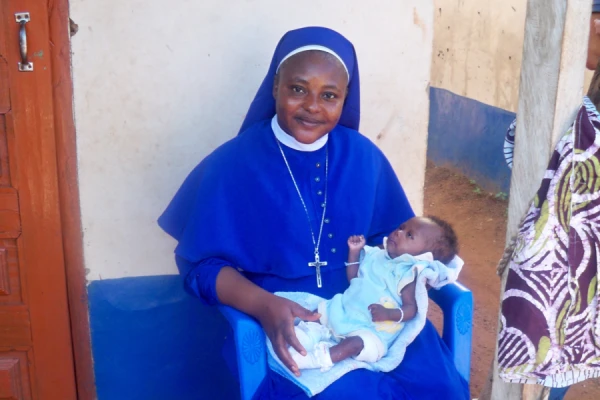
Rome, Italy, Jun 23, 2020 / 10:30 am (CNA).- Sister Stan Mumuni dedicates her life to caring for abandoned children with birth defects in Ghana. When the coronavirus pandemic spread to West Africa, she said that she ran to the market to buy soap and supplies, but the prices had already tripled.

“We ran to the place. The price has gone too high. We have to get food to store food to be able to feed these children,” Sister Stan said at a virtual symposium June 23.

Some of the children cared for by her religious order have such severe disabilities that they cannot eat solid food, but rely on milk. “Getting milk to feed them everyday was very, very hard,” she said.

“Many people are dying of hunger. We live in a poverty zone. … With the pandemic we have to struggle with the little we have to be able to even reach out to others to support them.”

As parts of Ghana went into lockdown, Sister Stan said that she received more and more phone calls. First, there were calls from the special needs schools asking her order to come pick up the orphaned children and bring them to their house as the schools closed.

Then there were the calls concerning newborn disabled children whose lives were at risk.

The Marian Sisters of Eucharistic Love, founded by Sister Stan in 2009, provide a home for children with special needs who were often rejected by their families and communities because of superstitious beliefs that associate birth defects with witchcraft. 

“At this period too, we have been called by so many priests: ‘Please rescue a child that is in danger,’” she said.

“‘Please, Sister, come, we have rescued two children that they wanted to kill them.’ ‘Please come, a woman gave birth and died and that child is considered ‘witch’ … and we need to do something about it.’”

Sister Stan said that although movement had become very difficult, she knew that God was calling her order to rescue these children. 

She recalled that she had heard this call very distinctly in the founding of the Marian Sisters of Eucharistic Love: “Christ told me: ‘Even though you have nothing, I am telling you to go and rescue my children.’”

“All this we have to risk our lives to go in search for such innocent victims,” she said. “Christ said: ‘Let the children come to me’ … children are precious to God.”

She added: “Our mission here on earth is to keep rescuing life, rescuing souls, and to keep spreading the good news of the kingdom of God.”

Sister Stan was one of several sisters who shared her religious order’s experience of the COVID-19 pandemic in the “Women Religious on the Frontlines” virtual symposium co-hosted by the U.S. and British embassies to the Holy See. 

Sister Alicia Vacas, regional leader of the Comboni Sisters in the Middle East, was also called to take risks to serve those in need amid the pandemic.

“Unfortunately one of our communities in Bergamo got infected at the very beginning of the coronavirus emergency, and we started receiving very bad news from the community,” Sister Alicia said at the symposium.

“And several young sisters, several of us nurses, we volunteered to go and reach them and to help them.”

Once she arrived in the town of Bergamo, located in Lombardy, the epicenter of Italy’s coronavirus outbreak, Sister Alicia said that the Comboni motherhouse “was in real chaos” because “everybody was sick.”

She estimated that 45 sisters of the 55 living in Bergamo were ill. Ten Comboni sisters from her community died during the outbreak.

“It has been a very powerful experience to live from inside the suffering of the people in Bergamo,” she said, adding that it has been an experience of Christ’s Passion.

“As a Comboni sister, I think it has been only a privilege … sharing with people’s lives, with people’s sufferings,” she said, calling it a “gift from God for the whole congregation.”

Sister Alicia, who is now back at the convent in Jerusalem, said that the coronavirus pandemic is not over and “the situation is very worrying” for many sisters in other parts of the world. 

The World Health Organization reported June 22 the largest single-day increase in coronavirus cases, with more than 183,000 new infections documented worldwide in 24 hours.

Sister Alicia said: “I have been in contact with many sisters working in places like Jordan … in South Sudan, in Chad, in Ecuador, and I can see the sisters exposed to many risks with no equipment at all. They don’t work in many cases in government hospitals. They don’t have access to tests. So they are receiving suspected cases and patients without any possibility of protecting themselves.” 

“For many other sisters who are not working in medical issues, they have to face this explosion … of poverty and social crisis, and many sisters … are dealing with starvation,” she added.

Callista Gingrich, the U.S. Ambassador to the Holy See, said that the coronavirus pandemic “has caused vast unemployment, poverty, and food insecurity — further challenging the work of women religious.”

“I want to take a moment to recognize and honor the tremendous sacrifices made by women religious during this pandemic,” she said. “Here in Italy, and around the world, many faithful sisters have made the ultimate sacrifice while caring for others. As we continue our work together, let us preserve and honor their memory.”

[…]

Longtime Catholic schools leader to head Seattle archdiocese task force

June 22, 2020 CNA Daily News 1

Denver Newsroom, Jun 22, 2020 / 08:19 pm (CNA).- Leading education expert Father Ronald Nuzzi will head a task force for Catholic schools in the Archdiocese of Seattle, with a special focus on the “ministerial covenant” that helps Catholic teachers witness to and pass on the Catholic faith.

“Catholic schools are rooted in the Catholic faith. It’s what makes them different from other private schools,” Nuzzi told CNA. “Therefore, our educators are asked to teach from this faith-based foundation.”

“At the core of the faith are the great mysteries, which root both parishes and schools in the Incarnation, the Trinity, the Paschal Mystery, and the Eucharist,” he said.

Nuzzi is a priest of the Diocese of Youngstown in Ohio and professor emeritus of the University of Notre Dame. He is senior director emeritus at the university’s Alliance for Catholic Education, which aims to support, improve and expand Catholic K-12 schools, especially schools lacking resources.

“Catholic schools had their origin in the immigrant Church, providing a safe and faith-filled place where newcomers to this country could learn, grow, and prosper,” Nuzzi said. “They served a vital social and religious purpose, providing waves of immigrants the opportunities to fully participate in American society. Today, Catholics are part of the mainstream, but schools are still providing a counter-cultural witness, addressing the secularization, consumerism, relativism, racism, and hyper-individualism that are so common today.”

“In some ways, a Catholic school education, rooted in Gospel values and the example of Jesus, are even more important today than they once were,” he continued.

Nuzzi’s task force is set up to secure three key goals. These include a review and study of Church documents about Catholic teaching and tradition, especially the formation of conscience, free will, and human social and sexual development. The task force will assess, analyze and summarize the convictions, beliefs and opinions of archdiocesan stakeholders about the ministerial covenant and its use in employment decisions.

They will make a recommendation based on “an informed and thoughtful approach” to renewal of the ministerial covenant in a way that respects both of the previous goals and “embraces the fullness of church teaching while honoring and appreciating the sense of the faithful,” the Seattle archdiocese said.

The archdiocese did not respond to CNA’s questions about the meaning of “the sense of the faithful,” or what would happen if public opinion conflicted with Church teaching.

“The Ministerial Covenant ensures that our 73 Catholic schools reflect our Catholic faith. How it is applied across our Catholic schools is of great interest not only to me, but to all our principals, teachers, parents and students,” Archbishop Paul Etienne of Seattle said in a June 16 statement from the Seattle archdiocese.

He voiced gratitude for Nuzzi’s leadership in “this important body of work.”

“He is a well-known leader in Catholic school administration and has a wealth of experience as well as a great passion for the faith and Catholic schools,” Etienne said.

Nuzzi will review nominees for task force membership. Nominees include principals, pastors, parents of children in Catholic schools, Catholic school teachers and members of the archdiocese’s Office for Catholic Schools. The nominees will be announced in July.

“The ministerial covenant is signed by all employees of the Archdiocese of Seattle. It hasn’t been updated in several years, so this taskforce will review its language and how it is applied at Catholic schools across the archdiocese,” Nuzzi told CNA. “What is important about the title ‘ministerial covenant’ is that every Catholic school in the country, including all in the Archdiocese of Seattle, considers teachers to be ministers of the Gospel and witnesses to the faith.”

Ministerial language is not intended to “clericalize” lay teachers or obscure the lay state, he said.

“Lay leaders not only help run our Catholic schools, they help run our entire archdiocese,” Nuzzi said. “This taskforce is focused on Catholic teaching and the Catholic faith – not on clericalization. In calling our teachers ministers, we are saying they are public, contractually committed, inspired examples, worthy of emulation, not clerics.”

The task force will meet 12 times from August 2020 to June 2021. Members are asked to maintain confidentiality about all deliberations.

In a statement from the archdiocese, Nuzzi described Catholic schools as a “vital part” of the Church’s mission. He said he was “enthusiastic” about the task force and “its potential to help shape a brighter future for youth, children, and families.”

The Seattle archdiocese covers the territory of western Washington State. Almost 580,000 Catholics are registered with a parish and make up over 15% of the area’s population.

The people of Washington state tend to be more secular than other Americans. Those without religious affiliation make up the largest group, about 32%, if small sections of atheists and agnostics are grouped with 22% who self-identify as “nothing-in-particular.” However, 61% self-identify as Christian. Evangelical Christians make up about 25% of Washingtonians, 17% identify as Catholic, and 13% as mainline Protestant, the Pew Research Center reported in 2019.

The task force was announced in February after the Seattle archdiocese saw a controversy in which the facts are disputed. Two teachers at Kennedy Catholic High School in Burien, Washington either resigned voluntarily in order to contract same-sex civil marriages with different partners, or were forced out of their positions.

Michael Prato, president of Kennedy Catholic, said in a February statement that the two teachers approached him in November 2019 to share their desire to civilly marry their same-sex partners.

The teachers had voluntarily signed a covenant agreement to “live and model the Catholic faith in accord with Church teaching,” Prato said. In light of the agreement they signed, both chose to resign, he said. The school worked out a transition plan and financial package for the teachers.

“I hired these teachers and I care about them very much. I still do,” Prato said. “I wanted to make sure they felt supported, and so we discussed several options including the possibility of finishing out the school year.”

Groups of students staged protests in support of the teachers. Students, as well as parents and alumni of the school, also staged a protest outside the diocesan chancery in Seattle.

The two teachers’ attorney, Shannon McMinimee, said the teachers were forced out. She said they “were hoping to have a dialogue with the school about their desire to be their authentic selves and not hide that they were engaged and not hide who they were engaged to.”

“And that — what they thought would be a conversation with their principal turned into being called into the presidents’ office and being told that the superintendent of the archdiocese school system wanted their keys the minute they found out they were gay and engaged,” McMinimee said, according to KING 5 News Feb. 21.

Archbishop Etienne addressed the situation in a Feb. 19 statement.

“Pastors and church leaders need to be clear about the church’s teaching, while at the same time refraining from making judgments, taking into consideration the complexity of people’s lived situations,” he said, stressing that the end goal of accompanying people in faith is “to help people embrace the fullness of the Gospel message and integrate the faith more deeply into their lives.”

“Those who teach in our schools are required to uphold our teaching in the classroom and to model it in their personal lives,” he said. “We recognize and support the right of each individual to make choices. We also understand that some choices have particular consequences for those who represent the church in an official capacity.”

The Catholic Church teaches that while homosexual inclinations are not sinful, homosexual acts “are contrary to the natural law… under no circumstances can they be approved.”

The Catechism of the Catholic Church goes on to say that people with these inclinations should be “accepted with respect, compassion, and sensitivity. Every sign of unjust discrimination in their regard should be avoided.”

In 2003, the Vatican’s Congregation for the Doctrine of the Faith said that “in those situations where homosexual unions have been legally recognized or have been given the legal status and rights belonging to marriage, clear and emphatic opposition is a duty.” It said Catholics must refrain from any kind of formal cooperation with such laws and, insofar as possible, any material cooperation.

“In this area, everyone can exercise the right to conscientious objection,” the CDF said.

In the United States, various Catholic schools and dioceses have faced lawsuits from employees who have been fired after contracting civil same-sex marriages in violation of the diocesan or school policy.

Despite strong social pressure, the legal freedom of primary and secondary Catholic schools appears secure at present. In the 2012 U.S. Supreme Court case Hosanna Lutheran Church and School v. Equal Employment Opportunity Commission, the court unanimously ruled that religious organizations do not need to follow federal anti-discrimination laws in what was characterized as a “ministerial exception.”

At the same time, religious freedom has become a target by some LGBT advocacy groups and politicians who say it wrongfully protects actions they consider discriminatory.


[…]