No Picture
News Briefs

Cardinal Gregory, young Catholic leaders to dialogue about humanitarian crises, racism, and solidarity

October 7, 2021 Catholic News Agency 0
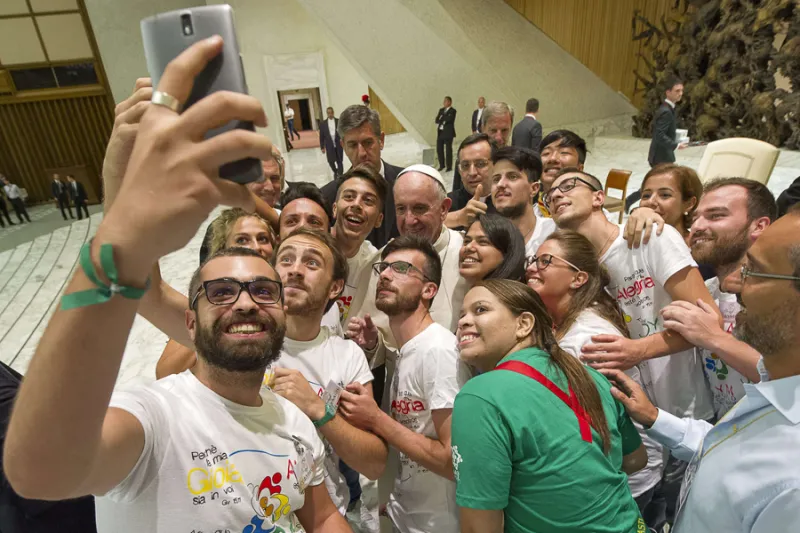
Pope Francis takes a selfie with members of International Eucharistic Youth Movement in Paul VI Hall on Aug 7, 2015. / L’Osservatore Romano

Washington D.C., Oct 7, 2021 / 14:05 pm (CNA).

Tonight, the Initiative on Catholic Social Thought and Public Life at Georgetown University will host the first of a three-part dialogue series for young adults on Fratelli tutti, Pope Francis’ encyclical on fraternity and social friendship. The first session, “Who is My Neighbor,” will focus on the humanitarian crises in Afghanistan and Haiti, as well as systemic racism in the United States. 

The series, which came about at the request of Pope Francis by way of the USCCB and Archbishop Jose Gomez, is designed to engage young adults in conversation around the topic of solidarity with their neighbors, both in the U.S. and abroad. The first dialogue will wrap up with a call-to-action for participants to consider the question, “Who is my neighbor?” 

“What’s one thing the young adults listening can do to practice what Pope Francis teaches us in Fratelli tutti to support our sisters and brothers, whether they’re our next door neighbors, or whether they’re in Afghanistan or Haiti?” said Anna Gordon, project manager for the Initiative on Catholic Social Thought and Public Life. “We’re hoping that people will leave the conversation feeling inspired to act on the message of Fratelli tutti.” 

The core of the initiative’s mission, Gordon said, is to bring young leaders together to talk about how their faith impacts the world. The initiative has been around for more than eight years, and it works closely with the Archdiocese of Washington on community initiatives.  

The dialogue will include four parts: a brief overview of the topic and a welcome from Cardinal Wilton Gregory, Archbishop of Washington; a discussion on the general themes of Fratelli tutti, led by two of the participants along with the cardinal; examples of what it means to be a neighbor in Washington, Haiti, and Afghanistan; and a time for questions and answers.  

“A big focus will be talking about what the role of social friendship and solidarity means when there are these humanitarian crises happening,” Gordon said. “We’re talking about global solidarity, but also what does solidarity look like in our own backyard.”

The panelists for the first dialogue are Muzhgan Azizy, a recent refugee from Afghanistan; Juan Aznaran, partnerships manager for the Newcomer Network of Catholic Charities in the Archdiocese of Washington; Omayma El Ella, project associate for the Just and Inclusive Society Project at Democracy Fund; Reynold Hyppolite, head of youth programming for Catholic Relief Services in Haiti; Gerald Smith, Jr., a Catholic school principal in Washington, D.C.; and Cardinal Gregory.

“We have such rich and diverse viewpoints and perspectives,” Gordon said. “They all have such wonderful things to share about their work, their lives, and how they’ve been seen as a neighbor and how people have reached out to them as neighbors.” 

“Despite the newsreel that we see on our phones, the constant, what seems like, negative news, these participants are giving us glimpses of what it really means to be a neighbor in a time of global humanitarian crises, racism, and the pandemic,” Gordon said.

Though encouraged, RSVPs are not required to participate in the series. The dialogue, an extension of the Theology on Tap programs of the Archdiocese of Washington, will be livestreamed on YouTube, Facebook, and Twitter at 7 p.m. EDT. 

“I hope it challenges the people watching to dream and to hope, and to really reach out to their neighbors and ask, ‘Who is my neighbor in my life?’ and ‘How can I be a better neighbor to everyone that I meet?’” Gordon said. 

The next two dialogues in the series will be held Nov. 4 and Dec. 2.


[…]

No Picture
News Briefs

National rosary rally to take place in nation’s capital

October 7, 2021 Catholic News Agency 1
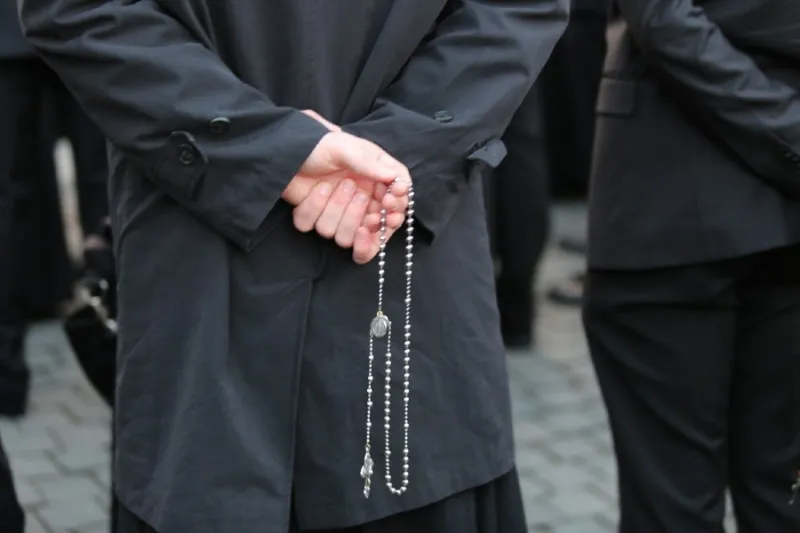
Seminarians from the North American College in Rome, Italy pray the rosary in St. Peter’s Square for Pope Francis on March 13, 2016. / Alexey Gotovskiy/CNA

Washington D.C., Oct 7, 2021 / 13:02 pm (CNA).

A “National Rosary Rally” in Washington D.C. on Oct. 10 will cap a 54 day rosary novena for the “protection and provision for the USA and the world,” prayed by Catholics around the country. 

“We now need to implore graces from Almighty God, to lead the Pope and the Bishops to follow sound doctrine and tradition, and firmly reject modernist interpretations of the priesthood, religion, and inculturation,” the website for Rosary Coast to Coast 2021, which is organizing the event, states.

The rosary novena began on Aug. 15, the Solemnity of the Assumption of the Blessed Virgin Mary, and ended on Oct. 7, the feast of Our Lady of the Rosary. 

The national rosary rally will be held in Washington, D.C. on Oct. 10, and local rallies are encouraged at state capitols and other public places around the country. “We are asking everyone to join us in Union Square in front of the U.S. Capitol for a very special Rosary Rally on October 10,” the website says. “We want to call out to God in a very special way at the conclusion of our 54 Day Rosary Novena.”

Participants are asked to assemble at St. Peter’s parish on Capitol Hill at 1:30 p.m, followed by exposition of the Blessed Sacrament at 1:55 p.m. and a procession at 2 p.m. to the rally site at Union Square. A rosary will be prayed during the Eucharistic procession.

During the rally, participants will be accompanied by the Immaculate Heart of Mary statue from the World Apostolate of Fatima USA.

For those who are unable to attend the national rally, they are encouraged to attend local rallies or pray outside a nearby abortion clinic or at their parish church. Recitations of the Glorious Mysteries of the rosary will commence on Sunday at 4 p.m. Eastern Time.

The rally will feature speakers including Bishop Joseph Coffey, auxiliary bishop for the Archdiocese of the Military Services; Fr. Chris Alar, MIC; Sister Deirdre Byrne, superior of the Little Workers of the Sacred Hearts; and Doug Barry, founder of the Catholic apostolate Radix-Battle Ready.

The initiative has received endorsements from Raymond Cardinal Burke, Bishop Athanasius Schneider, and Fr. Donald Calloway MIC, author of Consecration to St. Joseph.


[…]

No Picture
News Briefs

Missouri bishops condemn execution of Ernest Johnson

October 7, 2021 Catholic News Agency 1
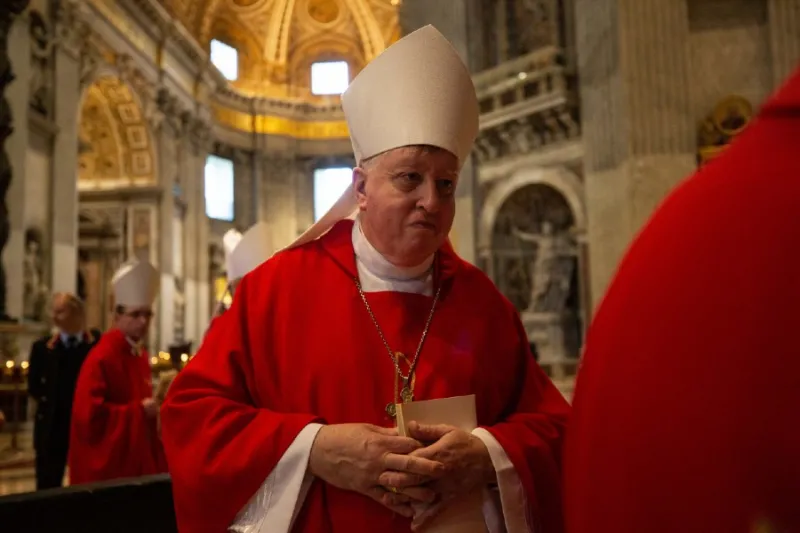
Mitchell Rozanski, then-Bishop of Springfield in Massachusetts and current Archbishop of St. Louis, in St. Peter’s Basilica, Nov. 7, 2019. / Daniel Ibanez/CNA

Washington D.C., Oct 7, 2021 / 11:10 am (CNA).

The four bishops of Missouri released a joint statement on Wednesday evening condemning the state’s execution of Ernest Lee Johnson, on whose behalf the Holy See pleaded for clemency.

Johnson, 61, was executed by lethal injection on Tuesday, after the Supreme Court denied his emergency appeal for a stay of execution. He was convicted of killing three convenience store employees with a claw hammer in 1994 while attempting to rob the store for drug money..

“As the Catholic bishops of Missouri, we express our disappointment with the decision to allow the execution of Ernest Lee Johnson to move forward yesterday,” said the statement, which was signed by Archbishop Mitchell Rozanski of St. Louis, Bishop James Johnson of Kansas City-St. Joseph, Bishop Shawn McKnight of Jefferson City, and Bishop Edward Rice of Springfield-Cape Girardeau. 

The bishops said that while Johnson’s crimes were “heinous and deserve to be punished,” the “pro-life state” of Missouri should cease the use of capital punishment. 

The bishops expressed their “sincerest condolences” to the families of Johnson’s victims. 

“The lives of Mary Bratcher, Mabel Scruggs and Fred Jones deserve honor and remembrance,” they said. “We pray for the comfort of their loved ones as they are forced to relive the trauma and pain of these crimes through this execution.” 

The death penalty, said the bishops, “does not make Missouri a safer or more civil state.” 

“As we communicated in our clemency request last month, the death penalty degrades us as a society and teaches our children that violence is the proper response to violence,” they said. “When someone is executed, the opportunity for them to undergo a conversion and repent prior to their final judgement may be lost. That important time for grace to work in a person’s heart is taken away.” 

Alternative punishments, such as life in prison without the possibility of parole, would serve as a suitable way to “address these crimes without resorting to the death penalty,” they said. 

“We ask Catholics and people of good will to join us in seeking alternatives to the death penalty for Missouri’s most violent criminals,” the bishops said. “Even those who commit the most offensive acts do not lose their human dignity before God.”

Johnson’s execution was controversial due to questions surrounding his intelligence. His lawyer, Jeremy Weis, claimed that Johnson was intellectually disabled and had an IQ below 70. 

The Missouri Supreme Court ruled that Johnson had not proven that he was intellectually disabled, noting that he had extensively planned the crimes and taken steps to destroy incriminating evidence. 

Johnson was initially scheduled to be executed in 2001, but the U.S. Supreme Court ruled that it was unconstitutional to execute those with intellectual disabilities. He was re-sentenced to death in 2003 before that sentence was tossed out by the state Supreme Court. He was re-sentenced to death again in 2006.

Archbishop Christophe Pierre, Apostolic Nuncio to the United States, on Monday issued a message to Missouri Gov. Michael Parson asking for “some appropriate form of clemency” for Johnson.


[…]