No Picture
News Briefs

Ecuador congress affirms parents’ rights to educate kids on sexuality

August 2, 2018 CNA Daily News 0

Quito, Ecuador, Aug 2, 2018 / 05:51 pm (ACI Prensa).- The National Assembly of Ecuador on July 31 unanimously upheld the right of parents to educate their children “in accordance with their principles, beliefs, and educational choices” without interference from the State in issues such as sex education.

The legislature’s gesture came in response to recent rulings by the Constitutional Court, including a June 27 decision which takes away “the protective authority of parents” and gives it to the state as the outside guarantor when considering the “rights” of minors “in education and sexual and reproductive health.”

Viviana de González, president of the Family and Future Foundation, said that the National Assembly’s 70-0 ratification of parental rights is supported by Article 29 of the Constitution of Ecuador as well as the United Nations’ Declaration of Human Rights.

“Although this political pronouncement by the legislative branch is not binding on the [recent] ruling of the Constitutional Court, it’s a clear response to the citizens’ public demonstration of a half million parents who took to the streets July 28 in more than 10 cities in the country,” she said.

The march was held in opposition to the government’s intention to impose gender ideology in education. It also demanded that any attempt to legalize abortion in the country be definitively shelved.

Demonstrators marched under the themes #ConMisHijosNoTeMetas (Don’t mess with my children) #EnfoquedeFamilia (Focus on the Family), #AmisHijosLosEducoYo (I’m the one to educate my children), and #SalvemosLas2Vidas (Save both lives).

De González said that the recent resolution by the National Assembly also urges the Constitutional Court and other state agencies to “protect parental rights, the family, childhood and adolescence.”

“Organizations such as the National Front for the Family will remain vigilant so that this resolution leads to concrete actions in support of the family in the different courts of the State,” she said.


This article was originally published by our sister agency, ACI Prensa. It has been translated and adapted by CNA.

[…]

No Picture
News Briefs

How banning plastic straws could impact the disabled

August 2, 2018 CNA Daily News 1

Washington D.C., Aug 2, 2018 / 04:21 pm (CNA).- Sea turtles often sleep wedged beneath boulders on the ocean floor, or tucked below protruding ridges in coral reefs. They live, quite literally, under rocks. This means that sea turtles likely haven’t heard that plastic drinking straws can kill them, and the straws are being banned in cities across the country.

Unlike sea turtles, most people don’t live under rocks. Which means that most people, or at least most Americans, have heard in recent weeks of the mortal danger that disposable straws might cause for sea turtles, and of recent efforts to forbid those straws.

A recent focus on the danger posed by discarded drinking straws for turtles and other aquatic life is widely credited to an online video that went viral this summer, showing a sea turtle struggling with a straw stuck up its nostril.

The video has attracted fervent public enthusiasm to curb the use of drinking straws. In recent weeks, many companies and cities have taken the step to ban single-use plastic straws, citing environmental concerns.

Starbucks announced that it would eliminate them from its stores by 2020, and the Walt Disney Co. followed suit shortly afterwards, saying it would cease using plastic straws and stirrers at its theme parks by 2019.

The city of Santa Barbara, California, took the unusual step of threatening jail time for those who distribute straws, while San Francisco’s city-wide ban is so expansive it actually prohibits one of the biodegradable alternatives that is encouraged by other other cities considering bans, including New York and Seattle.

But questions have arisen about just how actually effective these laws and policies will be for the environment, and some groups say that their lives will be made harder when straws are not available. And one Catholic theologian has told CNA that policymakers looking for ways to protect the environment should always consider the broader context of their work, and beware of unintended consequences.

Speaking about the recent focus on single use plastics, particularly drinking straws, by many companies and cities, Dr. Joe Capizzi, a moral theologian at the Catholic University of America and executive director of the school’s Institute for Human Ecology explained that “any environmental activity is going to affect different populations differently.”

Capizzi told CNA that well-motivated policy changes, like those banning plastic straws, can have unintended consequences, and policymakers should consider those who could be unexpectedly affected.

Responsible stewardship of the planet has been a point of emphasis for Pope Francis, most notably in his 2015 encyclical letter Laudato si, on the care of our common home.

In a message marking the World Day of Prayer for the Care of Creation in 2016, the pope called efforts to protect the natural environment a service to both the planet and to humanity, calling it a “work of mercy.”

Francis has emphasized especially a “human ecology” that recognizes the dignity of the human person, and man’s relationship to the environment.

The move to ban drinking straws has raised questions about how environmental policies can impact human dignity.

Disability-rights advocates point out that some people with physical or neurological disorders rely on plastic straws as tool of daily life. They say that drinking straw bans can cause real hardship for people with conditions like cerebral palsy, pointing out that for some people, a straw can be the difference between independence and needing help to drink.

“It’s no surprise, then, the bans on straws will impact different segments of society differently. Straws help provide a measure of independence to some people with disabilities,” Capizzi said.

More eco-friendly alternatives, such as straws made from metal, bamboo, and paper, are not as always as suitable as single-use plastic straws. Metal straws can get too hot, are not positionable, and can possibly break teeth, especially among people with certain disabilities. Paper straws can’t be used in hot liquids, and they dissolve, creating a choking hazard, advocates say.

At the same time, some argue that straw bans may actually do little to protect the environment. Popular support for bans on single use plastics tends to focus on oceanic pollution, as the Great Pacific Garbage Patch is now calculated to be more than 600,000 square miles. Yet straws compose only 0.02 percent of waste found in the ocean. Fishing gear–which the World Wildlife Fund identifies as the biggest threat to sea turtles–is the largest source of plastic waste.

Capizzi urged that while Catholics work to protect the planet as a common home for all humanity, they give attention to the personal concerns of those who might be left behind by advertising campaigns and popular videos.

“You may recall years ago, the Montreal Protocol was passed and implemented to address chlorofluorocarbons and their adverse effects on the ozone layer. Because some medicines were delivered by CFCs, special carve-out provisions were provided so those people could continue to receive their medicine cheaply and effectively,” he said.

“The move to look at the impact of plastics on the environments is well-intentioned: reliable evidence points out damaging effects of plastics on our environment. But before proceeding, care should be taken to weigh the impact this limited ban will have on populations for whom plastic straws are no mere convenience.”

[…]

No Picture
News Briefs

Abortion bill a matter of life and death, Australian bishop says

August 2, 2018 CNA Daily News 0

Queensland, Australia, Aug 2, 2018 / 11:23 am (CNA/EWTN News).- Archbishop Mark Coleridge of Brisbane, Australia encouraged members of parliament to look beyond the “worn-out ideologies and tricky language” behind a bill to legalization abortion in Queensland.

“When you talk about abortion you’re talking about two lives the mother and the child and both lives matter,” Archbishop Coleridge said, in comments reported by diocesan newspaper The Catholic Leader.

“To speak of a woman’s rights is important, but what of the rights of unborn children, or do they have no real human status?”

The archbishop responded to a Queensland proposal that would legalize abortion on demand up to 22 weeks, and abortion until birth with the permission of two separate doctors.

It would also prohibit protesters from coming within 150 meters of an abortion clinic.

Doctors would be permitted to refuse to perform abortions if they have moral objections to doing so, but they must refer patients to another doctor.

Currently, abortion is illegal in Queensland except when a doctor believes a woman’s physical or mental health to be in serious danger.

The proposal to legalize abortion is expected to be introduced this month, based on a June report from the Queensland Law Reform Commission, which recommended removing abortion from the Criminal Code.

It is uncertain whether it has the support to pass in parliament, local media reports said.

Opponents of the bill have argued that while the legislative proposal is being presented as a matter of health, it will in fact legalize abortion based on financial, social, or eugenic reasons.

“According to the draft bill, abortion will be permitted until the moment of delivery if two doctors consider that ‘in all circumstances, the termination should be performed’,” Archbishop Coleridge said in The Catholic Leader.

“So, it’s not a health issue. It’s an essentially moral issue that concerns the good of society as a whole because it touches on questions of life and death.”

He cautioned that many women choose abortion out of desperation, believing that they have no other options, because those who support abortion do not present other choices.

“Those MPs who favour the legislation should say why they can accept that Queensland babies who may have reached 40 weeks gestation can be aborted when health isn’t a factor,” he said.


[…]

No Picture
News Briefs

Pope Francis tells Jesuits in formation to help at-risk youth

August 2, 2018 CNA Daily News 2

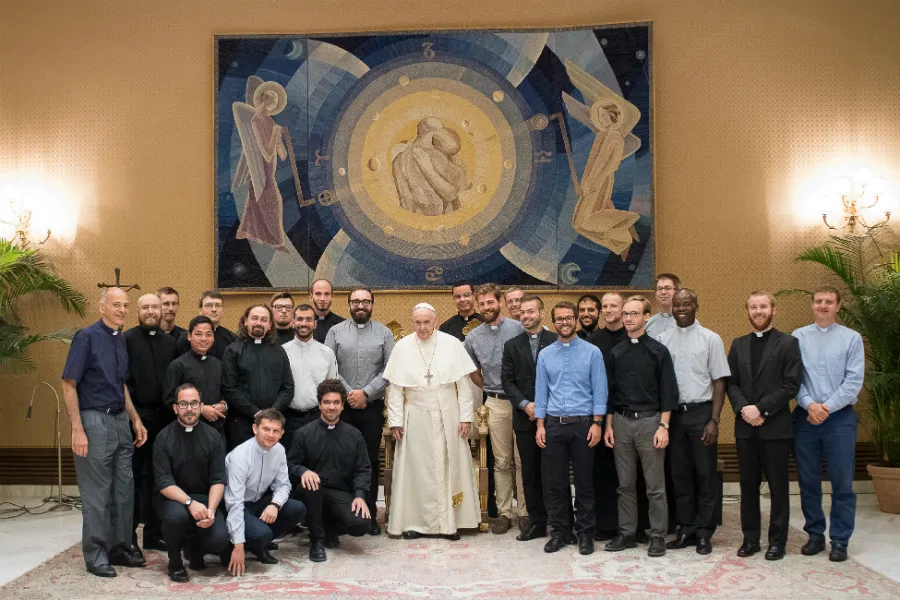
Vatican City, Aug 2, 2018 / 10:14 am (CNA/EWTN News).- Pope Francis met with a group of Jesuits Wednesday urging them to help youth who are unemployed, and who might be at risk of suicide, drug addiction, or of joining a terrorist organization.

Answering a question from a participant of a “European Jesuits in Formation” course, during a private audience in the anteroom of the Vatican’s Paul VI Hall Aug. 1, the pope said youth unemployment “is a problem of dignity,” and stressed it is an issue Jesuits should be working to help solve.

Unemployment, he said, may be “one of the most acute and painful problems for young people, because it goes right to the heart of the person. The person who has no work, feels [themselves to be] without dignity.”

“This is important: understand the problem of young people,” help them feel that you understand them, and “then move to solve this problem,” he said.

Francis encouraged those taking part in the Jesuit formation course to get their “hands dirty” looking for a solution to the problems of unemployment, suicide, and drug use among young people, as well as the issue of youth joining terrorist organizations.

He went on to say he believes one cause of the high unemployment rate among young adults is an attention on what he called intangible “finance,” rather than the economy, which can be more easily oriented toward the dignity of the person.

During the meeting, Pope Francis also indicated his desire for Jesuits to read two speeches: one by Bl. Paul VI at the 32nd general congregation in 1974, and one by Fr. Pedro Arrupe, former superior general of the Society of Jesus, whose cause for sainthood was recently opened in Rome.

“In these two speeches there is the frame of what the [Jesuits] must do today: courage, going to the peripheries, to the intersections of ideas, problems, of the mission…” he said.

“It takes courage to be a Jesuit. It does not mean that a Jesuit must be irresponsible, or reckless, no. But have courage. Courage is a grace of God…”

At the unscripted meeting, Francis also asked for their prayers, and made a comment about the difficulty of being pope, saying the work “is not easy.” Noting that perhaps that statement could sound like “heresy,” he added that it is also “usually fun.”

He recalled that it was said once that the primary role of the general superior was to “put to pasture the Jesuits,” meaning the general superior should be like a shepherd to the members of the congregation.

Francis said another person responded to this idea, saying, “‘Yes, but it is like putting to pasture a herd of toads:’ one from here, one from there…” because toads are not as easily shepherded as sheep.

This is a beautiful thing, however, the pope continued, “because it requires great freedom, [and] without freedom one cannot be a Jesuit.”

He pointed out that it also requires “great obedience to the shepherd; who must have the great gift of discernment to allow each of the ‘toads’ to choose what he feels the Lord is asking him [to do].”

“This is the originality of the Society [of Jesus]: unity with great diversity,” he said.

[…]

No Picture
News Briefs

On Aug. 2, you can get this St. Francis-themed indulgence

August 2, 2018 CNA Daily News 0

New York City, N.Y., Aug 2, 2018 / 03:18 am (CNA/EWTN News).- Today’s feast of Our Lady of the Angels of Porziuncola and its associated indulgence is a way to focus on the importance of Mary and the Franciscan tradition in the Church, said one friar.

The Aug. 2 feast is found in the Franciscan tradition, and marks the dedication of the parish church, called Porziuncola or “little portion,” which is one of those Italy’s St. Francis of Assisi rebuilt in obedience to Christ’s command to “rebuild my church.”

“The Porziuncola is at the heart of the Franciscan journey,” Father David Convertino, the development director for the Holy Name Province of the Observant Franciscans, told CNA.

“For Francis, it was his most beloved place. He lived near it with the early followers … and he loved the Porziuncola, as it was part of his devotion to Our Lady.”

The Catholic Church teaches that after a sin is forgiven, an unhealthy attachment to created things still remains. Indulgences remove that unhealthy attachment, purifying the soul so that it is more fit to enter heaven. Indulgences are either plenary (full) or partial.

A plenary indulgence also requires that the individual be in the state of grace and have complete detachment from sin. The person must also sacramentally confess their sins and receive Communion up to about 20 days before or after the indulgenced act.

Anyone who visits a Catholic church with the intention of honoring Our Lady of the Angels and recites the Creed, the Our Father, and prays for the Pope’s intentions, may receive a plenary indulgence on Aug. 2.

“Any kind of a prayer form that helps people come closer to God is obviously a good prayer form, and certainly an indulgence is one way,” Fr. Convertino said.

“It helps us focus on, in this case, the meaning of the Porziuncola and the Franciscan tradition, how it’s situated in the greater idea of the Church.”


Porziuncola located inside the Basilica of Santa Maria degli Angeli near Assisi. Credit: emmav674 via Flickr (CC BY_NC_SA 2.0)

The Porziuncola was built in honor of Our Lady of the Angels in the fourth century, and by St. Francis’ time had fallen into disrepair. The church, which was then located just outside of Assisi, became the “motherhouse” of the Franciscan orders.

“Although Francis realized that the kingdom of heaven is found in every dwelling on earth … he had learned nevertheless that the church of Saint Mary at Portiuncula was filled with more abundant grace and visited more frequently by heavenly spirits,” says the life of St. Francis written by Friar Thomas of Celano, read today by Franciscans.

“Consequently he used to say to his friars: ‘See to it, my sons, that you never leave this place. If you are driven out by one door return by the other for this is truly a holy place and God’s dwelling.’”

Fr. Convertino added that the Porziuncola “was the place he chose to lie next to on his deathbed, and at that time of course you could have looked up to the city of Assisi, which he also loved so well.”

The Porziuncola, a rather small chapel, is now located inside a large basilica which was built around it, to enclose and protect it.

“You have this large basilica built over this teeny tiny little chapel,” Fr. Convertino reflected. “If that chapel wasn’t there then the basilica wouldn’t be there, but if the basilica wasn’t there, the chapel probably wouldn’t be there either, given 800 years of war, weather, and turmoil.”

For Fr. Convertino, the duality of the big church and the little church is a reflection of the relationship between the world-wide Catholic Church and the smaller communities which make it up.

“We feel the Franciscans kind of convey, we’re the ones at the heart of the Church, the little church there.”

He said that each time he visits Assisi, the “experience” of the Porziuncola is “compounded more and more,” and added that “it’s such a magnificent place, and the friars there are wonderful.”

Fr. Convertino also discussed the fresco now painted around the entrance of the Porziuncola, which shows St. Francis, together with some of his followers, receiving the indulgence from Christ and Our Lady.

“The idea behind the story is that Francis is asking Jesus for a Porziuncola indulgence, and Jesus is saying to Francis, ‘Well, you really better ask Mary, ask my mother.’”

This article was originally published Aug. 2, 2013.

[…]

No Picture
News Briefs

Lincoln diocese responds to reports of misconduct by former vocations director

August 1, 2018 CNA Daily News 0

Lincoln, Neb., Aug 1, 2018 / 05:16 pm (CNA).- The Diocese of Lincoln, Nebraska acknowledged reports of inappropriate sexual behavior by a deceased former vocations director, following an article by a former priest alleging misconduct and scandal on the part of the director.

In an Aug. 1 statement, the Diocese of Lincoln said that it “is aware of past reports of conduct contrary to prudence and moral law by Monsignor Leonard Kalin, deceased in 2008.”

“The diocese addressed these allegations of misconduct directly with Msgr. Kalin during his time in priestly ministry,” the statement said, adding that the diocese is not aware that Kalin violated any civil laws.

“The Diocese of Lincoln is also aware of past reports of conduct contrary to prudence and moral law by former Diocese of Lincoln priest Peter Mitchell. The diocese addressed these allegations of misconduct directly with Mitchell during his time of ministry in the Diocese of Lincoln.”

In its statement, the diocese emphasized that it “reports all alleged violations of civil law to the proper authorities, and is committed to addressing all violations of prudence, morality, or civil law by its clergy, employees and volunteers at the time they are reported.”

The statement came in response to an Aug. 1 article in the American Conservative by Peter Mitchell, a former priest who had attended seminary in the Diocese of Lincoln. Mitchell was laicized in 2017 after violating his vow of celibacy on multiple occasions.

Mitchell’s article discusses Monsignor Leonard Kalin, was the vocation director for the Diocese of Lincoln and pastor of the University of Nebraska Newman Center from 1970 until the late 1990s.

While Kalin was well-respected for his orthodoxy and attracting vocations, Mitchell said, he led a life of sexual immorality and set a poor example for the seminarians he oversaw.

Mitchell said Kalin would regularly ask seminarians to help him shower, giving the excuse that he was old and needed help, and would then make sexual advances toward them.

He also said Kalin would invite seminarians on trips to Las Vegas and would require them to meet with him late at night at the Newman Center before inviting them to his private quarters for a drink.

Those who declined such invitations were subject to inferior treatment, he said. On one occasion, he said that he was questioned by another seminarian about his loyalty to Kalin after he had complained to the then-Bishop of Lincoln. He said he did not receive a response from the bishop.

“I experienced profound discrimination as a seminarian and later as a priest because I was a heterosexual in an overwhelmingly homosexual environment where sexually active gay priests protected and promoted each other,” Mitchell said.

Mitchell indicated that he avoided showering with Kalin, drinking with him alone late at night, or accompanying him to Las Vegas. Catholic News Agency contacted Mitchell to request additional detail about his knowledge of Kalin’s alleged sexual advances. Mitchell did not respond before deadline.

In his article, he said that his “life as a priest was undoubtedly affected by the totally inadequate and abusive formation I received in terms of preparing me for a healthy life as a celibate heterosexual male.”

He acknowledged his own violations of celibacy, which he said he regrets.

“I am painfully aware, however, that the people to whom my seminary formation was entrusted modeled addictive behavior to me and an entire generation of young men who are now priests,” he said.

Mitchell warned that Kalin’s behavior has had lasting effects on the diocese.  

“Although Kalin passed away in 2008, the seminarians he favored became the priests who continue to hold the reins of ecclesiastical power. To this day, anyone who tries to speak critically of Kalin’s behavior and legacy is met with a code of silence for ‘the good of the Church.’ If I ever tried to express frustration with Monsignor’s treatment of me, priests in positions of power over me quickly shut me down, almost robotically: ‘While he may have had a few flaws, he was very orthodox and recruited so many vocations.’”

He said that he believes priests currently in the diocese had bad experiences with Kalin, or knew about the misconduct, but are afraid to speak up due to fear of reprisal.

“Unfortunately, it is extremely difficult for active priests to speak out because the men they would be speaking out against control every aspect of their lives and their reputations,” he said. “But it needs to happen for their own good and for the good of the Church.”

The Diocese of Lincoln stressed that it “endeavors to maintain a culture of holiness, chastity, integrity and Christ-like joy among our seminarians and priests. We are also committed to maintaining the high standards of chaste behavior to which the Lord calls us.”

In its statement, the diocese asked “any priest, religious, seminarian, or lay Catholic with any information or concerns about past or current misconduct in a parish, school, or apostolate of the diocese to contact the diocesan chancery or, if criminal behavior is suspected, any law enforcement agency.”

Current Bishop of Lincoln James Conley acknowledged Mitchell’s article in his Aug. 3 column for the Southern Nebraska Register.

Discussing the accusations against both Kalin and Archbishop Theodore McCarrick, retired archbishop of Washington, D.C., who was removed from the college of cardinals last weekend, Conley stressed that Christ walks alongside the wounded in their pain and anger.

“Because sexuality is such a powerful gift, I believe that the evil one – Satan – tempts us to sin against chastity, and to misuse and abuse our sexuality, because doing so can cause great harm to the Lord’s beloved children,” he said.

Conley apologized on behalf of the Church to those who had been harmed by its members and leaders. He asked Catholics to pray for victims of sexual abuse and misconduct.

“Christ promises new life. May he renew his Church, and renew the hearts of those who are suffering,” he said.
 

J.D. Flynn, editor-in-chief of Catholic News Agency, previously served as special assistant to Bishop Conley and director of communications for the Lincoln diocese. Flynn has recused himself from coverage of this story to avoid a conflict-of-interest. He was not involved in the assigning, reporting, editing or oversight of this story.


[…]

No Picture
News Briefs

Catholic church in Northern Ireland hit with sectarian graffiti

August 1, 2018 CNA Daily News 0

Derry, Northern Ireland, Aug 1, 2018 / 04:01 pm (CNA/EWTN News).- A Catholic church in Northern Ireland was vandalized Tuesday morning with sectarian graffiti, upsetting parishioners and local leaders.

“We never had a problem like this before. There was something very minor about five or six years ago but this is completely new to us,” Msgr. Bryan McCanny, pastor of St. Mary’s in Limavady, fewer than 20 miles east of Derry, told BBC News NI.

“Parishioners are very upset about it. It’s depressing that things like this should happen when we are enjoying peace.”

“The two police officers who arrived this morning helped to clean the paint off the door,” he added.

Paramilitary slogans from an anti-Catholic group marked a door and some of the walls of St Mary’s July 31. A large crucifix outside of the church was also painted on.

The graffiti read UDA and UFF. The Ulster Defence Association is an Ulster loyalist vigilante group founded in 1971 whose paramilitary front organization is the Ulster Freedom Fighters.

The UDA is considered a terrorist organization by the United Kingdom, and between the late 1960s and 2007 it carried out more than 250 killings, with most of the victims Catholic civilians.

Msgr. McCanny said recent weeks have seen an increase in graffiti, and that “it needs nipped in the bud. Limavady has always been a respectful town. We don’t want the peace disturbed.”

The Northern Irish police are treating the incident as a sectarian hate crime.

Caoimhe Archibald, Member of the Legislative Assembly for East Londonderry, called the incident a “disgraceful attack.”

Archibald, a member of the Irish republican party Sinn Féin, said the attack “ comes after an increase in the number of paramilitary flags being flown and a surge in kerb painting in the town.”

“I would urge all elected and community leaders within unionism to show leadership in order to bring an end to the tensions in the area caused by marking territory in this way.”

Aaron Callan, a concillor of the Democratic Unionist Party, said the incident was “disgusting and vile and should be rightly condemned by everyone. There is no place for this kind of behaviour in our society, be it an attack on a chapel, church or an orange hall.”

And Ulster Unionist Party councillor Darryl Wilson told BBC News NI that “I’m saddened and angered to see another attack on a community building within my borough.”

Religious disputes have long been part of the history of Northern Ireland, which is predominantly Protestant and is part of the United Kingdom, while the majority-Catholic Republic of Ireland gained its independence in 1916.

The region has had ongoing religiously and politically based conflicts, most notably “the Troubles”, which included violent clashes that lasted from the late ‘60s until 1998, when the Good Friday Agreement was struck.

Since 1998, there has been only sporadic sectarian violence in Northern Ireland.

In October 2017, the loyalist paramilitary Ulster Volunteer Force made threats which forced four Catholic families to flee their homes at a social housing project in Belfast.

Recent demographic figures have suggested that Catholics will likely outnumber Protestants in Northern Ireland by 2021. According to the last census, in 2011, Protestants outnumbered Catholics in Northern Ireland by just three percent.

[…]