No Picture
News Briefs

When the Church finds itself in times of trouble, imitate Mary, bishop says

September 22, 2018 CNA Daily News 0

Dallas, Texas, Sep 22, 2018 / 05:34 pm (CNA/EWTN News).- Bishop Gustavo Garcia-Siller of the Archdiocese of San Antonio, said that the Catholic Church is currently in a “very dark moment” in its history, and that Catholics should look to the example of Mary in reacting to the abuse crisis.

Speaking in a closed session to reporters at the National V Encuentro conference in Grapevine, Texas on September 22, Garcia-Siller was asked how lay people can work to engage fallen-away Catholics who were upset by the recent sexual misconduct scandals.

Rather than turn away from the crisis, Garcia-Siller said that “we need to face how people are dealing with it,” and not just have emotional reactions to the stories of sexual assault and harassment. Garcia-Siller acknowledged that the problem of sexual abuse has existed in the Church for a long time, “and painfully.”

Garcia-Siller suggested that people “have to evangelize” during this time, despite everything that is happening in the Church. He said he’s seen suffering in his own archdiocese, and he has worked to let the survivors of abuse know that he will be there for them. He compared the current abuse crisis to the crucifixion of the Lord.

“People are suffering for many reasons. It is the way of the cross,” he said.

“And Jesus was very bold about it. It is the way of the cross,” he repeated.

The bishop shot down the idea of having to “re-evangelize” people who have fallen away from the Church during the crisis, saying that “somebody has to evangelize, (they don’t) need re-evangelization.” He said that they should work on ensuring proper formation for those who have already been exposed to the Church.

He cautioned against the mentality that people do not need to continually experience Christ. People “cannot grasp who he is and his work of love once,” and cannot be satisfied with one singular Church experience.

“We forget,” he said, “that the Holy Spirit will remind us who Jesus is and what is the work of the Kingdom.”

Garcia-Siller drew an example from Cardinal Sean O’Malley’s homily earlier that day, when the cardinal spoke of the Blessed Virgin Mary as the first “missionary disciple” of Jesus Christ, before the apostles.

In his homily, O’Malley said that Mary was courageous in her “yes” to the Lord, even when Jesus was on the cross.

“Mary was standing, a pillar of strength, courage and faith, even with her broken heart, she said ‘yes Lord, your will and not mine,'” O’Malley said. 

Now, Catholics should strive to imitate Mary during “this time of pain and suffering,” including the victims of abuse, and “in mysterious ways, the perpetrators, and the bishops,” Garcia-Siller said.

“All of us, to cope with this, we’ll be needed everywhere,” he noted.

“We need everyone, everyone,” he said, because the Church, as “the Body of Christ–when one hurts, everybody hurts. When one is joyful everyone should be joyful.”

“May we, by the mercy of God, carry on what He started.”

[…]

No Picture
News Briefs

Did Pope Francis call himself ‘the devil?’

September 22, 2018 CNA Daily News 5

Vilnius, Lithuania, Sep 22, 2018 / 02:36 pm (CNA).- Traveling Saturday to Lithuania, Pope Francis joked that, in the eyes of some, Pope St. John Paul II is considered a saint while he himself is considered “a devil.”

The pope’s joke … […]

No Picture
News Briefs

Bishop Cantu to Encuentro Catholics: Don’t become spiritual tumbleweeds

September 22, 2018 CNA Daily News 1

Dallas, Texas, Sep 22, 2018 / 11:39 am (CNA/EWTN News).- The Hispanic community in the United States produces many fruits, but must be careful to water the roots, Bishop Oscar Cantú of Las Cruces, New Mexico, warned the crowd at V Encuentro.

Cantú, along with Cardinal Blaise Cupich of Chicago, and three lay speakers on a panel, spent the morning praising the unique gifts of the Hispanic community in the United States, but cautioned against growing too complacent in their faith and ignoring the potential of young people.

Bishop Cantú, who is in the process of transferring to the San Jose diocese in California, related his experience living in Las Cruces with the current state of the Church in the United States and the Latino community in particular.

In Las Cruces, Cantú encountered a tumbleweed for the first time–a plant that had dried up and detached from its root system and literally tumbled away.

“I wonder sometimes, reflecting on a very changed world, a world that is changing before our very eyes–so rapidly and so drastically, said Cantú.

“I wonder and I worry, sometimes: Are we becoming spiritual tumbleweeds?” 

One risks becoming a “spiritual tumbleweed,” he said, if their roots are not sufficiently deep during a dry season, the bishop explained. He spoke during a panel for the National V Encuentro, a gathering of Hispanic Catholics throughout the United States.

“And the dry season is here, my friends, and it will be a long one,” said Cantú. Now is the time, he said, for people to “dig deep so that our roots may find water, that our roots may find living water.”

Cantú recounted a story from his time in seminary, when he accidentally genuflected when entering a row in a movie theater. He said that people today long for something sacred within their “spiritual DNA,” and when they do not encounter this, they end up treating the non-sacred objects things as if they are in fact sacred.

“People are not finding what is truly sacred,” he said, and “because they encounter you and me, that are supposed to show signs of the sacred, and maybe they don’t see it.”

People should strive to tap their roots into the “living water” in order to produce sacred fruit, Cantú advised the crowd.

“The human heart still yearns for what is beautiful, for what is truly beautiful, for what is good, and for what is true. We have that. The church has what is truly good, what is truly beautiful and good. His name is Jesus Christ.”

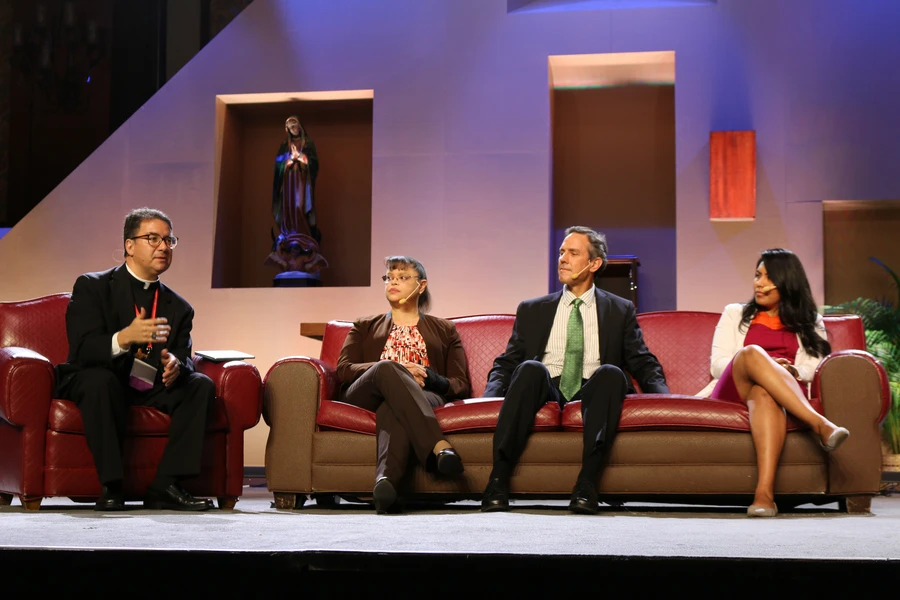
After Cantú spoke, he appeared on a panel with three laypeople–Sean Callahan, president and CEO of Catholic Relief Services; Brenda Noriega, Young Adults Ministry Coordinator, Diocese of San Bernardino; and Wanda Vásquez, Hispanic Ministry Director, Archdiocese of New York–where they discussed the fruits that had emerged from the four-year V Encuentro process.

Vásquez said it was “amazing” how people came together, and how the eight dioceses in her Encuentro region were able to work alongside each other during the planning stages. She particularly highlighted how the more experienced people were able to share their expertise with younger members, and that while “we are a young church, but we also are an experienced Church.”

Cantú and Noriega both said that young Hispanics need to be included in leadership positions and reminded of their particular talents. Noriega first began working in Hispanic ministry for her diocese at the age of 25, and she reiterated that it was extremely important to “make sure young people are sat at the table” and given positions on things like parish councils.

Cantú said that he often encounters discouraged youth, and that he himself felt similar growing up in a time where “it was a liability to be Hispanic.” He said that when he was applying to seminary, he was praised by a religious sister for being bilingual and fully immersed in two cultures. This sister told him that he would be “a gift to the Church,” and that he hopes the larger Latino community will “never forget that you are a blessing to the Church.”

Callahan reminded the crowd to keep their doors open to the stranger, and to also be cautious about identifying only as “Hispanic Catholics.” He believes the Latino Catholic community has the ability to lift up the entire Church, and should take steps to build bridges with the rest of the Church in the United States.

He advised people that even though the attendees of the non-Spanish Masses at a parish may look different from them, they should go out of their way to interact with them and get to know them.

“Let’s build a united church, so we can start lifting up everyone in the Catholic Church in the United States,” said Callahan, to loud applause.

Cupich, who led the morning prayer, had a slightly more optimistic look on the future of the Church than Cantú. Cupich said that he feels the Church in the United States is experiencing a “new birth,” and the Latino community is a big part of this panel. The cardinal was critical of what he called an “overly rational, logical, cerebral” approach to God in American culture, and that “faith is not only about what we hold, but it is about who holds us.”

This, explained Cupich, is where Latino culture comes in.

“The Latino experience is reminding us that faith is not only about what we hold, but who holds us,” he said.

Cupich said that while like in any birth there are “pains” and “sacrifices,” but he is convinced that the Church, as well as non-Catholic Americans, “will one day look back at the contributi you (Latinos) are making to our faith, and yes, to our nation, and rejoice at the new birth that has taken place.”


[…]

No Picture
News Briefs

Pope recognizes illicitly ordained Chinese bishops

September 22, 2018 CNA Daily News 2

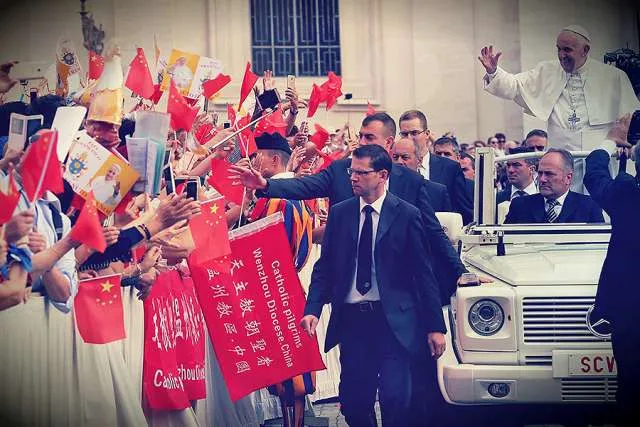
Vatican City, Sep 22, 2018 / 06:22 am (CNA/EWTN News).- After the signing Saturday of a provisional Vatican-China deal on the nomination of bishops, the Vatican announced Pope Francis’ recognition of seven illicitly ordained Chinese bishops.

The decision was made “with a view to sustaining the proclamation of the Gospel in China,” according to a Sept. 22 Vatican press brief.

Those bishops who will now be admitted to full communion with the Church are Bishop Joseph Guo Jincai of Rehe; Bishop Joseph Huang Bingzhang of Shantou; Bishop Paul Lei Shiyin of Jiading; Bishop Joseph Liu Xinhong of Wuhu; Metropolitan Archishop Joseph Ma Yinglin of Kunming; Bishop Joseph Yue Fusheng, apostolic administrator of Harbin; and Bishop Vincent Zhan Silu of Funing.

The pope also recognized Bishop Anthony Tu Shihua, who died on Jan. 4, 2017, but, according to the press release, “had expressed the desire to be reconciled with the Apostolic See” before his death.

The statement expressed Francis’ hope that the decision to recognize the bishops, who were ordained by the Chinese government without permission from Rome, would begin a new process “that will allow the wounds of the past to be overcome, leading to the full communion of all Chinese Catholics.”

The Catholic Community in China “is called to live a more fraternal collaboration, in order to promote with renewed commitment, the proclamation of the Gospel,” he continued. “In fact, the Church exists to give witness to Jesus Christ and to the forgiving and salvific love of the Father.”

Vatican Secretary of State, Cardinal Pietro Parolin, sent a statement commenting on the provisional agreement between the Vatican and China, saying, “today, for the first time all the Bishops in China are in communion with the Bishop of Rome, with the Successor of Peter.”

“Pope Francis, like his immediate Predecessors, looks with particular care to the Chinese People,” he noted. “What is required now is unity, is trust and a new impetus; to have good Pastors, recognized by the Successor of Peter – by the Pope – and by the legitimate civil Authorities.”

Addressing the Catholic community in China, including priests, bishops, religious, and laity, he said the pope asks, “above all, the commitment to make concrete fraternal gestures of reconciliation among themselves, and so to overcome past misunderstandings, past tensions, even the recent ones.”

Parolin said the objective of the deal is pastoral and meant to create greater freedom and autonomy for the Church in China, to aid its mission of spreading the Gospel. Signing the agreement is “of great importance, especially for the life of the Church in China,” he said.

It was also announced Sept. 22 that Pope Francis has established a new diocese in China, “the Diocese of Chengde,” as a suffragan diocese of the See of Beijing, for “the pastoral care of the Lord’s flock and to attend with greater efficacy to is spiritual good.”

Its cathedral will be the church of Jesus the Good Shepherd, which is situated in the administrative division of Shuangluan, “Chengde City.”

According to the statement the diocese’s territory will be defined by the civil boundaries of “Chengde City” and will require the modification of the dioceses of Jehol/Jinzhou and Chifeng, as a portion of each will become part of the new diocese.

The new diocese will be composed of roughly 15,000 square miles with a population of around 3.7 million. There are estimated to be around 25,000 Catholics in 12 parishes served by seven priests.

[…]