No Picture
News Briefs

Cardinal DiNardo hopeful for Church in US

November 14, 2018 CNA Daily News 1

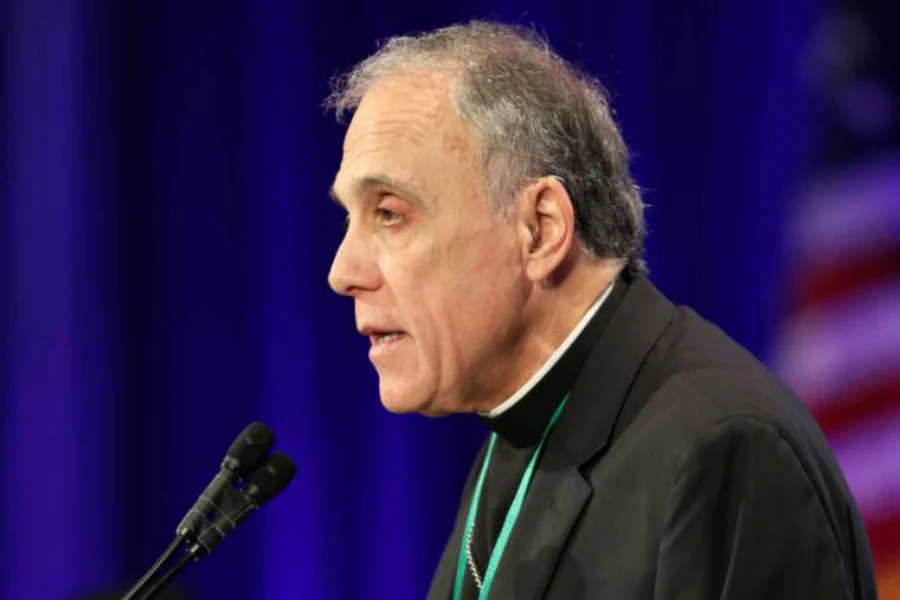
Baltimore, Md., Nov 14, 2018 / 05:03 pm (CNA/EWTN News).- Acknowledging that he was disappointed by the Vatican’s decision to block a vote on sex abuse reform measures, Cardinal Daniel DiNardo of Galveston-Houston said Wednesday he nonetheless sees a hopeful future for the Church in the United States.

In the closing statement of the USCCB’s Fall General Assembly Nov. 14, the president of the conference focused on the upcoming meeting of bishops’ conference presidents in Rome, and hopes that the discussions there among representatives of the global Church will assist with the continued “eradication” of sexual abuse in the Church.

DiNardo offered praise for the various abuse victim testimony and abuse experts throughout the week, saying that they had given him direction and “such good counsel in these last few days.”

In the wake of the allegations against Archbishop Theodore McCarrick, DiNardo reiterated how over the summer, the bishops committed themselves to three goals: an investigation of the claims against McCarrick, developing an easier way to report abuse, and developing a means of holding bishops accountable.

“We are on course to accomplish these goals,” DiNardo told the crowd of bishops.

“That is the direction you and the survivors of abuse have given me.”

DiNardo then proceeded to outline some of the “action steps” the bishops hope to take in the coming future. These include the creation of a process for complaints that are reported to a third-party compliance hotline, the completion of a proposal for a lay commission, and the creation of a national network of diocesan review boards and lay experts that will oversee metropolitans.

These steps represented a combination of some of the proposals that came up over the course of the week’s general assembly.

DiNardo also said that the bishops will look to finalize protocol and standards, and will be creating new guidelines for the release of list of names of priests who have substantiated claims of abuse. He also called for a “fair and timely” investigation of McCarrick and a publication of the results.

The bishops will be “committed to take the strongest possible action at the earliest possible moment,” he said. He looks forward to the February meeting, as he believes that working with the global Church will serve to make the Church in the United States even stronger.

“We must thus as bishops recommit to holiness and mission of the Church,” he said. He said that he is “confident” that along with Pope Francis, the Church will move forward “decisively” after this February’s meeting.

And despite Monday’s initial frustration, DiNardo said that the past three days were “a sign of hope for me, not a disappointment.”

[…]

No Picture
News Briefs

‘What are people to make of our silence?’ Bishops discuss McCarrick in Baltimore

November 14, 2018 CNA Daily News 4

Baltimore, Md., Nov 14, 2018 / 04:38 pm (CNA/EWTN News).- The bishops of the United States resumed their open-floor discussion on the recent sexual abuse scandals facing the Church in America Wednesday morning. In addition to debating the best means of institutionally responding to the crisis, the specific case of Archbishop Theodore McCarrick was raised by several speakers.

Bishop Richard Stika of Knoxville told the conference Nov. 14 that the allegations against McCarrick, and the scandal of his rise and fall, were not just affecting long-time Catholics. Many people in the process of entering the Church found themselves having the example of McCarrick throw at them by friends and family as evidence that they were entering an institution in crisis.

Stika said McCarrick, and the letters of former nuncio Archbishop Carlo Maria Vigano, were serving as “ammunition” to discourage people from entering the Church, and that many Catholics felt that bishops were only responding to the sexual abuse crisis when they were “forced to” by the media.

Several bishops spoke in favor of the USCCB acting as a body to speak out about McCarrick.

Bishop Michael Olson of Fort Worth told the conference hall that “we end where we begin.”

“So much of the outrage we experience – and I think it’s a rightful outrage – is prompted by the injustice that our people have experienced at the hands of predators, at the treatment of our seminarians and our priests who were entrusted to the care of former cardinal McCarrick, a trust that was not only violated, but was ignored by others who were responsible for paying attention.”

Olson observed that while Pope Francis had accepted McCarrick’s resignation from the college of cardinals and sent him to a life of prayer and penance pending a canonical process, the USCCB had yet to respond as a body to the scandal caused by one of their own.

“He is an emeritus [bishop of a U.S. diocese] and as such he is supposed to be a welcome guest here. He is not welcome and we should say it,” Olson said. He also questioned if the bishops’ reliance on structural and procedural reform was overshadowing their need to act with moral authority.

“We have said the Holy See should let us get some new norms, get a process together. Do we use this process as means of avoiding our pastoral responsibilities?” Olson asked, suggesting that the conference needed to condemn not just McCarrick’s alleged behavior, but also Vigano’s call for the resignation of the pope, which he called an attack on the Petrine office.

Bishop Liam Cary of Baker also insisted that the conference needed to respond to the McCarrick scandal as a body, saying McCarrick had “grievously offended” not just his victims but all Catholics, priests, and bishops.

By abusing seminarians “successively, over decades” Cary said McCarrick had left a “shameful residue” on all the bishops, and that while other institutions had revoked honors previously bestowed on the former cardinal the USCCB had taken no action.

Cary cited the example of bodies, like the U.S. Senate, which could pass resolutions to censure its members as one way they could respond, but insisted that some kind of action was urgently needed.

“What are people to make of our silence?” he asked. “How do we lead our brother to the mercy of God if we leave unspoken the demands of his justice?”

Bishop Cary echoed Bishop Olson’s concern that McCarrick was still technically qualified as a welcome participant at the conference.

“If McCarrick were to come to this microphone would he be allowed to speak?” Cary asked, noting that there was no open microphone for his victims.

In addition to the specific problem of Archbishop McCarrick, the bishops also discussed how they could proceed more generally in the light of the Holy See’s intervention to prevent them from voting to adopt the proposed Standards for Episcopal Conduct or to create an independent special commission to investigate allegations against bishops.

Bishop Kevin Vann of Orange summed up the dilemma facing the conference.

“We cannot just sit back and do nothing,” he told the bishops. If a deliberative vote was not possible, he said, the bishops needed to at least take “some sort of consultative vote” to show that the American bishops were firmly resolved among themselves.

Bishop Robert Christian, auxiliary bishop of San Francisco, expressed the frustrations of many bishops at the inability of the conference to act.

He pointed out that as several scandals broke over the summer “the leadership of this conference was blocked from either working in partnership with the Holy See or leaving it to us in the dioceses.”

Christian said that he was concerned by the Holy See’s intervention. He observed that it could take months for the Vatican to produce a final resolution after the February meeting of the heads of the world’s bishops’ conferences in Rome. This could mean, he said, that the U.S. bishops could find it still “impossible” to act in March, or even June, of next year.

“It is all the more important to vote today as if we were voting on a policy,” he said, so that both the faithful and the Holy See could see the clear mind of the bishops.

Despite the support of many on the conference hall for the original proposal for an independent commission to receive and investigate allegations against bishops, a few bishops have suggested they would prefer to see a different system altogether.

Bishop Gregory Hartmayer of Savannah proposed that Rome should instead be asked to consider amending canon law to give metropolitan archbishops an expanded role and authority for dealing with allegations against bishops in their province. His proposal was echoed by Bishop Robert Coerver of Lubbock.

Hartmayer noted that it might be better for accusations against a bishop to be considered by “a jury of their peers” since, he said, “no one understands a bishop so much as another bishop.”

He also said that bishops owed each other the “courtesy” of listening “to one of our brothers who has misbehaved in some way.”

While the majority of the interventions from the floor were concerned with what direct action the conference could take, others were more reflective.

Bishop Barry Knestout of Richmond gave a long and clearly personal reflection on the pain experienced by priests and laity alike in his former diocese, Washington.

Knestout said that he looked upon the current scandals on a continuum of previous crises, stretching back 50 years to the promulgation of Humanae vitae, saying that the rejection by many clergy of that document, and the Church’s teaching on the dignity of human life and sexuality, had caused “one long crisis of leadership and teaching” in the Church.

Despite the clear and forceful calls by several bishops for some clear statement on the case of Archbishop McCarrick, when the bishops resumed their seats after breaking for lunch they voted down a resolution to “encourage” the Holy See to release whatever documents it could on McCarrick.

As they debated the minutiae of the resolution’s wording, the bishops found they could not even agree on the inclusion of the word “soon.”

After the defeat of the proposal, one bishop remarked to CNA that “we cannot seem to speak clearly, even when we want to agree.”

[…]

No Picture
News Briefs

Angry, betrayed Catholics travel to Baltimore demanding answers, change

November 14, 2018 CNA Daily News 1

Baltimore, Md., Nov 14, 2018 / 12:42 pm (CNA).- As one of the testimonies progressed at the Silence Stops Now rally near the USCCB’s Fall General Assembly, Anna Ahlbin, an expectant mother of six who had traveled from Fredericksburg, Va., turned to her young children and instructed them to cover their ears.

While she thought it was important to bring her family to a rally demanding change, reform, and accountability for the Church’s bishops, she still wanted to do as much as she could to prevent her children from hearing graphic details of abuse.

Ahlbin told CNA that she felt “a deep sense of betrayal and confusion” by the bishops, a stark departure from her past views on the episcopacy.

“I used to be the type of person who thought, you know, I looked for the nihil obstat and I knew it was fine, and I just trusted, immediately,” she said.

“And now it’s, ‘Who can I trust? Who’s the good guys, who’s the bad guys? Who’s lying to me and who isn’t?’”

Ahlbin and her children were part of a crowd of about 200 who gathered at the rally, which was sponsored by numerous organizations who are unhappy with the way the U.S. Bishops’ Conference has handled reports of sexual abuse. A variety of speakers provided testimony at the rally, including an alleged victim of Archbishop Theodore McCarrick’s abuse.

Demonstrators CNA spoke to traveled from all over the country to attend various protests, including one woman who said she and her husband were visiting Baltimore from California to express their disappointment with the bishops.

The Silence Stops Now rally was the biggest gathering by far, but it was not the only demonstration. Throughout the three days of the USCCB’s Fall General Assembly, there have been pockets of protestors gathering, angry at the conference of bishops. While the groups they represent, the specific concerns, and the proposed solutions have varied, their feelings of anger, hurt, and confusion were consistent.

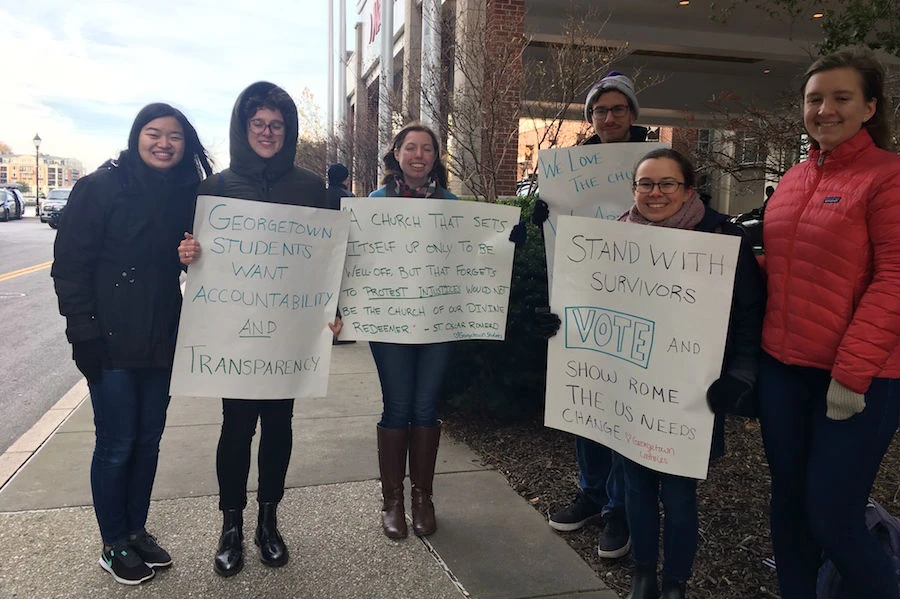
A group of Georgetown University students, all of whom are active in Catholic campus ministry, spoke to CNA about their concerns that the Church was not doing enough to stand with survivors of abuse and to punish the perpetrators. They also expressed disappointment at their own school refusing to rescind honorary degrees to McCarrick and Cardinal Donald Wuerl, whose resignation as Archbishop of Washington was recently accepted by the pope.

Grace Laria, a senior at Georgetown, told CNA that her group drove up from D.C. that morning “to show that Georgetown students really care about the Catholic Church and issues that confront it, particularly the sexual abuse crisis.”

Laria said that while there had been numerous events on campus regarding the abuse crisis, she wanted to travel to Baltimore to continue to demand some sort of action, even informal, that demonstrates the bishops “are willing to stand up for survivors and take action.”

Her concerns were echoed by fellow Georgetown student Julie Bevilacqua, who said the crisis made her feel angry and hurt.

“I just really feel a sense of urgency for some kind of action and for us to see some change to show…that our Church is willing to stand up for survivors and to stand with them,” Bevilacqua told CNA. She said that she hopes young people, women, and lay leaders like herself will be given a bigger platform in the Church in the future.

Although most of those demonstrating outside the assembly were critical of the bishops, the USCCB, and Church hierarchy as a whole, there was one notable exception to these feelings: Archbishop Carlo Vigano, the former apostolic nuncio to the United States.

In August, Vigano released an explosive letter that claimed, among other things, that Pope Francis had stripped penalties imposed on Archbishop McCarrick by his predecessor, Pope Benedict XVI. During the general assembly, many bishops publicly expressed displeasure at the Vatican’s perceived stalling of any investigation into the claims made in the letter.

At the Silence Stops Now rally, a mere mention of Vigano’s name drew wild applause, and at one point, those assembled chanted his name in a manner that was not unlike a political campaign rally. Conversely, the mention of just about any other bishop sparked a chorus of boos.

A six-foot-tall poster displayed outside the hotel on Wednesday was even less subtle: a picture of Vigano, captioned “Archbishop Carlo Maria Vigano, OUR HERO!! Thank you!”

That poster was positioned next to an image of Our Lady of Fatima, and another featuring a collage of American cardinals, accusing them of being complicit with Satan.

Connie McCalla, who traveled to Baltimore from Philadelphia, said that while she found the message at the Silence Stops Now rally to be a bit “mixed,” she was there to demand accountability among bishops.

A bishop needs to be transparent and remember “that they are to lead the Church and to protect the body of Christ,” said McCalla. The bishops “need to be heard and not behind stone and glass,” she said, pointing to the hotel where the assembly was being held.

Throughout the weekend, the majority of the demonstrators CNA spoke to had optimistic views on the future of the Church, despite the current controversies and difficulties.

Ahlbin told CNA that although she thinks the Church must “repent, submit to grace, and allow it to stop being about policy,” returning to a focus on God and the Holy Spirit, she’s “confident that the Immaculate Heart of Mary will triumph.”

[…]

No Picture
News Briefs

USCCB elects six new committee chairmen

November 14, 2018 CNA Daily News 1

Baltimore, Md., Nov 14, 2018 / 09:42 am (CNA).- On Wednesday morning, the U.S. bishops voted on a slate of positions and committee chairs for the United States Conference of Catholic Bishops. The votes were originally scheduled to be taken Thursday mor… […]