No Picture
News Briefs

Advocates lament exclusion of those with criminal records from business loan program

April 19, 2020 CNA Daily News 0

Denver, Colo., Apr 19, 2020 / 03:01 pm (CNA).- After receiving more than 1.6 million applications, a key part of the US government’s economic response to the coronavirus pandemic, known as the Paycheck Protection Program, ran out of money Thursday and will no longer be accepting new applications.

In the two weeks the Paycheck Protection Program was active, the application process for the loans excluded small business owners with criminal records from applying— potentially hurting both business owners with criminal records and their employees, advocates and those with personal experience told CNA.

What is the PPP?

Congress passed the Coronavirus Aid, Relief, and Economic Security Act March 27 to help relieve the economy during the coronavirus pandemic.

Among various measures, including expansions to unemployment benefits, the CARES Act authorizes some $350 billion in loans to small businesses, intended to allow these businesses to continue to pay their employees. The loans were given on a first come, first serve basis.

The loans were capped at $10 million, were open to businesses with fewer than 500 employees per location, and were intended to cover two months of payroll costs.

The federal government promised to forgive the loans if a business used at least 75 percent of the funds to maintain its payroll at “pre-pandemic levels” for eight weeks after the loan is disbursed, the New York Times reports.

The remaining money could be used only to pay for certain expenses, such as a mortgage, rent, and utilities, according to the Times.

Those with criminal records left behind

The most recent guidelines from the Small Business Administration regarding the PPP stated that business owners will be denied a loan if they are facing criminal charges, or have had a felony conviction in the past five years.

This policy is, according to a group of nonprofit social justice organizations who wrote an April 10 letter to Congress, more restrictive than the SBA’s existing regulations regarding criminal record restrictions for small business loans.

Applicants are asked about criminal history for regular SBA loans. A typical small business loan application from the SBA allows applicants to provide details about their criminal history beyond a simple “yes” or “no”— unlike the emergency loan application, which explicitly states that the loan will not be approved if the applicant answers “yes” to either of the two questions pertaining to criminal records.

“With one in three Americans having some sort of record, and people with records experiencing an unemployment rate five times higher than the average rate, these restrictions will have a significant and detrimental impact on individuals, families, and communities across the United States,” the group of nonprofits said in their letter.

The application form for the PPP itself had more restrictions, such as mandating that no one owning 20% or more of the business be subject to any “means by which formal criminal charges are brought in any jurisdiction.”

A similar loan from the SBA called the Economic Injury Disaster Loan also asked for the applicant’s criminal history, and seems to exclude those who have “ever” been convicted, pleaded guilty, pleaded no contest, been placed on pretrial diversion, parole, or probation for “any criminal offense.”

The small business hustle

James Blum, a Catholic who runs a community in Aurora, Colo., that assists men coming out of prison, told CNA that people with criminal records already face major challenges finding employment and getting loans.

Blum— who himself spent time in prison and has a felony on his record— considered applying for the PPP himself, but knew his felony would exclude him.

Many guys with criminal records hope, Blum said, that it would be easier to start their own company rather than try to get hired. The truth is, he said, most businesses, even if you’re not a felon, don’t succeed. There’s a lot of money that must be invested, and there’s an attitude of hustle that you have to have.

Reporting from the non-profit Marshall Project bears out Blum’s experience, suggesting that because people with felonies, in particular, often cannot get jobs, many start their own businesses.

Blum said he knows a man with a criminal record who started his own janitorial business, and found some success doing that until the company eventually went under.

Another man he knew started a company doing custom tile, and took on several employees, but “he’s working like a dog” to make ends meet.

“Many guys think, ‘Oh I’ll just work for myself.’ And that sounds good, but it’s very difficult to be successful as a small business owner in this country,” he said.

“The call never comes”

Blum’s organization, My Father’s House, helps men gain the skills they need to be successful post-prison. He said at least three of the men who frequent the house are currently out of work, one of whom was just released from prison and did not have a chance to look for a job before the pandemic began.

The other two, he said, have been laid off and are filing for unemployment.

“When they first get out of prison, men, especially those convicted of sexual offenses, aren’t even allowed to access the internet, and they have to have permission, and that can take months to build the trust with the parole officer and the treatment providers and let them access the internet, and even have an email address,” Blum said.

“To try to apply for a job in this world without an email address is just ridiculous. Every time you go on a website, the first thing they ask you is what’s your email address. And so even if you can get permission to go to a monitored computer site, like at the parole office, and you go to a website, the very first thing they’re going to ask you is for your email address.”

At some point the parole officer will allow them to create an email address, but they can only access that email at the parole office, Blum said. The logistics are difficult, partly because they have to create a resume on a computer they’re not familiar with, and they can’t access their email every day.

When an employer finally gives someone with a criminal record a job interview, you can explain a felony as best you can, but it may not always make a difference, Blum said. The interview could be going well, and the interviewer could be impressed with the applicant’s knowledge and experience, but it may end up being moot once they learn of the applicant’s record.

“The answer is just: ‘Well, we’ll give you a call.’ And the call never comes,” Blum said.

Though a recruiter may interview a candidate with a criminal record, most Human Resources departments will step in after that. Success in the interview is not a predictor of success in getting the job, Blum said.

“There’s a whole series of decision makers that you never even get to meet,” he said.

“At some point you end up with a whole class of people that have served their sentence, they’ve supposedly paid their debt to society, and yet they cannot enter into the economy, and into society at a regular level.”

Blum noted that he himself is very blessed to be able to work full-time hours from home during the pandemic, and not be laid off, but “I’m in the minority, for sure, among felons.”

“How does that make any sense?”

Brian, a Catholic living in Denver who is working to start a software consulting business, told CNA that he tried to apply for the emergency loan, but a misdemeanor on his record automatically excluded him.

Brian is on a diversion program and has a misdemeanor harassment charge on his record. While he does not have a felony on his record, he has found it difficult to find employment since his misdemeanor charge, despite being an experienced computer programmer.

“Now I’m going to have to suffer financially for it, as if I haven’t suffered enough,” he told CNA.

While it may be politically expedient to include a clause excluding those with criminal records from the emergency loan program, Blum said it ends up hurting not only the bosses, but the workers as well.

“By stopping the business owner— who was convicted of a felony five, six, seven years ago and served his time and paid his debt to society— by stopping that man from getting the loan, you’re punishing another guy who’s never committed a crime in his life, and that guy’s family,” Blum said.

“[The worker] is going to lose his job because the business owner can’t afford to pay the payroll. How does that make any sense?”

If the purpose of the emergency loan program is to relieve the American economy, he said, he doesn’t see why a business owner’s criminal history is important.

“They think they’re punishing the business owner, but really they’re punishing these other people,” he said.

[…]

No Picture
News Briefs

Pope prays for those caring for disabled patients amid pandemic

April 18, 2020 CNA Daily News 1

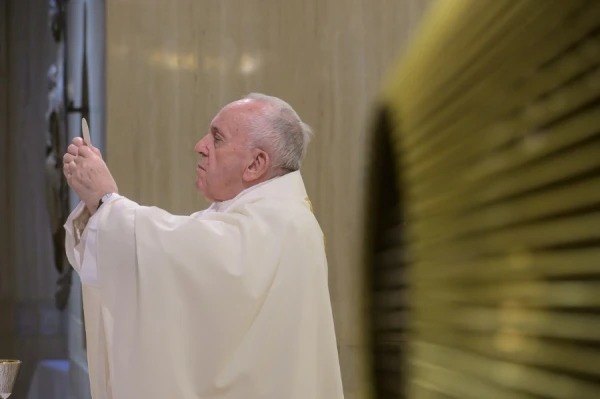
Vatican City, Apr 18, 2020 / 04:00 am (CNA).- Pope Francis prayed for those caring for people with disabilities during the coronavirus crisis at his morning Mass Saturday. 

Speaking from the chapel of his Vatican residence, Casa Santa Marta, April 18, he said he had received a letter from a religious sister working as a sign language interpreter for deaf people. She told him about the difficulties facing healthcare workers, nurses and doctors looking after disabled patients affected by COVID-19. 

“So let us pray for those who are always at the service of these persons with various disabilities,” he said.

The pope made the comments at the start of the Mass, which was livestreamed due to the pandemic. 

In his homily, he reflected on the day’s first reading (Acts 4:13-21), in which the religious authorities ordered Peter and John not to teach in the name of Jesus. 

The apostles refused to obey, the pope said, replying with “courage and frankness” that it was impossible for them to remain silent about what they had seen and heard. 

Ever since then, he explained, courage and frankness have been the hallmarks of Christian preaching. 

The pope recalled a passage in the Letter to the Hebrews (10:32-35), in which lukewarm Christians are urged to remember their early struggles and regain their confidence and candor.

“You cannot be Christian without this frankness: if it does not come, you are not a good Christian,” he said. “If you don’t have the courage, if to explain your position you slide into ideologies or casuistic explanations, you lack that frankness, you lack that Christian style, the freedom to speak, to say everything.”

Peter and John’s frankness confounded the leaders, elders and scribes, he said.

“Really, they were cornered by frankness: they didn’t know how to get out of it,” he observed. “But it didn’t occur to them to say, ‘Could this be true?’ The heart was already closed, it was hard; the heart was corrupt.”

The pope noted that Peter was not born brave, but had received the gift of parrhesia — a Greek word sometimes translated as “boldness” — from the Holy Spirit. 

“He was a coward, he denied Jesus,” he said. “But what happened now? They [Peter and John] answered: ‘Whether it is right in the sight of God for us to obey you rather than God, you be the judges. It is impossible for us not to speak about what we have seen and heard.’” 

“But where does this courage come from, this coward who has denied the Lord? What has happened in this man’s heart? The gift of the Holy Spirit: frankness, courage, parrhesia is a gift, a grace that the Holy Spirit gives on the day of Pentecost.” 

“Just after receiving the Holy Spirit they went to preach: a little brave, something new for them. This is consistency, the sign of the Christian, of the true Christian: he is courageous, he says the whole truth because he is consistent.”

Turning to the day’s Gospel reading (Mark 16:9-15), in which the risen Christ reproaches the disciples for not believing reports of his resurrection, the pope noted that Jesus gives them the gift of the Holy Spirit which enables them to carry out their mission to “Go into the whole world and proclaim the Gospel to every creature.”

“The mission comes precisely from here, from this gift which makes us courageous, frank in proclaiming the word,” he said.

After Mass, the pope presided at adoration and Benediction of the Blessed Sacrament, before leading those watching online in a prayer of spiritual communion.

The Pope recalled that tomorrow he would offer Mass at Santo Spirito in Sassia, a church near St. Peter’s Basilica, at 11 a.m local time. 

Finally, those present sang the Easter Marian antiphon “Regina caeli.”

In his homily, the pope clarified that Christians should be both courageous and prudent. 

“May the Lord always help us to be like this: courageous. This does not mean imprudent: no, no. Courageous. Christian courage is always prudent, but it is courage,” he said.

[…]

No Picture
News Briefs

US commission faults Indian hospital’s alleged religious segregation of coronavirus patients

April 17, 2020 CNA Daily News 1

CNA Staff, Apr 17, 2020 / 07:00 pm (CNA).- Reports of an Indian hospital’s segregated wards for Hindu and Muslim coronavirus patients drew concern from the U.S. Commission on International Religious Freedom, though Indian authorities strongly disputed the allegation.

“USCIRF is concerned with reports of Hindu and Muslim patients separated into separate hospital wards in Gujarat,” the commission said on Twitter and Facebook April 15. “Such actions only help to further increase ongoing stigmatization of Muslims in India and exacerbate false rumors of Muslims spreading COVID-19.”

The bipartisan U.S. federal government commission linked to a story in the Indian Express newspaper that cites a hospital official and a patient in the city of Ahmedabad in the western coastal Indian state of Gujarat.

India’s Ministry for External Affairs opposed the commission, saying it was spreading “misguided reports” and “adding religious color” that distracts from India’s efforts to combat the novel coronavirus.

“No segregation is being done in civil hospitals on the basis of religion, as clarified by the Gujarat government,” the ministry said April 15.

The reports concern Ahmedabad Civil Hospital, where there are some 1,200 beds prepared for patients suffering from the novel coronavirus.

Medical Superintendent Dr. Gunvant. H. Rathod described the hospital division to the Indian Express, saying “generally, there are separate wards for male and female patients. But here, we have made separate wards for Hindu and Muslim patients.”

“It is a decision of the government and you can ask them,” he said.

Deputy Chief Minister and Health Minister Nitin Patel said he was not aware of the situation and would make inquiries. Ahmedabad’s district magistrate, K.K. Nirala, also was not aware of any decision, the Indian Express reports.

However, the Indian Express cited a hospital patient who said the names of 28 men in a ward were called out, and they were moved to another ward.

“While we were not told why we were being shifted, all the names that were called out belonged to one community. We spoke to one staff member in our ward today and he said this had been done for ‘the comfort of both communities’,” the patient said.

The Gujarat Health and Family Welfare Department said the reports were “absolutely baseless.” Rather, it said, patients are treated based on symptoms and severity and “according to treating doctors’ recommendations.

As of Wednesday, new known cases of coronavirus in Gujarat rose by 127 to 766, with 88 cases in Ahmedabad. The death toll there totals 33, the Times of India reports.

The Indian newspaper The Week reported that the commission had previously criticized India’s Citizenship Amendment Act, which became effective in January 2020.

In December 2019 the commission expressed concern about the legislation, which enshrined a pathway to citizenship for immigrants but specifically excluded Muslims. The commission recommended U.S. sanctions on India as a possible response.

The U.S. Commission on Religious Freedom reviews alleged religious freedom violations and makes policy recommendations to the U.S. president, Secretary of State, and Congress.

The commission’s 2019 report said that religious freedom conditions in India “continued a downward trend” in 2018. It said India’s “history of religious freedom has come under attack in recent years with the growth of exclusionary extremist narratives—including, at times, the government’s allowance and encouragement of mob violence against religious minorities—that have facilitated an egregious and ongoing campaign of violence, intimidation, and harassment against non-Hindu and lower-caste Hindu minorities. Both public and private actors have engaged in this campaign.”

Mob violence against Christians by Hindus has been particularly acute.

In August 2019, six suspected members of a radical Hindu group were arrested after dozens of Catholics were attacked on a Marian pilgrimage from Karnataka to the Basilica of Our Lady of Good Health in Velankanni, a coastal town in south east India.

In September, around 500 armed Hindu extremists attacked a Jesuit mission in the Archdiocese of Ranchi. Armed with sticks, chains, iron bars, knives, and pistols, the mob beat tribal students including two who were seriously injured, and also seriously damaged the school’s facilities.

Archbishop Leo Cornelio of Bhopal has said numerous mob lynchings of Christians have occurred in which the victims are accused of eating beef or otherwise harming cattle, which are considered sacred in Hinduism.

Karnataka state suffered a wave of anti-Christian violence in 2008, when Hindu extremist groups led attacks on churches, schools and homes of Christians and physically beat hundreds of people. A 2011 independent report on the violence, known as the Saldhana Report, charged that attacks were pre-planned and backed by the state’s highest government authorities.


[…]

No Picture
News Briefs

How Catholic schools scrambled to meet technology needs for distance learning

April 17, 2020 CNA Daily News 1

Denver, Colo., Apr 17, 2020 / 05:12 pm (CNA).- It has been one month since most schools across the US closed their doors due to the coronavirus pandemic.

The solution to shuttered schools may seem simple, on the surface: move curriculum and teachers online. Teach classes on Zoom videos, assign and receive homework through Google Classroom, and send communications and grades via email or an online school portal.

But what happens when students, sent home to learn from their bedrooms or kitchen tables, do not have access to the internet at their house? Or when the whole family is studying or working from home, and the one computer in the household is needed by several people at once?

These are the questions Catholic schools have grappled with after the coronavirus forced the shutdown of schools across the nation, many of them for the rest of the school year.

The Archdiocese of Denver made the decision to close its schools on the night of Thursday, March 12. The following Friday had already been a planned day off for students and a working day for teachers, which was to the schools’ advantage as they figured out how to shift completely to distance learning.

“All Thursday night we figured out, okay, what would have to be true to make distance learning successful in the next two weeks?” Abriana Chilelli, director of curriculum and instruction in the Denver archdiocese, told CNA.

“Certainly, technology rose to the top, but also that children had internet access, that schools were able to get devices out to students. So we put together a think sheet, if you will, about a school’s capability of distance learning,” she said.

Originally, Chilelli said, the Catholic school system was planning for a two-week closure, but with some thought that it could be extended in a more long-term way.

During those two weeks, Chilelli said, some teachers “chose the paper-based route,” sending home packets with two weeks worth of materials with students.

During those initial two weeks, schools worked to get in touch with every family to evaluate their technology and internet needs for a longer-term closure.

“We realized…that we were short about 500 devices for students and 50 for teachers, plus 200 hotspots,” said Carol Nesbitt, director of schools marketing and communications in the Archdiocese of Denver. Those were the numbers after the archdiocese’s schools had already lent out whatever extra laptops and devices they had on hand.

“I heard of a student up in Glenwood Springs at St. Stephen’s school. The principal said he was trying to use his mom’s burner cell phone to get his assignments,” Nesbitt told CNA.

“We’ve heard from other principals who have said that (student’s families) have five people in one house, and mom and dad are both trying to work from home and they have one computer. So the kids can’t get on their Zoom call because mom has a call with her boss and different things,” she said.

The shortage motivated the office of schools to send out two emails, asking Denver Catholics to contribute to an emergency relief fund. So far, Nesbitt said, the fund has received $220,000 in donations, “which I think is incredible.”

It’s enough to start buying more computers and distributing them to families on a lending basis, Nesbitt said.

“The first 50 came yesterday…and we delivered to three schools right away, and the rest are coming in over the next few days. And we’ll turn those around as quickly as possible,” she said. “(It’s) all hands on deck to try to deliver those, of course, using social distancing measures,” she said. Families have also been able to pick up supplies from schools.

Chilelli said she thinks when it came to setting up long-term distance learning, Catholic schools were at an advantage because of their smaller sizes.

“I’m watching these large districts that, still a month later, don’t have contact with such huge percentages of their students. So I just think it’s a huge advantage of Catholic schools that we’re smaller, we can be more nimble and we have this one-on-one relationship with all of our families,” she said.

Dr. Brooke C. Tesche is the chancellor of education for the Diocese of Allentown, which has already announced that its schools will be closed for the remainder of the school year.

Tesche said while they’ve had some students who are lacking computers or tablets on which to do their work, the Catholic school system has been working to accommodate these students any way they can. One way, she said, has been through lending out existing technology at the schools to families.

Two local internet providers are currently offering free services in order to help students continue their education, which has also helped in Allentown.

“So many families who would not have been able to connect, are able to connect,” she said.

Still, Tesche added, there are students who do not have computers on which to complete their homework. For these students, teachers are putting together paper learning packets with two weeks of materials at a time. Parents and students can either pick up their packets in person, or see the packets mailed to students.

“So it’s definitely a challenge right now, but (teachers are) responding and using I think as many options as possible to make sure that the kids continue to move forward,” she said.

Tesche emphasized that schools are moving forward in their curriculum – rather than providing students with busy work or enrichment activities, teachers are working to prepare their students to be ready for the next grade level, whether schools will resume in-person in the fall or not.

The Diocese of Allentown is also unique in that it has the only Catholic high school for students in recovery from substance addiction, Kolbe Academy.

The school is in its first full year of operation, and so while it is “unfortunate” that the coronavirus closed the school’s doors in its first year, Tesche said those students have been able to move their instruction, and their counseling and therapy, completely online.

“We just had a student this week celebrate 100 days clean and sober,” she said. “I’m really proud of that. They are doing really good work.”

Additionally, the school system has also partnered with Catholic Charities at this time in order to be able to address any mental health or social-emotional needs that families might have, Tesche said.

“We’re just dovetailing really nicely to make sure they have support of Catholic Charities,” she said.

In Ontario, the Huron-Superior Catholic District School Board said in a meeting this week that the district has been accommodating students without access to technology by providing them with weekly paper packets. Teachers have adjusted instruction so that each week is planned out in advance, and students can complete the weekly work at their own pace.

“…(the students) enjoy having the freedom to complete their work (on their own schedule)…they can do all their Monday and Tuesday work on Monday. I’ve heard nothing but good things about the work. Surprisingly, no complaints,” Anthony DeLorenzi, an H-SCDSB student representative, said during a board meeting this week, according to local news source SOOTODAY.com.

Rose Burton Spohn, H-SCDSB director of education, told the board that about 70 students in the district were lacking either computers or access to the internet, and that the packets were being delivered to students on an ongoing basis. Teachers have also made themselves available via phone calls to students who lack internet access, she said.

Catherine Thompson is the Superintendent of Catholic Schools for Diocese of Las Vegas. Thompson told CNA that while the district has had some students who lacked access to computers at home, educators were able to fill those needs with what the schools had on hand.

Thompson said that the schools prepared for the impending closures as they watched the development of the pandemic, and particularly how it was affecting some harder-hit states on the East Coast.

Part of that preparation included a couple of surveys sent to parents, asking them about their technological needs as well as what they would like to see out of the distance learning experience.

“(What) we needed to know was what type of devices would be available – iPads, tablets, are they Windows people, are they Mac people. So they provided us with that,” Thompson said.

“Then the next thing we wanted to know was their shared access amongst the entire family. Then we were looking at what is your internet access like? Was it excellent? Like would you rate it as reliable or average, it’s mostly reliable or very, very low quality or very limited? We needed to know if they had a printer, we needed to know if they had a scanner. Then we also wanted to know were they comfortable with us using things like YouTube with the children,” Thompson said.

She added that they also asked about access to non-technology materials, such as paper, pens, or markers. Another part of the preparation included training teachers as well as some parents on how to use platforms such as Zoom or Google Classroom.

Thompson said the teachers and schools also focused on how to make distance learning most effective without students having to spend every moment of their day in front of a screen.

“There are a lot of different pieces that you can do both online and offline,” she said. Some teachers have instruction time and then offline time for students to work.

Other teachers are getting creative and assigning things like “exercise or a drawing a picture or recording something, or just make a tent and go inside and read, little things that they could do both inside and outside,” she said.

Chilelli, too, added that the Denver Catholic school system has always emphasized that technology should not be used in education for its own sake.

“When we were figuring out what must be true about distance learning, we wanted to make sure that yes, it happened at home, but it was also philosophically aligned with what we believe about education and specifically Catholic education,” she said.

“We would always say that we don’t think that education should happen behind a computer screen, and that children should be engaged with texts, with great texts, they should be engaged in human interaction, and with primary documents. So we always promoted distance learning as being necessarily very simple – that it should not be just attempting to take on a technology just simply because it was out there,” she said.

Chilelli said the shift to distance learning also forced teachers to evaluate what the most essential learning standards were for each subject matter, and to focus their time and lessons on those most essential things.

“Let’s make sure that everything we’re asking students do is really worthy of their time, which we would always say, but even more importantly now,” she said. 

Overall, Thompson said she’s been very impressed with the work both teachers and parents have done to make this new system work.

“I want people to know that our teachers are absolutely amazing. They are the lifeblood of our schools and they have just …the way and the manner in which they have risen to the occasion, the positive feedback that we’ve heard from our parents,” she said.

“They appreciate all the work that we’re doing on behalf of all of our students. Our schools – while our campuses are closed – our schools are very much open,” she said.

“The amazing teachers and principals, they’ve just done an amazing job working on behalf of our students. So I can’t say enough good things. I think that there will be so many more positives to come out of what’s been such a difficult situation.”

[…]