


On St Patrick’s Day, Ireland’s religious leaders stress progress and continued engagement
CNA Staff, Mar 17, 2021 / 05:36 pm (CNA).- Christianity can shed light on the path forward for the peace process in Ireland, religious and political coexistence, and understanding the shared the history of Ireland’s peoples, religious leaders of major religious groups said in a joint St. Patrick’s Day message as major centenaries approach in 2021.
“Christ’s teaching, ministry and sacrifice were offered in the context of a society that was politically divided, wounded by conflict and injustice. His call to ‘render to Caesar the things that are Caesar’s and to God the things of God’ conveyed the reassurance that beneath these societal fractures lay a deeper source of connection because all things belong to God,” said the March 17 statement “In Christ We Journey Together.”
“Jesus lived out this message of hope by repeatedly and intentionally crossing social boundaries to affirm the dignity of those who had been marginalized or excluded by his own people and by society,” the message continued. They cited gospel stories like Christ’s encounter with the woman of Samaria, saying, “Christ does not seek to minimize differences, but rather to establish connection through gracious listening, replacing exclusion and shame with the hope of new beginnings.”
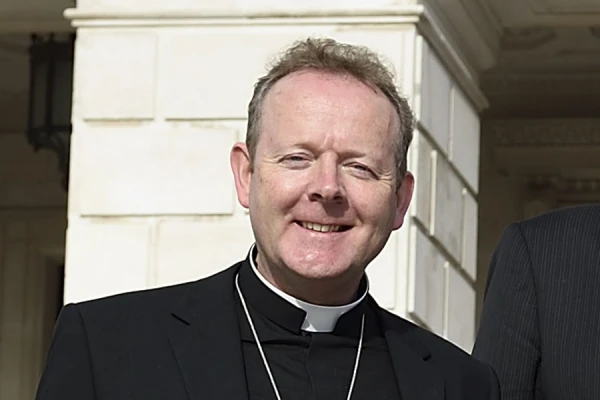
Archbishop Eamon Martin of Armagh was a signer of the statement, as was his Church of Ireland counterpart, John McDowell. Other signers were Dr. David Bruce, Moderator of the General Assembly of the Presbyterian Church in Ireland; Dr. Thomas McKnight, President of the Methodist Church in Ireland, and Dr. Ivan Patterson, President of the Irish Council of Churches.
The signers also filmed readings of the statement in a video message at St. Patrick’s Church of Ireland Cathedral in Armagh, the historic center of Irish Christianity.
“In our approach to the past we have a moral responsibility to acknowledge the corrosive impact of violence and words that can lead to violence, and a duty of care to those still living with the trauma of its aftermath,” the statement said.
The year 2021 will mark the centenary of the close of the Irish War of Independence and the Truce of July 11 which halted the war. This is followed by the Dec. 6 anniversary of the signing of the Anglo-Irish Treaty, which led to the partition of Ireland into the predominantly nationalist and Catholic Irish Free State, and the predominantly pro-United Kingdom and Protestant Northern Ireland.
Disputes over the treaty among nationalists led to the Irish Civil War, while Catholics in Northern Ireland would suffer discrimination and political and economic exclusion that helped to fuel further discord. A period of civil strife, reprisals, and terrorism known as The Troubles began in the late 1960s and largely closed with the 1998 Good Friday Agreement.
However, the departure of the U.K. from the European Union called “Brexit” has caused continued uncertainty and fears that the political border will again be a source of difficulty. There have been occasional violent paramilitary actions driven in part by renewed sectarian or political tensions.
In such a situation, the Christian leaders called for wisdom.
“Every generation of leaders, civil and political, is called to make choices about the structures that govern our life in community, now and in the future, in circumstances that will always be less than ideal,” they said. Significant anniversaries are a chance to reflect and re-examine “the contrasting and intertwined narratives of conflict and compromise that surround these pivotal points in our history.”
“We find inspiration and encouragement in the progress that has been made through our peace process in building relationships of mutual respect and trust across these islands,” they continued. “These relationships are often tested, and will at times be found wanting, but our communities have also demonstrated great resilience, solidarity and compassion, evident most recently in the response to Covid–19.”
“Some may struggle with the concept of a shared history when it comes to the centenary of the partition of Ireland, the establishment of Northern Ireland and the resulting reconfiguration of British–Irish relationships,” they added. “What is undeniable, however, is the reality that we have to live in a shared space on these islands, and to make them a place of belonging and welcome for all.”
The ecclesial leaders praised “considerable progress” in “addressing unjust structures that excluded people and unfairly limited their life chances.”
“The power of institutions has diminished, leading to greater accountability for those in leadership. This helps create an environment where we can value our different identities in a pluralist public square, conscious of both our rights and responsibilities. Yet there is much work still to do,” they said.
They warned against the temptation to retreat into online spaces or other areas where “our definition of community is limited to those who agree with us.” Doing so, they said, “leads to an increasingly fragmented society in which too many people fall through the cracks.”
They said there is a need “to be intentional in creating the spaces for encounter with those who are different from us, and those who may feel marginalized in the narratives that have shaped our community identity.”
“This will require us to face difficult truths about failings in our own leadership in the work of peace and reconciliation,” the leaders said. “As Christian churches we acknowledge and lament the times that we failed to bring to a fearful and divided society that message of the deeper connection that binds us, despite our different identities, as children of God, made in His image and likeness. We have often been captive churches; not captive to the Word of God, but to the idols of state and nation.”
That said, they added that Christian communities can contribute to society.
“Churches, alongside other civic leaders, have a role to play in providing spaces outside political structures that give expression to our inter–connectedness and shared concern for the common good,” they added. “It is our hope that shared reflection on our past will support and strengthen this engagement, inspiring us to renew our commitment to the work of building peace for the future.”
