No Picture
News Briefs

Newark archdiocese bought second beach house for use by McCarrick

September 9, 2020 CNA Daily News 2

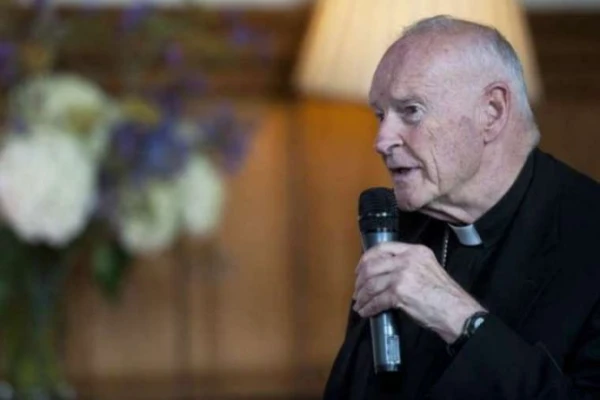
CNA Staff, Sep 9, 2020 / 11:30 am (CNA).- Months before officials in the Archdiocese of Newark sold a beach house used by former cardinal Theodore McCarrick for sexual abuse and coercion, the archdiocese bought a second beach house on the Jersey Shore, at which McCarrick reportedly hosted friends and courted donors.

The second beach house, according to an investigative report from northjersey.com, was purchased in 1997 by the Newark archdiocese from the neighboring Diocese of Metuchen. The house was located in Brick, New Jersey, on Barnegat Bay.

The archdiocese bought thar home four months before it sold the Sea Girt, New Jersey beach house which McCarrick was alleged to have used for sexual abuse and coercion since the 1980s.

Both homes were owned by the Diocese of Metuchen, which McCarrick led as a bishop from 1981 to 1986, before they were purchased by the Archdiocese of Newark, which McCarrick led from 1986 to 2000.

The Sea Girt house was purchased by the Metuchen diocese in 1985, and sold to the Newark archdiocese in 1988.

The Brick house was purchased in 1987 by a Metuchen priest, Msgr. Francis Crine, and Walter Uzenski, principal of the school at Crine’s parish. Crine died in 1989, and Uzenski gave the house to St. James Parish in Woodbridge, NJ, to settle an unspecified debt of McCarrick’s. In 1994, the parish transferred the property to the diocese, northjersey.com reported.

It is not clear what debt Crine owed to the parish.

Crine was a Metuchen chancery official during McCarrick’s tenure in Newark. He was also pastor of St. James Parish during a period in which at least three priests were assigned to the parish who eventually faced allegations of sexual abuse, misconduct, and theft.

McCarrick was first accused of misconduct toward seminarians, and of compelling them to visit the Sea Girt house, in the late 1980s. He was accused in 1994 of abusing a seminarian there. According to northjersey.com, the apostolic nuncio to the U.S. ordered the Sea Girt home be sold in the late 1990s.

In April 1997, four months before the Sea Girt home was sold, the Archdiocese of Newark purchased the Brick house. In 2002, after McCarrick had become Archbishop of Washington, the archdiocese sold the home.

According to northjersey.com, there are no allegations of sexual abuse or coercion at the beach house in Brick.

News that the Archdiocese of Newark purchased a second beach house at which McCarrick entertained guests comes as Catholics await the results of internal investigations on McCarrick conducted by the Vatican, and by the archdioceses of Newark and Washington.

Little information regarding McCarrick’s misconduct has been released by those dioceses or the Holy See since news emerged in June 2018 that McCarrick was credibly accused of sexually abusing minors.

The former cardinal has since been laicized, and is accused of serially sexually abusing and coercing minors, seminarians, and young priests.

The Archdiocese of Washington has declined repeatedly to release files on slush funds controlled by McCarrick in Newark and Washington, in which several hundred thousand dollars reportedly was under the archbishop’s direct control, with no auditing or oversight. McCarrick is believed to have used the funds to lavish cash gifts on other Church leaders.

The Vatican investigation is expected to report whether other senior Church leaders enabled, abetted, or ignored allegations against McCarrick. A report was initially expected to be released in late 2019, but there is not yet any indication of when it will be released. Several sources in the Vatican tell CNA the report has been completed, and can be released at any date selected by Pope Francis.


[…]

No Picture
News Briefs

Christian in Pakistan sentenced to death for blasphemy

September 9, 2020 CNA Daily News 1

CNA Staff, Sep 9, 2020 / 11:15 am (CNA).- A Pakistani court sentenced Asif Pervaiz, a Christian, to death Tuesday on charges of blasphemy.

The Sept. 8 sentencing by a court in Lahore arose from charges that Pervaiz, 37, included insulting remarks about Muhammad in a text message sent to Muhammad Saeed Khokher, his supervisor at the garment factory where he had worked.

Pakistan’s state religion is Islam, and around 97 percent of the population is Muslim. The country’s blasphemy laws impose strict punishment on those who desecrate the Quran or who defame or insult Muhammad. Although the government has never executed a person under the blasphemy laws, accusations alone have inspired mob and vigilante violence.

Pervaiz was also sentenced to a fine of 50,000 Pakistani rupees ($300), and three years’ imprisonment.

His lawyer told Reuters he would appeal the sentence. The lawyer has added that Pervaiz said he was accused of blasphemy only after refusing to convert to Islam, which Khokher has denied.

Khokher’s lawyer told Al Jazeera that Pervaiz “has taken this defence after the fact, because he had no other clear defence. That’s why he accused him of trying to convert him.”

Ucanews reported that Sajid Christopher, founder of the Pakistani religious freedom nonprofit Human Friends Organization, said that “A major mistake was that Pervaiz did not report the loss of his phone. He had heated arguments with a supervisor in factory who used messages from a stolen SIM card as evidence. Maybe the judges in session and trial courts feel insecure when dealing with such cases. They even consider evidence that has no relevance.”

Pervaiz’ trial began in 2013.

Pakistan’s blasphemy laws are reportedly used to settle scores or to persecute religious minorities; while non-Muslims constitute only 3 percent of the Pakistani population, 14 percent of blasphemy cases have been levied against them.

Many of those accused of blasphemy are murdered, and advocates of changing the law are also targeted by violence.

The blasphemy laws were introduced between 1980 and 1986. The National Commission for Justice and Peace said more than 1,300 people were accused under this law from 1987 until 2014. The Centre for Research and Security Studies reported that at least 65 people have been killed by vigilantes since 1990.

In July a US citizen on trial for blasphemy in Peshawar was killed at a court hearing.

More than 40 people are serving a life sentence or face execution for blasphemy in the country.


[…]

No Picture
News Briefs

Indian archbishop demands investigation into rotten rice

September 8, 2020 CNA Daily News 0

CNA Staff, Sep 8, 2020 / 07:29 pm (CNA).- An Indian archbishop has demanded action over a government mistake which has led poor people of Madhya Pradesh to purchase rotten grains from a public distribution system.

The Indian government issued a report cautioning against expired rice grains in fair-price shops, which allow people below the poverty line to have access to cheaper food. The rotten rice was found in Madhya Pradesh’s Mandla and Balaghat districts.

“I am shocked to learn that the government system has distributed food grains totally unfit for human consumption. It is distressing that it is done to poor people who are increasingly dependent on the government for their food, especially in these times of pandemic,” said Archbishop Leo Cornelio of Bhopal, according to UCA News.

The Ministry of Consumer Affairs, Food, and Public Distribution said 32 samples of food grains were collected for tests. The federal report found that the stocks were procured from recycled and old supplies, and the burlap sacks used to store the rice were at least two years old, UCA News reported.

Through its public distribution system, the government offers rice and wheat at a discounted price to help those suffering from poverty. Some 40 percent of Madhya Pradesh’s 71 million population are considered to be underneath the poverty line.

Archbishop Cornelio described it as “a serious case” that will negatively affect the lives of millions of poor people in Madhya Pradesh. He said some poor individuals do not have enough money for a single full meal a day.

“If such substandard food grain is supplied, it will endanger the health of close to half of the state’s population,” said Cornelio, according to UCA News.

“Such crimes happen because of misplaced priorities. Unless we love and respect human life, this kind of correction cannot be rooted out from society,” he added.


[…]

No Picture
News Briefs

A drowning man prayed for help. God sent a floating tiki bar filled with priests.

September 8, 2020 CNA Daily News 6

CNA Staff, Sep 8, 2020 / 06:07 pm (CNA).- When Jimmy Macdonald found himself floundering in the waters of Lake George in New York next to his tipped kayak, he thought he might die.

He had been enjoying a relaxing August day on the lake with his family, meditating and snapping pictures. He kept his lifejacket in the boat – he didn’t think he would need it, he told Glens Falls Living.

But his kayak ended up drifting, and suddenly he found himself far from shore and from his wife and stepchildren. Despite the rough waters, he still thought he could make it back to shore, and so he waved on several boats that had stopped to offer help.

But when his kayak tipped and his hastily-donned lifejacket came up to his ears, Macdonald knew he was in real trouble.

“I thought I was going to die. I was absolutely powerless and wished I had asked for help earlier. I was waving my hand and asked God to please help me,” he said.

God answered his prayers – but not in the form of Jesus walking on water.

“And then, out of the corner of my eye, I saw the tiki boat.”

Aboard the floating bar boat were seminarians and priests of the Paulist Fathers from St. Joseph’s Seminary in Washington, D.C. The Catholic religious community had been on retreat nearby and were taking a break on a boat rented from Tiki Tours.

A handful of the seminarians and priests helped the Tiki Tours staff hoist Macdonald to safety.

Noah Ismael, one of the seminarians aboard the boat, told NBC Washington that it was “a movement of the Holy Spirit” that they happened upon Macdonald at the right time.

Chris Malano, another seminarian, told WNYT that as Paulist seminarians, they are missionaries, and “that day, that was our mission, to be present and to help someone in need.”

Macdonald told WNYT that he took the rescue as a “sign from God” that his life still has a purpose on earth.

He also added that he found the rescue funny, in an ironic sense. Macdonald is an addict in recovery who counsels others through addiction recovery.

“How funny is it that I’ve been sober for seven years and I get saved by a tiki bar?” he said.


[…]

No Picture
News Briefs

Who is Our Lady of Charity of El Cobre?

September 8, 2020 CNA Daily News 0

CNA Staff, Sep 8, 2020 / 04:30 pm (CNA).- September 8 marks the Feast of the Nativity of the Blessed Virgin Mary. For the faithful in Cuba  – and other Hispanic countries – Mary is also venerated on this day under the title Our Lady of Charity of … […]