No Picture
News Briefs

Sri Lankan bishops oppose amendment that would strengthen presidency

October 15, 2020 CNA Daily News 1

CNA Staff, Oct 15, 2020 / 04:47 pm (CNA).- Sri Lanka’s bishops said Tuesday that the country’s democracy would decay if parliament passes a constitutional amendment that would strengthen the president’s power.

The bishops said the Twentieth Amendment, which would allow President Gotabaya Rajapaksa to take control of parliament, would be dangerous for the country. They instead encouraged government officials to focus on drafting a new constitution that safeguards democracy, law, and equality.

“We need to emphasize that concentration of power in an individual without checks and balances does not augur well for a Democratic, Socialist Republic,” they said in an Oct. 13 letter.

The letter was signed by the president and the secretary general of the Sri Lankan bishops’ conference, Bishop Winston Fernando of Badulla and Auxiliary Bishop Anthony Jayakody of Colombo.

Under the current constitution, adopted in 1978, presidential decisions are reviewed in court and the prime minister has the power to assign cabinet ministers who form central government. It also permits an independent commission to select officials to public institutions like the police force or the human rights commission.

If the amendment passes, the Associated Press reported, Rajapaksa would have the power to appoint judges, dissolve laws, and install or remove government ministers. The president would also be able to oversee any number of ministries giving him the power to appoint officials to public institutions.

Before parliament votes on the amendment, the Supreme Court must make a decision on whether specific aspects of the amendment will need a referendum to be approved. It is expected that members of parliament will approve the amendment, which needs a two-thirds majority to pass, the AP reported.

″A two-thirds majority of the members in the Parliament based on political parties does not necessarily manifest the true conscience of the people,” the bishops said.

“Therefore, let the entire membership of the parliament appoint an Independent Constitutional Council comprising a majority of men and women of proven integrity from the society who will take care of drafting a new constitution which ensures transparent democracy, the rule of law and the equality of all citizens.”

The Sri Lankan constitution established a unicameral parliament along with a powerful presidency. The Nineteenth Amendment, adopted in 2015, diluted the president’s powers; the proposed Twentieth Amendment would reverse the reforms of the Nineteenth.

“The Executive Presidency has been the bone of contention since it was created in 1978,” the Sri Lankan bishops reflected. “All elected presidents since 1994 vowed to abolish the Executive Presidency with powers vested in it by the 1978 Constitution and transfer power to the democratically elected Parliament, but none had the political will to do so for reasons not unknown to the people.”

The bishops said rules cannot be changed based on the inconsistencies and whims of individual political figures. They encouraged the installation of civilly responsible officials and challenged parliament to focus on rebuilding a constitution that protects and improves Sri Lanka.

“It is our view … to identify and elect or appoint suitable persons who will abide by the rules to safeguard true, justice, and the well-being of the country. It is the bounden-duty of the democratically elected Parliament to create wholesome governing structures capable of moving this country forward,” they said.

“Greater clarity is needed if the constitution is to serve the citizenry. Thus the 20th Amendment should not be proceeded with, in its entirety, and instead a new constitution needs to be the national priority at this moment.”


[…]

No Picture
News Briefs

Dutch government backs euthanasia for children under 12

October 14, 2020 CNA Daily News 3

CNA Staff, Oct 14, 2020 / 02:01 pm (CNA).- The government of the Netherlands has announced it will allow the euthanization of terminally ill children between the ages of one and 12.

“There is a need for active termination of life among doctors and parents of incurably ill children, who are suffering hopelessly and unbearably and will die within the foreseeable future,” Health Minister Hugo de Jonge wrote in an Oct. 13 letter to parliament.

Euthanasia is already legal in the Netherlands for infants under one year, with parental consent, and of minors 12-15 with their consent and that of their parents. Voluntary euthanasia is available to those aged 16-17 without parental consent.

De Jonge said allowing euthanasia for children under 12 would prevent their “suffering hopelessly and unbearably”.

The Health Minister also emphasized “the great importance of the best possible care for this group of terminally ill children.”

Those with “unbearable and endless suffering” would be eligible for euthanasia; their parents would have to consent, as would two doctors.

Children between 1 and 12 who have such conditions may currently be given palliative care, or their nutrition may be withheld.

NL Times reported that the Dutch pediatrician association NVK has called for the change; De Jonge said to parliament, “I want to ensure more legal safeguards for doctors who, on the basis of their professional standard, proceed with life-ending actions of children aged 1 to 12 years.”

Rather than a law change, doctors who euthanize patients aged 1-12 will be exempted from prosecution, De Jonge stated.

Prime Minister Mark Rutte leads a coalition government formed by the People’s Party for Freedom and Democracy, the Christian Democratic Appeal, Democrats 66, and the Christian Union.

Both the Christian Democratic Appeal and the Christian Union have opposed the change, while the VVD and Democrats 66 support it.

The government expect between five and 10 children a year to be euthanized under the new rule.

The Netherlands legalized euthanasia and assisted suicide in 2002 for terminaly ill adults who were mentally competent.

It has since been expanded to allow the practices for persons with non-terminal chronic illnesses, disabilities, and mental health problems.

In 2019 there were 6,361 casese of euthanasia in the country, according to the Guardian.

Cardinal Willem Eijk of Utrecht told CNA last month that the Netherlands shows that once euthanasia is legalized safeguards are slowly but inevitably abandoned, with the criteria having been “ever more extended”.

“Once accepting the termination of life for a certain measure of suffering, one will always be confronted with the question of whether it should not also be allowed in suffering that is only a little bit less,” he said.

Though it was defeated, a bill was introduced by the government in 2016 permitting assisted suicide in cases where people were not suffering from a disease but considered their life“completed.”

And earlier this year a private members’ bill was introduced that would allow assisted suicide in people older than 75 years.

In April, the Dutch Supreme Court found that doctors could forcibly euthanize dementia patients if they had previously signed a document approving the procedure.

A criminal court had acquitted of murder charges Marinou Arends, a doctor who euthanized a patient with dementia in 2016. The patient had made a written euthanasia declaration four years earlier, but seemed to withdraw from the administration of euthanasia. An anesthesiologist argued the withdrawal was merely a reflex action.

The Supreme Court ruled April 22 that the acquittal was correct.

Cardinal Eijk suggested that Catholics could do more to clarify that, while they firmly oppose euthanasia, they do not believe life must always be prolonged with burdensome medical treatment.

“A patient deciding to forego non-proportionate treatment and who consequently dies does not do something that is ethically equivalent to suicide, but merely accepts that life must come to an end,” he said.

“A medical doctor, by not offering non-proportionate treatment to the patient or dissuading him to undergo such treatment, as a consequence of which the patient dies, does not do something ethically equal to terminating his life. When the collateral effects, the complications and expenses are not proportionate to the chance of saving life or restoring or preserving health, one is allowed to forego it, albeit that it might lead to a shortening of life. Letting someone die is not always ethically equal to actively making somebody die.”


[…]

No Picture
News Briefs

US Labor Secretary: America still needs Columbus Day

October 13, 2020 CNA Daily News 0

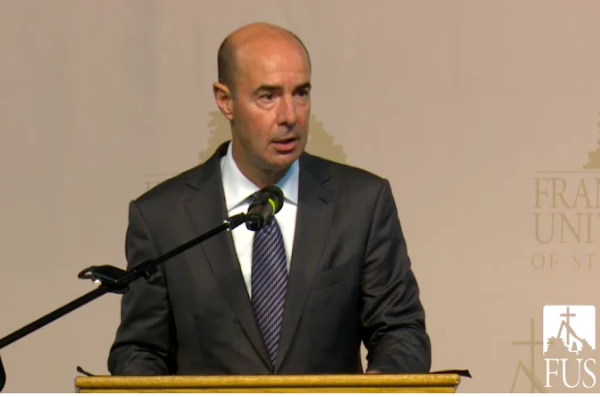
CNA Staff, Oct 13, 2020 / 06:03 pm (CNA).- Opponents of Columbus Day are misguided in their criticism and miss the important message about unity and inclusivity that the holiday continues to offer America, U.S. Secretary of Labor Eugene Scalia said this week.

“Columbus Day stands for ideals and principles that are woven into the fabric of our nation, and which are as important today as they were on the first Columbus Day in 1892,” he said.

Scalia spoke at Franciscan University of Steubenville on October 12. He reflected on criticisms of Christopher Columbus and the holiday that bears the explorer’s name.

“Columbus Day has been part of our American heritage for more than a century. There are some now who would like to do away with that commemoration. My message is that would be a mistake,” he said.

The labor secretary noted calls for Columbus Day to be re-designated as a day recognizing Native Americans. However, he said, honoring Native Americans can be accomplished without dishonoring the groups who have drawn inspiration from Christopher Columbus over the centuries.

“That first Columbus Day welcomed Catholics and recent immigrants as equal sharers in the American dream, and acknowledged—if only for a day— Native Americans as rightful participants in our national heritage,” he said. “Maligned by progressives today, Columbus Day was an early celebration of something progressives purport to value—diversity and inclusion.”

Numerous acts of vandalism and destruction against statues of Columbus and other historical figures have taken place in recent months, with officials removing other statues to protect them from the threat of mob attacks.

More than 30 statues of Columbus have been or are scheduled to be removed, Scalia said. Other statues across the country have also been torn down, including those depicting “Star-Spangled Banner” author Francis Scott Key, president and Union general Ulysses Grant, and Saint Junipero Serra.

Statues and memorials honoring George Washington, Thomas Jefferson, and Abraham Lincoln have also faced calls for removal.

Scalia warned that the activists driving the opposition to these statues “want to fundamentally redefine how we view our nation’s character and legacy,” proposing a vision of America as fundamentally oppressive and discriminatory.

However, he suggested, contemporary Americans can gain valuable insight about the country and its heritage from considering why previous generations revered Columbus.

The early American revolutionaries were inspired by Columbus’ great courage, which opened the door to new opportunities and “boundless possibilities,” Scalia said.

“Through the centuries, Columbus came to represent the spirit of adventure and discovery that we associate with America—our faith in our capacity to seek and find something new and better,” he said. “We have many heroes who personify our political ideals, but no figure so associated with the questing, the entrepreneurialism, the hope in the new that is part of the American spirit.”

Columbus was not perfect, Scalia acknowledged, and in fact had “grave faults.”

“He participated in the slave trade—as did others in his day—and was a harsh, at times inhumane ruler of indigenous people he subjugated.”

Many of the historical figures we admire had serious shortcomings, Scalia said, noting that several of the Founding Fathers owned slaves.

“[W]e know that the Founders did not fully live according to the ideals they espoused. They were sinners; they were fallen—in that respect, they were like all of us here. And they lacked the vision to fully see the implications and promise of what they wrote,” he said. “But they supplied the vision and principles for generations of Americans to forge the freest nation on earth—and they had the genius to craft a Constitution that made fulfilling those ideals possible.”

Heroes in the cause of civil rights embraced the founding era documents, despite the flaws of those who wrote them, Scalia said.

He noted that Frederick Douglass called the Constitution a “glorious liberty document,” and Martin Luther King Jr. famously said, “When the architects of our Republic wrote the magnificent words of the Constitution and the Declaration of Independence, they were signing a promissory note.”

King offers the country today an example of how to embrace what was good in the American founding, while rejecting errors and “calling on America to be even more American—to be ever truer to the Founders’ vision,” Scalia said.

The Knights of Columbus, a Catholic fraternal organization engaging in charitable work, was founded in 1882, taking the name of Columbus, Scalia said, citing a historian who said the Knights viewed Columbus as a “hero against American nativism, a symbol providing ‘social legitimacy and patriotic loyalty.’”

When Columbus Day was first celebrated nationally in 1892, it was presented by President Benjamin Harrison as a day of unity, which those from the North and South could celebrate together, the labor secretary said.

Over time, Columbus also came to be honored by immigrants – especially Italian and Irish Catholics – who faced strong discrimination in America, he added.

“[I]n the 19th century, in the face of sharp hostility associated with religion and national origin, Columbus became a powerful symbol of the claim of Italian, Irish, and other Catholic immigrants that they were fully American,” he said.

“The nation’s Protestant elite proudly claimed forebears among the sons and daughters of the Revolution; Columbus was an equally proud answer that Italians and Catholics, also, had roots in the nation’s founding and a claim to be fully American.”

This message of diversity and inclusion offered by Columbus Day is still needed in America, Scalia said.

He recalled the 2018 confirmation hearing of Brian Buescher, a judicial nominee and member of the Knights of Columbus who was told by Senators that the Knights take “extreme positions” and was asked if he was willing to resign his membership in the organization “to avoid any appearance of bias.”

He also pointed to Supreme Court nominee Amy Coney Barrett facing scrutiny for her faith and participation the charismatic Christian group People of Praise. Barrett was told by a senator at a 2017 hearing, “[T]he dogma lives loudly within you, and that’s of concern.”

Scalia also said the Department of Labor is working to remove regulations that require religious charitable organizations to warn the people they serve about their religious nature and refer them elsewhere if they object to it.

He added that President Donald Trump signed an order last month prohibiting race and sex scapegoating and stereotyping in federal workplace training programs. Scalia said the order will help fight training programs that tell certain employees that they are racist or morally culpable because of their race or sex.

“Harboring racist views is not the shared heritage of white Americans. For many it’s quite the opposite, as Columbus Day reminds us: Catholics, Irish, Italians, Poles, Jews, and others had their own struggles gaining acceptance in American society,” Scalia emphasized.

“Columbus Day is a day about overcoming that; it’s a day that was first set aside to embrace this country’s diversity and welcome all citizens into the American polity, regardless of creed or national origin.”

While there is still work to do in this regard, abandoning Columbus Day does not help achieve that purpose, he continued. Rather, Americans should be inspired by the rich history of Columbus Day to celebrate diversity and work for unity.

“Our nation did not establish Columbus Day to commemorate oppression or discrimination,” he said, “we established Columbus Day to overcome it.”


[…]

No Picture
News Briefs

St. Junipero Serra statue defaced, pulled down on California’s Indigenous People’s Day

October 13, 2020 CNA Daily News 0

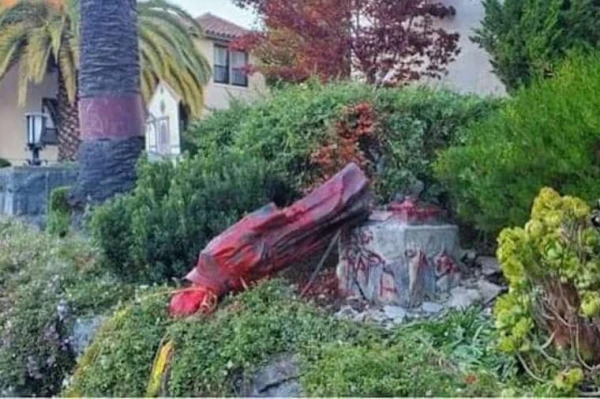
Denver Newsroom, Oct 13, 2020 / 03:54 pm (CNA).- A group of activists near San Francisco on Monday defaced a statue of St. Junipero Serra on private property with red spray paint before tearing it from its foundation.

Serra, an 18th-century Franciscan priest and missionary, is viewed by some activists as a symbol of colonialism and of the abuses that many Native Americans suffered after contact with Europeans. However, historians say the missionary protested abuses and sought to fight colonial oppression.

San Francisco Archbishop Salvatore Cordileone on Tuesday decried the “mob rule” that led to the statue of the saint being “mindlessly defaced and toppled by a small, violent mob.”

“This kind of behavior has no place in any civilized society. While the police have thankfully arrested five of the perpetrators, what happens next is crucial, for if these are treated as small property crimes, it misses the point: the symbols of our faith are now under attack not only on public property, but now on our own property and even inside of our churches,” Cordileone said Oct. 13.

The riot that led to the statue’s destruction took place Oct. 12 at Mission San Rafael Arcángel in San Rafael, CA, north of San Francisco Bay.

Though Serra himself did not found Mission San Rafael, it owes its existence to Serra’s legacy, as he founded the first nine missions in what would become California.

The hourlong protest, organized by members of the Coast Miwok tribe, marked Indigenous People’s Day, the holiday that some cities and states – including California – have designated to replace Columbus Day.

A church maintenance worker had covered the statue in duct tape before the protest to protect it from graffiti, and boarded up windows at the mission. Numerous statues of the saint have been vandalized or destroyed this year, most of them in California.

The masked rioters peeled off the duct tape and sprayed red paint in the statue’s face.

“This is a continued reminder of the impact of colonization and genocide of our people,” Dean Hoaglin, chair of the Coast Miwok Tribal Council of Marin, told Fox2.

The protestors tried to prevent local news cameras from filming the toppling, but Fox2 captured the statue’s fall on video. At least five people can be seen pulling on the statue’s head with nylon cords and ropes.

The tape appears to show the statue falling on one of the protestors, though there have not been any injuries reported.

Police arrested five women in connection with the incident and charged them with felony vandalism, Fox2 reported.

“We cannot allow a small unelected group of lawbreakers to decide what sacred symbols we Catholics or other believers may display and use to foster our faith. This must stop,” Cordileone said.

“Attacking the symbols of faith of millions of Catholics, who are as diverse in ethnicity as any faith in America, is counterproductive. It’s also simply wrong.”

Mike Brown, spokesman for the San Francisco archdiocese, told local news media that the protestors had not asked the mission to take down the statue prior to Monday’s demonstration.

Catholics in San Francisco are planning a peaceful prayer demonstration at the statue site Tuesday evening, Brown told CNA.

Cordileone noted that the protest against the statue began peacefully, but soon descended into violence. He encouraged people to learn more about Serra.

“There is no question that the indigenous peoples of our continent suffered under Europeans who came here and their descendants, especially after the mission era ended and California entered into the United States. But Fr. Serra is the wrong symbol of those who wish to address or redress this grievance,” Cordileone contended.

“Fr. Serra and his fellow Franciscans renounced all worldly pursuits to give their lives to serving the native peoples and so protected them from the abuses of their fellow Spaniards.”

Experts have disputed claims that Serra was in any way involved in genocide, and in contrast, there is evidence that Serra advocated for the rights of the indigenous people in the face of mistreatment by the Spanish military.

A California archeologist, who has studied the missions for over 25 years, told CNA earlier this year that it is clear from Serra’s own writings that he was motivated by a missionary zeal to bring salvation to the native people through the Catholic faith, rather than by genocidal, racist, or opportunistic motivations.

“Serra writes excitedly about how he had finally found his life’s calling, and that he would give his life to these people and their salvation,” Dr. Ruben Mendoza, an archeologist and professor at California State University-Monterey Bay, told CNA.

Born on the island of Petra Mallorca in Spain in 1713, Serra joined the Franciscans and quickly gained prominence as both a scholar and professor.

He chose to give up his academic career to become a missionary in the territory of New Spain, in which Spanish colonizers had already been active for over two centuries.

Traveling almost everywhere on foot and practicing various forms of self-mortification, Serra founded mission churches all along the coast— the first nine of the 21 missions in what is today California.

Many of the missions would form the cores of what are today the state’s biggest cities— such as San Diego, San Francisco, and Los Angeles.

In many ways, the missions were a communal venture between the friars and Native leaders, Mendoza said. Soldiers were typically housed in a garrison just off-site from the compound. The compound itself would include work areas, such as a blacksmith’s shop and places for crafts and weaving.

The Europeans taught the Natives new agricultural techniques, as well as instruction in the faith, performing thousands of baptisms.

“Unlike many of us today, Serra was a man on a mission,” Mendoza said.

“He was absolutely determined to engage the salvation of indigenous communities. And while for some that may be seen as an intrusion, for Serra in his time, that was seen as one of the most benevolent things one could do— to give one’s life over to others, and that’s what he did.”

Serra specifically advocated for the rights of Native peoples, at one point drafting a 33-point “bill of rights” for the Native Americans living in the mission settlements and walking all the way from California to Mexico City to present it to the viceroy.

Mendoza said the worst abuses against the Native Americans in California took place after the age of the missions ended, when the Spanish government ceased sending funding to the 21 sites and to the Spanish military.

The soldiers, without the support of their faraway benefactors, began to prey on the missionaries and the Natives. Many more Natives died during this time than had in the 60 years that the missions were operational.

Mendoza said there was a time during the transition to the American era when indigenous people were more vulnerable to attacks by settlers and white authorities if they were not Christian. The fact that the missions had converted many Native communities to Christianity actually helped them survive later European abuses, he said.

By the 1820s— nearly four decades after Serra’s death— friars at the now mostly destitute missions were writing letters of grievance to the American and Mexican governments, advocating for better treatment for the Natives, Mendoza said.

The California gold rush in the 1840s saw hundreds of thousands of European settlers come to the area, with little to no protections afforded to the Natives.

While many Native peoples did suffer horrific abuse, Mendoza said many people conflate the abuses the Natives suffered long after Serra’s death with the period when Serra was alive and building the missions.

Pope Francis canonized Serra in 2015 during a visit to the United States.

“Junípero sought to defend the dignity of the native community, to protect it from those who had mistreated and abused it,” the pope said in his homily at the Mass of canonization.

Statues of the saint have this year become focal points for protests and demonstrations across California, with images of the saint being torn down or vandalized in protest of California’s colonial past.

A statue of the saint was torn down in Golden Gate Park, San Francisco, on June 19 by a crowd of about 100 people, and on the same day a statue of the saint was torn down in Los Angeles.

Rioters pulled down and defaced a statue of Serra in Sacramento on July 4, inspiring a local Catholic to set up a makeshift shrine to Serra on the statue’s empty plinth July 5, and lead other Catholics in cleaning graffiti from the site.

Some California institutions, such as the University of San Diego, have put their statues of Serra in storage to protect them.

The San Rafael arson is the latest in a spate of attacks against Catholic churches across the country.

On July 11, an arson attack gutted the 249-year-old Mission San Gabriel in Los Angeles, a mission church founded by St. Serra.

That same morning, a man crashed a minivan through the front door of Queen of Peace Catholic Church in Ocala, Florida. He then set the church aflame while parishioners inside prepared for morning Mass.

Police arrested Stephen Anthony Shields, 24, of Dunnellon, Florida later that day. He has been charged with attempted murder, arson, burglary, and evading arrest.

Also in July, an as-yet unidentified assailant beheaded a statue of Christ the Good Shepherd at a parish in the Archdiocese of Miami, in Southwest Miami-Dade County.

In 2019, the co-cathedral of the Diocese of Pensacola-Tallahassee was damaged by fire, with several of the chairs in the sanctuary set ablaze using an accelerant. A 32-year-old man with a history of mental illness was later arrested in connection with the arson.

On July 10, the Diocese of Brooklyn announced that New York City police were investigating the vandalization of a statue of the Virgin Mary at Cathedral Prep School and Seminary in Queens. The next day, local police in Boston confirmed that a statue of the Blessed Virgin, located outside the church of St. Peter’s Parish, had been set on fire and suffered damage.

In September, a man broke at least six windows, beat several metal doors, and broke numerous statues around grounds of a Louisiana parish in a late-night vandalism attack that lasted over two hours. The assailant has since been arrested and confessed to the crime.

Also in September, a vandal entered the sanctuary of St. Patrick’s Cathedral in El Paso, Texas and destroyed a nearly 90-year-old statue of the Sacred Heart of Jesus.

Eighty-three percent of Catholic likely voters are concerned about attacks on churches in recent months, according to a poll conducted Aug. 27 – Sept. 1 by RealClear Opinion Research in partnership with EWTN News.


[…]