No Picture
News Briefs

Pope Francis: ‘Those who pray never turn their backs on the world’
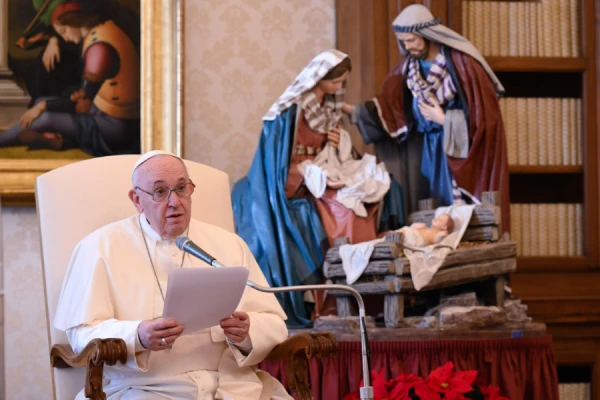
December 16, 2020 CNA Daily News 1

Vatican City, Dec 16, 2020 / 04:30 am (CNA).- People who pray for others are like God’s antennas, Pope Francis said at the general audience Wednesday.

In his address Dec. 16, the pope insisted that those who seek solitude and silence to intercede for others are not evading reality.  

“Whoever can knock on the door of someone who prays finds a compassionate heart which does not exclude anyone,” he said, seated beside a traditional depiction of the nativity.

He added: “These people pray for the entire world, bearing its sorrows and sins on their shoulders. They pray for each and every person: they are like God’s ‘antennas’ in this world.”

In his audience address, the pope continued his cycle of catechesis on prayer, which he began in May. He dedicated the address to the prayer of intercession, which the Catechism of the Catholic Church recognizes as one of the principal forms of prayer, alongside blessing and adoration, petition, thanksgiving, and praise.

Speaking via livestream from the library of the Apostolic Palace due to coronavirus restrictions, the pope underlined that prayer was not a form of escapism.

He said: “Those who pray never turn their backs on the world. If prayer does not gather the joys and sorrows, the hopes and the anxieties of humanity, it becomes a ‘decorative’ activity, a superficial, theatrical attitude, an intimist attitude.”

“We all need interiority: to retreat within a space and a time dedicated to our relationship with God. But this does not mean that we evade reality.” 

The pope noted that when Christians pray behind closed doors, as Jesus recommended in Matthew 6:6, they still “keep the doors of their hearts wide open.”

“In every poor person who knocks at the door, in every person who has lost the meaning of things, the one who prays sees the face of Christ,” he said. 

He quoted the Catechism of the Catholic Church, which says that intercession is “characteristic of a heart attuned to God’s mercy.”

“This is beautiful,” he said. “When we pray we are in tune with God’s mercy.” 

Speaking off the cuff, he added: “Jesus is our intercessor, and praying is a bit like doing as Jesus did: interceding in Jesus to the Father, for others. And this is very beautiful.”

The pope said that to pray seriously one must love one’s neighbors, no matter what errors they have made.  

“It can be said: in a spirit of hatred one cannot pray; in a spirit of indifference one cannot pray. Prayer is only given in a spirit of love. Those who do not love pretend to pray, or they think they are praying, but they do not pray, because they lack the very spirit that is love.” 

He continued: “When a believer, moved by the Holy Spirit, prays for sinners, no selection is made, no judgment or condemnation is uttered: they pray for everyone. And they pray for themselves. At that moment they know they are not that different from those for whom they pray: they feel they are a sinner among sinners and they pray for everyone.” 

The pope highlighted the parable of the Pharisee and the publican, recorded in Luke 18:9-14, in which Jesus contrasts the prayer of a self-satisfied Pharisee with that of a humble tax collector.  

“The lesson of the parable of the Pharisee and the publican is always alive and current: we are not better than anyone, we are all brothers and sisters who bear fragility, suffering and being sinners in common,” he said. 

The pope observed that those who intercede for others are largely unknown to the world, but not to God, and they help to sustain the world.

“The Church, in all of her members, has the mission of practicing the prayer of intercession. This is especially so for those who exercise roles of responsibility: parents, teachers, ordained ministers, superiors of communities…. Like Abraham and Moses, they must at times ‘defend’ the persons entrusted to them before God,” he said.

“In reality, we are talking about protecting them with God’s eyes and heart, with His same invincible compassion and tenderness. Praying with tenderness for others.”

He concluded: “Brothers and sisters, we are all leaves on the same tree: each one that falls reminds us of the great piety that must be nourished in prayer, for one another. Let us pray for one another: it will do us good and do good to all.”

In his greetings to Polish-speaking Catholics, the pope noted that the Novena to the Child Jesus begins on Dec. 16, nine days before Christmas. 

He said: “In your Advent journey this year, in a special way, may St. Joseph accompany you. May the Divine Child, who saw in him the tenderness of God, fill your hearts, especially in these difficult times, with the certainty that our Heavenly Father is a God of tenderness, who is good to all and His mercy extends over all His children. I bless you from my heart.”

Addressing Italian-speakers, the pope reflected on the difficulties of celebrating Christmas amid coronavirus restrictions.

“I would like to exhort everyone to ‘hasten the step’ towards Christmas, the real one, that is, the birth of Jesus Christ,” he said

“This year restrictions and inconveniences await us; but let us think of the Christmas of the Virgin Mary and St. Joseph: it was not all rosy! How many difficulties they had! How many worries! Yet faith, hope and love guided and sustained them.” 

“May it be the same for us! May this difficulty also help us to purify a little our way of experiencing Christmas, of celebrating it, moving away from consumerism: may it be more religious, more authentic, more true.”


[…]

No Picture
News Briefs

India’s Supreme Court to hear complaint over mandatory confession in Oriental Orthodoxy

December 15, 2020 CNA Daily News 3

CNA Staff, Dec 15, 2020 / 06:01 pm (CNA).- The Supreme Court of India agreed Monday to consider a petition that the requirement of annual confession in the Malankara Orthodox Syrian Church violates its members’ privacy rights.

Three members of the Church, which is part of Oriental Orthodoxy, have petitioned the court after some of the Church’s priests allegedly used information learned in the confessional for blackmailing and both sexual and monetary exploitation.

India’s Supreme Court agreed to hear the case Dec. 14.

The petitioners called the Church’s requirement of confession a “serious intrusion into the privacy of a person.”

The Malankara Orthodox Syrian Church codified its constitution in 1934. That constitution requires that all Church members over 21 years go to Confession annually. It also requires that a confession register be kept in each parish.

The petitioners argue that the requirement of confession violates the protection of life and personal liberty and freedom of conscience and free profession found in articles 21 and 25 of the Constitution of India.

They also took issue with the Church’s ability to remove members from its registers for failure to support the Church financially.
Fr. Johns Abraham Konatt, a spokesman for the Malankara Orthodox Syrian Church, said that “confession is one of the seven sacraments of the Church.

He told UCA News, “There might be a few instances of misuse of confession, but that does not mean that the sacrament should be done away with.”

The petition comes amid reports of some priests using the confessional to exploit women for sexual purposes, and men for monetary purposes.

In mid-2018, five priests of the Malankara Orthodox Syrian Church were accused of using confession to blackmail and sexually abuse a 34 year-old married woman. They have since been suspended.

At the time, a proposal to abolish confessions in all Churches in the nation was put forth by India’s National Commission for Women, a government advisory agency.

Cardinal Oswald Gracias of Bombay said at the time that he was “shocked” by the proposed ban.

“(The ban) betrays a total lack of understanding of the nature, meaning, sanctity and importance of this Sacrament for our people; and also an ignorance of the strict laws of the Church to prevent any abuse,” he said. Such a ban would be a violation of the freedom of religion guaranteed by the country’s constitution, Gracias said.

“Millions of people from all over the world, over the centuries, have testified to the spiritual benefit of this Sacrament and to the grace, pardon and peace they have experienced as a result of receiving this Sacrament,” he added. “I am confident the Government will totally ignore this absurd demand from the Commission.”

According to local media, the National Commission for Minorities vice-chairman George Kurian also criticised the proposal during a TV discussion, calling it unconstitutional and saying that it unnecessarily provokes division and misunderstanding among minority communities.

The Oriental Orthodox Churches rejected the 451 Council of Chalcedon, and its followers were historically considered monophysites, those who believe Christ has only one nature, by Catholics and the Eastern Orthodox.

The Malankara Orthodox Syrian Church is based in the Indian state of Kerala, where most of its dioceses are located.

The government of India is officially secular, while nearly 80 percent of the population identifies as Hindu. About 2.3 percent of India’s population is as Christian.

The U.S. Commission on International Religious Freedom earlier this year recommended that India be designated by the State Department as a “country of particular concern” — a designation reserved for the worst violators of religious freedom or the countries where the worst abuses are taking place and the governments do not stop them. USCIRF had not recommended India for the CPC list since 2004.

Christians have been subject to increasing attacks by mobs in India, with national and state governments failing to protect them and administer justice to perpetrators. A 2020 Open Doors report noted at least 447 verified incidents of violence and hate crimes committed against Christians in India in a year, many of them by radical Hindus.


[…]

No Picture
News Briefs

International court declines to investigate China for Uyghur persecution

December 15, 2020 CNA Daily News 1

CNA Staff, Dec 15, 2020 / 05:00 pm (CNA).- The International Criminal Court has declined to investigate the Chinese government for their detention of ethnic and religious minorities, the organization announced on Monday. While declining to proceed with the allegations of human rights abuses, the court left the complaint open for the possibility of future action.

The complaints were filed by two groups of exiled Uyghur people: the East Turkistan Government in Exile and the East Turkistan National Awakening Movement.

According to the court’s report, the Office of the Prosecutor of the International Criminal Court received allegations on July 6, 2020, that “Chinese officials are responsible for acts amounting to genocide and crimes against humanity committed against Uyghurs falling within the territorial jurisdiction of the Court on the basis that they occurred in part on the territories of Tajikistan and Cambodia, States Parties to the Rome Statute.”

China is not a state party to the Rome Statute of the International Criminal Court, a 1998 treaty which makes genocide, crimes against humanity, war crimes, and the crime of agression as international crimes. Tajikistan and Cambodia, however, are signatories of the Rome Statute. 

Per the report, however, the International Criminal Court lacks jurisdiction in this case, “since the actus reus of each of the above-mentioned alleged crimes appears to have been committed solely by nationals of China within the territory of China, a State which is not a party to the Statute.” 

The Chinese government admitted in October 2018 that “re-education camps” for members of the Uyghur population had been established. The camps were first spotted on satellite imagery in 2017.

The highest estimate sets the total number of inmates in the camps at 3 million, plus approximately half a million minor children in special boarding schools for “re-education” purposes. Survivors have reported indoctrination, forced abortions, beatings, forced labor, and torture in the camps.

While the International Criminal Court will not be investigating China, a lawyer representing the East Turkistan Government in Exile expressed optimism that additional evidence will show that the court has jurisdiction in the matter. 

“The (Office of the Prosecutor) has in effect asked for more evidence if it is to be able to open an investigation,” said Rodney Dixon, QC, the lead barrister who submitted the complaint, said in a press release on Tuesday, December 15. 

“The OTP says there is insufficient evidence now, but further evidence can be provided which can lead to an investigation being opened. The fact is that the file is not closed as we have submitted under Article 15(6) was acknowledged by the OTP, the purpose of which is to get an investigation opened which the Prosecutor will consider,” he said.  

“We are submitting further evidence to get an investigation opened. This process before the ICC is ongoing and we are hopeful that an investigation will be commenced.”

Dixon referred to this as “a very important moment” for the Uyghur people. 

“The millions of Uyghur victims who are suffering terrible atrocities at the hand of the Chinese Government officials need justice and we are hopeful that the ICC will take up this investigation,” he said. 

“We will be providing highly relevant evidence that will permit this to happen in the coming months. We are engaging with the Office of the Prosecutor as these proceedings go on with the aim of opening a full investigation.” 

The repression of Uyghurs is part of a widespread effort by the Chinese government to “Sinicize” religion and culture across the country.

In October, a bipartisan group of U.S. senators introduced a resolution to declare China’s actions against the Uyghur population as a genocide, and express “the sense of the Senate that the atrocities perpetrated by the Government of the People’s Republic of China against Uyghurs, ethnic Kazakhs, Kyrgyz, and members of other Muslim minority groups in the Xinjiang Uyghur Autonomous Region constitutes genocide.” 

The senators said that China’s actions violate the norms outlined in the 1948 United Nations Convention on the Prevention and Punishment of the Crime of Genocide, and called for an international response to China’s actions.


[…]

No Picture
News Briefs

Austrian court strikes down ban on Muslim headscarves in schools

December 15, 2020 CNA Daily News 0

CNA Staff, Dec 15, 2020 / 04:21 pm (CNA).- A ban on headscarves for elementary school students was discriminatory and unconstitutional because it singled out Muslim girls’ headscarves, the Austrian Constitutional Court has ruled.

The court said the law banning headscarves for girls under 10 years old “contravened the principle of equality in relation to freedom of religion, belief and conscience.”

Drafters tried to keep the text of the law neutral, banning “ideologically or religiously influenced clothing which is associated with the covering of the head.”

Judge Christoph Grabenwarter, however, said additional material from the government made it clear that the law could only be understood as targeting Muslim head coverings. The law violated the principle of equality and the state’s obligation to be religiously neutral because it singled out Muslim students.

Grabenwarter voiced concern of the ban’s effects on students.

“It carries the risk of hindering Muslim girls’ access to education and more precisely of shutting them off from society,” Grabenwarter said, according to the German news site Deutsche Welle.

Austria’s coalition government of the center-right People’s Party and the far-right Freedom Party passed the measure in 2019, just days before the government collapsed amid a corruption scandal.

Backers depicted the proposal as a “child protection law,” claiming it protected girls and women against sexism and politicized Islam. They also said it would protect the nation’s culture from Islamic influences and the infiltration of parallel societies.

The new government, a coalition of the People’s Party and the left-wing Green Party, had wanted to extend the ban to girls under age 14.

Two Muslim children and their parents challenged the law, noting that it applied only to headscarves and not to smaller religious head coverings like those of Jewish or Sikh boys. In addition to religious freedom and equality concerns, they objected to the law’s infringement on religious upbringing of children.

Umit Vural, president of the Austrian Islamic Faith Community, praised the decision, the German news site Deutsche Welle said.

“Equal opportunity and the autonomy of girls and women in our society cannot be achieved through bans,” said Vumal, who also criticized pressuring girls to wear a headscarf.

“We don’t condone disparaging attitudes towards women who decide against the headscarf… and we also cannot agree with the curtailing of the religious freedom of those Muslim women who understand the headscarf to be an integral part of their lived religious practice.”

People’s Party Education Minister Heinz Fassmann said the ministry would “take note of the judgement and look into its arguments.”

“I regret that girls will not have the opportunity to make their way through the education system free from compulsion,” he said, according to Agence France Presse.

In 2018 the Muslim community in Austria had voiced concerns over the proposal, calling the proposal “counterproductive.” They said that “very few” girls under age 10 wear headscarves to school.


[…]

No Picture
News Briefs

Federal judge again rules against allowing Tennessee abortion waiting period

December 15, 2020 CNA Daily News 0

CNA Staff, Dec 15, 2020 / 03:25 pm (CNA).- A federal judge on Monday ruled against Tennessee for a second time this year, refusing to reinstate a 48-hour waiting period for abortions while the state appeals to a higher court.

In October, Judge Bernard Friedman ruled unconstitutional Tennessee’s mandatory 48-hour waiting period for women seeking abortion, which had been in effect since 2015.

Though waiting periods have been struck down before in state courts, this case marks the first time a federal court has struck down an abortion waiting period.

In the legal challenge brought by Planned Parenthood and the pro-abortion Center for Reproductive Rights, Friedman wrote that most women are already certain about their decision to have an abortion when they go in for their first appointment.

The judge said the regulation placed an “undue burden” on women’s “right to abortion.”

Tennessee Attorney General Herbert Slatery filed a motion in November in the U.S. District Court in Nashville asking Friedman to keep the waiting period law in place while the state seeks the opinion of the 6th U.S. Circuit Court of Appeals.

On Dec. 14, Friedman refused, reiterating his opinion that “the Tennessee statute constitutes a ‘substantial obstacle to a woman seeking an abortion’ and, thus, an undue burden.”

Tennessee Right to Life, a pro-life organization active in the state, decried the court’s October decision, contending that the waiting period had saved “countless unborn lives” and spared women the regret of abortion by allowing them extra time to identify life-affirming resources near them.

“Not only is this decision a slap at Tennessee’s abortion-vulnerable women, it is an affront to Tennessee’s voters who passed a 2014 constitutional amendment in which allowing a short waiting period was a key factor,” Brian Harris, president of Tennessee Right to Life, said at the time.

“Our organization remains committed to seeing a similar statute drafted and enforced during the next legislative session.”

Tennessee’s law required abortion doctors to inform a woman during her first appointment “that numerous public and private agencies and services are available to assist her during her pregnancy and after the birth of her child” if she chooses not to have the abortion.

Barring a medical emergency, a patient was then required to wait 48 hours before the second appointment and proceeding with the abortion.

Under Tennessee law, the district court’s striking down of the 48-hour waiting period would automatically bring a 24-hour waiting period into effect for the state, but Friedman also blocked the state from enforcing the 24-hour requirement.

At least 26 states mandate waiting periods for women seeking abortions, most of them 24 hours. Five states— Utah, Missouri, Arkansas, Oklahoma, and South Dakota— have a 72-hour waiting period in place.

In Iowa, the legislature passed a 72-hour waiting period during May 2017, which the Iowa Supreme Court in 2018 declared unconstitutional. The Iowa House and Senate passed a 24-hour waiting period requirement for abortion during June 2020, which also requires a woman to have the chance to view an ultrasound of the unborn child and to receive information on adoption.

In January 2020, the authors of a study from Advancing New Standards in Reproductive Health (ANSIRH) reported that approximately 95% of women who had abortions did not regret their decision five years after the fact, even if they did initially experience regret. Friedman cited that study in his opinion.

Dr. Priscilla Coleman, a professor of human development and family studies at Bowling Green State University who testified in the Tennessee case, told CNA that she disagrees with that study’s conclusion and methodology.

In addition, larger studies have turned up opposite conclusions. While it did not directly measure “regret,” a study by Dr. D. Paul Sullins of The Catholic University of America published in 2016 followed more than 8,000 women for over 13 years, and found that a significant increase in the relative risk of mental health disorders such as depression and anxiety for women who have abortions.


[…]